

If you keep your current Medicare stand-alone drug coverage without reviewing options, your monthly premium could surge by an average of 50 percent. Open Enrollment closes December 7, 2026, giving you a short window to protect your retirement budget.
Major federal policy changes are resetting the prescription drug market for 2027. Millions of seniors face higher base costs, shifting formularies, and terminated plans unless they actively review their coverage today.
Taking three strategic steps before the December 7 deadline guarantees you secure the lowest total out-of-pocket costs for your prescriptions next year.
Why Stand-Alone Part D Premiums Are Surging in 2027
Stand-alone Part D prescription drug plans (PDPs) face an unprecedented pricing shakeup for 2027. If you remain in your current plan without switching, your monthly premium could jump substantially.
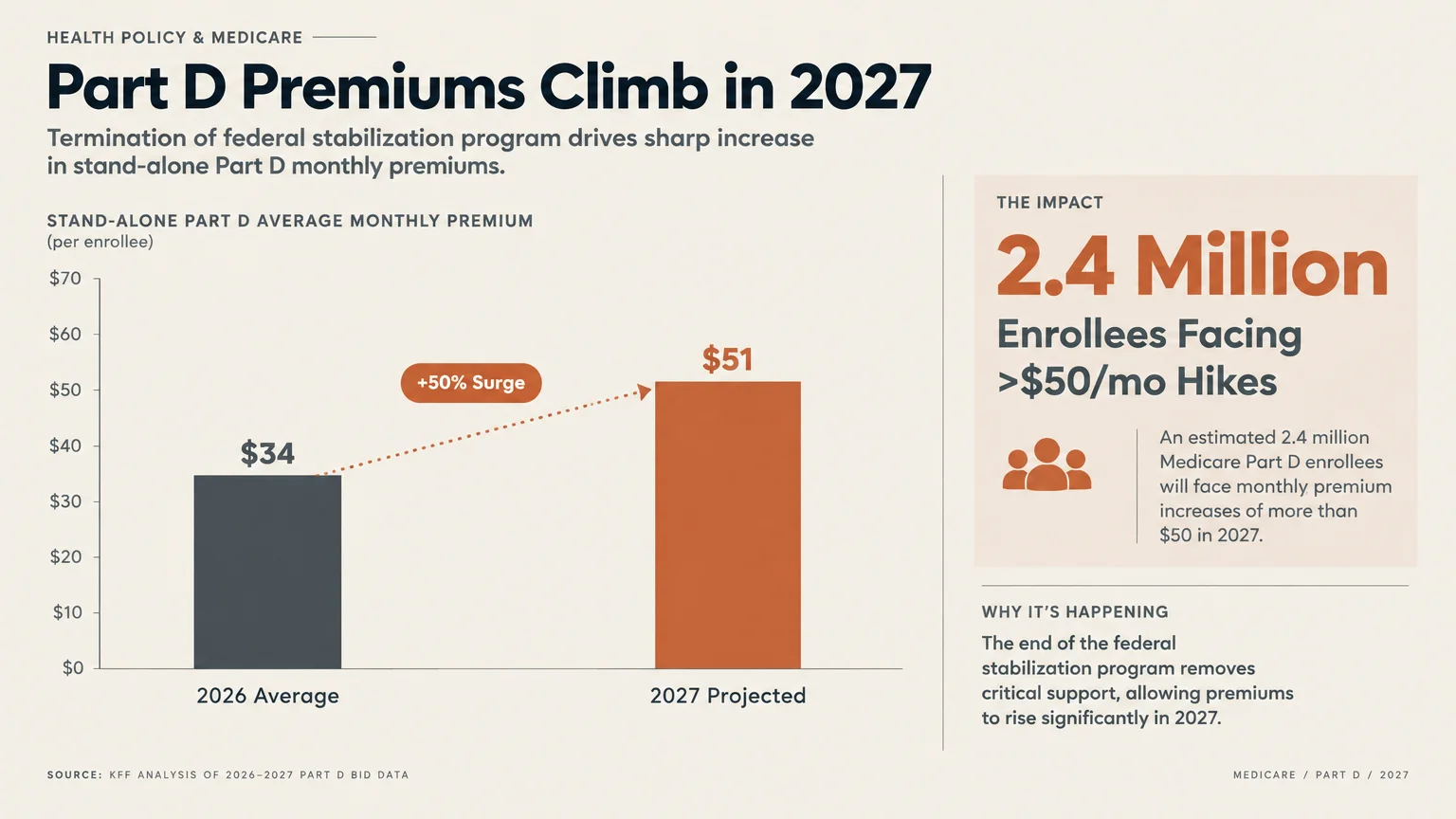
Research from KFF reveals that the enrollment-weighted average monthly premium for stand-alone PDPs is projected to jump 50 percent. That increase lifts average monthly payments from $34 in 2026 to $51 in 2027.
This projected increase affects roughly three-fourths of non-subsidized PDP enrollees, representing 10.4 million beneficiaries nationwide. These retirees face immediate cost increases if they let their plans roll over automatically.
Even more dramatic, 2.4 million enrollees face monthly premium hikes exceeding $50 per month. In 2026, only 38,000 enrollees experienced an increase of that magnitude.
The price increases stem from the expiration of temporary federal relief. The Centers for Medicare & Medicaid Services (CMS) is terminating the Part D Premium Stabilization Demonstration at the end of 2026.
That demonstration provided roughly $9.8 billion in federal subsidies across 2025 and 2026. The program capped participating PDPs’ annual premium hikes at $35 in 2025 and $50 in 2026.
Terminating the program one year earlier than originally planned leaves insurers responsible for higher structural costs. Consequently, carriers have passed these liabilities directly to enrollees through elevated monthly premiums.
However, you can avoid this spike by shopping the broader market. CMS projects that the overall weighted average PDP premium will rise less than $1, moving from $35.09 to $36, because cheaper plans remain available.
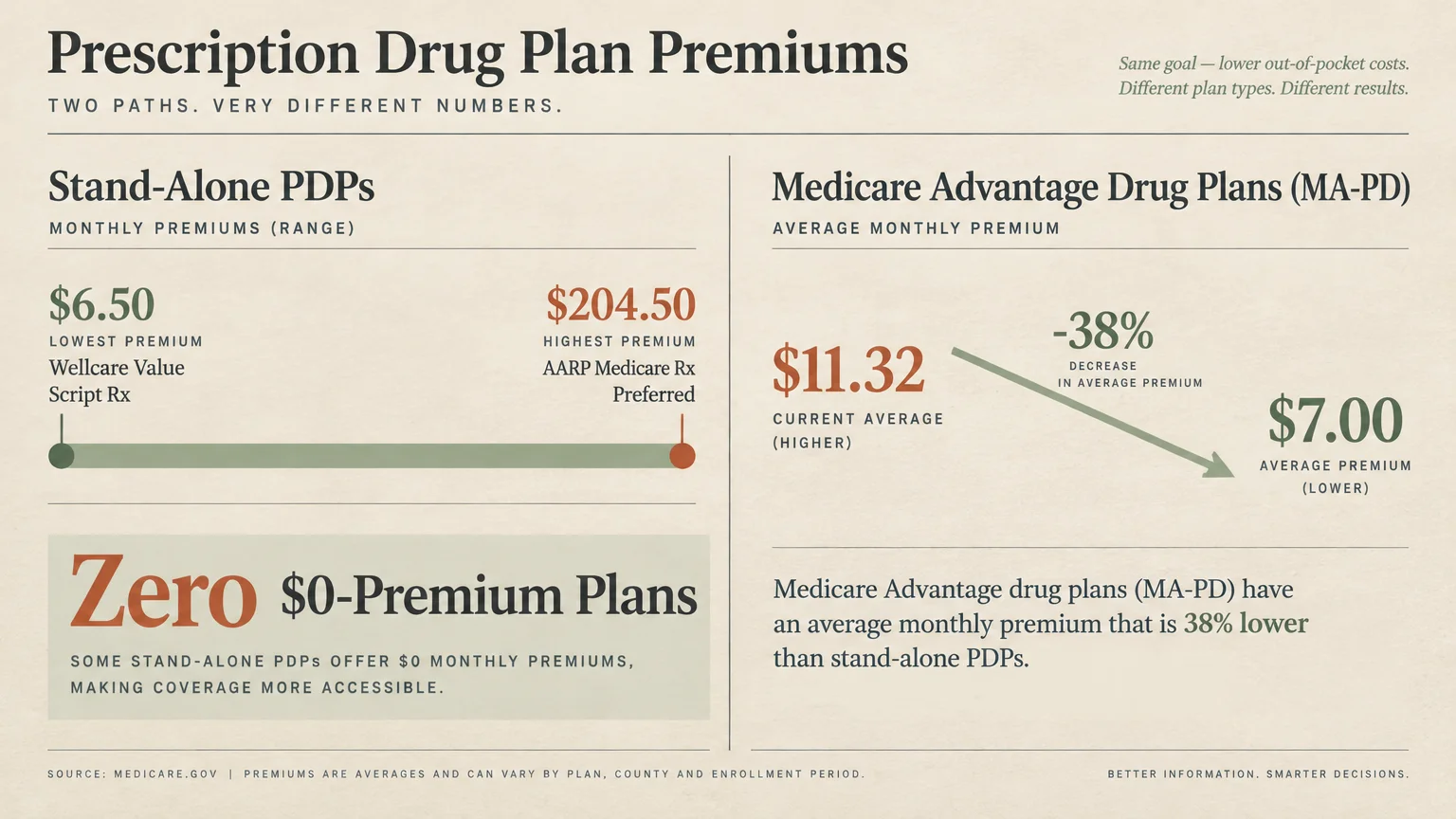
The marketplace also displays a stark contrast between coverage types. CMS estimates that drug premiums inside Medicare Advantage plans (MA-PDs) will actually decrease 38 percent, falling from $11.32 to an average of $7 per month.
If you prefer Original Medicare paired with a stand-alone PDP, you must navigate an altered landscape. For the first time in program history, zero $0-premium stand-alone PDPs exist for enrollees without subsidies.
This historic shift directly affects more than 4 million enrollees currently enjoying $0-premium stand-alone drug plans. Every non-subsidized retiree must pay a monthly premium for stand-alone coverage in 2027.
The financial gap between carriers is wider than ever. Across the eight national PDPs available in 2027, average monthly premiums range from $6.50 on the low end to $204.50 on the high end.
Centene’s Wellcare Value Script Rx offers the lowest national average premium at $6.50 per month. Conversely, United’s AARP Medicare Rx Preferred averages $204.50 per month, rising from $126.00 in 2026.
Major 2027 Part D Changes You Need to Know
While monthly premiums are shifting rapidly, other program rules provide strong financial relief. Familiarizing yourself with these structural adjustments helps you calculate your true out-of-pocket exposure.
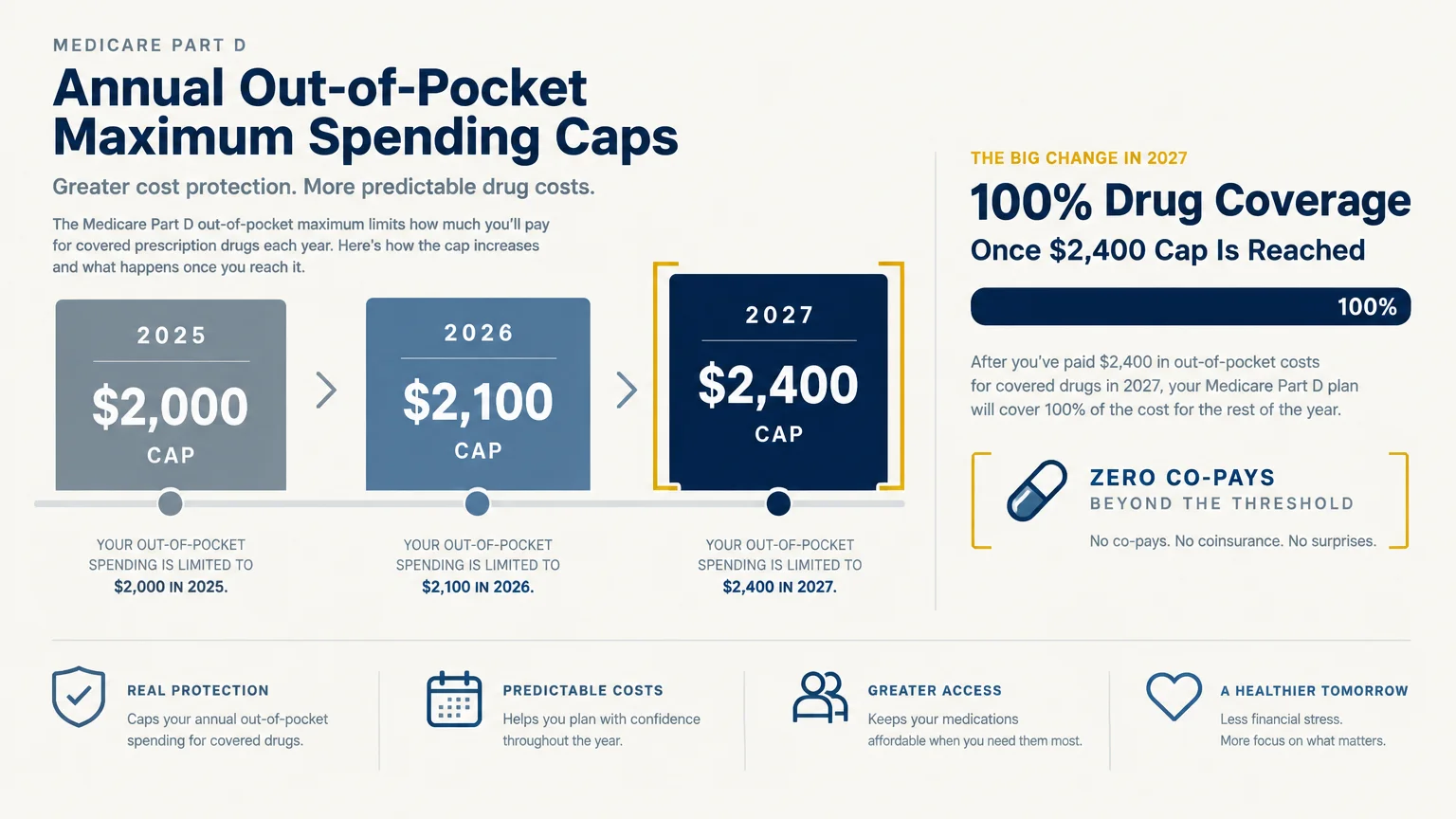
The annual Part D out-of-pocket maximum spending cap rises to $2,400 in 2027. This is an increase from $2,100 in 2026 and $2,000 in 2025.
Once your covered prescription spending reaches $2,400, your plan pays 100 percent of covered drug costs for the rest of the year. You pay nothing further at the pharmacy counter.
At the same time, the maximum allowable standard deductible increases. In 2027, the Part D deductible limit climbs from $615 to $700.
Almost all stand-alone PDP enrollees—99.8 percent—sit in plans that charge a deductible if they do not change policies. Additionally, 85 percent of MA-PD enrollees face a deductible in 2027.
Critical safeguards established by recent legislation remain firmly in place. Covered insulin products remain capped at $35 for a 30-day supply, completely exempt from your plan deductible.
Furthermore, January 1, 2027, introduces Medicare’s second round of negotiated Maximum Fair Prices. This milestone applies negotiated price limits to 15 high-cost Part D medications.
These negotiated rates lower your out-of-pocket costs when you satisfy deductibles or pay percentage coinsurance. Flat dollar copayments, however, may remain determined by your specific plan tier.
For example, Ozempic, Rybelsus, and Wegovy carry a negotiated price of $274 per month. This reflects a 71 percent discount from the 2024 list price of $959.
Respiratory inhalers also see sharp reductions. Trelegy Ellipta drops 73 percent to $175 per month, while Breo Ellipta drops 83 percent below prior list prices.
Common diabetes therapies see substantial relief as well. Janumet and Janumet XR prices fall 85 percent, while Tradjenta drops 84 percent.
Crucial oncology medications receive substantial price adjustments. Negotiated rates take effect for life-saving cancer drugs including Xtandi, Pomalyst, Ibrance, and Calquence.
Seniors seeking weight-management therapies also gain new protections. The Medicare GLP-1 Bridge program provides qualifying enrollees access to select GLP-1 medications for a flat $50 monthly copayment.
2026 vs. 2027 Part D Landscape at a Glance
Reviewing program benchmarks side by side illustrates how Medicare drug coverage is transforming. Use this comparison to assess your exposure across deductibles, caps, and plan structures.
| Coverage Feature | 2026 Standard Rule | 2027 Standard Rule | Retiree Impact |
|---|---|---|---|
| Annual Out-of-Pocket Cap | $2,100 | $2,400 | Increases maximum annual out-of-pocket exposure by $300. |
| Maximum Plan Deductible | $615 | $700 | Raises initial out-of-pocket spending before plan coverage begins. |
| Projected PDP Premium (No Switch) | $34.00 / month | $51.00 / month | Reflects a 50% average surge for seniors who do not compare plans. |
| Weighted PDP Premium (CMS Estimate) | $35.09 / month | $36.00 / month | Shows premiums remain steady if beneficiaries switch to lower-cost plans. |
| Average MA-PD Drug Premium | $11.32 / month | $7.00 / month | Drug premiums inside Medicare Advantage drop by 38%. |
| $0-Premium Stand-Alone PDPs | Available in many states | 0 plans available nationwide | Forces 4 million retirees to pay monthly premiums for PDPs. |
| National Base Beneficiary Premium | $38.99 / month | $41.33 / month | Rises 6%, increasing the baseline for late enrollment penalties. |
| Negotiated Drug Pricing Roster | 10 Initial Part D Drugs | 15 Additional Part D Drugs | Delivers discounts up to 85% on drugs like Ozempic and Trelegy. |
These figures show why passive renewal is no longer a safe strategy. The market rewards active comparison while penalizing inertia.

Plan Terminations and Market Contraction
Financial pressures have prompted several commercial carriers to exit specific regional markets. As a result, millions of retirees will lose their existing coverage when the calendar turns.
KFF reports that 4.3 million Medicare beneficiaries face plan terminations on December 31, 2026. This group includes 1.2 million stand-alone PDP enrollees and 3.1 million Medicare Advantage members.
An additional 1.4 million Medicare Advantage enrollees will have their coverage consolidated into different carrier products. These transitions frequently alter network providers and prescription formularies.
Retiree choices have narrowed across the country. The average Medicare beneficiary can choose from 9 stand-alone PDPs in 2027, down from 11 in 2026 and significantly fewer than historical averages.
Meanwhile, the average beneficiary maintains access to 28 Medicare Advantage plans offering prescription drug coverage. This product disparity reflects carrier preferences for integrated managed care contracts.
If your plan is terminating, you should have received a formal notice by late October. You must choose a new plan before December 7 to ensure seamless coverage starting January 1.

Move 1: Audit Your Prescriptions on Medicare Plan Finder
Your first critical step is auditing your medication list using the official tools at Medicare.gov. Never assume that a plan covering your drugs this year will cover them next year.
Insurance companies revise their drug lists, called formularies, each fall. A medication classified as a Tier 2 preferred generic this year may shift to a Tier 3 non-preferred drug for 2027.
To begin, visit the Medicare Plan Finder tool and log into your personal account. Logging in allows the tool to import your current prescription history automatically.
Verify each imported medication carefully. Confirm the exact formulation, such as extended-release tablets versus standard capsules, along with your daily dosage.
Even minor dosage variations can alter tier placement and copayment costs. Inputting precise details ensures the Plan Finder generates accurate cost estimates.
Next, evaluate utilization management rules for each drug. Insurance carriers frequently introduce prior authorization requirements, step therapy protocols, or quantity limits between plan years.
A prior authorization rule requires your physician to submit clinical justification before your plan covers the medication. Identifying these restrictions early avoids sudden prescription rejections in January.
Finally, examine your preferred pharmacy options. Most Part D plans maintain distinct cost structures for standard network pharmacies versus preferred network pharmacies.
Filling your prescriptions at a preferred pharmacy often cuts your copayments in half. If your local pharmacy dropped out of your plan’s preferred network, your expenses could surge regardless of premium rates.

Move 2: Calculate Total Annual Costs, Not Just Monthly Premiums
Selecting a plan based solely on its monthly premium is the most expensive mistake you can make. A low monthly premium can easily conceal steep deductibles and punitive copayments.
Consider the massive pricing spread across 2027 stand-alone drug plans. While one national plan charges just $6.50 monthly, another charges $204.50 per month.
A bare-bones plan charging $6.50 per month often imposes the full $700 deductible. It may also classify your regular maintenance medications on higher, more expensive tiers.
Conversely, a plan charging $45 per month might waive the deductible entirely for Tier 1 and Tier 2 drugs. That plan could provide zero-dollar copayments at preferred retail pharmacies.
Always evaluate the “Estimated Total Annual Drug and Premium Cost” displayed on Medicare’s comparison tool. This critical metric combines twelve months of premiums, your deductible, and your projected copayments.
If you take high-cost brand-name drugs, you will likely hit the $2,400 out-of-pocket maximum early in the year. Once you hit that threshold, your copayments drop to zero.
In that scenario, a plan with a higher premium simply increases your fixed annual costs without offering extra protection. Calculating total annual costs reveals the true economic winner.
“Risk comes from not knowing what you’re doing.” — Warren Buffett, Chairman and CEO of Berkshire Hathaway
Disciplined investors evaluate total costs before committing capital, and healthcare decisions deserve the exact same rigor. Checking the math protects your monthly cash flow.
Move 3: Watch Out for the Medicare Prescription Payment Plan Trap
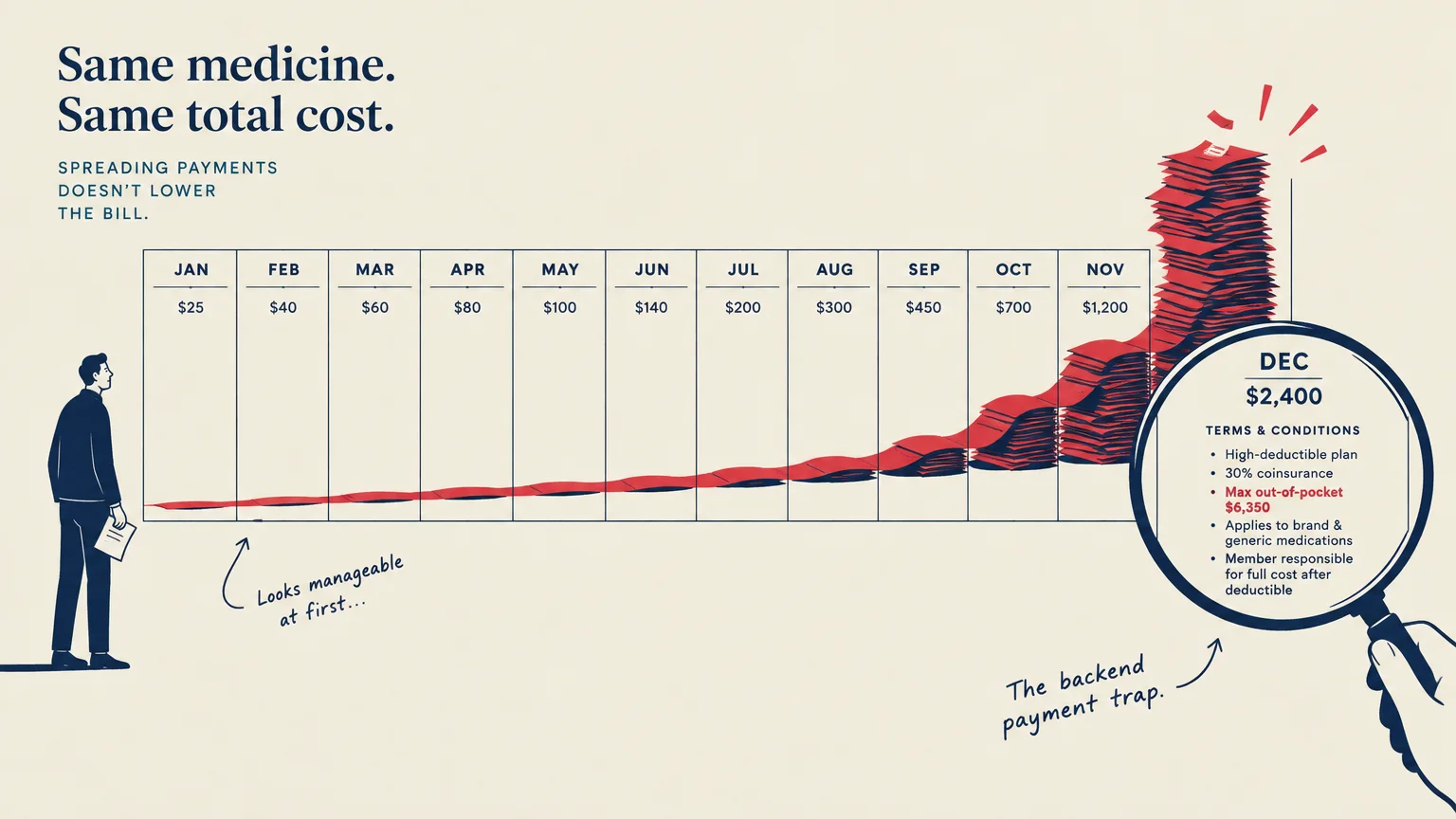
The Medicare Prescription Payment Plan (M3P) offers valuable cash-flow budgeting for retirees facing steep initial drug costs. This voluntary program spreads your out-of-pocket pharmacy expenses across capped, monthly bills.
Instead of paying a $400 pharmacy bill in January to satisfy your deductible, M3P divides that expense into predictable payments across the calendar year. The service is interest-free and fee-free.
Remember that M3P does not reduce your total out-of-pocket costs. It simply smooths your cash flow across twelve months.
However, an operational trap awaits anyone switching drug plans this fall. If you used M3P in 2026 and remain in your current plan, your enrollment rolls over automatically for 2027.
If you switch to a new Part D plan before December 7, your M3P participation is immediately terminated. It does not transfer to your new insurance company.
You must actively submit a new M3P election form to your new carrier. Failing to re-enroll means the pharmacy will demand full out-of-pocket payment at the counter in January.
Contact your new plan sponsor as soon as you receive your 2027 enrollment confirmation. Request immediate enrollment in their Medicare Prescription Payment Plan to ensure uninterrupted payment smoothing.
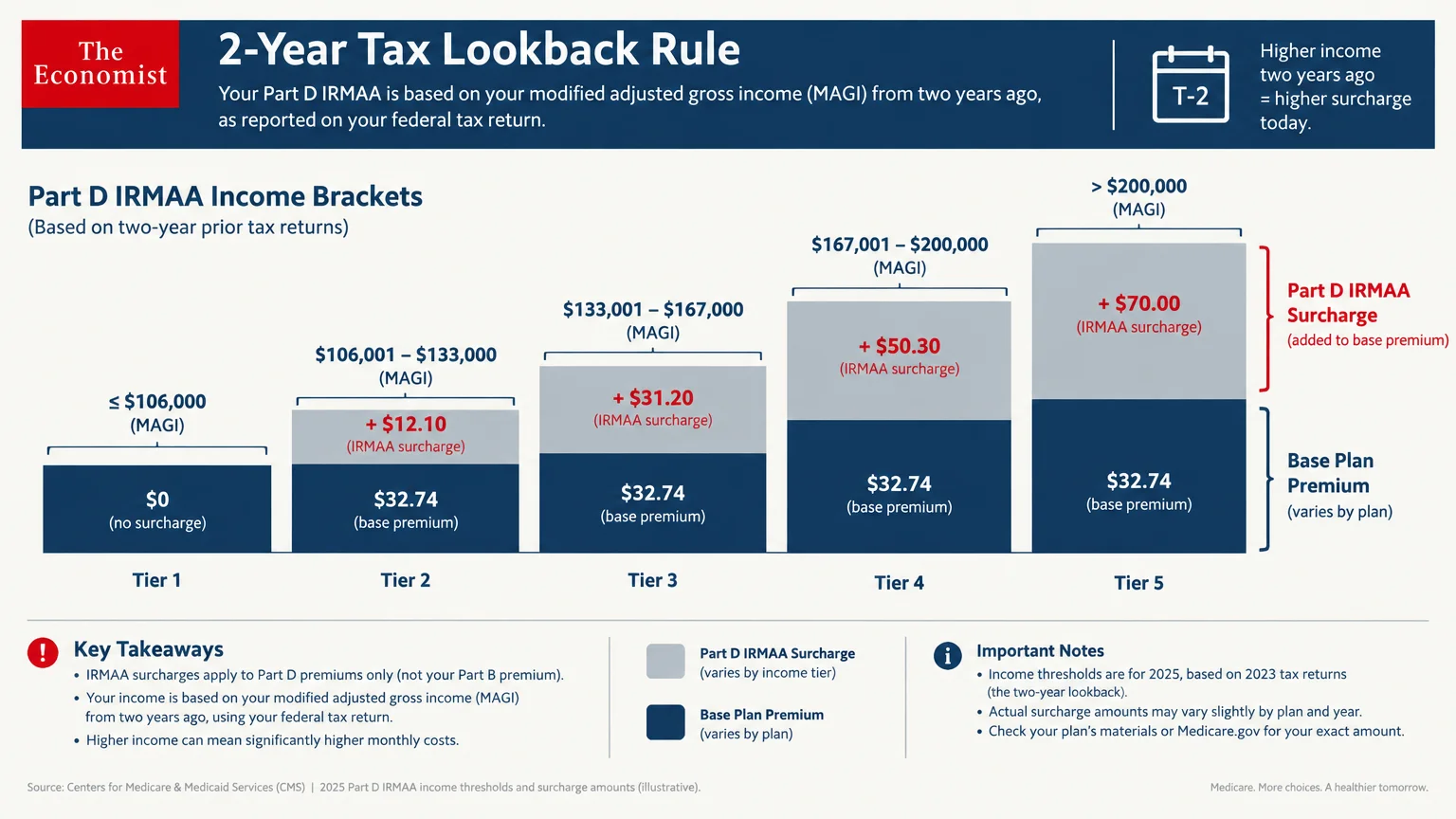
High-Income Retirees: Managing 2027 Part D IRMAA Surcharges
Higher-earning retirees must account for additional monthly charges above their basic plan premiums. This extra fee is the Income-Related Monthly Adjustment Amount, commonly known as IRMAA.
The Social Security Administration (SSA) determines your 2027 IRMAA status using your 2025 modified adjusted gross income (MAGI). This two-year lookback is standard administrative practice.
For 2027, Part D IRMAA surcharges begin when 2025 MAGI exceeds $112,000 for single tax filers. For married couples filing jointly, surcharges trigger above $224,000.
These entry thresholds reflect an inflation increase from 2026 limits of $109,000 for singles and $218,000 for couples. Surcharges add between $15.40 and $96.40 per month per person to your drug coverage.
You pay this surcharge directly to the government, typically as a deduction from your monthly Social Security check. Your private insurance company never receives these funds.
For financial context, the standard Part B premium is $209.40 per month in 2027, representing a $6.50 increase. Meanwhile, Social Security benefits receive a 3.6 percent Cost-of-Living Adjustment (COLA).
Carefully managing your modified adjusted gross income prevents sudden jumps into higher surcharge tiers. Roth conversions, capital gain harvesting, and large IRA withdrawals must be timed with precision.
If your household income dropped significantly after 2025 due to a qualifying life event, you can appeal. Qualifying events include retirement, work reduction, divorce, or the death of a spouse.
Submit Form SSA-44 to the Social Security Administration along with documentation proving your reduced income. A successful appeal eliminates or lowers your IRMAA assessment for 2027.

Extra Help (LIS) Opportunities for 2027
Retirees living on modest incomes should explore whether they qualify for the federal Low-Income Subsidy, known as Extra Help. This program eliminates Part D financial strain.
Extra Help waives annual Part D plan deductibles and eliminates coverage gap liabilities. It also covers monthly premiums when you select a designated benchmark drug plan.
For 2027, the resource limits for full Extra Help rise to $17,210 for an individual and $34,340 for a married couple. These limits exclude your home, one vehicle, and personal belongings.
When including the allowable $1,500 per person burial expense exclusion, asset limits expand to $18,710 for individuals and $37,340 for couples. This provides broader qualification access.
Under Extra Help in 2027, your prescription copayments cannot exceed $5.80 for generic medications. Brand-name prescription copayments are capped at $14.40.
Advocacy groups like the National Council on Aging (NCOA) report that eligible seniors miss out on billions in assistance each year simply because they never apply. Applying online takes only minutes.
Current 2026 income guidelines of $23,940 for single individuals and $32,460 for married couples remain active for applications until updated figures are published in early 2027.

What Can Go Wrong Before December 7
Navigating Medicare Open Enrollment requires vigilance, as administrative oversights can trigger severe financial penalties. Being aware of frequent pitfalls helps you avoid costly mistakes.
Ignoring your Annual Notice of Change (ANOC) letter leaves you completely blind to upcoming policy shifts. Plans mail these documents in September, yet many retirees discard them as junk mail.
The ANOC outlines exact modifications to your premium, deductible, and covered drug list. Overlooking this document is how enrollees accidentally incur the projected 50 percent premium jump.
Another major mistake involves relying on commercial pharmacy discount coupons instead of your Part D insurance. Commercial coupon programs often advertise attractive cash prices on select maintenance medications.
However, CMS strictly warns that purchases made using retail discount coupons or programs like TrumpRx.gov do not count toward your Medicare deductible. They also do not count toward your $2,400 out-of-pocket maximum.
Bypassing your Part D coverage prevents you from advancing toward catastrophic coverage protections. If a sudden health crisis emerges later in the year, your out-of-pocket spending resets from zero.
Missing the December 7 Open Enrollment deadline locks you into your existing plan for the entire upcoming calendar year. After December 7, changes are barred unless you qualify for a narrow Special Enrollment Period.
Finally, dropping Part D coverage entirely triggers permanent late enrollment penalties. Medicare assesses a permanent penalty if you go 63 consecutive days without creditable drug coverage.
The penalty equals 1 percent of the national base beneficiary premium multiplied by the total number of uncovered months. For 2027, CMS set the national base beneficiary premium at $41.33 per month.
This base premium reflects a 6 percent increase from $38.99 in 2026, reaching the maximum statutory annual cap allowed under current law. This permanent surcharge is added to your monthly premium for life.

When to Consult a Professional
While the Medicare Plan Finder simplifies plan comparisons, certain health and financial situations demand personalized expertise. Consider seeking guidance if you face any of the following circumstances:
- You take complex specialty medications requiring strict prior authorizations, step therapy rules, or specialized compounding pharmacies.
- Your household income fluctuates near IRMAA thresholds, making coordination between retirement accounts and healthcare surcharges necessary.
- You are transitioning from Original Medicare with a Medigap policy and stand-alone PDP into a Medicare Advantage plan, or attempting the reverse.
- You suspect your household assets qualify for Extra Help subsidies but need assistance navigating state Medicaid and federal social security application processes.
State Health Insurance Assistance Programs (SHIP) provide free, unbiased local counseling. Working alongside fee-only financial planners also ensures your healthcare strategy coordinates with your tax and estate goals.
Frequently Asked Questions
When is the Medicare Open Enrollment deadline for 2027 coverage?
The Medicare Open Enrollment Period runs from October 15 through December 7, 2026. Any plan changes you finalize during this window take effect on January 1, 2027.
Why are stand-alone PDP premiums projected to rise while Medicare Advantage drug premiums fall?
Stand-alone PDPs bear the direct brunt of expiring federal stabilization subsidies and uncapped drug liabilities. Medicare Advantage plans can cross-subsidize drug coverage using federal rebates generated from their medical care management.
Do retail discount cards or coupons count toward my $2,400 out-of-pocket cap?
No. Prescriptions purchased outside your Medicare Part D benefit using commercial discount coupons or programs like TrumpRx.gov never count toward your plan deductible or your $2,400 out-of-pocket maximum.
What happens to my Medicare Prescription Payment Plan (M3P) if I switch carriers?
If you switch Part D plans, your M3P participation does not carry over. Your enrollment is automatically canceled, and you must submit a new M3P election request to your new plan sponsor.
Can I return to a $0-premium stand-alone drug plan in 2027?
No. For the first time in Medicare history, no $0-premium stand-alone PDPs exist in 2027 for retirees without Low-Income Subsidies. Every non-subsidized enrollee in a stand-alone plan will pay a monthly premium.
Take Control of Your Medicare Drug Costs Before Dec. 7
The 2027 Medicare Part D shakeup proves that passive retirement planning carries severe financial consequences. Letting your drug plan roll over automatically leaves you exposed to higher premiums, altered formularies, and unexpected deductibles.
Spend one hour on Medicare.gov before the December 7 deadline to review your medications, verify pharmacy networks, and compare total annual expenses. Taking charge of your prescription coverage today preserves your hard-earned savings all year long.
This article provides general retirement education and information only. Every retiree’s situation is unique—what works for others may not work for you. For personalized advice, consider consulting a qualified financial professional such as a CFP or CPA.
Last updated: November 2026. Retirement benefits, tax rules, and healthcare regulations change frequently—verify current details with official sources.