

Downsizing your longtime family home promises lower maintenance and unlocked equity for your retirement. Yet selling a residence you have owned for decades often unleashes sudden tax burdens that erode your cash gains.
A single transaction can push you into steep tax brackets, eliminate key retirement deductions, and sharply inflate your ongoing Medicare premiums.
Federal tax laws do not grant automatic breaks simply because you retire. Avoiding these downsizing tax traps requires identifying potential liabilities before you sign a listing agreement.
01 Capital Gains Exceeding Section 121 Limits
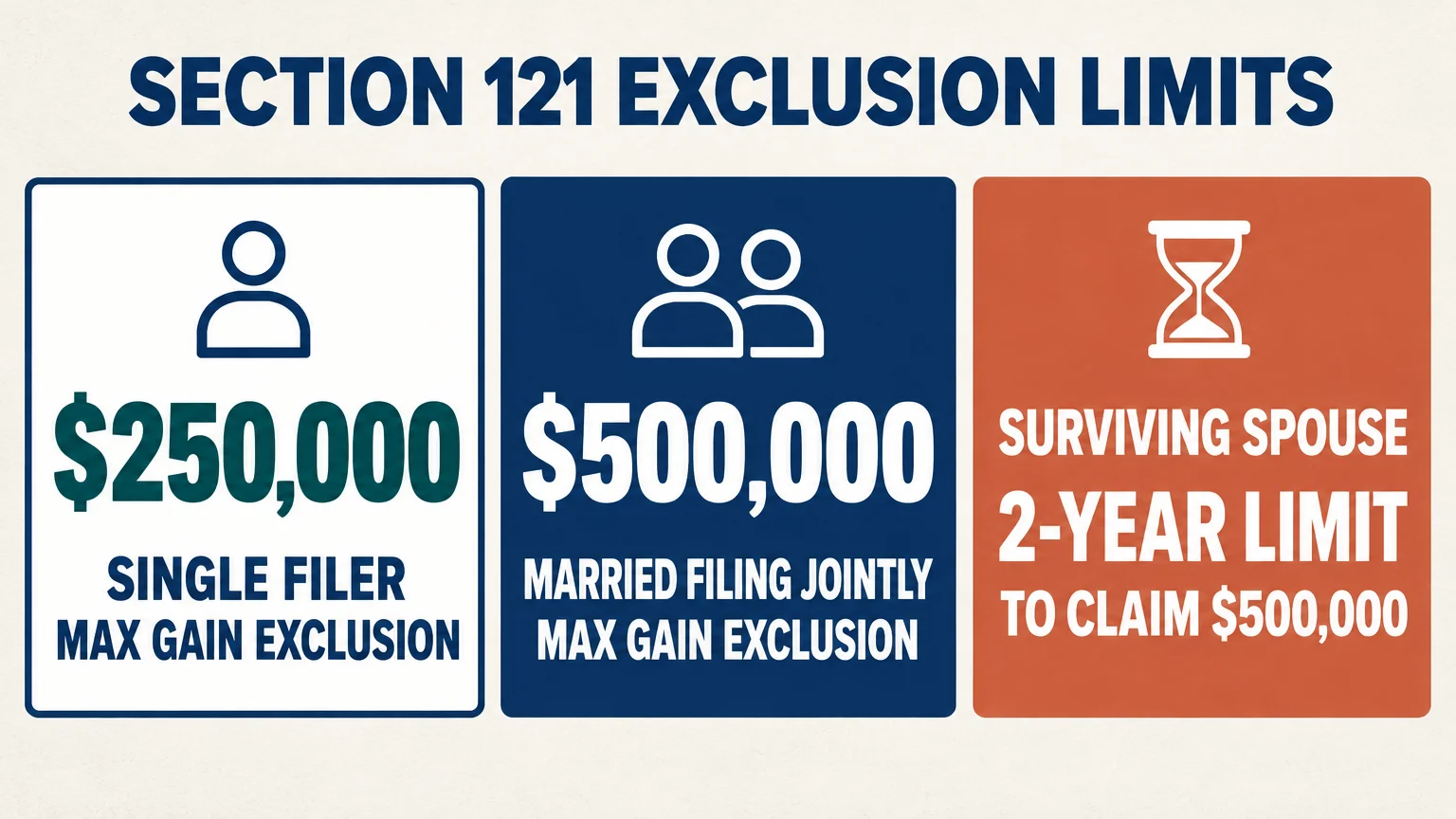
Under the Section 121 exclusion, you can exclude up to $250,000 of gain if you are single, or $500,000 if married filing jointly. To qualify, you must have owned and lived in the residence for at least two of the five years preceding the sale.
Congress fixed these limits in 1997 without including annual inflation adjustments. Decades of steady appreciation mean many long-term homeowners now hold equity exceeding these thresholds.
If you bought your house decades ago for $150,000 and sell it for $900,000, your gross profit reaches $750,000. Even with the full $500,000 married exclusion, you owe tax on $250,000 of profit.
Surviving spouses face an even more rigid deadline. You retain the $500,000 joint exclusion only if you sell the property within two years of your spouse’s death.
Missing that date cuts your exclusion to $250,000; this sudden reduction can expose substantial amounts of accumulated equity to federal taxation.
Prior depreciation creates an additional liability. The Internal Revenue Service (IRS) taxes allowable depreciation deductions from past home office or rental use at a rate of up to 25%.
02 The Medicare IRMAA Surcharge Spike
Many retirees assume that a capital gains home sale only triggers ordinary capital gains taxes. In reality, large home sales frequently produce severe Medicare premium spikes two years later.
The federal government calculates Medicare Part B and Part D Income-Related Monthly Adjustment Amounts (IRMAA) using your tax data from two years prior. A home sale in 2026 dictates your healthcare premiums in 2028.
For 2026, IRMAA surcharges begin when your Modified Adjusted Gross Income (MAGI) exceeds $109,000 for single filers or $218,000 for joint filers. Crossing these tiers raises your Part B premium well beyond the standard $202.90 monthly baseline.
Surcharges can push Part B premiums as high as $689.90 per person per month. You will also pay supplemental surcharges on Part D drug plans.
Do not count on an administrative appeal to erase this surcharge. The Social Security Administration (SSA) strictly excludes one-time home sales from qualifying life-changing events on Form SSA-44.
03 Bracket Creep, NIIT, and Phaseout of Senior Deductions
Non-excluded profits from your sale flow directly onto Form 1040, expanding your Adjusted Gross Income. This sudden bump can trigger multiple secondary taxes.
Gains above the exclusion can trigger the 3.8% Net Investment Income Tax (NIIT). This levy applies once MAGI surpasses $200,000 for single filers or $250,000 for married couples.
Combining the top 20% federal capital gains bracket with the NIIT creates a 23.8% top federal rate. State income taxes will raise this total liability even higher.
High gains can also eliminate the senior standard deduction enacted under recent federal legislation. This deduction phases out by 6% for each dollar of MAGI above $75,000 for singles or $150,000 for joint filers.
In addition, elevated provisional income can subject up to 85% of your Social Security benefits to regular income taxes.
04 Local Real Estate Transfer Levies
Beyond real estate commissions, moving out often triggers local transaction levies. Approximately 75% of states enforce transfer taxes or documentary recording fees on property sales.
Many municipalities and counties impose supplemental transfer levies on top of state assessments. In most jurisdictions, the seller pays these charges directly from closing proceeds.
Certain metro areas utilize progressive transfer rates that escalate on higher transaction amounts. Selling a million-dollar property in these jurisdictions can trigger significant municipal transfer bills.
Settlement agents deduct these mandatory fees before distributing your check, reducing your available cash for your next residence.

05 Property Tax Reassessment on Replacement Homes
Downsizing retirees frequently anticipate lower property tax bills in a smaller dwelling. However, local property tax reassessment rules can upend those calculations.
Longtime homeowners often benefit from legal assessment growth caps that kept taxable values suppressed for decades. Purchasing a new home resets that assessment to the current fair market value.
Some states offer relief, though strict regulations govern each program. California allows seniors age 55 and older to transfer base-year values under Proposition 19, provided you purchase within two years.
In Florida, the Save Our Homes program allows homeowners to port accumulated tax benefits. However, downsizing to a less expensive home reduces your transferable benefit proportionally.
Tax Impact: Long-Held Family Home vs. Downsized Property
| Tax Consideration | Long-Held Family Home | Downsized Replacement Home |
|---|---|---|
| Capital Gains Exposure | High risk of exceeding the $250k/$500k Section 121 limit | Resets cost basis to current market purchase price |
| Property Tax Assessment | Often protected by cumulative annual assessment caps | Reassessed to full purchase price upon acquisition |
| Medicare IRMAA Effect | Unrealized gains cause zero Medicare impact | Taxable sale gains trigger premium hikes 2 years later |
| Transfer Taxes | Due at closing based on gross sales price | May include buyer recording fees depending on state |
“A big part of financial freedom is having your heart and mind free from worry about the what-ifs of life.” — Suze Orman, Personal Finance Author
Common Mistakes to Avoid
Avoid these common pitfalls to keep more of your equity during your move:
- Discarding home improvement receipts: Remodeling projects, new roofs, and additions increase your adjusted basis, reducing your taxable capital gain.
- Missing the two-year widowhood deadline: Surviving spouses must close the sale within two years of death to secure the full $500,000 exclusion.
- Failing to budget for Medicare IRMAA: Expecting standard premiums after reporting large capital gains leads to cash-flow shocks two years later.
- Ignoring local transfer taxes: Failing to verify city-level transfer ordinances can leave you short of cash at settlement.

Professional vs. Self-Guided Downsizing
Evaluating your personal situation determines whether you need professional intervention before listing your property:
Self-Guided Planning: You can manage the transition independently if your profit falls well below exclusion limits. This path works best when your property has no rental history and minimal local transfer taxes.
CPA Consultation: Seek professional accounting support if your total gain exceeds statutory limits. An accountant can uncover valid home improvement basis adjustments to minimize your capital gains exposure.
Healthcare Coordination: Consult a financial planner if your projected proceeds will trigger higher Medicare premiums. They can help adjust the timing of retirement account withdrawals to balance your multi-year income.
Frequently Asked Questions
Will selling my house cause my Social Security benefits to be taxed?
Yes, non-excluded capital gains increase your adjusted gross income, which counts toward provisional income. If your provisional income exceeds $34,000 as a single filer or $44,000 jointly, up to 85% of your benefits become taxable.
Can I appeal an IRMAA surcharge caused by selling my home?
No, the Social Security Administration does not view home sales as qualifying life-changing events. While events like marriage, divorce, or work stoppage qualify for Form SSA-44 appeals, one-time capital gains do not.
What home improvements add to my tax basis?
Capital improvements that prolong your home’s life or adapt it to new uses increase your basis. Qualifying projects include new roofs, additions, remodeled kitchens, and updated heating systems, but not routine maintenance or cosmetic repairs.
Downsizing should streamline your lifestyle rather than burden you with unforeseen liabilities. Review your cost basis records and calculate your net income profile before putting your home on the market.
This article provides general retirement education and information only. Every retiree’s situation is unique—what works for others may not work for you. For personalized advice, consider consulting a qualified financial professional such as a CFP or CPA.
Last updated: November 2026. Retirement benefits, tax rules, and healthcare regulations change frequently—verify current details with official sources.