
Creating your will protected your family once, but leaving it untouched can unravel your hard-earned retirement security. Outdated estate documents often transfer assets to unintended recipients, trigger unnecessary tax burdens, or spark bitter courtroom disputes.
Tax codes evolve, family relationships shift, and financial priorities transform over time. A regular will review prevents costly administrative headaches and ensures your true intentions stand.
If your estate plan has sat unread in a drawer for years, key life events signal that an update is overdue. Spotting these changes early safeguards your legacy and protects the people you cherish most.

1. Your Family Dynamic Changed Through Marriages, Divorces, or Births
Family expansion is one of the most common catalysts for revising an estate plan. Welcoming a child or grandchild into your family creates an immediate need to adjust your distributions.
If your current document omits new grandchildren, they may receive nothing under strict legal interpretations. Specifying whether distributions occur per stirpes or per capita guarantees that branches of your family receive equal treatment.
Divorce introduces even greater urgency into estate planning. While some state statutes automatically revoke bequests to an ex-spouse, others do not invalidate them until a divorce decree is finalized.
Failing to update your documents after a divorce can leave your former spouse in charge of your financial estate. It may also leave them named as the primary beneficiary of valuable family heirlooms.
Remarriage brings unique complications, particularly for blended families with children from previous relationships. If you leave all assets to a new spouse outright, your biological children could be disinherited entirely.
A revised will can establish testamentary trusts that support your surviving spouse while guaranteeing remaining assets pass to your children. Clear stipulations prevent friction between your spouse and your adult children during probate.
Marriages among your adult children also warrant a careful review of your estate plan. You might want to protect an inheritance from potential future divorce claims through protective trust provisions.
2. You Moved to Another State or Purchased Out-of-State Property
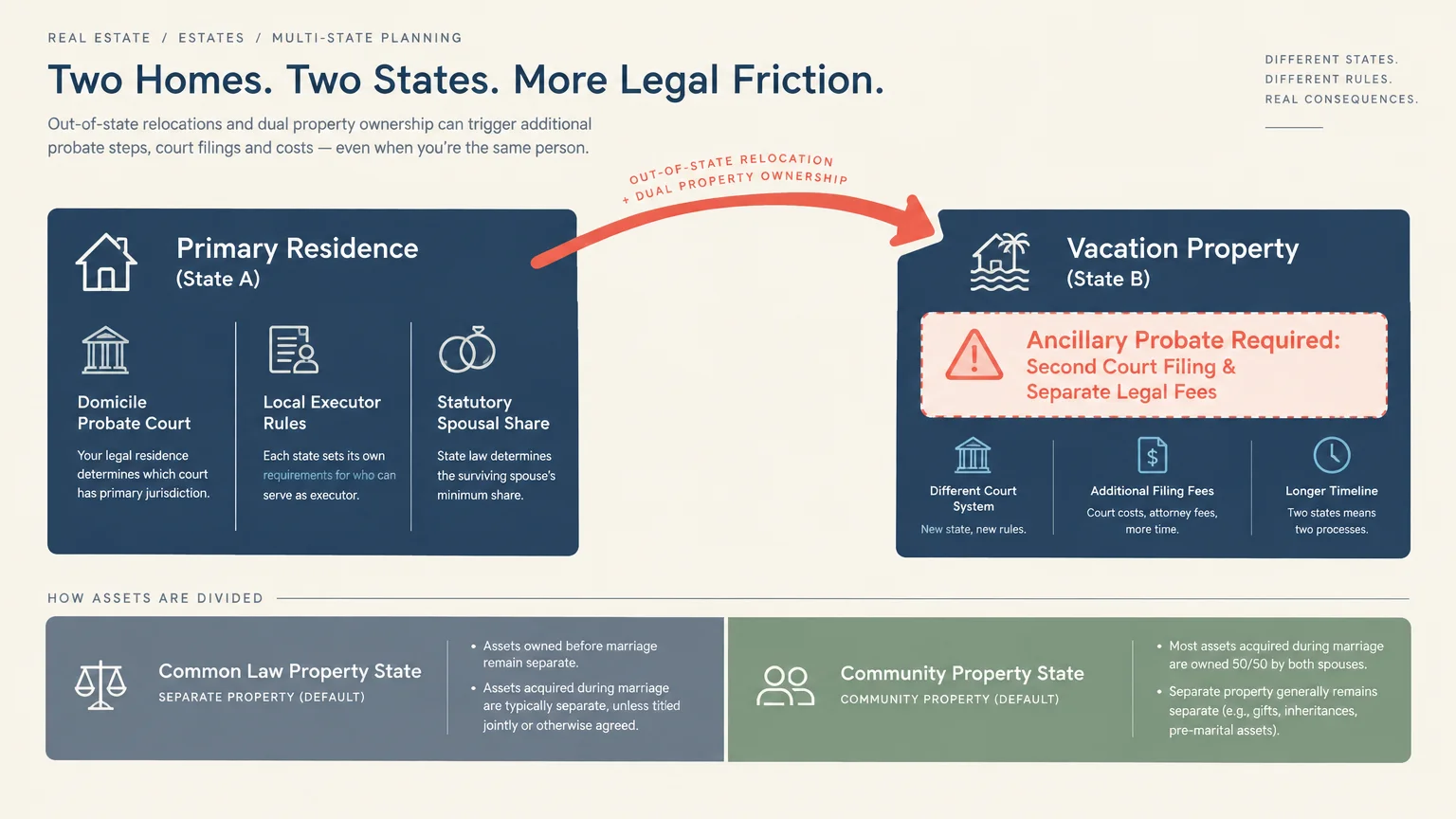
Estate planning statutes operate at the state level rather than under a single federal code. Moving your primary residence across state lines frequently impacts how probate courts administer your estate.
States differ significantly on probate procedures, statutory allowances for surviving spouses, and execution formalities. A will drafted in Florida may encounter unexpected legal friction in a California probate court.
Property ownership classifications vary dramatically between common law property states and community property jurisdictions. Moving into or out of a community property state directly alters how your marital assets are divided.
Executor eligibility requirements also differ substantially by jurisdiction. Some states prohibit out-of-state executors unless they are related by blood or marriage, while others require non-resident executors to post a costly surety bond.
Purchasing secondary real estate in another state introduces the headache of ancillary probate. Without proper planning, your heirs must open two separate court proceedings to settle your estate.
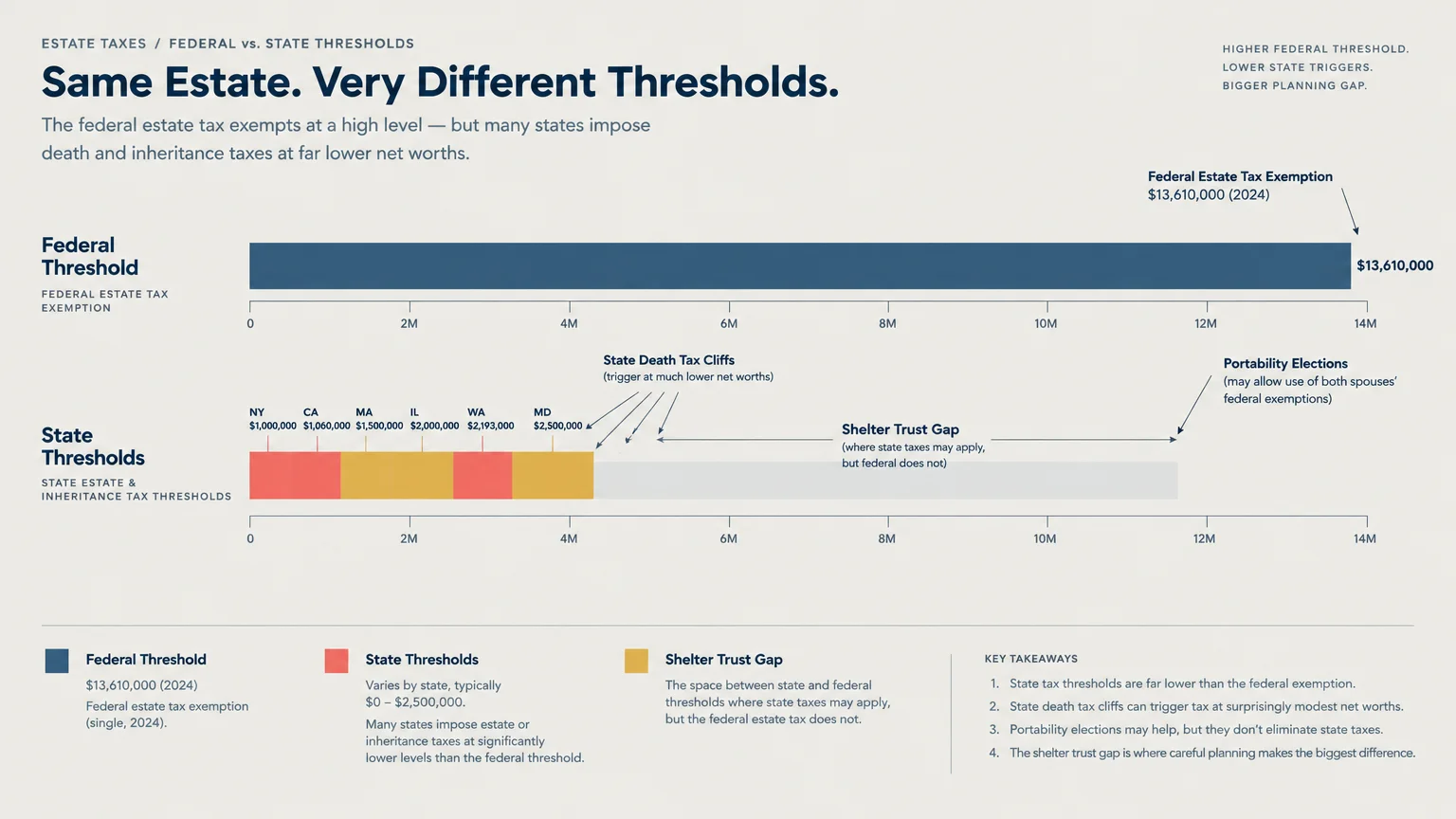
State-level estate and inheritance taxes create another pressing reason to adjust your estate documents after relocating. While the federal exemption sits at elevated levels, numerous states enforce estate or inheritance taxes with much lower thresholds.
If you relocate to a state that levies death taxes, your current plan might expose your heirs to unexpected state tax liabilities. Consulting a local estate attorney ensures your documents satisfy regional requirements and minimize state tax burdens.

3. A Named Executor, Trustee, or Beneficiary Has Died or Become Incapacitated
Estate documents rely entirely on the individuals named to carry out your wishes. When an executor, trustee, or legal guardian passes away, your plan loses an essential pillar of support.
Failing to name a replacement executor forces probate courts to appoint an administrator of their choosing. The court could select a distant relative or professional fiduciary you would never have trusted with your estate.
Even if your named fiduciaries remain alive, their circumstances may change significantly over time. An executor who agreed to handle your estate 15 years ago might now face chronic health challenges or cognitive decline.
According to the Consumer Financial Protection Bureau, fiduciaries carry strict legal obligations to manage assets responsibly. Appointing someone incapable of meeting those duties risks costly mismanagement.
Geography also impacts an executor’s practical effectiveness. An executor who moved across the country may struggle to secure your physical property, sort personal possessions, or attend local probate hearings.
Beneficiaries experience life changes that require structural updates to your bequests. If a named beneficiary predeceases you, an outdated will creates uncertainty about where their allocated share should go.
Personal relationships can also deteriorate or shift over the course of retirement. If you experience an estrangement, updating your will clarifies your current intentions and prevents contentious post-death challenges.
“A will is not about how much money you have. It’s about making sure the people you love are taken care of and that your wishes are carried out.” — Suze Orman, Personal Finance Expert

4. Your Net Worth or Asset Portfolio Changed Substantially
Dramatic swings in personal wealth require a comprehensive re-evaluation of how you allocate your assets. Significant portfolio appreciation, a business liquidation, or receiving an inheritance can render existing distribution formulas obsolete.
Leaving specific dollar amounts to beneficiaries rather than percentages often creates unintended inequities. If your overall asset base shrinks, a fixed cash bequest could consume the bulk of your estate, leaving residuary heirs with very little.
Conversely, if your wealth grows considerably, a fixed dollar bequest might deliver far less support than you intended. Using percentage-based distributions allows your bequests to adapt automatically to market fluctuations.
Acquiring unique or illiquid assets also demands specific instructions in your will. Closely held business interests, rental properties, and valuable collectibles require designated succession plans to prevent forced fire sales.
Modern retirees also accumulate significant digital footprints that traditional documents frequently overlook. Digital assets like cryptocurrency keys, online trading accounts, and digital royalties require explicit executor access authorized under state law.
Selling off substantial assets during retirement can trigger the legal doctrine of ademption. If you bequeath a specific home in your will but sell it before you die, that beneficiary receives nothing from that gift.
Revising your documents ensures your current asset inventory matches your legal instructions. It provides clear authority for managing your financial holdings and simplifies the transfer process for your heirs.
5. Tax Laws and Federal Estate Rules Have Shifted
Estate planning statutes do not remain static. Legislative adjustments at both federal and state levels can dramatically alter the financial consequences of your existing estate plan.
Under Public Law 119-21, signed on July 4, 2025, the federal estate and lifetime gift tax basic exclusion amount increased to $15,000,000 per individual ($30,000,000 for married couples). This legislation eliminated the looming sunset cliff that would have halved the exemption, extending elevated thresholds through December 31, 2034.
If your existing will contains formula clauses designed around previous exemption limits, your estate could distribute assets unexpectedly. Complex bypass trusts established years ago might no longer serve your family’s best financial interests.
Maintaining outdated credit shelter trusts can unnecessarily forfeit a full step-up in basis for surviving spouses. That mistake can expose heirs to significant capital gains taxes when they sell inherited investments.
The Internal Revenue Service sets the annual gift tax exclusion at $19,000 per recipient ($38,000 for married couples splitting gifts). For gifts to a spouse who is not a U.S. citizen, the annual exclusion stands at $194,000.
Retirement account regulations have also shifted through retirement legislation. Most non-spouse beneficiaries must now deplete an inherited IRA within 10 years, eliminating the traditional lifetime stretch distribution strategy.
If your will coordinates with retirement accounts through testamentary trusts, outdated language could cause severe tax penalties. Coordinating your will with current tax codes ensures your assets transfer efficiently without unnecessary tax leakage.

6. A Beneficiary Developed a Disability or Serious Health Challenge
Health shifts within your family require swift protective measures in your estate planning documents. According to survey data from Caring.com, 10% of Americans who updated their estate plans did so following a medical diagnosis, while 7% updated documents prior to a serious medical procedure.
Leaving an outright bequest to a child or grandchild with special needs can cause catastrophic financial harm. Direct inheritances often push beneficiaries over strict asset limits for government support programs.
Essential public benefits like Supplemental Security Income and Medicaid require recipients to maintain very limited countable resources. A sudden inheritance can instantly disqualify a vulnerable loved one from coverage.
Updating your will allows you to direct that inheritance into a third-party Special Needs Trust instead. This legal vehicle holds assets for the individual’s benefit while preserving their eligibility for vital government assistance.
The trust assets can pay for supplemental expenses like specialized therapies, educational programs, technology, and recreation. These expenditures enhance your loved one’s quality of life without disrupting their public medical coverage.
You must also carefully select a reliable trustee to oversee the distribution of these funds. Naming a trustworthy fiduciary ensures the money serves your beneficiary’s daily needs according to your explicit standards.
Cognitive decline or memory loss in an aging beneficiary or spouse also warrants immediate updates. Establishing managed trusts protects vulnerable family members from financial exploitation, scams, and poor judgment.

7. You Have Not Reviewed Your Estate Plan in Three to Five Years
Even if your life appears tranquil, the simple passage of time is a compelling reason for a will review. Financial planners and legal professionals recommend conducting a thorough estate plan check every 3 to 5 years.
Caring.com’s 2025 Wills and Estate Planning Study revealed that only 24% of American adults have a valid will, dropping from 32% in 2024 and 33% in 2022. Furthermore, over 50% of Americans have no estate documents whatsoever, with 43% blaming procrastination.
Procrastination leaves families vulnerable to unnecessary emotional and financial stress. A regular checkup ensures your documents reflect your current values, philanthropic goals, and relationship dynamics.
A routine review also provides the opportunity to cross-check non-probate asset transfers. Beneficiary designations on 401(k) accounts, IRAs, annuities, and life insurance policies supersede whatever you write in a will.
If you designate an individual in your will but forget to update your IRA beneficiary form, the IRA form wins every time. Aligning your will with non-probate beneficiary designations prevents tragic, irreversible administrative errors.
Resources from organizations like AARP emphasize that regular estate checkups facilitate essential conversations among family members. Clear communication today eliminates confusion and costly probate challenges tomorrow.
“By failing to prepare, you are preparing to fail.” — Benjamin Franklin
Comparing Methods to Update Your Will
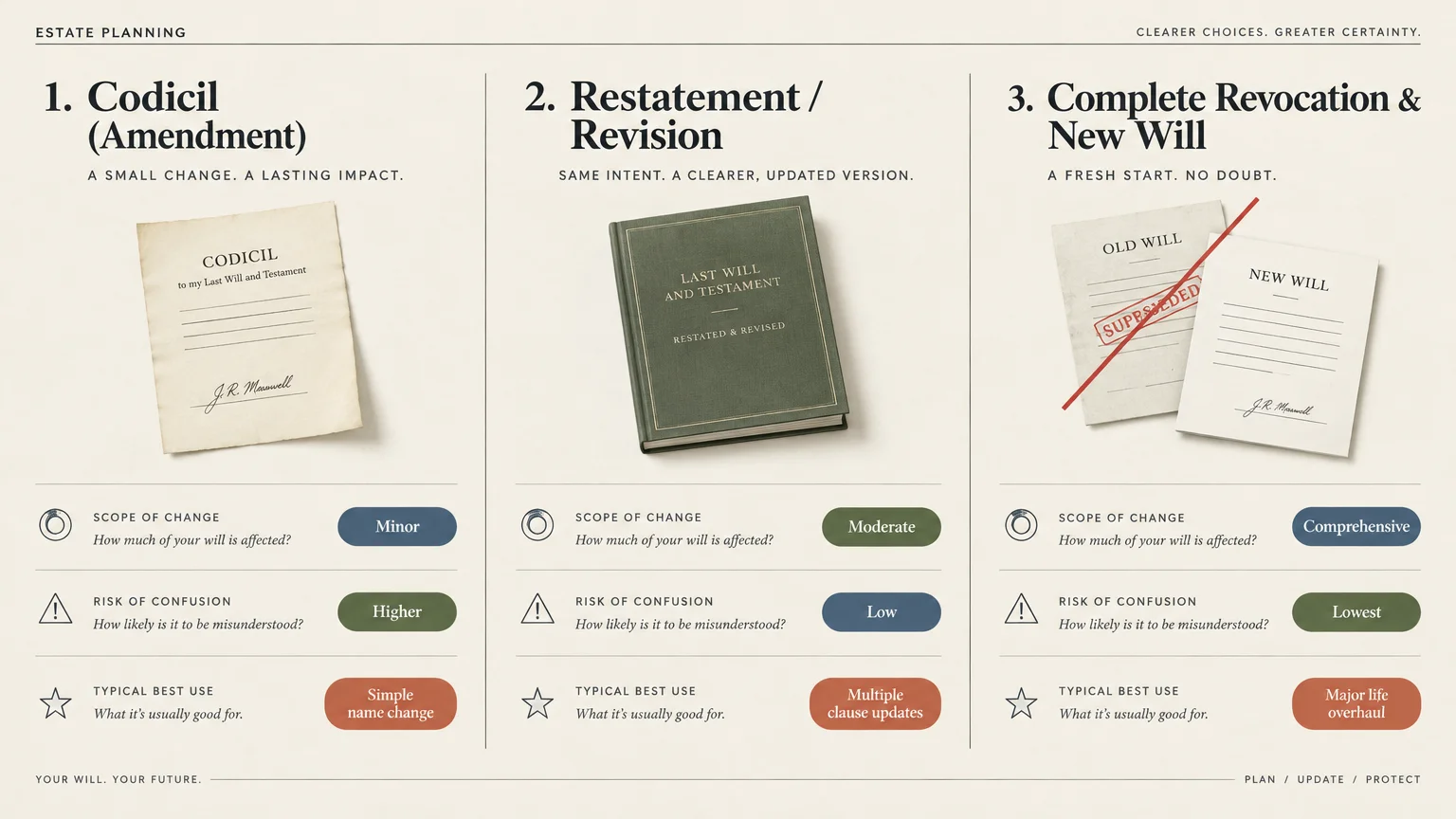
When you determine that your will needs modifications, you must choose the appropriate legal approach. You can amend existing terms with a codicil, draft an entirely new will, or transition to a revocable living trust.
Each method offers distinct advantages, costs, and potential legal pitfalls. The table below outlines how these strategies compare so you can make an informed choice with your legal counsel.
| Update Method | Best Used For | Typical Cost Range | Primary Advantages | Key Risks or Drawbacks |
|---|---|---|---|---|
| Codicil | Minor, simple tweaks such as replacing an alternate executor | $150 – $400 | Inexpensive and quick to draft for basic administrative corrections | Risk of contradictory language; creates paper trails exposing previous provisions |
| New Will (Full Revocation) | Substantial family, financial, or geographic distribution changes | $500 – $1,000+ | Revokes older wills completely, eliminating confusion and contradictory clauses | Requires formal execution, witness signatures, and notarization |
| Revocable Living Trust | Avoiding probate, managing out-of-state property, maintaining privacy | $1,500 – $3,500+ | Bypasses probate court entirely; protects privacy; manages incapacity smoothly | Higher initial cost; requires retitling personal assets into the trust name |
| Online Will Platforms | Modest estates with straightforward, simple distribution wishes | $0 – $60 initial ($50 – $60/yr subscription) | Affordable; convenient updates through digital subscription models | Lacks bespoke legal counsel; offers limited protection for complex family situations |
Codicils were historically favored before modern word processing because retyping a lengthy document was labor-intensive. Today, most attorneys prefer drafting a clean, fresh will to eliminate the risk of contradictory language.
Using an attorney to formally rewrite an estate plan typically costs between $500 and $1,000+. This expense reflects the thorough review required to prevent unintended legal consequences.
Online will-making tools provide affordable alternatives for simple estates, generally charging $0 to $60 for initial creation. However, self-directed platforms carry hidden risks if your family situation involves blended relationships or specialized needs.

When DIY Isn’t Enough
While do-it-yourself online tools handle straightforward scenarios, certain legal realities demand professional legal representation. Relying on generic templates during complex circumstances can inadvertently spark bitter litigation among your surviving heirs.
An estate planning attorney crafts tailored language that satisfies strict state probate codes. Here are four common scenarios where professional guidance is essential:
- Managing Blended Family Assets: If you have children from a prior marriage alongside a current spouse, standard templates often fail. An attorney establishes marital trusts to protect your children’s inheritance while supporting your spouse.
- Protecting Special Needs Dependents: Structuring a third-party Special Needs Trust requires precise statutory compliance. A minor drafting error can disrupt critical Medicaid and Supplemental Security Income benefits for a vulnerable family member.
- Owning Out-of-State Real Estate: Owning real property across state lines exposes your estate to multiple probate proceedings. Legal counsel can structure living trusts or specialized deeds to avoid costly ancillary probate.
- Navigating State-Level Estate Taxes: If your estate exceeds state death tax exemptions, generic forms will not optimize your tax liabilities. Attorneys utilize specialized disclaimer trusts and lifetime gifting strategies to preserve wealth.
Professional legal counsel provides personalized protection that no automated template can replicate. Investing in tailored planning protects your beneficiaries from protracted courtroom disputes and administrative gridlock.

Avoiding Common Errors When You Update Your Will
Updating your will involves more than altering words on paper; you must follow precise statutory formalities. Even minor procedural oversights can invalidate your changes and leave your estate vulnerable to judicial interference.
According to guidance from Investopedia, one of the most destructive mistakes is writing handwritten notes directly onto an existing will. Cross-outs, marginal notes, and handwritten additions rarely satisfy legal requirements and can void entire clauses.
Failing to revoke older documents formally creates significant legal ambiguity. Your new document must explicitly state that it revokes all prior wills and codicils to prevent conflicting interpretations during probate.
Another frequent misstep is ignoring the execution ceremony required by your state. Most jurisdictions require two independent, disinterested witnesses to observe your signature and sign the document in each other’s presence.
Selecting interested witnesses—such as named beneficiaries or their spouses—can invalidate their gifts under state voiding statutes. Always use neutral third parties who receive no financial benefit from your estate.
Do not forget to attach a notarized self-proving affidavit to your newly executed will. This document allows the probate court to validate your will immediately without tracking down the physical witnesses years later.
Finally, avoid storing your newly signed will in a hidden, inaccessible location. While a safe deposit box seems secure, bank rules may freeze access upon your death, delaying probate when your family needs swift resolution.
Frequently Asked Questions
How much does it cost to update an existing will?
Hiring an estate planning attorney to update or rewrite a will typically costs between $500 and $1,000+. Minor codicil amendments generally cost between $150 and $400. Online platforms provide initial drafting for $0 to $60, with annual update subscriptions averaging $50 to $60.
Does a will override named beneficiaries on bank accounts and IRAs?
No, a will does not override beneficiary designations on retirement accounts, life insurance policies, or payable-on-death bank accounts. Non-probate contractual designations supersede instructions in your will. You must update beneficiary forms directly with your financial institutions to align with your wishes.
Can I make handwritten changes to my will?
You should never write handwritten changes, cross out names, or make marginal notes on an existing, executed will. Handwritten alterations can invalidate specific bequests or cause the probate court to reject the entire document. You must execute a formal codicil or sign a new will to enact valid modifications.
What is the difference between a codicil and drafting a new will?
A codicil is an amendment document that alters specific sections of an existing will while leaving the remainder intact. A new will revokes all previous documents entirely and establishes a unified estate distribution plan. Modern estate attorneys prefer drafting fresh wills to eliminate confusion and contradictory phrasing.
What happens if I move to a new state and never update my will?
Most states recognize a will that was legally executed in another state under full faith and credit principles. However, procedural issues, varying spousal share laws, and out-of-state executor restrictions can delay probate significantly. Updating your will after moving guarantees compliance with local state probate requirements.
Taking Action on Your Estate Plan
Updating your will provides immediate clarity and lasting peace of mind for you and your loved ones. Procrastination remains the primary obstacle to sound estate management, but taking deliberate action safeguards your life’s work.
Begin by locating your existing documents, compiling an updated asset inventory, and noting family milestones. Schedule a consultation with a qualified estate planning attorney to review your goals and implement necessary revisions.
The information in this guide is meant for educational purposes. Your specific circumstances—including income, health needs, tax situation, and goals—may require different approaches. When in doubt, consult a licensed professional.
Last updated: March 2026. Retirement benefits, tax rules, and healthcare regulations change frequently—verify current details with official sources.








Leave a Reply