
Retirement offers the ultimate luxury: unstructured time to explore subjects you set aside during your working career. You do not need to spend thousands of dollars to gain access to world-class instruction.
Across the country, public colleges, community centers, and municipal agencies provide no-cost courses designed specifically for older adults. You can master digital tools, learn a foreign language, or study art history locally for free.
Knowing where to look allows you to unlock these hidden community resources without dipping into your savings. Here are nine proven educational pathways open to you right now.
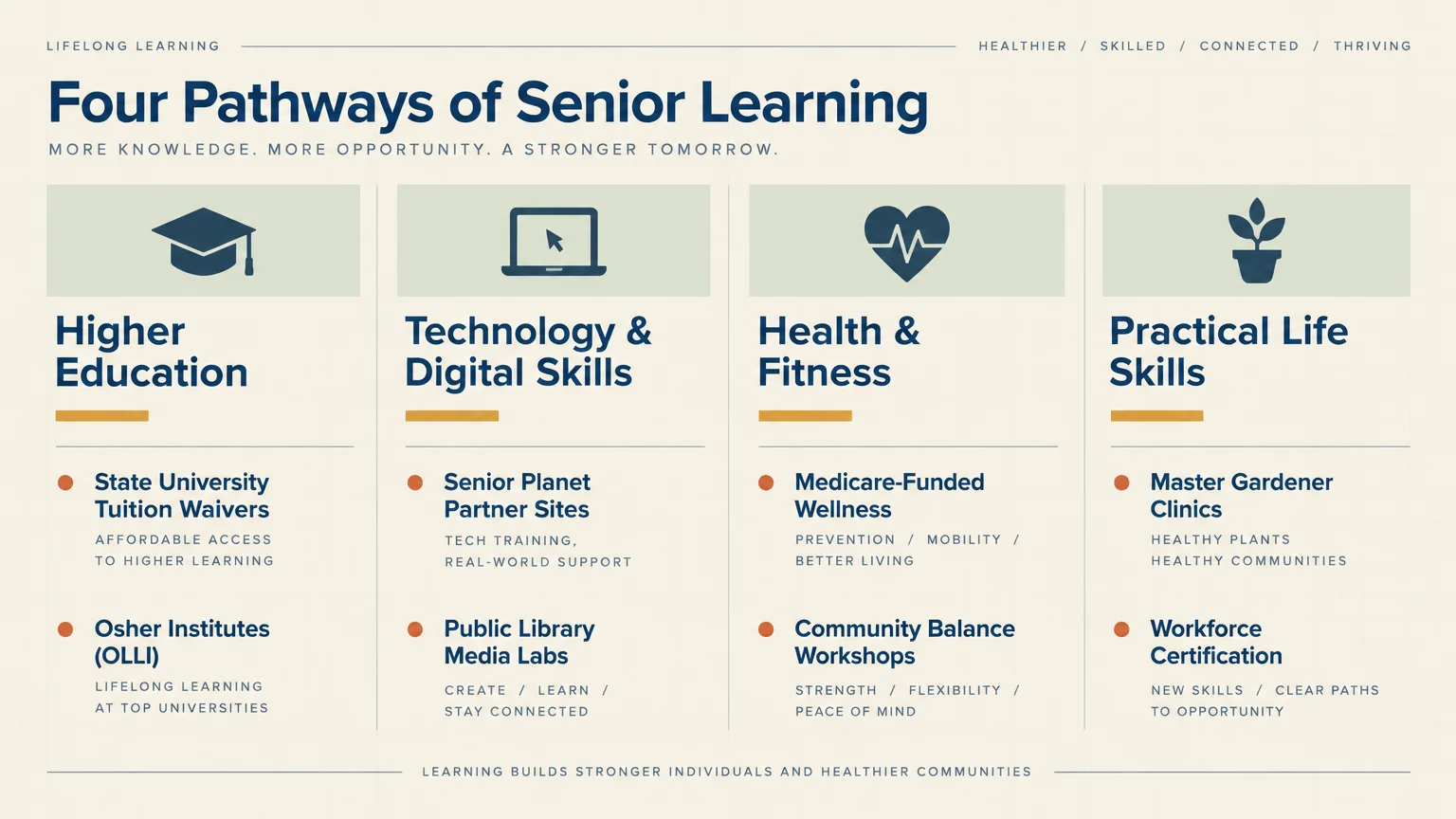
At a Glance: Free Local Education for Retirees
Lifelong learning keeps your mind sharp, introduces you to new social circles, and gives retirement structure. You can tap into state university campuses, public library systems, Medicare wellness programs, and federal grant opportunities.
Every program operates under different age rules and registration schedules. Understanding these distinctions helps you secure a seat in high-demand classes before they fill up.
- Higher Education: State college tuition waivers and Osher Lifelong Learning Institutes.
- Technology and Digital Skills: Senior Planet licensed partner sites and local library media labs.
- Health and Fitness: Medicare-funded wellness courses and community balance workshops.
- Practical Life Skills: Master Gardener agricultural clinics, workforce certificates, and tax coaching.

The Mental and Social Benefits of Lifelong Learning
Engaging in regular intellectual challenges helps preserve cognitive functioning as you age. Research confirms that acquiring complex new skills stimulates neural pathways and builds cognitive reserve.
Retirement can also shrink your everyday social network. Stepping into a local classroom connects you with multi-generational peers who share your passions and curiosity.
Education provides a tangible sense of purpose and routine. Replacing a corporate schedule with weekly lectures or studio workshops establishes healthy rhythm in your retirement life.
“Retirement is not the end of the road. It is the beginning of the open highway.” — Mitch Anthony, Retirement Lifestyle Author
Treating your brain like a muscle pays long-term dividends. The following nine options provide structured environments where you can expand your horizons without spending a dime.

1. State University and Community College Tuition Waivers
All 50 U.S. states and Washington, D.C., offer free or discounted college classes for older adults at public institutions. These programs allow you to attend legitimate undergraduate and graduate lectures alongside degree-seeking students.
Age requirements vary significantly depending on state statutes. Some states, including Colorado, Louisiana, and Tennessee, open eligibility at age 50 or 55, while most states set the threshold at age 60 or 65.
Most universities offer these slots on an auditing basis, meaning you attend lectures without taking exams or receiving grades. Other institutions provide full academic credit at zero tuition.
For example, the University of Maine system waives both tuition and mandatory fees for state residents aged 65 and older. This policy applies to courses taken for credit as well as non-credit audits.
To take advantage of these senior education programs, you generally register during the late add-drop period. Universities prioritize tuition-paying students first, then release remaining open seats to registered seniors.
Contact the registrar or admissions office at your local public community college or state university. Ask specifically for their senior citizen tuition waiver coordinator to learn their exact semester enrollment deadlines.

2. Public Library Digital Labs and Continuing Education
Modern public libraries serve as thriving educational centers rather than quiet book storehouses. Today, local library branches host extensive calendars of instructor-led workshops tailored to older community members.
You can attend hands-on classes covering smartphone management, cybersecurity fundamentals, genealogy research, and creative writing. Most branches offer dedicated computer labs with patient instructors who guide you step-by-step.
Your library card also unlocks premium online learning subscriptions that normally cost hundreds of dollars annually. Many systems offer free access to platforms like LinkedIn Learning, Gale Courses, and Mango Languages.
These digital platforms allow you to complete structured coursework at home, then attend local library discussion groups to review assignments. You gain access to professional-grade instruction completely free of charge.
Visit your local library branch in person to pick up their monthly community event calendar. Speak with a reference librarian to activate your digital learning accounts and register for upcoming hands-on computer workshops.

3. Medicare-Covered Fitness and Health Workshops
Maintaining physical vitality is essential for healthy aging, and your healthcare coverage might pay for your instruction. High-quality exercise and movement instruction is readily available without out-of-pocket costs.
Currently, 93% of Medicare Advantage plans and select Medigap supplement plans provide free fitness benefits such as SilverSneakers. You can review plan rules directly through Medicare.gov to verify your coverage details.
This single benefit unlocks access to more than 15,000 participating fitness centers, local community facilities, and public parks nationwide. It includes admission to over 80 distinct instructor-led group class formats.
You can attend weekly classes in chair yoga, tai chi for balance, aquatic aerobics, and functional strength training. Certified instructors modify movements to accommodate joint stiffness, previous injuries, or balance limitations.
According to the National Council on Aging (NCOA), evidence-based physical activity significantly reduces catastrophic fall risks among older adults. Participating in these local sessions protects both your health and your retirement budget.
Check the back of your health plan membership card to locate your member services number. Call them to confirm your fitness eligibility and retrieve your unique gym pass ID.
4. Senior Planet Technology and Digital Life Classes
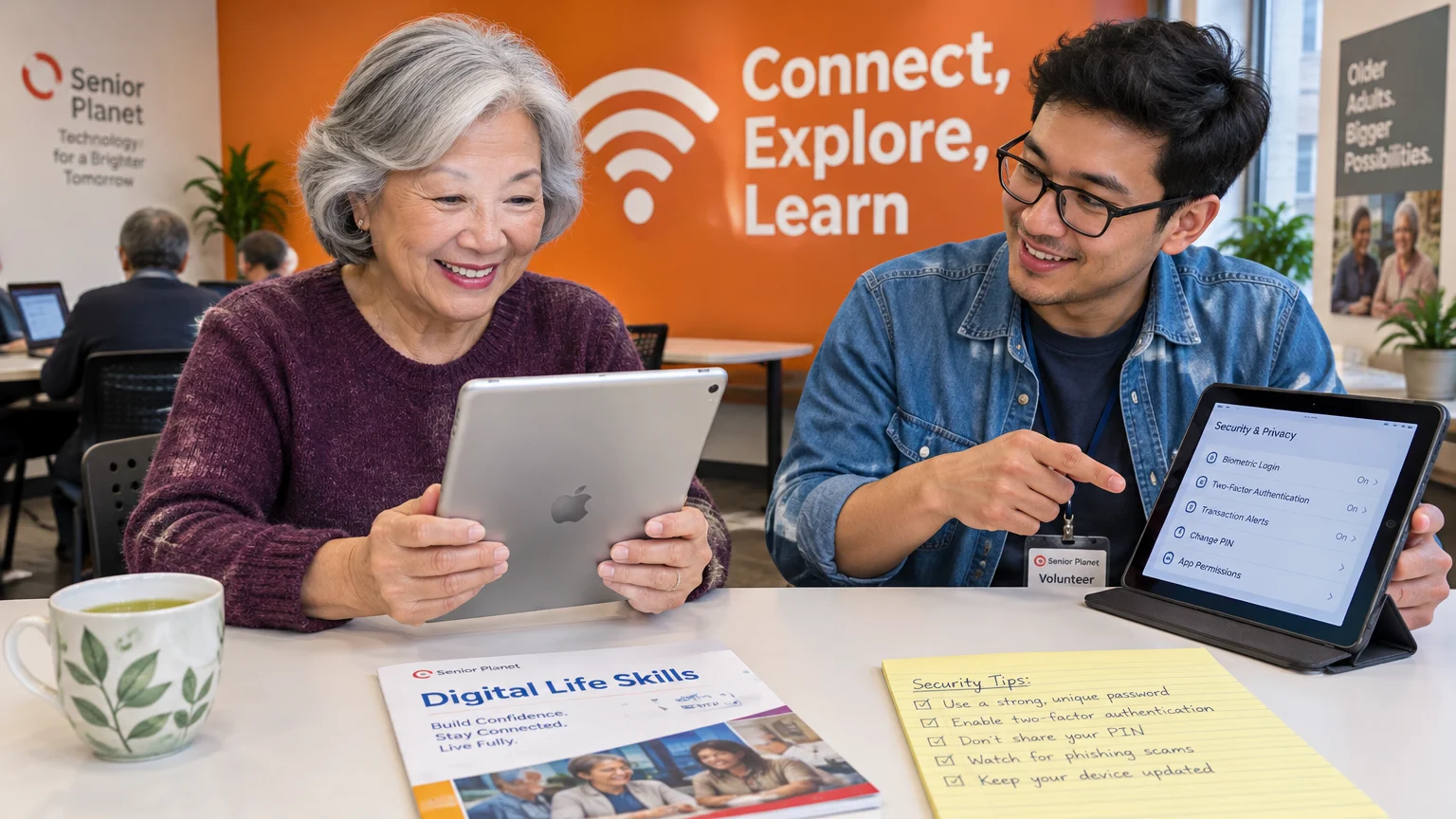
Older Adults Technology Services, run through AARP, operates the celebrated Senior Planet educational initiative. This non-profit program provides completely free classes for adults aged 60 and older, with no paid membership required.
Senior Planet operates physical flagship centers in New York City, Plattsburgh, Denver, and Miami. They also run dedicated partner hubs in San Antonio, Montgomery County, Maryland, and Santa Clara County, California.
For retirees outside these metropolitan centers, Senior Planet delivers in-person programming through a network of over 750 licensed partner sites nationwide. These sessions take place inside neighborhood public libraries, senior centers, and community buildings.
The curriculum tackles essential digital skills needed in modern retirement. Courses cover online banking security, telemedicine navigation, social media safety, voice-activated smart home tools, and artificial intelligence basics.
Classes move at a deliberate, respectful pace that encourages questions. Instructors provide physical handouts and walk through software applications together on classroom-provided devices.
Check the Senior Planet community portal to find licensed partner sites operating in your immediate area. You can drop in for standalone lectures or enroll in multi-week technology boot camps.

5. County Cooperative Extension Gardening and Ecology Clinics
If you love nature, horticulture, or conservation, your county Cooperative Extension office offers an exceptional educational resource. Extension services operate through land-grant universities across all 50 states and Puerto Rico.
These local offices host free public workshops and diagnostic plant clinics taught by Extension Master Gardener volunteers. This nationwide network includes more than 76,500 active volunteers dedicated to community education.
Workshops cover native plant landscaping, vegetable gardening, composting techniques, fruit tree pruning, and local soil ecology. The information is scientifically backed and tailored specifically to your regional climate and pests.
While earning a formal Master Gardener certification requires course fees and volunteer commitments, the regular public clinics taught by these experts remain completely free. You can attend seasonal workshops year-round.
Extension offices also offer free diagnostic services for your home garden. You can bring plant clippings or insect samples to local workshops for identification and organic treatment recommendations.
Search online for your county name alongside the phrase “Extension office” to find your local branch. Review their seasonal calendar for upcoming weekend gardening demonstrations and environmental stewardship clinics.

6. Osher Lifelong Learning Institutes (OLLI)
The Bernard Osher Foundation supports a distinguished network of Osher Lifelong Learning Institutes across the country. There are roughly 125 OLLI programs affiliated with colleges and universities in all 50 states and Washington, D.C.
These institutes cater specifically to adults aged 50 and older who love learning simply for the joy of discovery. The courses feature no homework, no grading, and no mandatory exams.
Subjects span an inspiring range of topics, including international diplomacy, classical music history, philosophy, creative writing, and film studies. Courses are taught by retired professors, active university faculty, and industry experts.
OLLI institutes generally assess modest annual membership or course fees, but substantial financial relief exists. Nearly every local OLLI chapter maintains robust scholarship funds that fully cover tuition fees for qualifying applicants.
Furthermore, many institutes completely waive fees for retirees who volunteer to assist with administration, technology, or classroom management. You can also teach a subject based on your prior career expertise to attend other courses free.
Contact your nearest university-based OLLI program coordinator to ask about their fee waiver policies. Complete their simple scholarship application to enjoy unlimited academic exploration without paying retail membership costs.
7. AARP Foundation Tax-Aide Self-Assistance Coaching
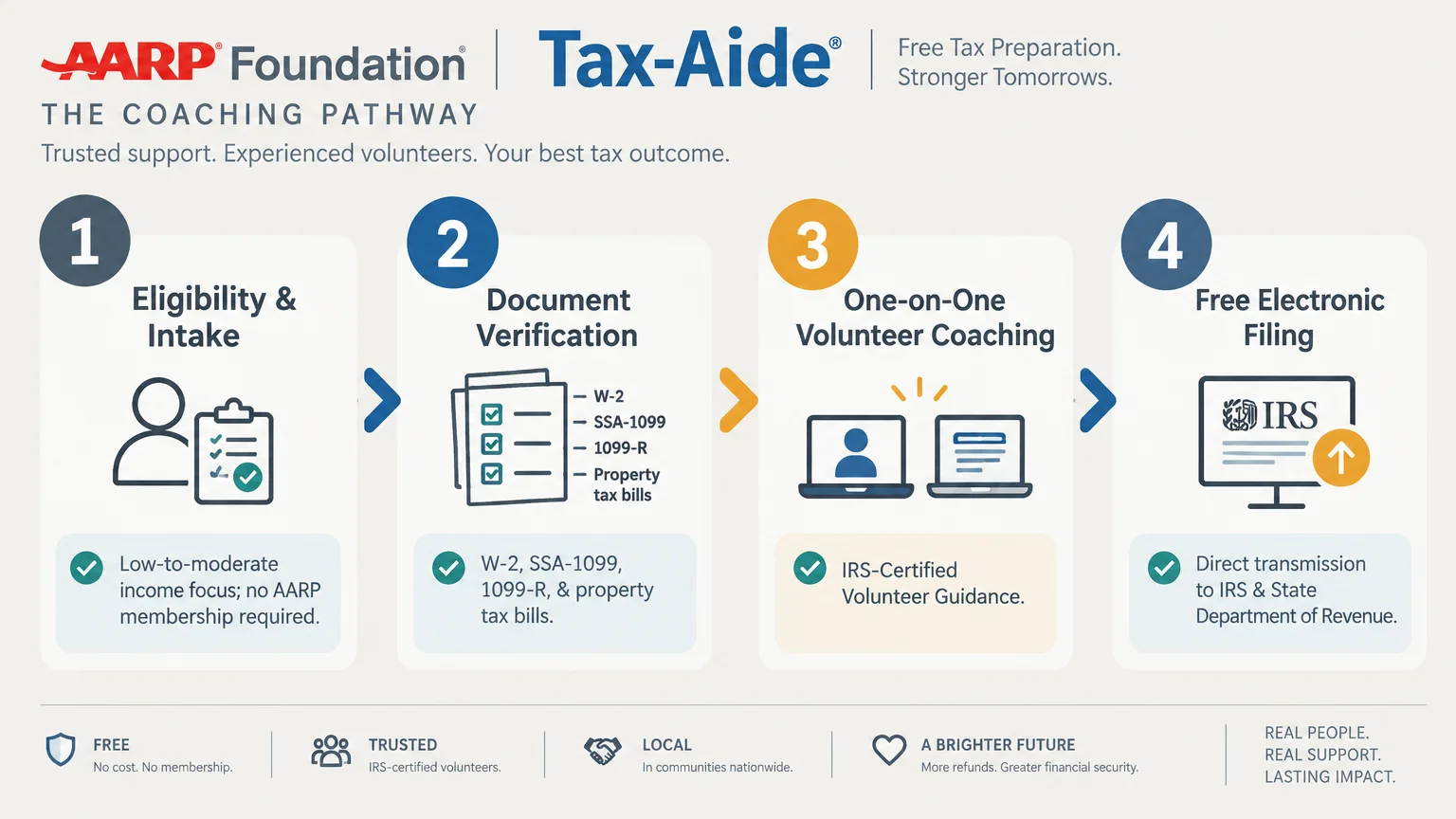
Financial literacy remains crucial throughout your retirement years, especially as tax regulations shift. The AARP Foundation Tax-Aide program provides a unique, no-cost learning opportunity for retirees looking to understand their tax filings.
Operating annually from February 1 through April 15 across all 50 states, this program focuses on adults aged 50 and older with low-to-moderate incomes. You do not need to be an AARP member to participate.
Beyond traditional tax preparation, many local sites offer Facilitated Self-Assistance workshops. In these coaching sessions, IRS-certified volunteers sit alongside you and teach you how to prepare and e-file your own return using free software.
This hands-on coaching empowers you to master retirement tax rules yourself. Volunteers help you navigate retirement account distributions, Social Security benefit taxation, and healthcare deductions.
Volunteers also walk you through the enhanced senior deduction of up to $6,000 for single filers and $12,000 for married couples aged 65 and older. They explain how this deduction phases out starting at $75,000 for single filers and $150,000 for joint filers.
Learning how these rules apply gives you confidence when planning portfolio withdrawals throughout the year. Look for Tax-Aide self-assistance locations at neighborhood community centers and libraries starting in January.

8. Community College Workforce Pell Grant Programs
Many older adults seek practical vocational training to start an encore career, launch a small consulting practice, or master a technical craft. Community colleges have introduced powerful federal funding mechanisms that make this possible.
The federal Workforce Pell Grant program launched on July 1, 2026, opening up need-based federal grant funds for short-term vocational programs. Eligible courses run between 8 and 15 weeks in duration.
Community college seniors can use these grants to cover 100% of tuition and mandatory fees for targeted career certificates. Qualifying areas include computer programming, medical billing, solar installation, and digital drafting.
Unlike student loans, federal Pell Grants never require repayment as long as you complete the coursework. This allows lower-income retirees to gain valuable technical credentials without touching retirement reserves.
Taking structured technical training provides modern skills that you can convert into flexible, part-time retirement income. It also provides structured interaction with ambitious students of all ages and backgrounds.
Schedule an appointment with the financial aid office at your local community college. Ask their advisors which short-term certificate programs qualify under the Workforce Pell Grant guidelines.
9. Area Agency on Aging and Municipal Senior Center Courses
Your local Area Agency on Aging represents one of the most reliable hubs for free, localized education. The Administration for Community Living (ACL) oversees this nationwide aging network under the federal Older Americans Act.
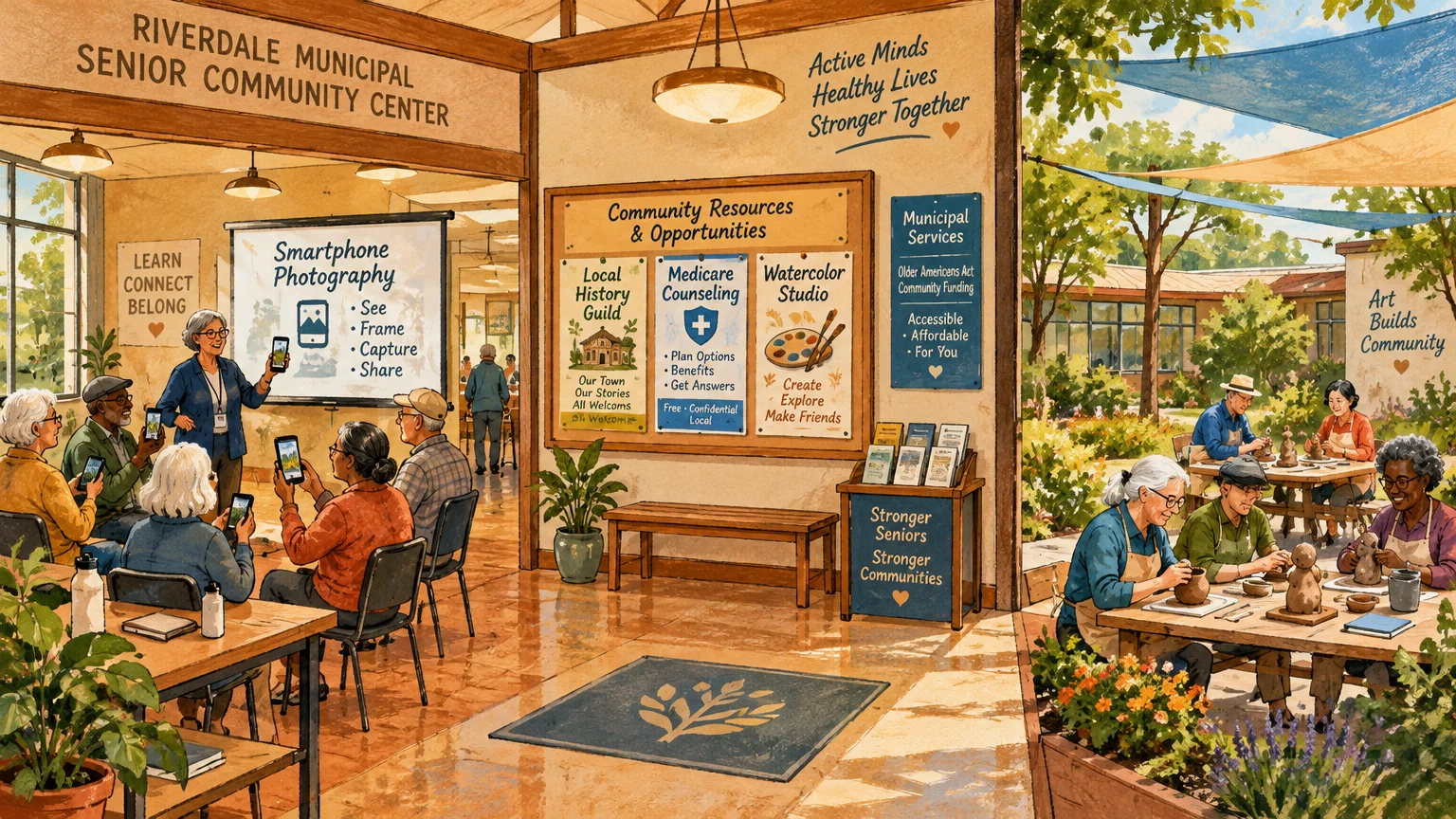
These agencies distribute funding to municipal senior centers, community recreation complexes, and local non-profit partners. They provide diverse educational workshops for residents aged 60 and older.
Class catalogs frequently feature chronic disease self-management, culinary nutrition, watercolor painting, estate planning basics, and choral music. Programs focus on holistic wellness and practical life enrichment.
Municipal senior centers also organize guest speaker series featuring local civic leaders, elder law attorneys, and healthcare clinicians. These lectures give you direct access to specialists who answer your personal questions at no cost.
In addition to educational instruction, these centers serve as safe, vibrant gathering spaces. You can enjoy free classes while building enduring friendships with neighbors from your immediate community.
Contact your county government or use the national Eldercare Locator directory to identify your local Area Agency on Aging. Request their latest community catalog to see this semester’s schedule.
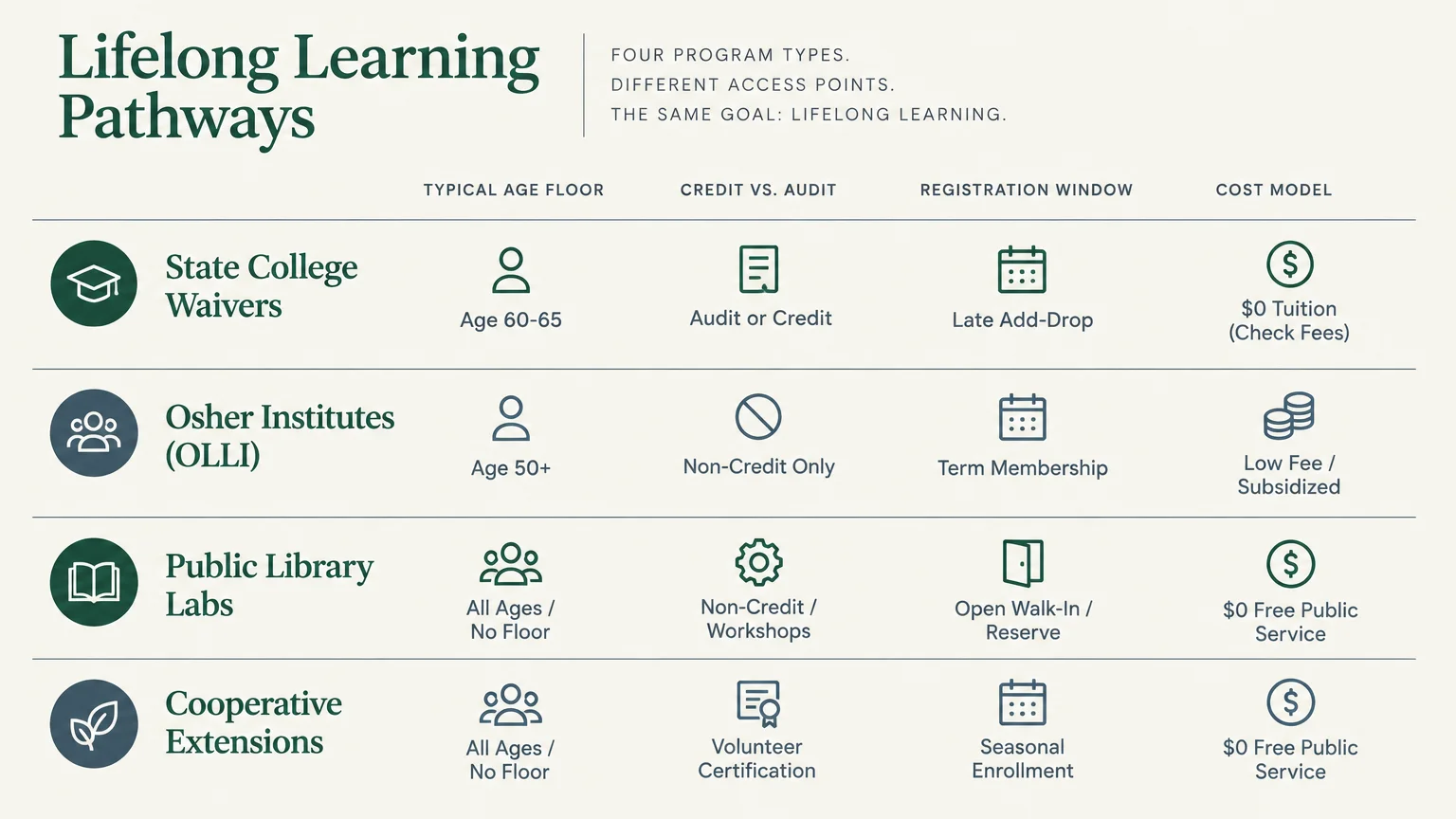
Comparing Local Free Learning Options for Retirees
Choosing the right educational program depends on your personal schedule, physical mobility, and intellectual goals. The table below compares these local resources to help you evaluate which fits best.
| Program Provider | Eligible Age | Primary Focus | Format |
|---|---|---|---|
| State Universities | 50–65+ (Varies by State) | Undergraduate Academic Courses | Classroom Auditing |
| Public Libraries | All Ages | Digital Literacy and Language | Workshops and Online Labs |
| Medicare Wellness (SilverSneakers) | 65+ (Plan Dependent) | Movement, Balance, and Fitness | Gym and Studio Classes |
| Senior Planet from AARP | 60+ | Technology, Telehealth, and AI | Community Partner Labs |
| Cooperative Extension | All Ages | Gardening, Ecology, and Soil | Public Workshops and Clinics |
| Osher Institutes (OLLI) | 50+ | Arts, Humanities, and History | Campus Seminars (Scholarship) |
| AARP Tax-Aide | 50+ (Low/Mod Income) | Self-Assisted Tax Preparation | Interactive Coaching Labs |
| Community College Workforce | Adults (Need-Based) | Vocational Certificates (8–15 Wks) | Structured Coursework |
| Municipal Senior Centers | 60+ | Creative Arts and Health Defense | Community Center Rooms |
Reviewing these factors ensures you select a program that matches your energy levels. You can easily blend academic auditing with weekly fitness sessions for a well-rounded retirement lifestyle.

How to Audit Classes Successfully as an Older Adult
Auditing university classes represents one of the greatest privileges of retirement living. However, walking onto a modern college campus requires a small amount of administrative preparation.
Always reach out to the course professor via email before the semester begins. Introduce yourself warmly, explain your background, and confirm that they welcome an auditing senior in their lecture hall.
Professors almost universally appreciate having engaged, experienced retirees in their classrooms. Your real-world perspectives can enrich classroom discussions and model professional behavior for younger students.
Be sure to ask the campus registrar about parking regulations and campus student identification cards. Many colleges issue free or heavily discounted parking permits and library borrowing privileges to registered senior auditors.
Commit to the reading syllabus just as you would if you were paying full tuition. Doing the preparatory reading ensures you derive the maximum intellectual value from every classroom lecture.
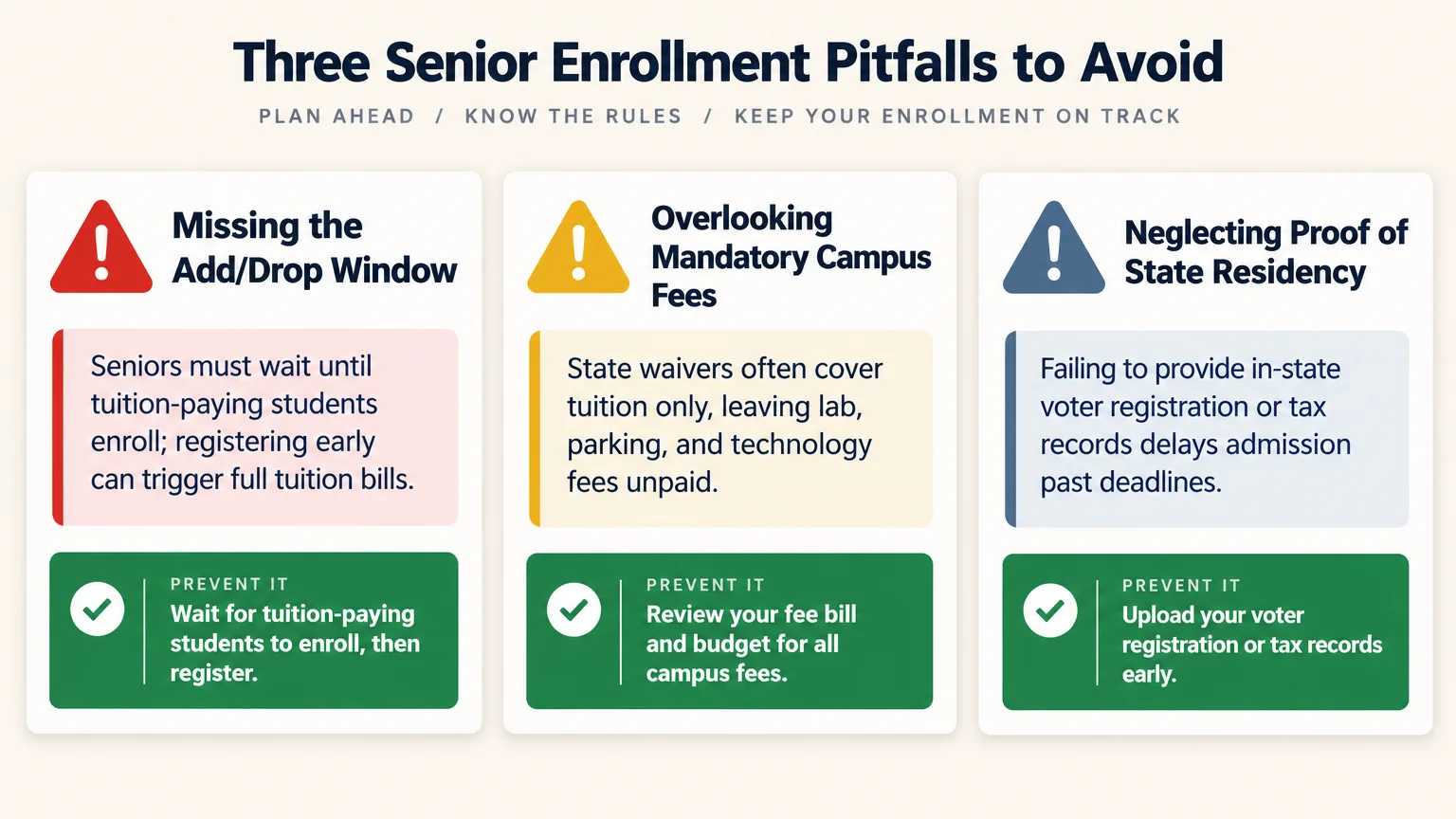
Avoiding Common Errors When Enrolling in Free Courses
Missing administrative deadlines is the most common pitfall when attempting to access state college tuition waivers. Universities enforce strict registration windows for senior auditors that open only after regular degree students finish enrolling.
If you attempt to register on the general student enrollment date, the registrar’s computer system may assess full tuition charges. Always confirm the official senior citizen add-drop date with the registrar before submitting your forms.
Another frequent oversight involves hidden administrative or laboratory fees. While state laws waive classroom tuition, universities often charge modest fees for science lab supplies, digital course software, or facility use.
Always review the course syllabus and financial breakdown carefully before finalizing your course registration. Knowing fee obligations upfront prevents unexpected billing surprises later in the semester.
Do not assume that non-credit courses lack rigor or substance. Arriving unprepared or missing consecutive sessions disrupts classroom dynamics and wastes valuable community resources intended to serve everyone.
Frequently Asked Questions
Do I have to take tests or complete homework when auditing a college course?
No, auditing students do not take tests or submit homework assignments for grades. You attend lectures, listen to classroom discussions, and read course materials purely for personal enrichment.
Can I earn a full college degree for free through senior tuition waivers?
Most state tuition waivers cover non-credit auditing seats rather than full degree pathways. However, select state systems allow credit accumulation if you meet standard undergraduate admission criteria.
What identification do I need to bring to prove eligibility for senior classes?
Bring a valid government-issued photo ID, such as a driver’s license or passport, to verify your age. You should also bring a recent utility bill to verify in-state or in-county residency.
Can I register for these free courses if I have never attended college before?
Yes, community college senior waivers and lifelong learning institutes welcome students of all educational backgrounds. Prior college attendance or degrees are not required to participate in auditing or community classes.
Next Steps for Your Lifelong Learning Journey
Lifelong learning is one of the most rewarding investments you can make in your personal health, happiness, and cognitive longevity. The resources in your local community offer world-class instruction without threatening your retirement nest egg.
Begin by selecting one topic that genuinely excites you, whether it is landscape gardening, digital photography, or European history. Contact your local library or community college today to check registration deadlines and begin your next intellectual adventure.
This article provides general retirement education and information only. Every retiree’s situation is unique—what works for others may not work for you. For personalized advice, consider consulting a qualified financial professional such as a CFP or CPA.
Last updated: October 2026. Retirement benefits, tax rules, and healthcare regulations change frequently—verify current details with official sources.









Leave a Reply