
Relocating for retirement often forces a tough compromise between neighborhood safety, local prosperity, and everyday living costs. On the West Coast, high housing prices and regional tax rules make choosing the right city even more consequential.
Recent crime and income rankings reveal 13 West Coast cities where low victimization rates meet strong local economies. Below, you will find how these communities compare—plus the tax, housing, and insurance numbers you need before moving.
Whether you prioritize walkable coastal suburbs or midsize hubs with strong healthcare access, understanding the real trade-offs helps protect your nest egg.

Why West Coast Safety and Prosperity Cluster Together
When you search for the safest west coast cities, you quickly notice a striking geographic pattern. Affluence and low street crime rarely spread evenly across California, Oregon, and Washington.
In GOBankingRates’ October 2025 analysis of the 25 safest and richest West Coast cities—which weighed U.S. Census income, Zillow home values, Bureau of Labor Statistics living costs, and FBI crime figures—just two metropolitan corridors dominated the list.
The San Francisco and San Jose Bay Area claimed 15 of the top 25 spots, while Washington’s Puget Sound region captured nine spots, including the top two rankings. Oregon placed a single city in the top 25, and no California city outside the Bay Area made that specific list.
Broader state crime data explains why retirees look closely at city-level numbers rather than statewide averages. According to SafeWise’s February 2026 report using 2024 FBI figures, the U.S. violent crime rate stands at 4.43 incidents per 1,000 residents, while property crime sits at 22.89 per 1,000.
Encouragingly, the Council on Criminal Justice reported in July 2026 that average homicides across sampled U.S. cities fell 18% year-over-year during the first half of 2026 and dropped 31% compared to 2019.
Even so, statewide perceptions and property crime rates vary sharply along the Pacific:
- California: Violent crime (4.24 per 1,000) and property crime (20.84 per 1,000) both sit slightly below national benchmarks, yet SafeWise found only 37% of Californians feel safe statewide—the fifth-lowest confidence level in the nation.
- Oregon: Violent crime remains below the U.S. average at 4.08 per 1,000, but SafeWise and SafeHome.org note that Oregon’s property crime rate still ranks third-highest nationally despite falling 27% between 2022 and 2025.
- Washington: Several Eastside Seattle suburbs post violent and property crime rates far below national norms, even as broader metropolitan affordability pushes buyers to search elsewhere.
Housing affordability directly shapes who moves in and who moves out. Redfin data from September and October 2026 shows a U.S. median home sale price of $388,634 alongside a 7.3% national average 30-year fixed mortgage rate.
By comparison, median sale prices reached $755,833 in California, $587,538 in Washington, and $504,949 in Oregon. Those costs help explain why Redfin ranked California (#1) and Washington (#4) among the top states homebuyers searched to leave in 2026, while lower-cost Sacramento ranked #5 for inbound searches.
Yet if you are selling an appreciated home elsewhere—or prioritizing low crime, strong municipal services, and high household incomes—the 13 west coast places to live profiled below stand apart.
Washington’s Safe and Affluent Puget Sound Standouts
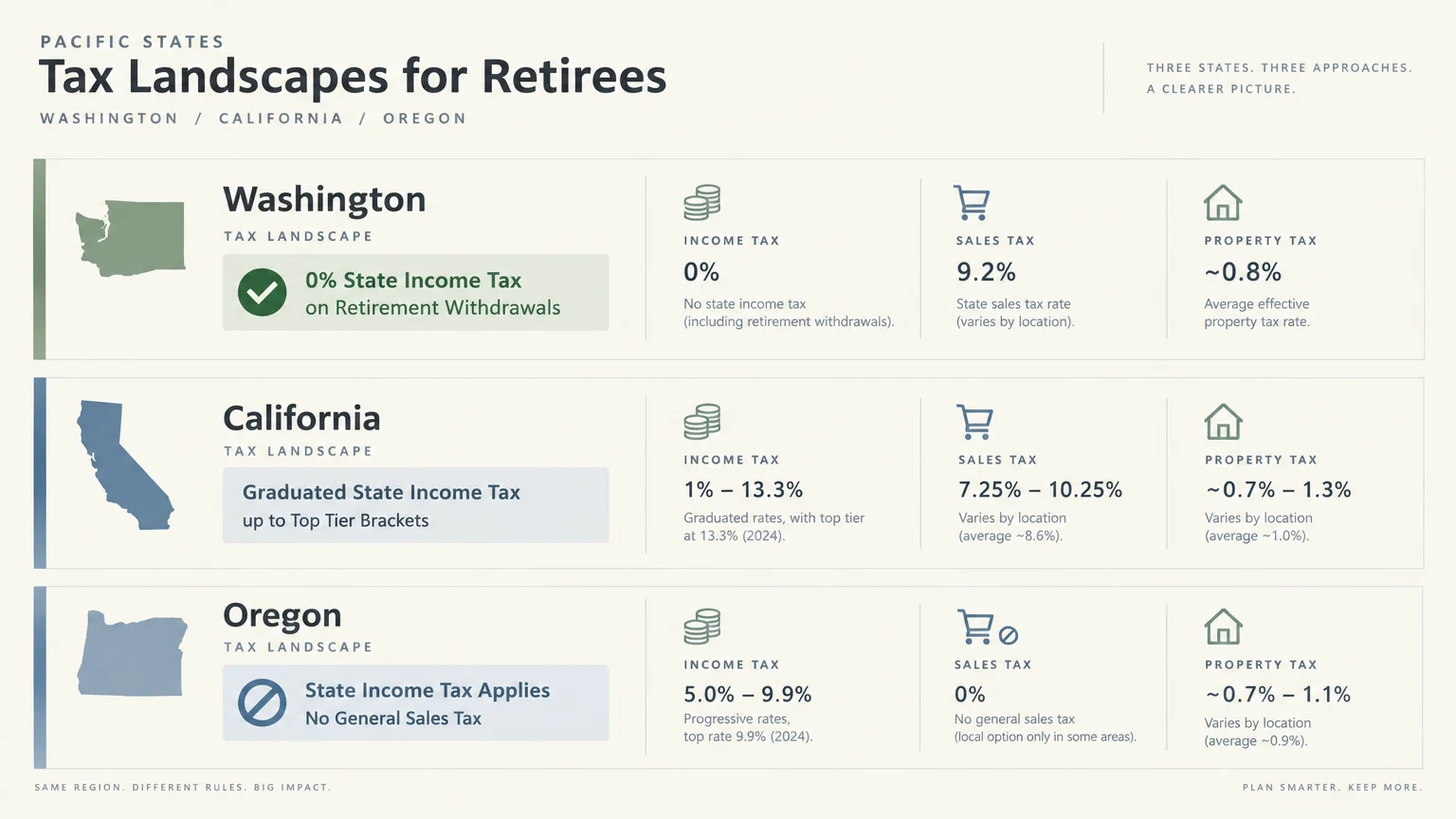
Washington offers retirees a rare combination: no state income tax on retirement withdrawals and several of the wealthiest west coast cities in the country. Four Puget Sound communities stand out for safety and economic stability.
1. Sammamish, Washington
Sammamish sits east of Lake Sammamish and holds the #1 spot on GOBankingRates’ safest and richest West Coast cities ranking. In June 2025, U.S. News & World Report also named Sammamish the nation’s #1 richest city, with median household income exceeding $230,000.
SafeWise 2026 data shows Sammamish records roughly 567 total crimes per 100,000 residents—79% below the national average. Your statistical chance of violent victimization there is about 1 in 4,070, compared to 1 in 245 nationwide.
2. Snoqualmie, Washington
Just southeast of Sammamish near the Cascade foothills, Snoqualmie claims the #2 ranking among GOBankingRates’ safest and richest West Coast cities. You get newer planned neighborhoods, mountain views, and quick access to Eastside medical centers without urban congestion.
3. Bellevue, Washington
If you want full-scale city amenities rather than a quiet bedroom community, Bellevue offers the largest footprint in GOBankingRates’ top 25 (#24 overall), with more than 150,000 residents. Average household income reaches $224,401, supporting polished parks, transit, and major regional healthcare.
That scale brings higher living costs and more property crime than smaller suburbs. Bellevue’s average home value sits at $1,782,685 with a $150,439 annual cost of living, while crime runs 1.507 violent and 34.373 property incidents per 1,000 residents.
4. Auburn, Washington
For retirees seeking one of the best midsize cities in the Puget Sound region without Eastside luxury prices, Auburn merits a close look. SmartAsset’s 2026 Safest Midsize Cities study (covering populations from 65,000 to 250,000) places Auburn among the lowest violent crime rates in the country.
However, SmartAsset notes that high FEMA natural disaster risk ratings pull Auburn’s composite safety score below inland peers. Fifteen of SmartAsset’s top 20 safest midsize cities sit in noncoastal states for that exact reason.

Northern and Southern California Cities Balancing Safety and Wealth
California requires careful financial planning due to high state income taxes and steep home values. Still, eight California cities deliver exceptional public safety, thriving local economies, and deep community infrastructure.
5. San Ramon, California
Located in Contra Costa County’s San Ramon Valley, San Ramon bridges suburban calm and midsize convenience. It ranked #6 on the West Coast in October 2025 and #9 nationally in GOBankingRates’ September 2026 ranking of the 50 safest and richest midsize cities.
With a population of 85,993, San Ramon posts an average household income of $239,072, an average home value of $1,543,534, and an AreaVibes livability score of 87. Crime remains remarkably low at 0.86 violent and 11.13 property crimes per 1,000 residents.
U.S. News & World Report also ranked San Ramon #2 among the nation’s richest cities—right behind Sammamish—with median household income above $230,000. SmartAsset similarly highlights San Ramon as having one of the lowest violent crime rates among U.S. midsize cities.
6. Mill Valley, California
Nestled at the base of Mount Tamalpais in Marin County, Mill Valley ranked #3 among GOBankingRates’ safest and richest West Coast cities. You gain immediate access to coastal trails, cultural venues, and San Francisco hospitals just across the Golden Gate Bridge.
7. Lafayette, California
Lafayette (#4 on GOBankingRates’ West Coast list) sits in the East Bay hills with a walkable downtown, BART rail access, and mature oak-lined neighborhoods. Its strong residential tax base funds attentive local policing and well-kept public spaces.
8. Ross, California
Tiny, affluent Ross in Marin County rounds out the top five (#5 overall). Retirees drawn to Ross value quiet residential streets, low density, and proximity to Marin’s broader medical and recreational network.
9. Cupertino, California
Ranking #8 on the West Coast list, Cupertino anchors the western edge of Silicon Valley with steady municipal revenue and highly maintained neighborhoods. You also live minutes from major South Bay specialty clinics and international airports.
10. Saratoga, California
If property security tops your priority list, Saratoga (#13 on GOBankingRates’ West Coast list) recorded the lowest property crime rate in the entire top 25. That peace of mind carries an ultra-luxury price tag, as average single-family homes exceed $4 million.
11. Morgan Hill, California
At the southern tip of Santa Clara County, Morgan Hill (#25 on GOBankingRates’ list) offers a slightly less dense alternative to core Silicon Valley towns. Average household income reaches $199,024 alongside an average home value of $1,408,718.
Safety figures remain solid for a growing South Bay community. Morgan Hill records 2.482 violent crimes and 10.980 property crimes per 1,000 residents.
12. Irvine, California
Although no Southern California city appeared in GOBankingRates’ Bay Area-heavy top 25, Irvine stands out among large U.S. cities over 300,000 residents. MoneyGeek’s July 2026 study found Irvine has the lowest estimated annual cost of crime among big cities at $447 per resident.
Master-planned neighborhoods, wide parks, and strong municipal services drive that low crime cost. Even so, FEMA earthquake and wildfire risk ratings kept Irvine at #12 in SmartAsset’s 2026 safest big cities ranking.
Oregon’s Safest Prosperous Suburbs
Oregon appeals to many retirees moving to the west coast because it levies zero state sales tax and features lower median home prices ($504,949 statewide) than California or Washington. Just south of Portland, one affluent suburban pocket consistently leads the state in safety.
13. Lake Oswego, Oregon
Lake Oswego ranked #7 on GOBankingRates’ safest and richest West Coast cities list—making it the sole Oregon city in the top 25. SafeWise also places Lake Oswego among Oregon’s top 10 safest cities for 2026.
Built around Oswego Lake with a lively town center, Lake Oswego pairs tree-lined neighborhoods with quick highway access to Portland’s major hospitals. Its standing is especially notable in a state where property crime remains high overall.
Neighboring West Linn—which claimed the #1 spot on SafeWise’s 2026 list of safest Oregon cities—shares that same south-metro corridor. Together, these communities give you a lower-crime foothold while keeping Portland’s arts, dining, and airport within an easy drive.
Comparing the Top Cities and State Benchmarks
Before visiting neighborhoods in person, compare the hard numbers side by side. The first table below highlights verified city-level income, housing, and crime benchmarks reported across 2025 and 2026 datasets.
| City | Notable 2025–2026 Safety & Wealth Benchmark | Income / Cost Indicator | Reported Crime Metric |
|---|---|---|---|
| Sammamish, WA | #1 West Coast safest & richest; #1 richest U.S. city | Median household income >$230,000 | ~567 total crimes per 100,000 (79% below U.S. avg) |
| San Ramon, CA | #6 West Coast; #9 U.S. midsize; #2 richest U.S. city | $239,072 avg income; $1,543,534 avg home | 0.86 violent / 11.13 property per 1,000 |
| Lake Oswego, OR | #7 West Coast; SafeWise top 10 safest OR cities | Only OR city in West Coast top 25 | Top 10 lowest crime in Oregon (2026) |
| Saratoga, CA | #13 West Coast safest & richest | Avg single-family home >$4 million | Lowest property crime rate in West Coast top 25 |
| Bellevue, WA | #24 West Coast (largest city >150,000 pop.) | $224,401 avg income; $1,782,685 avg home | 1.507 violent / 34.373 property per 1,000 |
| Morgan Hill, CA | #25 West Coast safest & richest | $199,024 avg income; $1,408,718 avg home | 2.482 violent / 10.980 property per 1,000 |
| Irvine, CA | Lowest large-city crime cost; #12 SmartAsset big city | Major Orange County hub (>300,000 pop.) | $447 annual cost of crime per resident |
City-level quality only tells half the story; state borders dramatically alter your tax bill and carrying costs. Use the statewide comparison below to weigh California, Oregon, and Washington against your retirement income mix.
| State | Retiree Tax Rating | Social Security & Retirement Withdrawals | State Estate Tax Threshold (2026) | Median Home Price (Sept.–Oct. 2026) |
|---|---|---|---|---|
| California | Not Tax Friendly | Social Security exempt; pensions, IRA/401(k) & gains taxed up to 13.3% | None | $755,833 |
| Oregon | Moderately Tax Friendly | Social Security exempt; IRA/401(k) & gains taxed up to 9.9% (no sales tax) | $1,000,000 (10%–16% rates) | $504,949 |
| Washington | Tax Friendly | No income tax on wages, Social Security, pensions, or IRA withdrawals | $3,076,000 | $587,538 |
How State Taxes Affect Your Retirement Income Out West
One bright spot unites all three Pacific states: California, Oregon, and Washington all exempt Social Security benefits from state income tax. Nationally, only eight states still tax Social Security benefits in 2026.
Remember, however, that federal taxes still apply to your benefits. Up to 85% of your Social Security check can face federal income tax under combined-income thresholds created in 1983 and 1993 that remain unindexed for inflation.
You can review benefit estimates and combined-income rules directly through the Social Security Administration and the Internal Revenue Service before finalizing a move. Beyond Social Security, the three states treat retirement savings very differently.
SmartAsset rates Washington as tax-friendly for retirees, Oregon as moderately tax-friendly, and California as not tax-friendly. Your portfolio structure determines how much those ratings matter to your annual budget.
In Washington, you pay zero state income tax on wages, pensions, or 401(k) and IRA distributions. Starting in 2026, Washington does apply a two-tier tax on certain non-retirement, non-real-estate long-term capital gains: 7% on taxable gains from $278,000 to $1 million, and 9.9% above $1 million.
Washington also updated senior and disabled property tax exemption and deferral income thresholds for 2027 through 2029 under ESSB 6162. Those adjustments can help long-term homeowners manage rising county assessments.
Oregon offsets its zero state sales tax with a steep 9.9% top marginal income tax rate that hits pensions, IRA withdrawals, and capital gains. Fidelity estimates that a married couple withdrawing $100,000 from an IRA in Oregon pays a 5.39% effective state income tax rate.
California carries the highest top marginal income tax rate in the nation at 13.3%, taxing pensions, retirement account withdrawals, and capital gains as ordinary income. California levies no state estate or inheritance tax, and voters weighed Proposition 42 in November 2026 regarding prohibiting new taxes on retirement holdings and personal savings.
Pitfalls to Watch For
Moving West for low crime and vibrant communities can still backfire if you overlook regional financial hazards. Watch closely for these six common traps before signing a purchase contract:
- Underestimating homeowners insurance shocks: While NerdWallet reports the 2026 U.S. average homeowners premium at $2,490 per year ($208 monthly) for $400,000 in dwelling coverage, SoFi’s 2026 survey found 62% of Western homeowners say premiums rival their mortgage payment—compared to 44% nationally and 34% in the Midwest.
- Ignoring regional rate hikes and carrier pullbacks: Insurify projects California will post the largest homeowners insurance increase in the U.S. in 2026 at +16% (+$388 on average), Washington rates jumped 55% between 2020 and 2025, and insurers have curtailed wildfire coverage across California and Oregon.
- Confusing low street crime with total safety: Cities like San Ramon, Auburn, and Irvine post minimal violent crime, yet FEMA earthquake and wildfire ratings pull down their overall hazard scores—meaning you must budget for seismic retrofits, defensible space, and specialty deductibles.
- Walking blindly into Oregon or Washington estate taxes: Compared to the $15 million federal estate tax exclusion in 2026, Oregon taxes estates starting at just $1,000,000 (10% to 16% rates) and Washington taxes estates above $3,076,000; both states also use apportionment formulas that can expose nonresidents who simply own in-state real property.
- Financing high coastal prices at elevated mortgage rates: With 30-year fixed mortgage rates tracking near 7.3% and Bay Area or Bellevue homes routinely topping $1.4 million, borrowing heavily can drain retirement cash flow faster than expected.
- Overlooking county-level Medicare changes: Moving across state lines triggers a Special Enrollment Period and alters Medicare Advantage networks and Part D plan pricing, so check local coverage options on Medicare.gov well before closing day.

Getting Expert Help
High-value real estate, multi-state tax rules, and wildfire insurance constraints make West Coast relocations uniquely complex. Working with qualified specialists in four targeted scenarios often saves far more than their fees.
First, consult a fiduciary planner or CPA before selling your current home if you plan to move to California or Oregon. Converting traditional IRAs to Roth accounts or harvesting taxable investment gains while you still reside in a zero- or low-tax state can shield future income from 9.9% or 13.3% brackets.
Second, work with an estate attorney licensed in your destination state if your net worth approaches $1 million in Oregon or $3.076 million in Washington. Proactive gifting, trust design, or titling strategies—especially for married couples—can prevent avoidable state estate tax bills.
Third, engage an independent West Coast insurance broker during your home inspection contingency, not after closing. A local broker can verify whether private carriers still write standard policies on a specific street in Mill Valley, Lake Oswego, or Morgan Hill—and quote earthquake or state FAIR Plan gaps early.
Fourth, coordinate your Social Security claiming timeline and healthcare transition with a retirement specialist before changing your legal domicile. You can locate vetted, credentialed planners through the Certified Financial Planner Board.
Frequently Asked Questions About Safe West Coast Retirement Cities
Which West Coast city ranks as both the safest and most prosperous?
Sammamish, Washington holds the #1 spot on GOBankingRates’ list of the 25 safest and richest West Coast cities and ranks #1 among the nation’s richest cities, with median household income above $230,000. Its total crime rate runs roughly 79% below the U.S. average.
Are midsize West Coast cities safe for retirees?
Yes, several stand out for low street crime. San Ramon, California (population 85,993) ranked #9 nationally among safe, wealthy midsize cities with just 0.86 violent crimes per 1,000 residents, while Auburn, Washington posts among the lowest U.S. violent crime rates in its size tier—though FEMA disaster ratings factor into both cities’ overall safety scores.
Do California, Oregon, or Washington tax Social Security benefits?
No. None of the three Pacific states tax Social Security benefits at the state level, though up to 85% of your benefits may still be subject to federal income tax depending on your combined income.
Why do housing and insurance costs carry extra weight when moving West?
Median home prices in California ($755,833), Washington ($587,538), and Oregon ($504,949) far exceed the $388,634 U.S. median, while wildfire risk has driven steep insurance increases. In 2026, 62% of Western homeowners reported that insurance costs rival their mortgage payment.
Practical Next Steps Before You Pack
Start by shortlisting two or three cities from different tax environments—such as Sammamish or Bellevue in Washington alongside Lake Oswego in Oregon or San Ramon in California. Renting locally for several months lets you test microclimates, traffic, and medical access before committing capital.
Before making an offer, request binding homeowners and wildfire insurance quotes on the exact parcel and run a five-year after-tax cash flow projection. Testing those numbers upfront ensures your move West delivers both daily peace of mind and lasting financial security.
This is educational content based on general retirement and financial principles. Individual results vary based on your situation.
Always verify current benefit rules, tax laws, and eligibility requirements with official sources like SSA, Medicare.gov, or the IRS.
Last updated: November 2026. Retirement benefits, tax rules, and healthcare regulations change frequently—verify current details with official sources.