

Retirees often surrender thousands of dollars each year simply by leaving their healthcare on autopilot. The annual medicare open enrollment 2026 window gives you the power to evaluate coverage before costs quietly climb next year.
Insurance networks shift, formularies evolve, and out-of-pocket rules change significantly every January. Sticking with your current policy without checking can trigger surprise medical bills and restrict your doctor choices.
A disciplined review medicare plan session takes less than an hour; it ensures your doctors, prescriptions, and retirement budget remain secure for 2027.
Critical Deadlines and What They Mean for Your Coverage
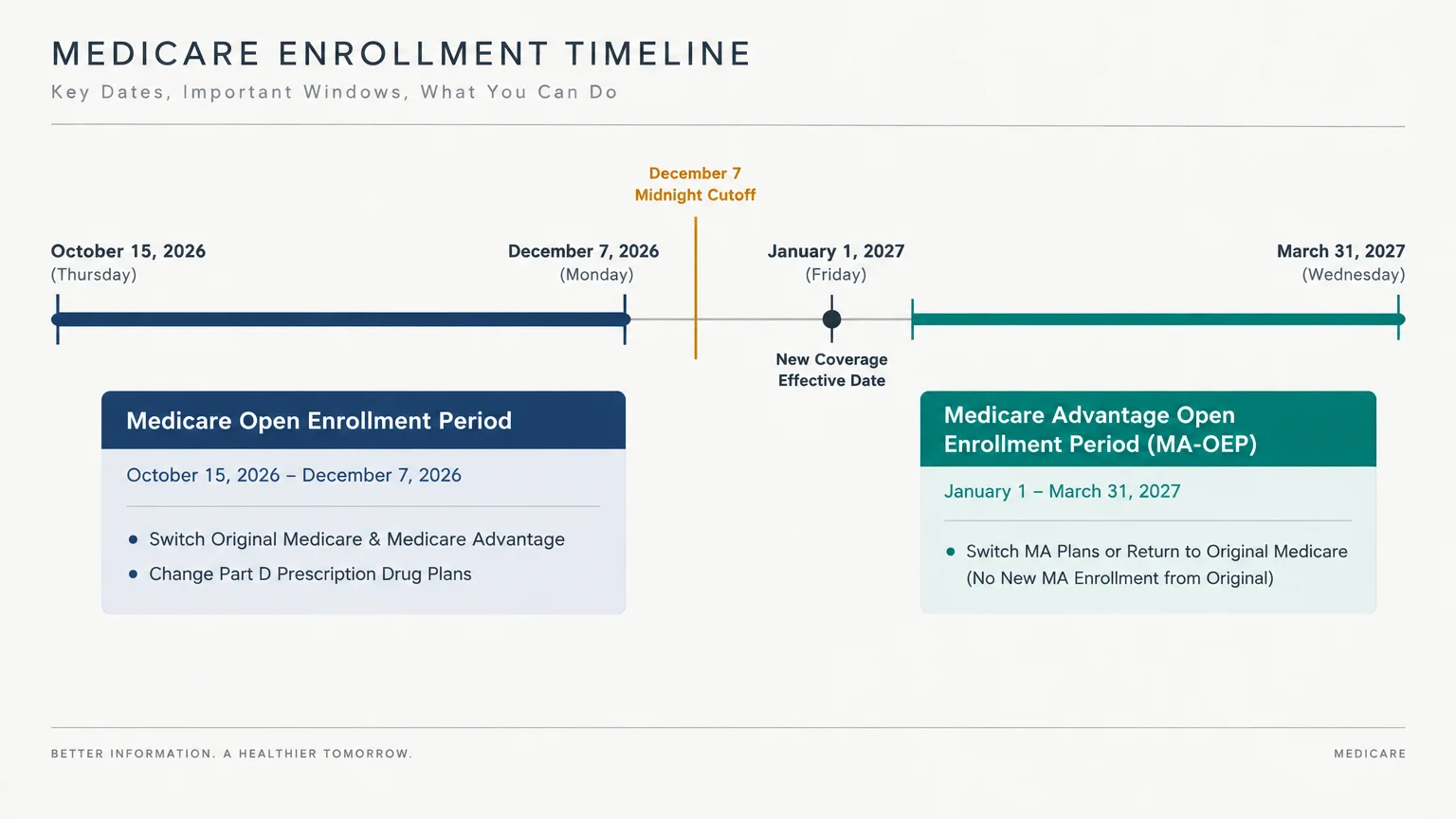
The annual Open Enrollment Period runs from October 15 through December 7, 2026. This seven-week window is your primary opportunity to reshape your Medicare setup.
During this period, you can switch between Original Medicare and Medicare Advantage. You can also change your standalone Part D prescription drug plan or choose a different Medicare Advantage carrier.
Any coverage adjustment you make during this window takes effect on January 1, 2027. Your request must reach your chosen insurer by midnight on December 7.
If you miss this cutoff, your current plan automatically rolls over into the new calendar year. That automatic renewal locks in any premium hikes, benefit reductions, or provider network removals.
Beneficiaries enrolled in Medicare Advantage receive an additional safety valve early next year. The Medicare Advantage Open Enrollment Period runs from January 1 through March 31, 2027.
This early-year window lets you switch to a competing Medicare Advantage plan or return to Original Medicare. It does not, however, permit someone enrolled in Original Medicare to join a Medicare Advantage plan.
Decoding Your Medicare Annual Notice of Change (ANOC)
Federal regulations require Medicare Advantage and Part D plan sponsors to mail your medicare annual notice of change by September 30. This document contains the exact road map for your upcoming plan adjustments.
Many beneficiaries mistake this thick booklet for junk mail and discard it. Overlooking this document is a costly error because insurers modify plan details every single year.
Start your review by examining the monthly premium and medical deductibles. Plans frequently alter these figures to offset broader healthcare inflation.
Next, scrutinize the provider network section to confirm your physicians and facilities remain in-network. Insurers routinely renegotiate contracts, meaning your trusted specialists might vanish from the directory on January 1.
Pay close attention to changes in prior authorization rules. Medicare Advantage plans continue to tighten restrictions on diagnostics, surgical procedures, and inpatient rehabilitation stays.
Finally, review the pharmacy network and medication formulary carefully. A drug you rely on today could easily shift to a higher pricing tier or disappear from coverage entirely.
Note that Medigap supplemental plans do not issue an ANOC document. Because Medigap benefits are standardized under federal law, their core coverage benefits remain uniform from year to year.
Major Prescription Drug Coverage Changes Arriving in 2027
Prescription drug coverage under Medicare Part D undergoes structural adjustments for 2027. Staying informed about these shifting thresholds ensures you avoid unexpected retail pharmacy bills.
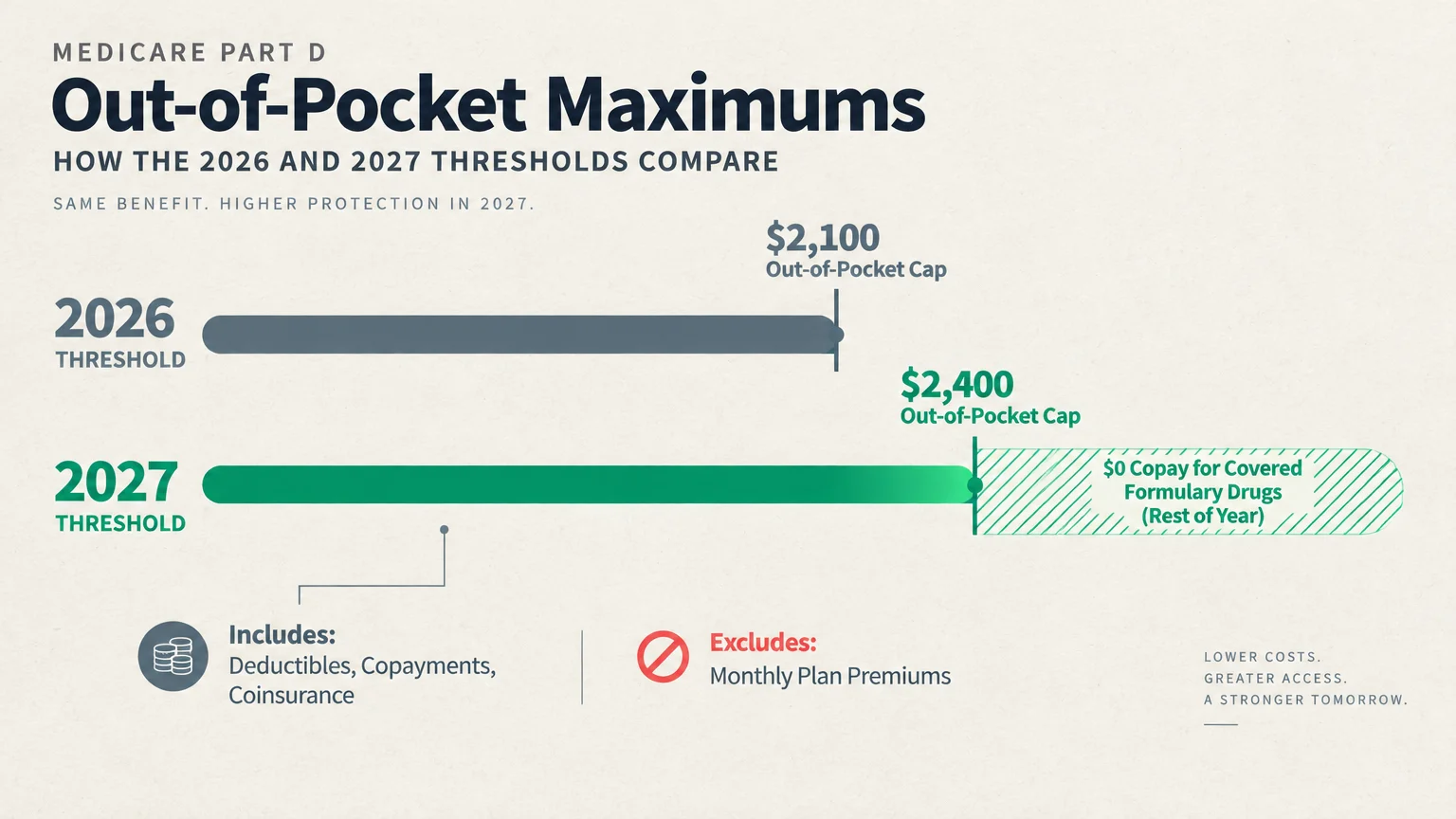
The annual out-of-pocket spending cap on covered Part D medications rises to $2,400 in 2027, up from $2,100 in 2026. Once you reach that threshold, you pay $0 for covered formulary drugs for the rest of the year.
Monthly plan premiums do not count toward this $2,400 spending cap. Only direct payments toward deductibles, copayments, and coinsurance apply to your total.
Meanwhile, the statutory maximum annual Part D deductible climbs to $700 in 2027, compared to $615 in 2026. Plans can set their deductibles lower, but many adjust upward toward this federal limit.
Standalone Part D plan premiums face intense upward rate pressure heading into 2027. The temporary federal Part D Premium Stabilization Demonstration program expires at the end of 2026.
Without those federal subsidies buffering carrier costs, standalone drug premiums are rising across many regional markets. That expiration makes an active medicare plan comparison vital before the December deadline.
Several landmark consumer protections remain firmly established for 2027. Insulin copayments remain capped at $35 per month per covered prescription, and recommended adult vaccines cost $0 at in-network pharmacies.
The dreaded coverage gap, traditionally known as the donut hole, remains eliminated. Beneficiaries also have access to the Medicare Prescription Payment Plan, which spreads pharmacy out-of-pocket expenses into predictable monthly installments.
Federal drug price negotiations continue to expand access to life-saving medications. Starting January 1, 2027, newly negotiated rates take effect for expensive brand-name therapies, including oral oncology drugs Xtandi, Pomalyst, and Ibrance.
Additionally, Medicare introduces the GLP-1 Bridge program for qualifying Part D enrollees in 2027. This initiative offers designated medications for weight loss and cardiovascular improvement at a flat $50 monthly copayment.
Note that this $50 GLP-1 Bridge copayment does not count toward your $2,400 annual out-of-pocket drug maximum. Factor that specific exclusion into your overall annual healthcare budget.
“A healthcare crisis can derail even the best retirement plan. Taking time to review your insurance every single year is non-negotiable.” — Suze Orman, Personal Finance Author & Advisor
Medicare Advantage vs. Original Medicare: Evaluating Network and Benefit Shifts
Every autumn requires weighing the structural strengths of Original Medicare against private Medicare Advantage plans. Neither option represents a universal solution; your health status and travel habits dictate the correct choice.
Original Medicare pairs Part A hospital insurance and Part B medical insurance with standard private Medigap supplements and standalone Part D drug plans. This setup offers unrestricted access to any physician nationwide who accepts Medicare.
In contrast, Medicare Advantage bundles hospital, medical, and usually prescription coverage into a managed private plan. These policies often add dental, vision, and fitness benefits to attract prospective members.
Part B costs adjust heading into the new calendar year. The standard monthly Part B premium sits at $202.90 in 2026, with Medicare Trustees projecting an increase to $209.50 in 2027.
The annual Part B deductible also rises from $283 in 2026 to a projected $292 in 2027. Official updates from the Centers for Medicare & Medicaid Services confirm final amounts late each autumn.
Medicare Advantage plans frequently advertise $0 monthly plan premiums to attract retirees. However, these plans limit your care to regional provider networks and enforce stringent prior authorization rules.
If you spend extended periods traveling across states, managed care networks can generate unexpected out-of-network liabilities. A sudden illness away from home may leave you responsible for hefty out-of-pocket costs.
| Coverage Dimension | Original Medicare with Medigap | Medicare Advantage (Part C) |
|---|---|---|
| Provider Access | Any doctor or hospital nationwide accepting Medicare | Restricted regional HMO or PPO networks |
| Referrals & Prior Authorizations | No specialist referrals; prior authorizations are extremely rare | Frequent prior authorizations; referrals often needed for HMOs |
| Prescription Drug Handling | Requires separate standalone Part D plan | Usually bundled directly inside the plan |
| Out-of-Pocket Protections | Predictable; comprehensive Medigap plans eliminate most cost-sharing | Variable out-of-pocket limits up to statutory maximums |
| Supplemental Perks | Basic Medicare benefits only; no dental, vision, or gym perks | Often includes basic vision, dental, hearing, or fitness allowances |
Examine the stability of your regional Medicare Advantage network before committing. When prominent hospital systems terminate insurer contracts, thousands of patients lose continuity of care overnight.
If your health needs increase, switching back from Medicare Advantage to Medigap is not guaranteed. In most states, private Medigap insurers require medical underwriting once you leave your initial enrollment window.
A preexisting condition like heart disease, diabetes, or cancer could lead to application denials or inflated Medigap rates. Evaluate long-term health risks carefully before abandoning supplemental coverage.

Step-by-Step Medicare Plan Comparison Using Medicare Plan Finder
Navigating plan options feels overwhelming without a structured comparison method. The federal government provides digital tools that organize complex pricing and formulary data into clear choices.
Access the official Plan Finder portal located on Medicare.gov to start your review. Creating or logging into your personal account saves time by automatically importing your current prescription history.
Accurate drug details determine your true healthcare expenses for the upcoming year. Follow these progressive steps to conduct an airtight comparison:
- Enter your exact medications, including precise dosages, tablet strengths, and dispensing frequencies.
- Input your preferred local pharmacies and add mail-order options to assess retail pricing disparities.
- Filter available policies by total annual cost—combining premiums, deductibles, and drug copays—rather than premium alone.
- Examine the plan star ratings to assess customer satisfaction, claims processing accuracy, and customer service quality.
- Verify that your high-cost maintenance medications do not carry step therapy mandates or quantity restrictions.
Plan Finder categorizes local pharmacies as either preferred, standard, or out-of-network. Filling prescriptions at a standard retail location rather than a preferred pharmacy can triple your copayments.
Review the comprehensive year-end cost projection displayed at the bottom of each plan summary. This projection models your entire annual financial liability based on your real-world drug routine.
Keep a physical or digital record of the confirmation code generated whenever you change medicare plan arrangements online. That unique code serves as permanent proof of timely enrollment if administrative disputes arise.
“Financial wellness in retirement isn’t just about what you save; it’s about what you protect against unexpected medical costs.” — Jean Chatzky, Financial Journalist
Avoiding Common Errors During Open Enrollment
Beneficiaries routinely make preventable missteps during the fall enrollment window. Recognizing these traps protects your personal savings and ensures uninterrupted medical treatment.
The most pervasive error is shopping based strictly on the monthly premium. A policy carrying a $0 monthly premium often hides a $700 drug deductible and costly specialist copayments.
Always calculate your worst-case financial exposure by factoring in maximum out-of-pocket caps and annual deductibles. The cheapest monthly premium frequently proves to be the most expensive plan over twelve months.
Another widespread mistake involves assuming your preferred physicians will remain in-network. Provider directories change continuously throughout the year as contractual negotiations stall between health systems and carriers.
Never rely on verbal assurances from office receptionists regarding network participation. Contact your insurance carrier directly, or check the carrier’s digital provider directory, citing your doctor’s National Provider Identifier (NPI).
Overlooking changes to drug formularies creates immediate hardship at the pharmacy counter in January. Insurers frequently reclassify brand-name drugs from Tier 3 to Tier 4, dramatically hiking your coinsurance liability.
Retirees also confuse Medicare Advantage open enrollment rules with Medigap protections. Dropping a Medigap policy to experiment with Medicare Advantage can permanently lock you out of comprehensive supplemental coverage.
Finally, waiting until the final days of the enrollment window creates unnecessary stress. Website traffic spikes, phone wait times expand, and missing paperwork can derail your coverage before the December 7 deadline.

When DIY Isn’t Enough: Getting Objective Enrollment Help
Comparing healthcare options online works well for straightforward situations, but complex medical profiles require professional analysis. Certain circumstances warrant stepping away from self-service tools to seek seasoned counsel.
Consider engaging professional or institutional assistance if you encounter any of these scenarios:
- Managing Multiple Chronic Conditions: Coordinating multiple specialists, infusion therapies, and complex maintenance medications requires meticulous network and formulary cross-referencing.
- Qualifying for Low-Income Subsidies: If your monthly income is limited, programs like Extra Help or Medicare Savings Programs significantly reduce premiums and prescription copayments.
- Transitioning Back to Original Medicare: Leaving a Medicare Advantage plan after several years requires exploring whether your health history satisfies Medigap medical underwriting standards in your state.
- Relocating to a New Geographic Area: Moving across state or county lines alters your service area, triggering a Special Enrollment Period that operates outside standard fall deadlines.
Avoid accepting recommendations from aggressive insurance brokers selling products from only one carrier. Captive sales agents have an incentive to push specific policies that may not match your medical requirements.
Turn instead to your local State Health Insurance Assistance Program (SHIP) for unbiased support. SHIP counselors receive federal funding through the Administration for Community Living to deliver free, personalized guidance.
These trained volunteers do not sell insurance or earn commissions on plan enrollments. They provide neutral evaluations tailored to your medications, financial resources, and local medical providers.
Additional resources, including counseling on low-income assistance, are accessible through the National Council on Aging. Their benefits enrollment centers assist retirees with finding state and federal support programs.
Frequently Asked Questions About Changing Medicare Plans
Can I change my Medicare plan after December 7 if I discover a mistake?
If you are enrolled in Medicare Advantage, you can make one coverage adjustment between January 1 and March 31 during the Medicare Advantage Open Enrollment Period. Beneficiaries on Original Medicare with standalone Part D plans cannot switch outside fall enrollment without qualifying for a Special Enrollment Period.
Will switching Medicare Advantage plans cause me to lose my Medigap policy?
You cannot use a Medigap policy while enrolled in Medicare Advantage. If you dropped Medigap in the past, returning to it typically requires passing medical underwriting, unless you qualify for a federal trial-right protection period.
What happens if my doctor leaves my Medicare Advantage network mid-year?
If your doctor leaves the network, you must usually select a replacement in-network physician or bear the full out-of-pocket cost. A doctor leaving a network does not automatically qualify you for a Special Enrollment Period to change plans.
How does the Medicare Prescription Payment Plan work in 2027?
This program allows you to spread out-of-pocket pharmacy expenses across monthly payments throughout the calendar year instead of paying large sums at once. It does not lower your overall drug bills, but it prevents sudden spikes in pharmacy costs during early months.
Does the $2,400 Part D out-of-pocket cap apply to all pharmacy expenses?
The cap covers only payments for medications listed on your plan’s formulary. Non-covered drugs, plan premiums, and specialty copays like the $50 GLP-1 Bridge program do not count toward this $2,400 statutory threshold.
Taking Action Before the Window Closes
Protecting your retirement budget requires ongoing vigilance rather than passive renewal. Healthcare expenses represent one of the largest budget categories in retirement, and small plan modifications compound into substantial annual savings.
Gather your prescription bottles, open your ANOC letter, and compare your 2027 options on Medicare.gov today. Taking decisive steps before December 7 guarantees comprehensive medical access and financial peace of mind for the year ahead.
This is educational content based on general retirement and financial principles. Individual results vary based on your situation. Always verify current benefit rules, tax laws, and eligibility requirements with official sources like SSA, Medicare.gov, or the IRS.
Last updated: November 2026. Retirement benefits, tax rules, and healthcare regulations change frequently—verify current details with official sources.