

About 2.1 million Americans ages 65 and older moved in 2025, with nearly one in five crossing state lines. Many are trading cramped, high-tax coastal homes for larger properties and lower annual bills.
Your choice of zip code shapes how far your retirement savings stretch. State income taxes, property levies, and homeowners insurance premiums can vary by thousands of dollars each year.
Fresh migration data shows where retirees are moving right now—and why traditional favorites like Florida are losing ground to five lower-cost alternatives.
Why Retiree Migration Patterns Are Shifting Away From Traditional Hubs
For decades, retirement relocation followed a predictable script toward Florida’s beaches. That pattern cooled sharply as housing costs and insurance premiums climbed across the Sunshine State.
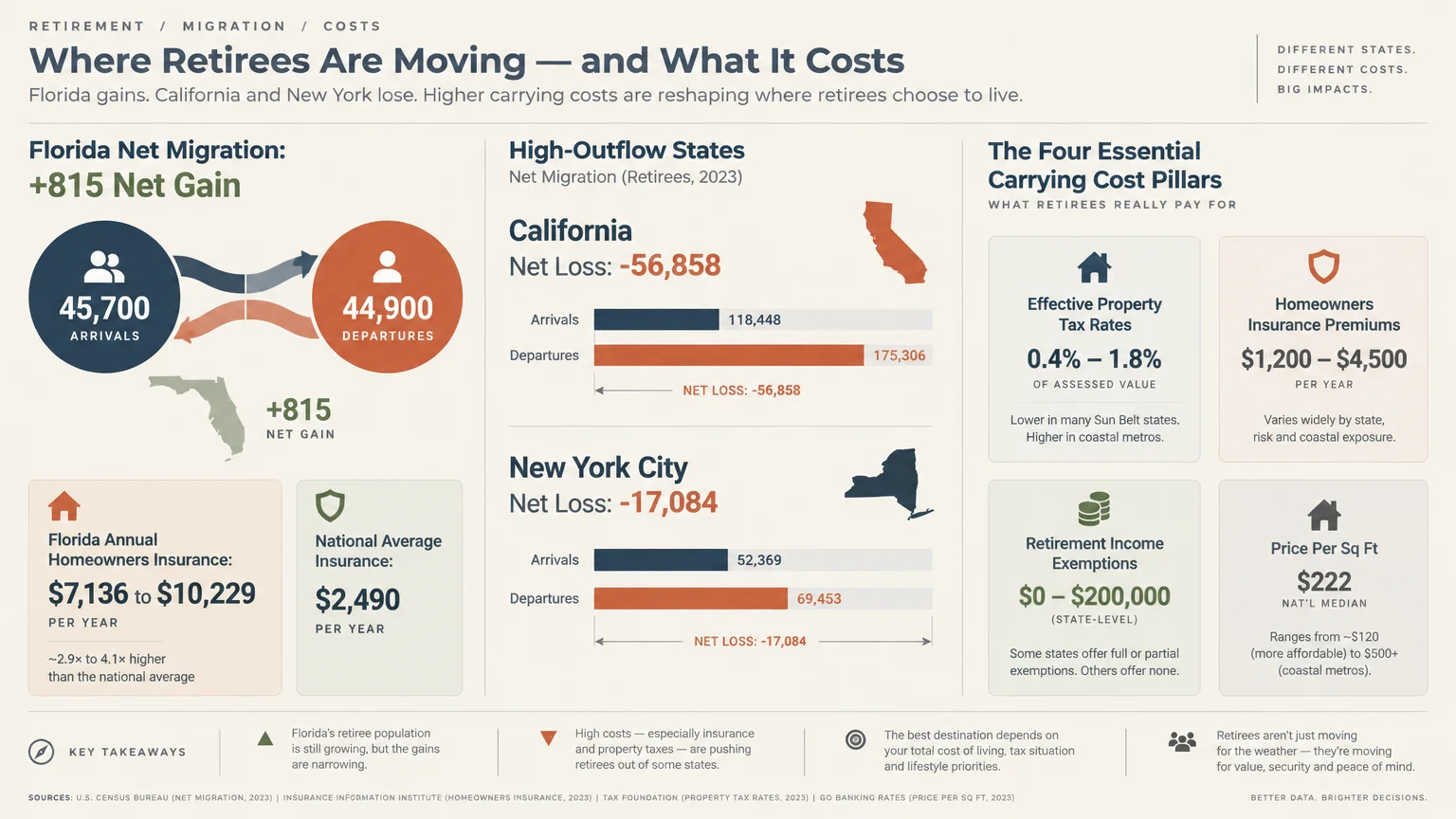
According to HireAHelper data reported by AARP and Boldin, Florida still drew roughly 45,700 arrivals ages 65 and older in 2025. Yet nearly 44,900 older residents left, leaving a net gain of just 815 people.
Sixteen states posted larger net gains of retirement-age movers than Florida. Homeowners insurance is a heavy cost there, with Florida policies averaging $7,136 per year in Insure.com’s November 2026 analysis and $10,229 on InsuranceQuotes’ standardized sample home.
Meanwhile, high prices in coastal exit states continue to push residents outward. SmartAsset’s analysis of U.S. Census data showed California lost 56,858 net residents ages 60 and older, while New York City lost 17,084.
Typical 2026 Zillow home values sit at $760,208 in California, $653,798 in Massachusetts, $573,374 in New Jersey, and $522,644 in New York. Property taxes compound the squeeze, led by Connecticut’s 3.05% median effective rate and New Jersey’s $8,638 median annual bill, according to Ownwell.
Even no-income-tax Texas carries steep hidden carrying costs despite ranking second in net 65-plus arrivals at 5,156. Ownwell data places Texas 10th highest nationally with a 1.48% effective property tax rate and a $3,441 median bill, alongside $4,085 to $4,458 average homeowners insurance.
A Nationwide Retirement Institute survey found 32% of Americans are considering a retirement move, with 16% saying cost of living will force it. Before choosing a destination, compare four carrying costs rather than looking at income taxes alone:
- Effective property tax rates: A low percentage rate protects your budget even if your home appreciates.
- Homeowners insurance premiums: Storm and wildfire risk can easily double the national average of $2,490 per year for $400,000 in dwelling coverage.
- Retirement-specific income exemptions: Many states with modest income taxes exempt Social Security, military pensions, or a portion of 401(k) withdrawals.
- Price per square foot: With the national median listing price at $222 per square foot in October 2026, lower-cost markets let you gain space without draining savings.
01 South Carolina: Top Net Gainer With Fresh 2026 Tax Cuts
South Carolina led the nation in net migration among adults 65 and older in 2025, adding 5,427 net residents in HireAHelper’s study. Medicare enrollment records analyzed by Annuity.com also showed a 3.8% net retiree gain from 2020 to 2025.
Sweeping state tax reform enacted in March 2026 made the Palmetto State even more attractive for tax-conscious households. Under House Bill 4216, South Carolina replaced its three income tax brackets with two starting in tax year 2026.
Taxable income under $30,000 is now taxed at 1.99%, while income of $30,000 or more is taxed at 5.21% minus $966, per South Carolina Department of Revenue Information Letter #26-20. Revenue-triggered cuts toward a flat 1.99% rate begin in 2027.
Retirees receive additional protection on top of those lower brackets. Social Security benefits and military retirement pay are 100% exempt from state tax.
Residents ages 65 and older can deduct up to $10,000 of qualifying retirement income and claim a $15,000 age-65 deduction, reduced by retirement or military deductions taken. That structure shields modest pension and IRA distributions from state tax.
Housing space and property taxes deliver equally strong savings. SmartAsset’s 2026 rankings tie South Carolina for the fifth-lowest effective property tax rate nationwide at 0.45%.
Homeowners ages 65 and older who live in the state for a full calendar year also qualify for a senior homestead exemption. As reported by The Post and Courier in November 2026, that exemption excludes $75,000 of a primary home’s value.
Typical home values sit near $304,589 according to Zillow data—nearly $94,000 below the $398,536 national median single-family price. Homeowners insurance averages $1,980 to $2,736 depending on coverage level, while Charleston earned a top-10 spot in WalletHub’s 2026 retirement rankings.
02 North Carolina: Expanding Space and Falling Flat Tax Rates
North Carolina continues to rank among the most popular tax friendly states retirees choose when leaving the Northeast. It placed third nationally for net 65-plus migration in HireAHelper’s 2025 study and added 20,369 net residents ages 60 and older in SmartAsset’s Census analysis.
Unlike South Carolina’s tiered system, North Carolina uses a simple flat income tax that keeps stepping downward. The rate dropped from 4.25% to 3.99% for 2026, with scheduled reductions reaching 2.99% by 2028.
North Carolina does not tax Social Security benefits, which protects a core slice of retiree cash flow. However, Kiplinger and state revenue guidance note that pensions, 401(k) distributions, and traditional IRA withdrawals remain taxable.
That distinction makes North Carolina best suited for retirees with sizable Roth balances, taxable brokerage accounts, or moderate withdrawal needs. If you plan large traditional IRA rollovers, completing them before rates drop further—or using lower federal brackets—requires careful timing.
On the housing side, Zillow places North Carolina’s typical 2026 home value at $332,584. Selling a home in New York or New Jersey often allows buyers to purchase a larger single-story home in North Carolina with cash left over.
Lower- and moderate-income seniors can also tap state property tax relief. Homeowners ages 65 and older qualify for the Homestead Property Exclusion with income up to $37,900 under the 2025 threshold, or the Circuit Breaker Property Tax Deferment up to $56,850 after five years of ownership.

03 Tennessee: Zero Income Tax Paired With Low Property Bills
Tennessee offers a clean financial formula if you want zero state income tax without Texas-sized property bills. It is one of nine states in 2026 that levies no broad-based individual income tax on wages, Social Security, pensions, or retirement account withdrawals.
For retirees taking large required minimum distributions or converting traditional IRAs to Roth accounts, zero state tax creates immediate breathing room. Every dollar withdrawn from your portfolio avoids state-level withholding.
Where Tennessee truly stands out is property taxation. SmartAsset’s 2026 data ties Tennessee with South Carolina for the fifth-lowest effective property tax rate at 0.45%.
The median annual property tax bill in Tennessee is just $1,488 on a $332,600 median home value. That is less than half the $3,209 national median property tax bill reported by Ownwell.
Typical 2026 Zillow home values sit at $335,560, keeping spacious lots and newer construction within reach for downsized coastal equity. You also avoid the severe coastal hurricane surcharges that drive up insurance budgets along the Gulf and Atlantic shorelines.
Keep one practical trade-off in mind when budgeting for Tennessee. States without income taxes rely more heavily on sales taxes, so everyday retail purchases and dining out will take a slightly larger share of your monthly cash flow.
04 Delaware: Fastest Medicare Growth and Minimal Insurance Costs
Many retirees assume lower taxes require moving hundreds of miles south, yet Delaware quietly posted the fastest retiree growth rate in the country. Annuity.com’s review of Medicare enrollment records from 2020 through 2025 showed Delaware grew by 8.8%, adding 5,000 net retirees.
Proximity explains part of the surge, since East Coast movers stay within driving distance of adult children and familiar medical centers. Carrying-cost math explains the rest.
While Delaware has a graduated income tax topping out at 6.60% above $60,000, several retiree rules soften the bill. Social Security benefits are exempt, and residents ages 60 and older can exclude up to $12,500 per year of qualifying retirement income.
Delaware also delivers standout savings on fixed housing expenses. SmartAsset ranks it seventh-lowest nationally for effective property taxes at 0.47%, with a $1,750 median annual bill on a $371,600 median value.
Homeowners insurance provides another major win for your annual budget. ValuePenguin and Insure.com place Delaware among the five to eight least expensive states for coverage, averaging $1,091 to $1,374 per year.
Compared with New Jersey’s $573,374 typical home value or Massachusetts’ $653,798, Delaware’s $404,421 typical value frees up substantial home equity. Buyers gain newer master-planned communities and coastal access without Mid-Atlantic tax shock.

05 Arizona: Low Flat Taxes and Sunbelt Affordability
West Coast retirees seeking drier air, single-level floor plans, and smaller tax bills continue to anchor retiree migration toward Arizona. Medicare enrollment grew 4.1% between 2020 and 2025—a net gain of 14,383 retirees—while Census migration data showed 20,203 net arrivals ages 60 and older.
Local hubs remain especially active. Tucson drew 7,627 inbound movers ages 65 and older in HireAHelper’s 2025 ranking, trailing only Las Vegas’s 7,854, while Mesa gained 2,044 net residents 60 and older and Scottsdale placed in WalletHub’s top 10 cities to retire.
Arizona keeps state tax filing straightforward with a flat 2.50% individual income tax rate in 2026. Social Security benefits are completely exempt from state taxation.
Property taxes are similarly gentle on fixed incomes. Motley Fool data puts Arizona’s effective property tax rate at 0.42%, resulting in a $1,918 median bill on a $453,500 median home value.
Typical 2026 Zillow home values sit at $417,156—down 1.2% year over year—creating far more breathing room than California’s $760,208 average. If you prefer zero state income tax in the same region, neighboring Nevada charges no income tax and carries a 0.47% property tax rate, though typical Nevada home values run higher at $441,180.
Side-by-Side Comparison: Taxes, Home Prices, and Carrying Costs
Comparing these five areas side by side highlights how differently each state treats your paycheck, your portfolio, and your house. Reviewing all four cost columns together prevents unpleasant surprises after closing day.
| Area | 2026 Top Income Tax Rate | Retirement Income & Social Security Rules | Effective Property Tax Rate | Typical 2026 Home Value |
|---|---|---|---|---|
| South Carolina | 5.21% (1.99% under $30,000) | Social Security & military exempt; $10k retirement & $15k age-65 deductions | 0.45% ($75k senior homestead exemption) | $304,589 |
| North Carolina | 3.99% flat (dropping toward 2.99% by 2028) | Social Security exempt; pensions, 401(k), & IRAs taxed | Senior exclusion or deferment available | $332,584 |
| Tennessee | 0% (No state income tax) | Social Security, pensions, 401(k), & IRAs exempt | 0.45% ($1,488 median annual bill) | $335,560 |
| Delaware | 6.60% (over $60,000) | Social Security exempt; $12,500 exclusion at age 60+ | 0.47% ($1,750 median annual bill) | $404,421 |
| Arizona | 2.50% flat | Social Security exempt; retirement withdrawals taxed at 2.50% | 0.42% ($1,918 median annual bill) | $417,156 |
| Florida (Benchmark) | 0% (No state income tax) | Social Security & retirement accounts exempt | High insurance offsets ($7,136–$10,229/yr) | $375,054 |
If your retirement income comes mainly from large 401(k) or IRA withdrawals, Tennessee’s 0% rate or South Carolina’s deductions tend to stretch furthest. If Social Security and modest pensions cover your bills, Delaware or Arizona can keep total housing and insurance costs lower.
How 2026 Federal Tax Rules Affect Your Relocation Math
State tax savings only tell half the story, because federal rules changed meaningfully for retirees in 2026. Understanding how federal deductions interact with your move helps you time home sales and portfolio withdrawals smartly.
Under Internal Revenue Service Revenue Procedure 2025-32, the 2026 standard deduction is $16,100 for single filers and $32,200 for married couples filing jointly. Taxpayers ages 65 and older receive an extra $2,050 deduction per single filer or $1,650 per qualifying spouse on joint returns.
In addition, the One Big Beautiful Bill Act introduced a temporary senior deduction for 2025 through 2028. Taxpayers ages 65 and older can claim up to $6,000 per person—or $12,000 for joint filers when both spouses qualify—whether they itemize or take the standard deduction.
That extra senior deduction phases out at 6% above $75,000 of modified adjusted gross income for single filers and $150,000 for joint filers, disappearing completely at $175,000 and $250,000. Avoiding oversized capital gains or unscheduled IRA withdrawals in the same year as a move helps you keep this deduction intact.
The federal state and local tax (SALT) deduction cap also rose to $40,400 in 2026 before phasing down above $505,000 of income. Meanwhile, the federal estate and gift tax exemption increased to $15 million per individual, or $30 million per married couple.
Keep federal Social Security rules on your radar regardless of which state you choose. While 42 states and Washington, D.C., leave Social Security untaxed in 2026, up to 85% of your benefits remain taxable federally once combined income passes $25,000 single or $32,000 married, as noted by the Social Security Administration.
Evaluating Safety, Healthcare, and Insurance Before You Buy
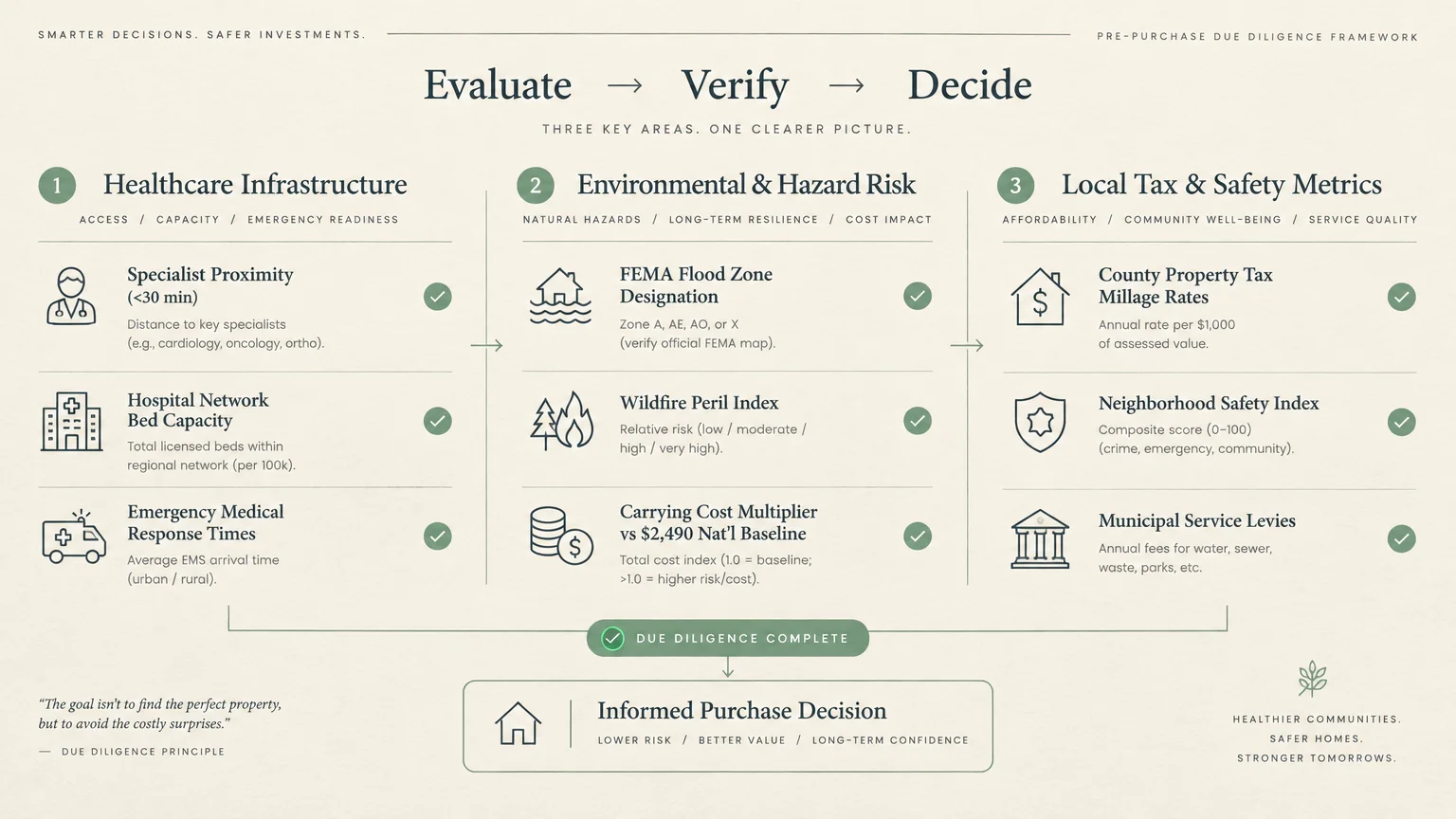
Lower taxes and a bigger yard mean little if you feel uneasy in your neighborhood or far from reliable medical care. Finding safe places to retire requires looking closely at crime data, road safety, weather exposure, and hospital access.
WalletHub’s 2026 Safest Cities analysis evaluates 182 U.S. cities across 41 metrics combining crime rates, traffic fatalities, natural disaster exposure, and financial security. Similarly, Forbes’ 2026 best-places list explicitly screened out areas facing the highest natural-disaster risks.
Never judge a retirement state by its income tax rate alone. Add up property taxes, homeowners insurance, healthcare access, and daily living expenses before deciding where your dollars go furthest.
Before locking in a neighborhood, check how your health coverage translates across state lines. Moving to a new county or state triggers a Special Enrollment Period for Medicare Advantage and Part D drug plans, so verify local hospital networks on Medicare.gov early.
Financing choices matter just as much in 2026. With 30-year mortgage rates averaging 7.18% in October 2026 according to Freddie Mac—up from 6.24% a year earlier—borrowing to buy a retirement home is expensive.
Selling a $520,000 to $760,000 coastal property and paying cash in a $305,000 to $417,000 destination market eliminates that 7.18% interest cost altogether. That single move often saves more every month than any state tax break.
Pitfalls to Watch For
Even well-researched moves can run into expensive surprises if you overlook legal timelines or hidden fees. Watch out for these five common retirement relocation missteps:
- Failing to sever old state tax residency cleanly: High-tax states audit former residents who keep driver’s licenses, voter registrations, or primary doctors behind, so update all records and track days spent in each state.
- Skipping live homeowners insurance quotes before making an offer: Flood zones, roof age, and regional storm risk can swing premiums by thousands of dollars between neighborhoods just miles apart.
- Assuming every tax-friendly state treats IRAs like Social Security: States such as North Carolina and Arizona exempt Social Security while still taxing 401(k) and traditional IRA withdrawals.
- Buying immediately instead of renting first: AARP surveys show 80% of adults 65 and older want to stay rooted in their communities, so renting for six to twelve months lets you test traffic, climate, and social fit before paying closing costs.
- Waiting too long to file senior homestead exemptions: Property tax breaks like South Carolina’s $75,000 exclusion require meeting residency timing and filing paperwork directly with your county assessor.

Getting Expert Help
Relocating across state lines touches taxes, estate documents, Medicare, and housing equity all at once. Targeted advice before you list your current house often pays for itself many times over in these four situations:
- Coordinating domicile changes and retirement withdrawals: A certified public accountant can map out part-year tax returns, protect your $6,000 federal senior deduction, and sequence Roth conversions around your move date.
- Evaluating cash purchases versus mortgages: A fiduciary financial planner can calculate whether selling appreciated investments or using home equity makes more sense against 7.18% mortgage rates and capital gains rules.
- Updating wills, trusts, and healthcare directives: An estate planning attorney licensed in your new state ensures your power of attorney, living will, and property deeds follow local probate laws.
- Comparing county-level Medicare options: A licensed Medicare advisor or State Health Insurance Assistance Program counselor can check whether your prescriptions and preferred specialists stay in network after you move.
Frequently Asked Questions About Retiree Relocation
Which states do not tax Social Security or retirement account withdrawals in 2026?
Nine states levy no broad-based individual income tax at all: Alaska, Florida, Nevada, New Hampshire, South Dakota, Tennessee, Texas, Washington, and Wyoming. Four additional states with income taxes—Illinois, Iowa, Mississippi, and Pennsylvania—fully exempt qualifying pension, 401(k), and IRA distributions, with Michigan reaching full exemption in 2026.
For Social Security specifically, 42 states and Washington, D.C., leave benefits untaxed in 2026, following West Virginia’s transition to a 100% exemption. Only eight states tax Social Security benefits in some form, usually with income-based credits or phaseouts.
Why are fewer retirees ending up in Florida compared with earlier years?
Florida still attracts more older movers than any other state, but almost as many retirees are leaving as arriving. Steep homeowners insurance premiums—averaging $7,136 to $10,229 annually depending on the study—alongside storm concerns and higher living costs have pushed net 65-plus growth down to just 815 people in 2025.
Do you lose your federal senior tax deductions if you move to a low-tax state?
No, because federal deductions apply nationwide regardless of your state’s income tax rate. You still qualify for the 2026 standard deduction, the extra age-65 standard deduction, and the temporary $6,000 OBBBA senior deduction if your income falls within the federal phaseout limits.
Should you pay cash for a home when relocating in 2026?
Paying cash avoids October 2026’s 7.18% average 30-year mortgage rate and keeps monthly fixed expenses low. Just make sure buying outright leaves enough liquid cash in reserve for healthcare, home maintenance, and emergencies.
Taking Your Next Step
Start by building a simple side-by-side budget for your current home and two target counties, plugging in real property tax records, live insurance quotes, and state rules on your specific income sources. Spend a week—or better yet, rent for a season—testing daily drives, grocery stores, and local clinics before putting down roots.
The information in this guide is meant for educational purposes. Your specific circumstances—including income, health needs, tax situation, and goals—may require different approaches. When in doubt, consult a licensed professional.
Last updated: November 2026. Retirement benefits, tax rules, and healthcare regulations change frequently—verify current details with official sources.