
Discovering that your Medicare Advantage plan blocks access to a top cardiologist, oncologist, or orthopedic surgeon often happens at the worst possible moment—right after a serious diagnosis. While Medicare Advantage now covers over 54 percent of eligible beneficiaries, private insurance networks frequently restrict provider choice far more than Traditional Medicare. Private plans often contract with less than half of the practicing specialists in your county, impose strict referral rules, and require pre-approvals that delay critical treatment. Recognizing the structural signs of specialist access restrictions allows you to protect your health, appeal improper denials, and make informed coverage adjustments during Medicare enrollment periods.
The Essentials: Medicare Advantage Specialist Access at a Glance
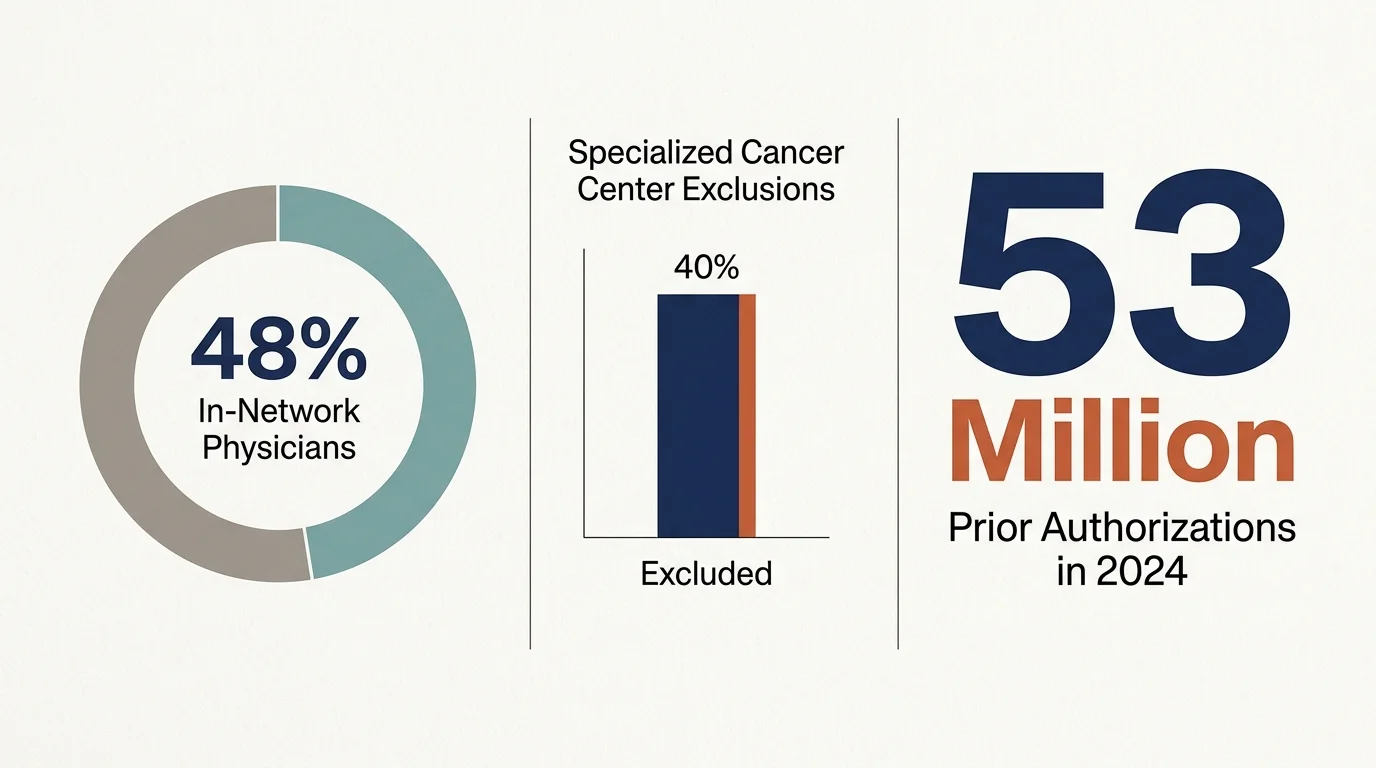
- Narrow Networks: The average Medicare Advantage plan includes only 48 percent of physicians in a given county, with narrow networks covering just one-third of area doctors.
- Specialized Facility Gaps: Nearly 40 percent of Medicare Advantage plans geographically adjacent to an NCI-designated comprehensive cancer center exclude that facility from their network.
- Prior Authorization Hurdles: Insurers issued roughly 53 million prior authorization determinations in 2024, denying up to 12 percent of requests initially—even though over 80 percent of appealed denials were overturned.
- Federal Protections: Under federal regulation 42 CFR § 422.112(a)(3), your plan must provide out-of-network specialist access at in-network cost-sharing if it lacks a qualified in-network provider within reasonable travel standards.

Understanding Specialist Restrictions in Modern Medicare Advantage
More than 33 million older adults and individuals with disabilities rely on Medicare Advantage (Part C) plans. Private insurance carriers market these plans aggressively, highlighting zero-dollar premiums, bundled prescription coverage, and extra dental or fitness perks. However, private insurers fund these extra benefits primarily through managed care mechanisms: utilization management, strict provider contracting, and closed networks.
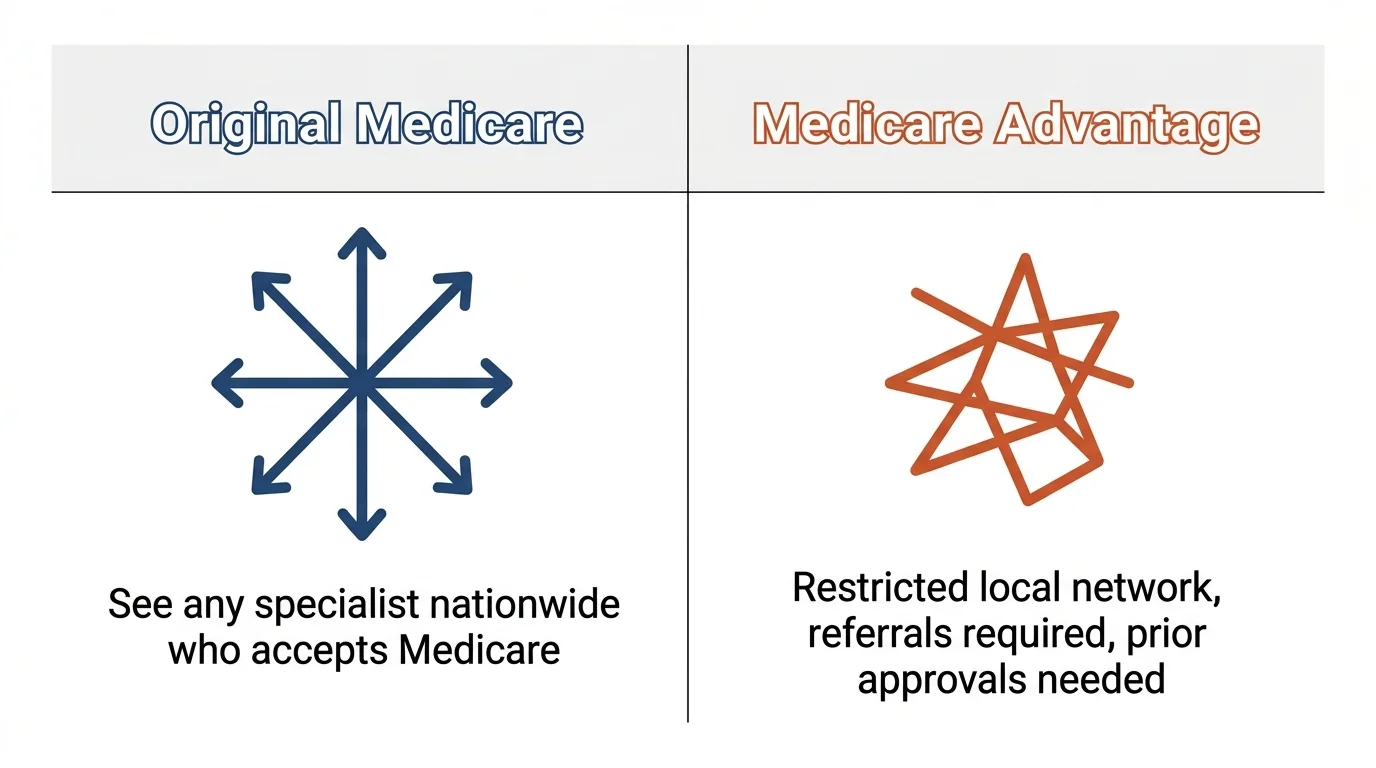
Unlike Original Medicare—where you can visit any specialist nationwide who accepts Medicare assignment without asking permission—Medicare Advantage relies on localized networks. When you face complex conditions like cardiovascular disease, neurological disorders, or aggressive cancers, network limitations directly influence the speed and quality of your clinical care.
“Consumers deserve clear, transparent rules so they know whether their health insurance will actually cover the doctors they need when an emergency strikes.” — Elizabeth Warren, U.S. Senator and Consumer Advocate

1. Mandatory Primary Care Referrals Gatekeep In-Network Consultations
One of the clearest structural signs that your plan limits specialist care is a mandatory referral policy. In Health Maintenance Organization (HMO) models and certain restrictive Point-of-Service (POS) plans, you cannot book an appointment directly with a dermatologist, rheumatologist, or gastroenterologist. Instead, your primary care physician (PCP) must act as a financial and clinical gatekeeper.
This requirement introduces substantial friction into your healthcare management:
- Administrative Scheduling Delays: You must secure an initial appointment with your PCP, wait for the consultation, request the referral, and wait for the insurer to log the paperwork before scheduling your specialist visit.
- Restricted Specialist Routing: Your primary care clinic may belong to an integrated health system. When making referrals, PCPs frequently face organizational pressure to keep patients inside that specific corporate health system, even if a superior, independent specialist is available in the broader plan network.
- Referral Expiration Windows: Many referrals remain valid for only 60 to 90 days or cover only a specific number of visits. If your treatment requires long-term management, you must repeatedly return to your PCP for renewed documentation.
If you must ask permission before every specialty consultation, your plan imposes formal Medicare Advantage referral requirements that slow your access to necessary care.

2. Regional Academic Hospitals and Cancer Centers Are Excluded
High-level medical care often requires university teaching hospitals, academic medical centers, or specialized research institutions. If you develop a complex health condition, access to cutting-edge clinical trials, advanced surgical subspecialists, and multidisciplinary tumor boards becomes vital.
Research from the Kaiser Family Foundation (KFF) reveals that nearly two in five Medicare Advantage plans (approximately 40 percent) exclude nearby National Cancer Institute (NCI)-designated comprehensive cancer centers from their provider directories. Insurers frequently exclude these top-tier institutions because academic centers demand higher reimbursement rates for their advanced diagnostic and surgical capabilities.
Review your plan directory for premier regional institutions. If your network excludes the major academic medical center or specialized orthopedic hospital in your region, your plan creates a significant barrier to advanced subspecialty care.
3. Prior Authorization Creates Chronic Delays and Administrative Denials
Even when a specialist participates in your plan network, you may encounter severe treatment bottlenecks through prior authorization. Prior authorization requires your specialist to obtain explicit pre-approval from the insurance company before performing diagnostic procedures, ordering advanced imaging (such as MRIs and PET scans), prescribing specialty therapies, or scheduling surgeries.
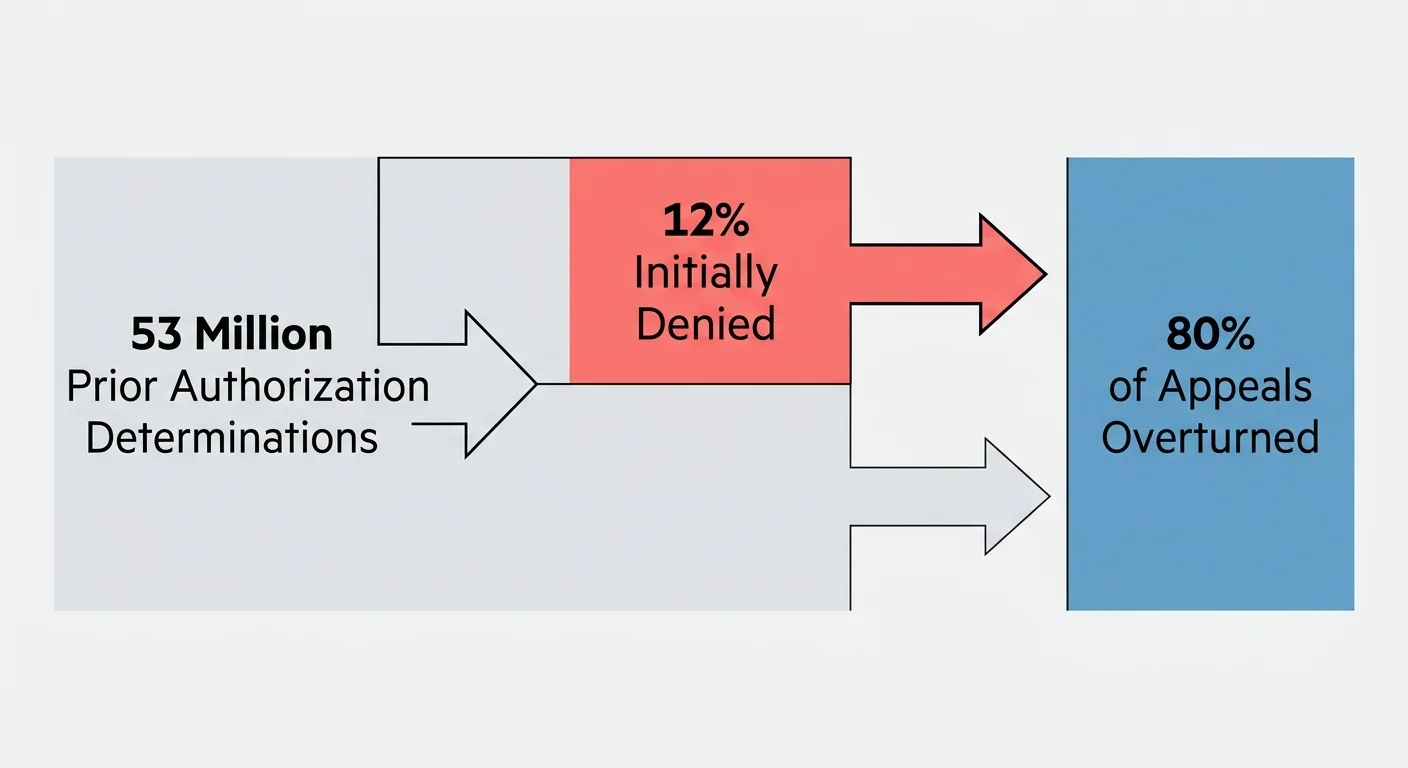
Federal data shows that Medicare Advantage plans processed nearly 53 million prior authorization determinations in 2024. Insurers initially denied between 7.7 percent and 12 percent of these requests for medically necessary services. Strikingly, independent evaluations reveal that when patients and physicians appeal these denials, plans overturn more than 80 percent of them.
This high reversal rate demonstrates that initial prior authorization denials often serve as administrative hurdles rather than legitimate clinical determinations. To address this issue, the Centers for Medicare & Medicaid Services (CMS) enacted regulation CMS-0057-F. Starting in 2026 for calendar year 2025 data, insurers must publicly publish their annual prior authorization metrics, including specific approval percentages, denial rates, and average turnaround times.

4. Excessive Wait Times and Unreasonable Travel Distances to See Specialists
If your plan directory shows in-network specialists, but the nearest available provider is 45 miles away or has a four-month waitlist for new patients, you are experiencing Medicare Advantage narrow network issues. Insurers sometimes build “phantom” or “ghost” networks—directories filled with providers who have retired, moved, passed away, or stopped accepting that specific insurance plan.
CMS establishes network adequacy standards under 42 CFR § 422.116, defining maximum travel times and distances across 27 medical provider specialties and 13 facility types based on county size:
| Provider Specialty | Metro County Standard (Max Time / Distance) | Micro County Standard (Max Time / Distance) | Rural County Standard (Max Time / Distance) |
|---|---|---|---|
| Cardiology | 20 mins / 10 miles | 50 mins / 35 miles | 75 mins / 60 miles |
| Oncology (Medical/Surgical) | 20 mins / 10 miles | 45 mins / 30 miles | 70 mins / 55 miles |
| Orthopedic Surgery | 20 mins / 10 miles | 50 mins / 35 miles | 75 mins / 60 miles |
| Neurology | 30 mins / 15 miles | 60 mins / 45 miles | 90 mins / 75 miles |
| Endocrinology | 30 mins / 15 miles | 60 mins / 45 miles | 100 mins / 85 miles |
When you cannot secure an appointment with a local specialist within reasonable clinical timeframes, your insurer may be failing to meet basic network adequacy requirements.
5. Your Plan Excludes Over Half of Local County Physicians
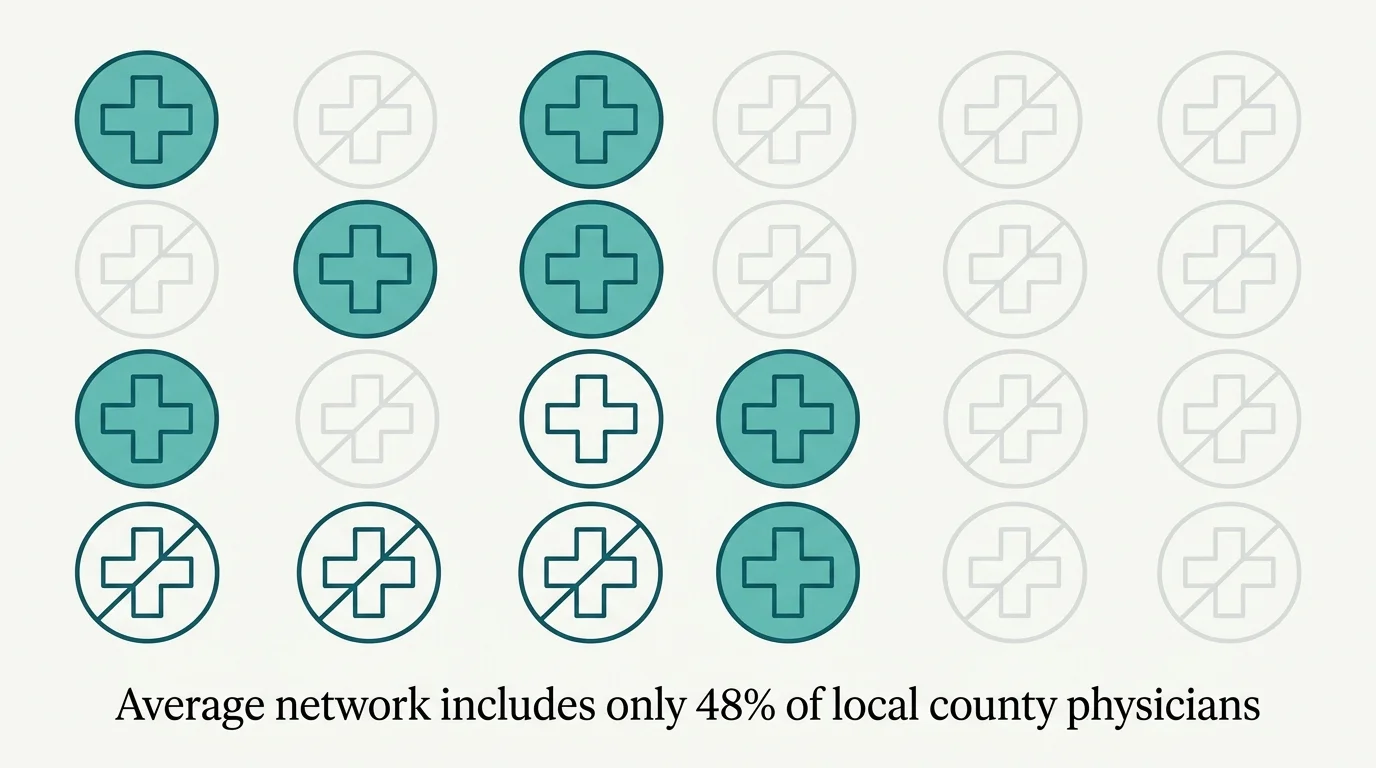
Under Traditional Medicare, you have access to roughly 98 percent of all non-pediatric physicians in the United States who accept Medicare assignment. In contrast, Medicare Advantage plans contract with a selective subset of regional providers.
Comprehensive analyses by KFF show that Medicare Advantage enrollees have access to an average of just 48 percent of physicians and specialists practicing within their home county. In plans with the narrowest network designs, provider access plunges to between 33 percent and 39 percent of available county doctors.
You can identify broad versus narrow networks by cross-referencing local independent medical groups with your plan directory. If leading local cardiology practices, independent imaging centers, and regional surgical groups are completely absent, your plan relies on a narrow network model designed to suppress utilization.

6. Prohibitive Out-of-Network Coinsurance Reaches 30% to 50%
Preferred Provider Organization (PPO) plans advertise out-of-network coverage flexibility, leading many enrollees to assume they can see any specialist for a modest additional fee. However, out-of-network cost-sharing in Medicare Advantage PPOs often creates severe financial barriers.
While an in-network specialist consultation might require a flat $35 or $45 copayment, visiting an out-of-network specialist frequently triggers coinsurance charges between 30 percent and 50 percent of the total negotiated bill. Furthermore, out-of-network expenses apply to a separate, significantly higher annual out-of-pocket maximum—frequently exceeding $10,000 to $13,000 per calendar year.
If you belong to an HMO plan, out-of-network specialist visits carry zero coverage except in life-threatening emergencies. You become 100 percent financially responsible for every doctor bill, lab test, and imaging scan conducted outside the network.

7. Mid-Year Network Churn and Contract Terminations Disrupt Care
You choose your Medicare Advantage plan during the Annual Enrollment Period (October 15 to December 7) based on the doctors listed in the directory at that time. However, Medicare Advantage provider contracts do not align permanently with your enrollment year. Hospital systems and physician groups frequently renegotiate or terminate their commercial contracts with Medicare Advantage insurers in the middle of the calendar year.
When a physician group terminates its contract with your carrier mid-year:
- Your specialist suddenly becomes out-of-network, leaving you to either pay high coinsurance or abandon your established doctor.
- You must navigate complex “continuity of care” rules, which typically grant temporary transition access (30 to 90 days) only if you are undergoing active chemotherapy, third-trimester pregnancy care, or post-surgical recovery.
- Insurers are not legally required to permit you to change Medicare Advantage plans outside of standard enrollment windows simply because an individual doctor left the network.
Frequent contract disputes and mid-year physician dropouts in your area represent clear signs that your carrier struggles to maintain stable specialist access.
Comparing Specialist Access: Original Medicare vs. Medicare Advantage Plans
To see how specialist access differs across coverage options, compare how Original Medicare and Medicare Advantage plan types manage specialist care:
| Feature / Access Rule | Original Medicare + Medigap | Medicare Advantage PPO | Medicare Advantage HMO |
|---|---|---|---|
| Primary Care Referral Needed? | No; schedule directly with any specialist. | No; direct scheduling allowed. | Yes; PCP referral required for almost all specialists. |
| Prior Authorization for Specialists? | Extremely rare (limited to select cosmetic/bariatric services). | Frequent; required for imaging, treatments, and procedures. | Standard requirement; extensive pre-approval rules. |
| Nationwide Provider Network? | Yes; any provider accepting Medicare nationwide (~98% of doctors). | No; localized network with out-of-network coverage penalties. | No; strictly local network with zero non-emergency out-of-network coverage. |
| Out-of-Network Cost-Sharing | $0 or small deductible if you have Medigap Plan G or Plan F. | 30% to 50% coinsurance; high separate out-of-pocket maximum. | 100% of all costs paid by the patient out of pocket. |
| Access to NCI Cancer Centers | Full access to any NCI center accepting Medicare assignment. | Variable; often out-of-network with high coinsurance penalties. | Often completely excluded; no out-of-network benefits. |

CMS Protections: Exercising Your Rights Under Federal Law
Federal Medicare guidelines provide clear protections when your plan’s network cannot deliver necessary specialty care. If you need specialized medical treatment and your Medicare Advantage plan lacks a qualified in-network provider, you can invoke federal regulation 42 CFR § 422.112(a)(3).
This rule explicitly mandates that if an in-network specialist is unavailable within reasonable time and distance standards, the Medicare Advantage organization must arrange and authorize care with an out-of-network specialist. Crucially, the insurer must cover this care at the exact same cost-sharing level as an in-network visit.
To exercise your rights under this regulation:
- Document the Network Failure: Call your plan’s customer service and document all in-network specialists within your geographic radius who have full patient rosters or waitlists exceeding 30 to 60 days.
- Obtain Clinical Documentation: Have your primary care physician write an expedited letter of medical necessity stating that your condition requires evaluation by a specific specialist and that no adequate in-network provider is reasonably accessible.
- Request an Out-of-Network Exception: Submit a formal request for an organization determination through your plan. Cite 42 CFR § 422.112(a)(3) and demand that the carrier authorize an out-of-network consultation at in-network cost-sharing.
- File an Expedited Appeal: If the plan denies your request, submit an expedited appeal immediately. The plan must respond within 72 hours for urgent clinical situations. You can find official grievance tools on Medicare.gov.

What Can Go Wrong: The Hidden Cost of Delayed Specialist Care
Restricted specialist access affects more than just your calendar; it can severely impact your health and retirement finances. When managed care rules delay critical consultations, clinical outcomes often deteriorate.
Consider the potential consequences of network restrictions:
- Delayed Oncology Staging: A six-week wait to resolve prior authorization for a biopsy or PET scan can allow an aggressive tumor to advance from an early, localized stage to a regional or metastatic stage.
- Financial Shock from Surprise Out-of-Network Bills: Seeing an out-of-network surgeon during an emergency or following an informal referral can leave you responsible for tens of thousands of dollars in uncovered facility and professional fees.
- Fragmented Medical Records: Bouncing between restricted clinics disrupts care coordination. Specialists outside your primary network may lack access to your electronic health records, leading to repeated imaging, duplicate blood panels, and medication errors.
“A healthcare crisis can derail even the best retirement plan if you don’t understand what your insurance covers before you get sick.” — Suze Orman, Personal Finance Author and Retirement Expert

When to Consult a Professional
Navigating Medicare coverage options is complex, especially when balancing specialty medical needs against retirement budgets. Consider seeking personalized assistance in the following scenarios:
- You Receive a Complex Chronic Diagnosis: If you are diagnosed with cancer, Parkinson’s disease, heart failure, or a rare autoimmune disorder, consult an independent Medicare broker or a State Health Insurance Assistance Program (SHIP) counselor to determine whether your current network can adequately support your treatment plan.
- Your Plan Issues Multiple Prior Authorization Denials: If your insurer repeatedly denies physician-recommended treatments or diagnostic imaging, consult a patient advocate or healthcare attorney to file a formal appeal through CMS. You can connect with counseling resources via the National Council on Aging (NCOA).
- You Relocate or Your Local Health System Drops Your Plan: If your regional medical center terminates its Medicare Advantage contracts, speak with a licensed health insurance advisor to evaluate Special Enrollment Periods (SEPs) that allow you to change plans.
- You Want to Transition Back to Original Medicare: If you decide to drop Medicare Advantage and return to Original Medicare to gain unrestricted nationwide specialist access, check whether your state requires medical underwriting for a Medicare Supplement (Medigap) policy. The educational resources at AARP provide state-by-state breakdowns of Medigap guaranteed-issue rights.
Frequently Asked Questions About Medicare Advantage Specialist Access
Can a Medicare Advantage plan legally refuse to let me see an out-of-network specialist?
If you are enrolled in an HMO, the plan is generally not required to pay for non-emergency out-of-network specialist care unless no qualified in-network specialist is available within federal time-and-distance standards (under 42 CFR § 422.112). In a PPO plan, you have the right to see out-of-network specialists, but you will pay substantially higher coinsurance rates, and the provider must agree to bill your private insurer.
What should I do if the only in-network specialist has a six-month waitlist?
An in-network provider with an unreasonable waitlist constitutes an inadequate network under federal standards. Contact your Medicare Advantage plan immediately and request an out-of-network exception under 42 CFR § 422.112(a)(3). Ask your primary care doctor to submit an expedited request detailing why your medical condition cannot safely tolerate a multi-month delay.
Why do Medicare Advantage plans deny prior authorizations if most appeals are successful?
Prior authorization serves as an administrative utilization control. Many patients and overburdened physician offices do not appeal initial denials due to paperwork burdens and strict deadlines. Because only a minority of denials are formally appealed, initial rejections help insurance carriers reduce utilization and manage overall claim costs across large populations.
Can I switch back to Traditional Medicare if my specialist leaves my plan mid-year?
Losing an individual doctor does not automatically qualify you for a Special Enrollment Period (SEP) to switch plans mid-year. However, you can change your coverage during the annual Medicare Advantage Open Enrollment Period (January 1 to March 31) or the standard Annual Enrollment Period (October 15 to December 7). If you return to Original Medicare, verify your state’s Medigap underwriting rules to ensure you can secure a supplement policy without health screening penalties.
Taking Action: Securing the Specialist Care You Need
Take proactive control of your healthcare access today. Check your current plan directory for your preferred specialists, hospitals, and diagnostic clinics. If you encounter referral delays, excessive travel distances, or repeated prior authorization denials, document every interaction and exercise your federal appeal rights under CMS regulations.
During the next Medicare enrollment period, evaluate whether the lower premiums of Medicare Advantage outweigh the unrestricted specialist access and flexibility provided by Original Medicare paired with a Medigap policy. Your health and retirement security depend on having direct access to experienced medical specialists when you need them most.
This is educational content based on general retirement and financial principles. Individual results vary based on your situation. Always verify current benefit rules, tax laws, and eligibility requirements with official sources like SSA, Medicare.gov, or the IRS.
Last updated: March 2026. Retirement benefits, tax rules, and healthcare regulations change frequently—verify current details with official sources.









Leave a Reply