
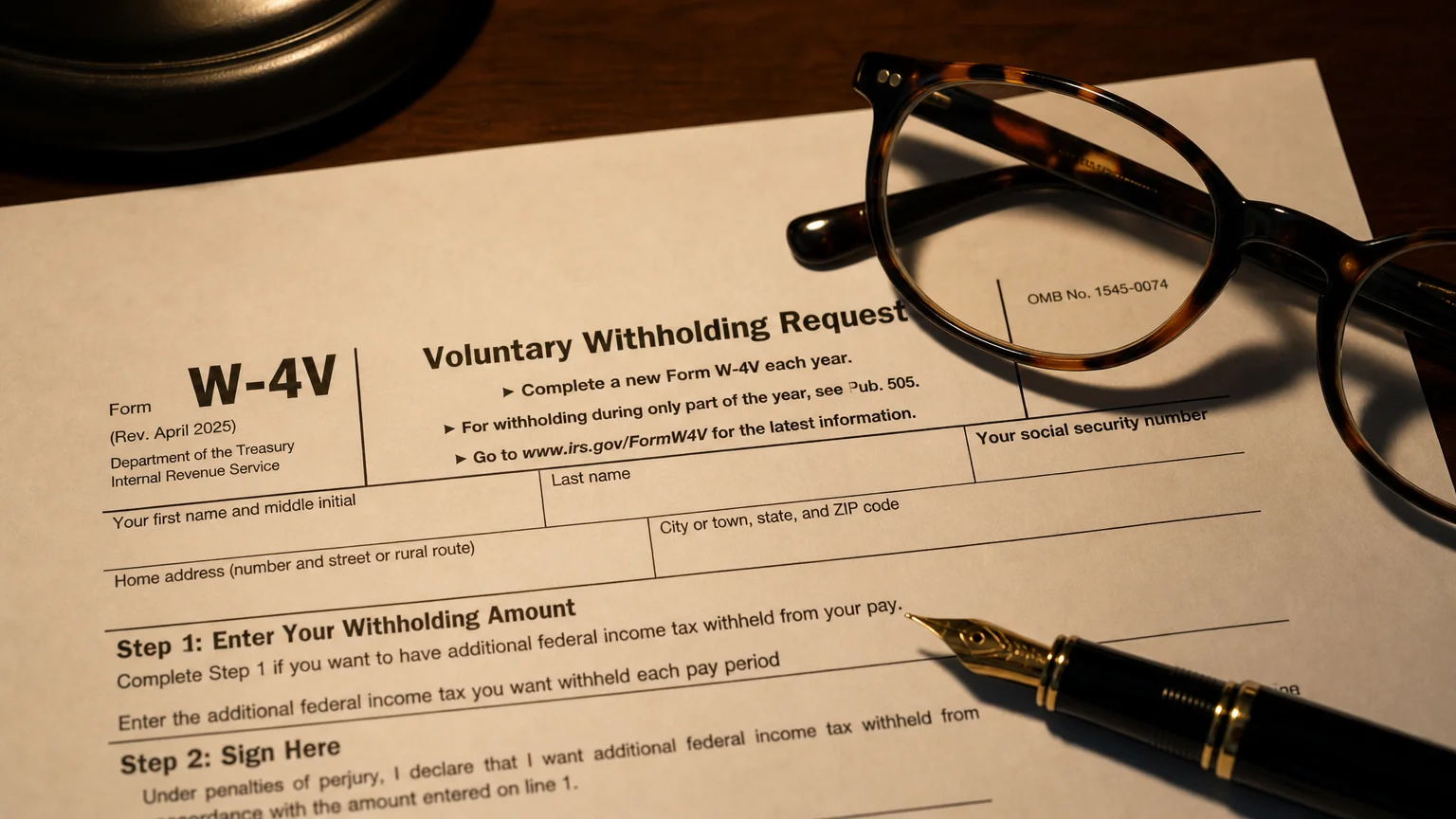
Tax Withholding: Taking Control of Your Final Payout
A shocking revelation for many retirees is discovering that their Social Security benefits may be subject to federal income taxation. Unlike standard employment income, taxes are not automatically withheld from your monthly benefit. If you do not proactively manage this liability, you may face substantial tax bills and underpayment penalties when you file your annual returns.
The Internal Revenue Service (IRS) utilizes a specific formula known as “Provisional Income” to determine how much of your benefit is taxable. Provisional income is calculated by adding your Adjusted Gross Income (AGI), any nontaxable interest (such as municipal bond yields), and exactly 50% of your total Social Security benefits.
Understanding how this formula applies requires looking at distinct taxpayer scenarios:
- The Sole-Income Retiree: If you are a single filer whose only source of income is a $20,000 annual Social Security benefit, your provisional income is just $10,000 (half of the benefit). Because this falls well below the IRS threshold of $25,000, absolutely none of your Social Security benefit is taxed.
- The Middle-Income Filer: If you are a single filer drawing $18,000 from Social Security and pulling $20,000 from a traditional IRA, your provisional income is $29,000. Because this falls between $25,000 and $34,000, up to 50% of your Social Security benefits may be subject to federal income tax.
- The High-Income Couple: If you are married filing jointly with $40,000 in combined Social Security benefits, a $30,000 pension, and $20,000 in part-time wages, your provisional income is $70,000. Because this far exceeds the $44,000 threshold for married couples, up to 85% of your Social Security benefits will be taxed at your standard income tax rate.
To avoid a massive tax bill in April, you have the right to request voluntary tax withholding directly from your monthly payment. You accomplish this by completing IRS Form W-4V (Voluntary Withholding Request) and mailing it to your local Social Security office. You cannot choose arbitrary dollar amounts; the law requires you to select a flat withholding rate of 7%, 10%, 12%, or 22%. By strategically matching this percentage to your estimated tax liability, you effectively smooth out your tax burden across the entire calendar year.









Thank you for this message. Very much appreciated.
Great article
Thank you for the monthly layout of the S.S. payment schedule.
Thank you very much for your message.
Excellent info thank you.
Thank you for your message .
We appreciate it
Thank you the article was very informative.
Thank you , it helps to see it in writing,
I am extremely grateful to you for such valuable information.
I am 74, I get S.S., but I am now considered permanently disabled, do I get additional money . Someone told me to check. Who do I call.
when does it start
No you do not, once you turn retirement age , disability stops and you are on regular social security.
Thank you for this important information.
When does this change going into effect?
There is nothing new here. If you read the article closely, you’ll notice that this change has been in effect since May 1997.
So what changed? This seems to be a summaru of what has been for a long time.
I would love it if SS went to twice a month. We go all our working lives getting paid twice a month (or once a week) and suddenly you’re down to once a month. I understand that we get them same no matter how many times we get paid but I know my budget would be better if I continued to get my checks on the 1st and 15th but I guess it’s all about saving money and the lowest bidder. Still sucks though.
Thank you for keeping us updated!
It’s already in effect and has been since 1997
Amazing how many people DON’T “read closely”. This is NOT News!!
Me on the sixth and wife on the 13th–do we get separate days for the payment or do we both get paid on my pay date?
“Claiming at age 62, your Full Retirement Age, or delaying until age 70 will still result in your payment landing on your birth-date-assigned Wednesday.”
This statement is incorrect! My husband took his retirement at 62 and was getting his check on the 4th wednesday, but once he turned 65 it started coming on the 3rd.
It’s news to me as I get SS based on my husband’s earnings, but based on my birthday, not his!! His birthday is the 2nd, mine is the 26th!? Big difference in when I receive SS!
thank you for this important message!
i am 92; will be 93 in December – i do not have a pension. Will I continue to receive social security? That is the only income I have.
My b-day is the 19th. I received my ss check on the 3rd Wednesday of the month. All of a sudden, three years ago, the date was changed to the 1st of each month. I do not understand the change since this article clearly provide that my ss payment should be deposited on the third Wednesday.