
Medicare covers second opinions for non-emergency surgical recommendations and major medical treatments, protecting both your health and your retirement budget from costly missteps. When facing a significant diagnosis, understanding the specific guidelines under Medicare Part B and Medicare Advantage ensures you receive the specialist insights you need without triggering unexpected out-of-pocket bills. From verifying doctor assignment to navigating third-opinion rights when specialists disagree, knowing these operational boundaries empowers you to advocate effectively for your care. Here is everything you need to know about how Medicare handles second surgical and medical opinions.

Why a Second Opinion Matters for Your Health and Finances
Receiving a recommendation for major surgery or an invasive medical procedure often triggers anxiety and uncertainty. Whether your doctor suggests a joint replacement, back surgery, or cardiovascular intervention, getting another perspective provides clarity. Clinical studies consistently reveal that second opinions frequently alter initial diagnoses, refine staging, or suggest less invasive, lower-risk treatment alternatives.
From a financial standpoint, avoiding an unnecessary procedure preserves your retirement savings by eliminating avoidable surgical copayments, extended rehabilitation stays, and prescription drug costs. Many beneficiaries mistakenly ask: does Medicare cover a second opinion if the surgery is non-urgent? The short answer is yes. Medicare actively encourages patients to seek confirmation before committing to major elective operations, provided you follow established program guidelines.
“Taking control of your health decisions is one of the most effective ways to protect your retirement wealth; informed choices prevent both medical and financial regret.” — Jean Chatzky, Financial Educator and Author

The 9 Essential Medicare Rules for Second Opinions
Navigating the healthcare system requires an understanding of how coverage mechanisms function. Below are the primary Medicare rules for second opinions that dictate how consultations, diagnostic tests, and provider networks operate.
1. Part B Covers Second Opinions for Medically Necessary, Non-Emergency Surgeries
Under Original Medicare, Part B handles outpatient medical services, doctor visits, and second surgical consultations. Medicare covers a second opinion when your primary physician or specialist recommends surgery that is medically necessary and non-emergency. In this context, “non-emergency” refers to elective surgeries—procedures where scheduling a consultation does not present an immediate threat to your life or long-term health, such as knee replacements, cataract removals, or elective spinal fusions.
The Medicare.gov framework allows you to consult another physician to discuss whether the proposed surgery is necessary, evaluate alternative non-surgical therapies, or verify the diagnosis. The coverage extends beyond traditional open surgeries to include major diagnostic or therapeutic procedures like heart catheterizations or complex biopsies.
2. Medicare Automatically Covers a Third Opinion If Diagnoses Conflict
One of the most valuable yet underutilized protections in the Medicare specialist second opinion policy is the third-opinion rule. If your first doctor recommends surgery and the second physician advises against it—or suggests a fundamentally different approach—Medicare Part B automatically covers a third medical opinion.
This provision ensures you do not remain trapped between conflicting medical advice. The third consultation operates under the exact same coverage standards and cost-sharing percentages as the second opinion. You do not need special dispensation or an administrative appeal from the Centers for Medicare & Medicaid Services (CMS) to access this third consultation; your provider simply bills Part B using appropriate medical billing codes indicating a conflicting prior opinion.
3. Standard Part B Cost-Sharing Rules and Deductibles Apply
Getting a second medical opinion Medicare consultation does not involve separate out-of-pocket fee structures; it follows standard Part B cost-sharing rules. Once you meet your annual Part B deductible ($240 in 2024 and $257 in 2025), you pay 20% of the Medicare-approved amount for the consultation.
If you maintain a supplemental insurance policy (Medigap), your out-of-pocket costs may decrease substantially:
- Medigap Plan G or Plan F: Covers 100% of your 20% Part B coinsurance for the consultation.
- Medigap Plan N: Covers the 20% coinsurance, though you may owe a copayment of up to $20 for the office visit.
- Medigap Plans K and L: Cover a percentage (50% or 75% respectively) of the coinsurance until you reach your annual out-of-pocket limit.
4. Doctor Assignment Controls Whether You Face Excess Charges
When selecting a physician for your second opinion under Original Medicare, the provider’s billing status directly influences your total bill. Doctors fall into three distinct Medicare billing categories:
- Participating Providers: These doctors accept “assignment,” agreeing to charge only the Medicare-approved rate. You pay only your 20% coinsurance.
- Non-Participating Providers: These doctors accept Medicare but reserve the right not to accept assignment on a claim-by-claim basis. They may charge up to 15% above the Medicare-approved rate (known as a Part B excess charge), which you must pay out-of-pocket unless your Medigap policy (such as Plan G or Plan F) covers excess charges.
- Opt-Out Providers: These practitioners do not participate in Medicare at all and have signed private contracts. Medicare pays nothing for visits to opt-out doctors, leaving you responsible for 100% of the bill.
To avoid unexpected balance billing, always ask the second specialist’s office staff: “Does the physician accept Medicare assignment as a participating provider?”
5. Medicare Advantage (Part C) Plans Require In-Network Compliance and Prior Authorization
By federal statute, Medicare Advantage plans must provide at least the same baseline coverage as Original Medicare. However, private insurers set distinct operational hurdles for second opinion coverage rules Medicare beneficiaries must follow:
- Health Maintenance Organization (HMO) Plans: Typically require a formal referral from your primary care physician (PCP) before you can schedule a second opinion. You must generally see an in-network specialist; consulting an out-of-network doctor without prior plan authorization usually results in zero coverage.
- Preferred Provider Organization (PPO) Plans: Allow you to visit out-of-network specialists without a PCP referral, but you will pay substantially higher coinsurance rates or copayments compared to in-network doctors.
- Prior Authorization: Medicare Advantage insurers often mandate prior authorization before approving consultations with advanced tertiary specialists or surgical sub-specialists.
6. Emergency Interventions and Elective Cosmetic Procedures Are Excluded
Medicare explicitly excludes second opinions in specific clinical circumstances. Recognizing these boundaries prevents billing denials:
- Emergency Medical Conditions: Acute medical emergencies requiring immediate surgical intervention—such as an acute appendicitis, aortic dissection, severe trauma, or acute intracranial hemorrhage—do not qualify for second opinion coverage delays. Care must proceed immediately under emergency Part A or Part B guidelines.
- Non-Covered Elective Services: If Medicare does not cover the primary procedure (such as cosmetic rhinoplasty or elective face lifts), it will not cover a second opinion regarding that procedure.
- Experimental Treatments: Consultations evaluating unapproved clinical trials or experimental procedures not recognized by Medicare coverage determinations are generally excluded.
7. Transferring Medical Records Prevents Duplicate Diagnostic Costs
When you consult a second doctor, that physician needs access to your previous diagnostic work, including blood panels, tissue biopsies, CT scans, and MRI imaging. Medicare covers new diagnostic tests ordered by the second physician only if they are medically necessary to establish or verify a diagnosis.
If the second physician orders redundant imaging simply because they do not have your existing scans on file, Medicare may deny the duplicate claim, leaving you responsible for the expense. According to resources from the National Institute on Aging (NIA), requesting digital copies of your imaging discs and pathology reports from your initial physician and hand-delivering them to your second appointment streamlines your care and eliminates duplicate 20% coinsurance charges.
8. You Retain Total Treatment Autonomy Without Jeopardizing Future Coverage
A common misconception among retirees is that requesting a second opinion commits them to the second doctor’s proposed treatment, or that rejecting surgical recommendations forfeits Medicare coverage for future related care. Under Medicare regulations, you maintain full autonomy over your treatment path.
You can choose to proceed with the first surgeon, switch to the second surgeon, pursue conservative non-surgical management, or choose to forgo treatment entirely. Medicare covers the consultation regardless of your final decision. Your future coverage for the underlying medical condition remains fully intact.
9. Original Medicare Gives You Nationwide Specialist Access Without Referrals
Under Original Medicare (Part A and Part B), you possess unrestricted nationwide access to any specialist who accepts Medicare assignment. You do not need a referral from your primary care physician to schedule a second opinion, nor are you restricted by geographic boundaries or state lines.
This freedom allows you to seek second opinions at leading national research institutions and academic medical centers across the country. Whether you live in a rural area and need to visit an urban comprehensive cancer center, or you spend winters in a different state, Original Medicare processes your claim identically regardless of where the consultation occurs.
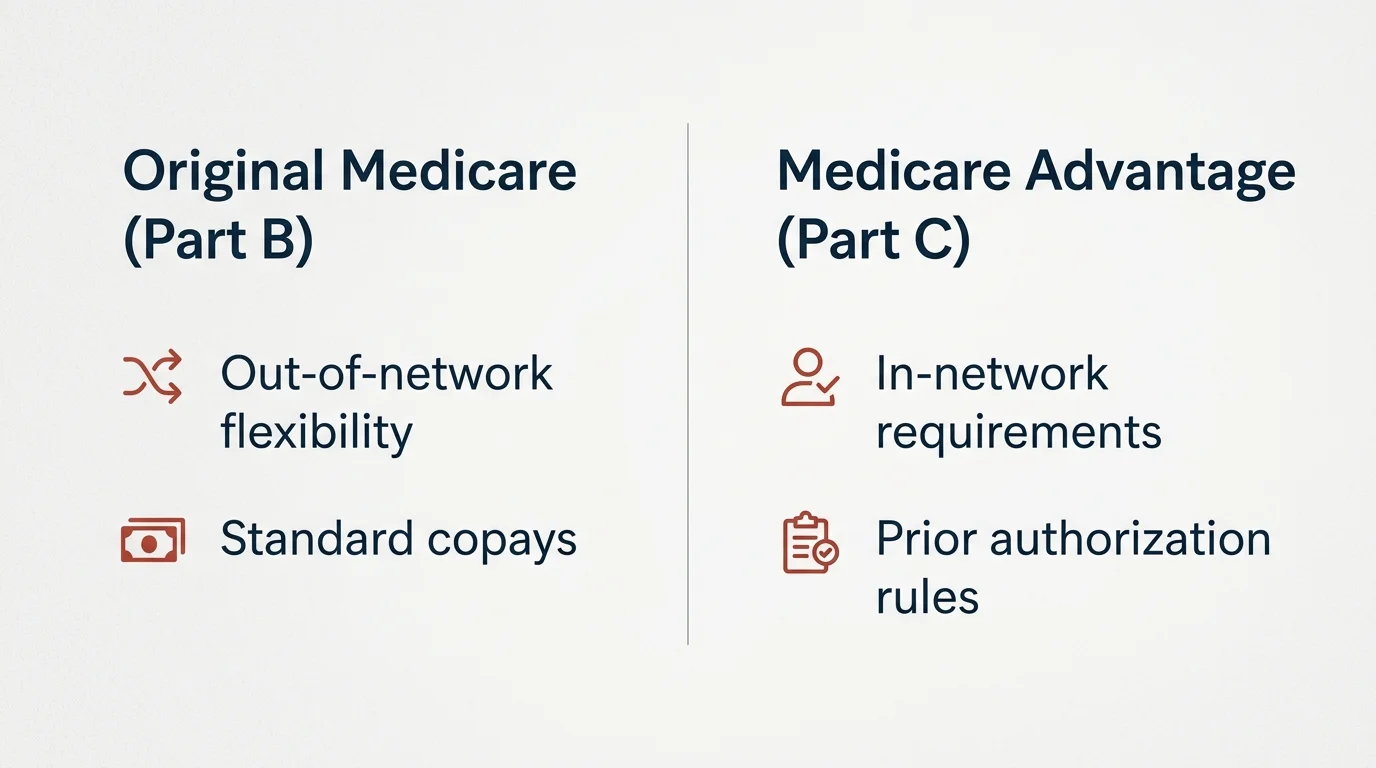
Comparing Second Opinion Coverage: Original Medicare vs. Medicare Advantage
Evaluating how your coverage works across different plan types helps you avoid administrative delays when scheduling a consultation. The table below outlines the core functional differences:
| Coverage Feature | Original Medicare (with Medigap) | Medicare Advantage (HMO) | Medicare Advantage (PPO) |
|---|---|---|---|
| Primary Care Referral Required? | No | Yes (typically required) | No |
| Network Restrictions | None (Any provider accepting Medicare) | Strict in-network requirement | In-network preferred; out-of-network costs more |
| Third Opinion Covered? | Yes, if first two conflict | Yes, but within network rules | Yes, subject to cost-sharing rules |
| Cost-Sharing Baseline | 20% coinsurance (often paid by Medigap) | Set specialist copayment (e.g., $35–$50) | Copayment (in-network) / Coinsurance (out-of-network) |
| Geographic Limitations | Nationwide coverage | Local service area (except emergencies) | Regional/national, with higher out-of-network fees |

Pitfalls to Watch For
While Medicare’s second opinion rules are designed to protect patients, administrative missteps can result in unnecessary out-of-pocket expenses. Watch out for these common errors:
- Failing to Verify Provider Participation: Assuming all specialist physicians at major hospitals accept Medicare assignment can lead to Part B excess charges or private billing rates. Always verify network and assignment status directly with the billing department prior to your visit.
- Forgetting to Forward Complete Imaging Files: Bringing only written radiology reports instead of the raw DICOM imaging discs often forces the second specialist to order new scans, incurring additional deductible and coinsurance obligations.
- Ignoring Medicare Advantage Network Rules: Scheduling an appointment with a renowned academic surgeon without verifying if your Medicare Advantage plan contracts with that facility can leave you personally liable for the entire consultation fee.
- Assuming Second Opinions Apply to Dental or Vision Surgery: Medicare Part B excludes routine dental surgeries and routine eye care; second opinions for non-covered elective procedures are likewise non-covered.

Getting Expert Help
Navigating specialist care and insurance rules can be complicated, especially when managing a difficult diagnosis. Consider seeking outside assistance in the following scenarios:
- Navigating a Denied Advantage Plan Authorization: If your Medicare Advantage plan denies a second opinion referral for a specialized surgical procedure, contact your local State Health Insurance Assistance Program (SHIP) or the National Council on Aging (NCOA) for free, objective guidance on filing an expedited administrative appeal.
- Complex Multi-Disciplinary Diagnoses: When dealing with oncology, neurology, or complex cardiovascular decisions, engage an independent patient advocate or hospital social worker to coordinate medical record transfers and cross-state provider communications.
- Evaluating Supplemental Medigap Coverage: If you currently face substantial 20% coinsurance bills under Original Medicare without supplemental insurance, speak with a licensed, independent health insurance broker during appropriate enrollment periods to evaluate Medigap or Advantage plan transitions.
Frequently Asked Questions About Medicare Second Opinions
Does Medicare cover a second opinion for non-surgical treatments?
Yes. While Medicare regulations specifically highlight “second surgical opinions,” Part B also covers diagnostic second opinions for major non-surgical conditions, such as cancer treatment regimens, complex autoimmune therapies, and major cardiovascular interventions, provided the visits meet medical necessity criteria.
How much will I pay out-of-pocket for a second opinion under Original Medicare?
Under Original Medicare Part B, you pay 20% of the Medicare-approved amount after meeting your annual Part B deductible. If you have a Medigap policy like Plan G or Plan F, your supplemental insurance covers this 20% coinsurance entirely.
Can my doctor refuse to share my records for a second opinion?
No. Under the federal Health Insurance Portability and Accountability Act (HIPAA), you have a legal right to inspect and receive copies of your complete medical records, including diagnostic reports, clinical notes, and imaging files. The provider may charge a reasonable administrative fee for copying physical media.
What happens if the second doctor suggests a totally different procedure?
If the second physician disagrees with the initial surgical recommendation or proposes a different approach, Medicare automatically covers a third medical opinion to help you make an informed choice. You are free to choose whichever treatment path you prefer.
Moving Forward With Confidence
Securing a second medical opinion is a fundamental right that protects your health, reduces surgical complications, and clarifies the road ahead. By understanding Medicare Part B cost-sharing, verifying provider assignment, and coordinating your medical records ahead of time, you can consult top medical experts without unexpected financial strain.
Take an active role in your healthcare planning. If you face a major surgical or therapeutic decision, assemble your records, verify your specialist’s Medicare status, and schedule a second consultation to confirm your diagnosis and treatment strategy.
This article provides general retirement education and information only. Every retiree’s situation is unique—what works for others may not work for you. For personalized advice, consider consulting a qualified financial professional such as a CFP or CPA.
Last updated: March 2026. Retirement benefits, tax rules, and healthcare regulations change frequently—verify current details with official sources.









Leave a Reply