
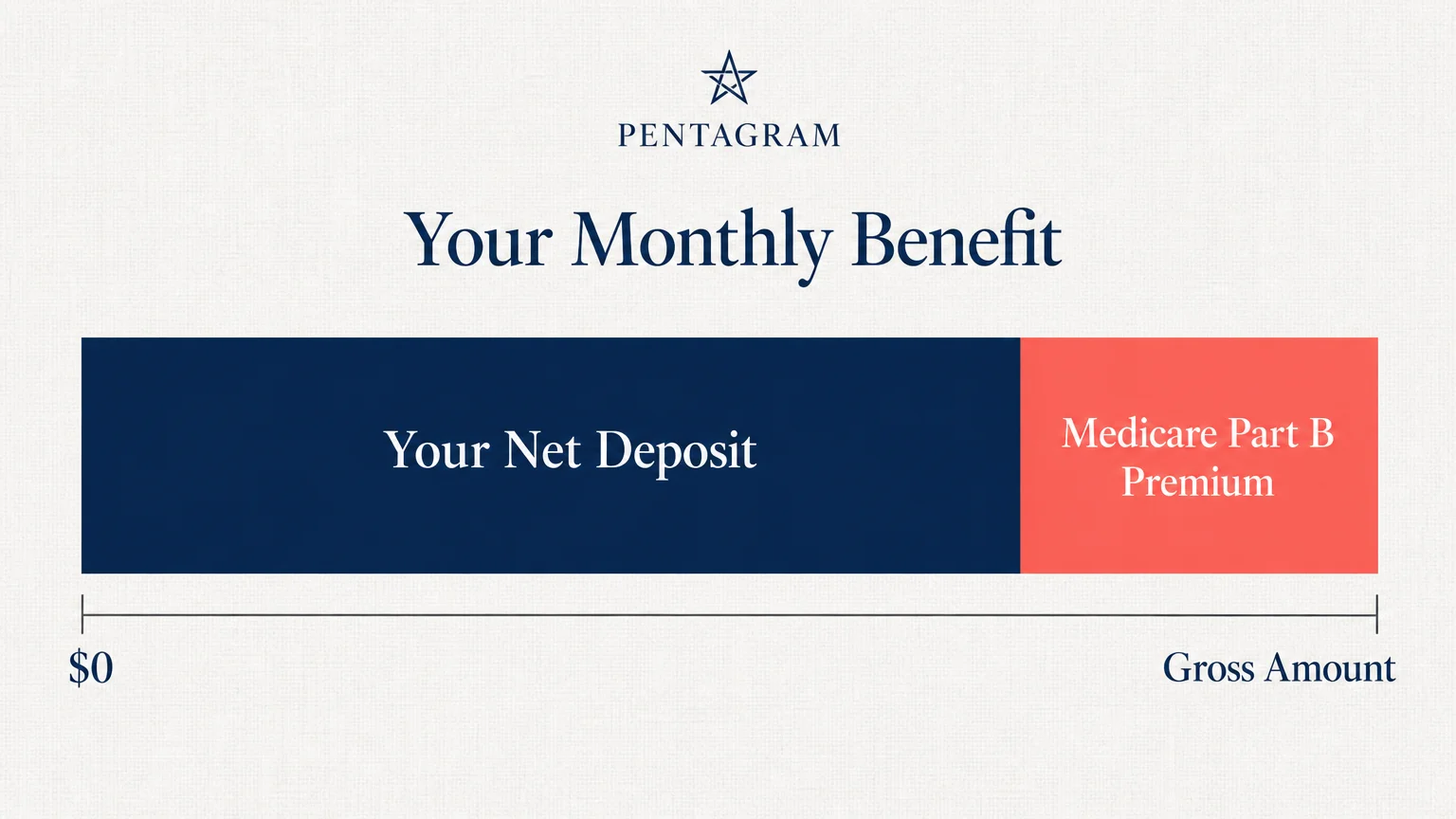
How Medicare Premiums Affect Your Net Deposit
One of the most common sources of confusion for new retirees is the discrepancy between their official award letter and the actual amount deposited into their bank account. Your official benefit amount—often referred to as your gross benefit—is rarely the exact dollar figure that you receive. For the vast majority of beneficiaries, healthcare premiums are siphoned off before the money ever leaves the Treasury.
If you are enrolled in Medicare, your Part B premium (which covers outpatient services, doctor visits, and durable medical equipment) is automatically deducted from your monthly Social Security payment. You do not write a separate check to Medicare.gov; the coordination is handled seamlessly between the two agencies.
Your exact deduction depends entirely on your lifetime earnings and your current income bracket. Most Americans pay the standard Part B premium. However, if your modified adjusted gross income from two years prior exceeds specific IRS thresholds, you will be subject to the Income-Related Monthly Adjustment Amount (IRMAA). This surcharge can significantly reduce your net monthly deposit, and it recalculates annually based on your latest tax returns.
Fortunately, the government enforces a consumer protection mechanism known as the “Hold Harmless” provision. This law dictates that an increase in your Medicare Part B premium cannot reduce your net Social Security benefit below what it was the previous year. If the annual cost-of-living adjustment (COLA) applied to your Social Security benefit is extremely low, and the Medicare premium increase is exceptionally high, the government will cap your Medicare premium increase to ensure your actual take-home pay does not shrink.









Thank you for this message. Very much appreciated.
Great article
Thank you for the monthly layout of the S.S. payment schedule.
Thank you very much for your message.
Excellent info thank you.
Thank you for your message .
We appreciate it
Thank you the article was very informative.
Thank you , it helps to see it in writing,
I am extremely grateful to you for such valuable information.
I am 74, I get S.S., but I am now considered permanently disabled, do I get additional money . Someone told me to check. Who do I call.
when does it start
No you do not, once you turn retirement age , disability stops and you are on regular social security.
Thank you for this important information.
When does this change going into effect?
There is nothing new here. If you read the article closely, you’ll notice that this change has been in effect since May 1997.
So what changed? This seems to be a summaru of what has been for a long time.
I would love it if SS went to twice a month. We go all our working lives getting paid twice a month (or once a week) and suddenly you’re down to once a month. I understand that we get them same no matter how many times we get paid but I know my budget would be better if I continued to get my checks on the 1st and 15th but I guess it’s all about saving money and the lowest bidder. Still sucks though.
Thank you for keeping us updated!
It’s already in effect and has been since 1997
Amazing how many people DON’T “read closely”. This is NOT News!!
Me on the sixth and wife on the 13th–do we get separate days for the payment or do we both get paid on my pay date?
“Claiming at age 62, your Full Retirement Age, or delaying until age 70 will still result in your payment landing on your birth-date-assigned Wednesday.”
This statement is incorrect! My husband took his retirement at 62 and was getting his check on the 4th wednesday, but once he turned 65 it started coming on the 3rd.
It’s news to me as I get SS based on my husband’s earnings, but based on my birthday, not his!! His birthday is the 2nd, mine is the 26th!? Big difference in when I receive SS!
thank you for this important message!
i am 92; will be 93 in December – i do not have a pension. Will I continue to receive social security? That is the only income I have.
My b-day is the 19th. I received my ss check on the 3rd Wednesday of the month. All of a sudden, three years ago, the date was changed to the 1st of each month. I do not understand the change since this article clearly provide that my ss payment should be deposited on the third Wednesday.