
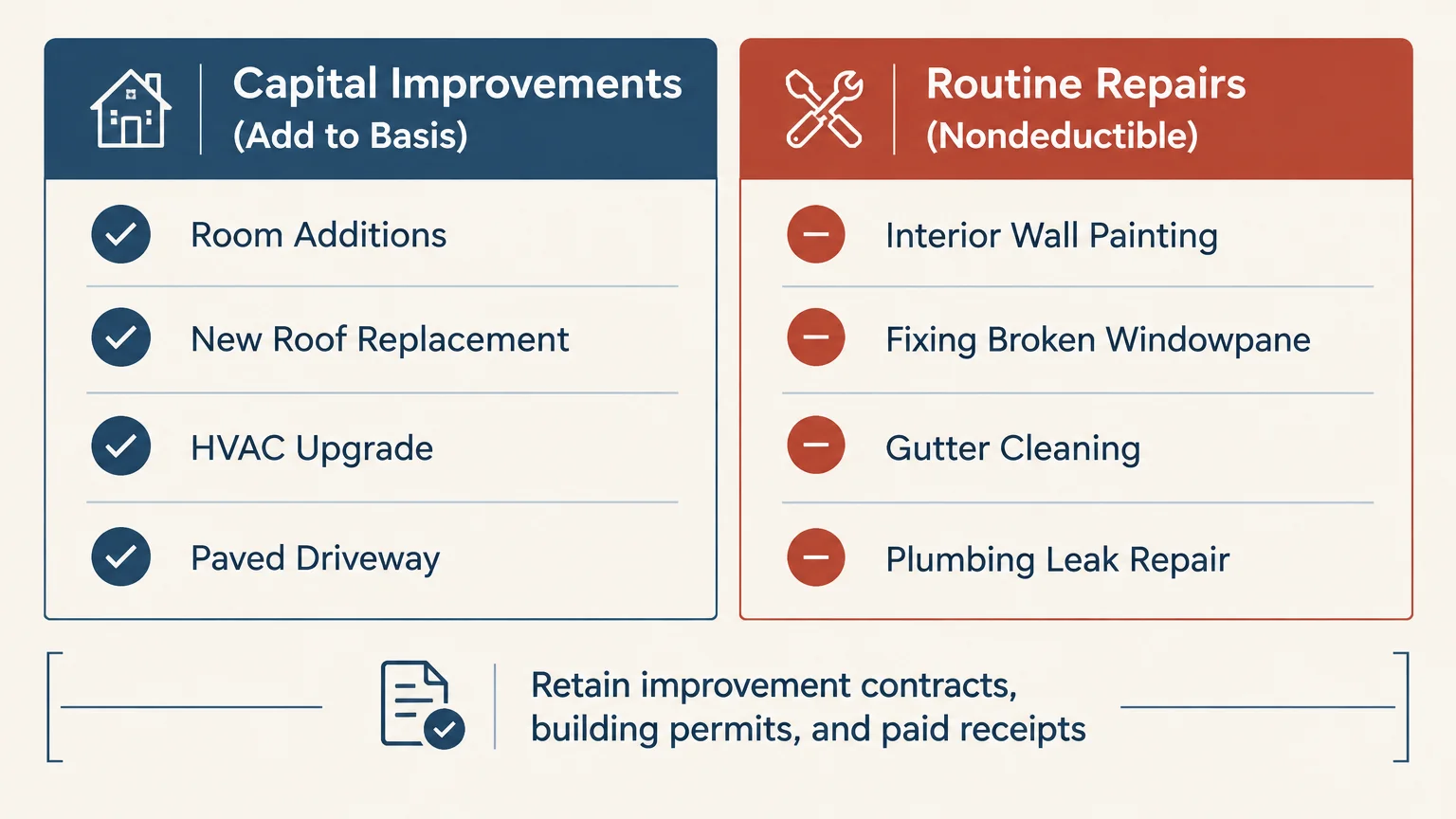
Capital Improvements vs. Routine Repairs: What Paperwork Counts?
Adding capital improvements to your basis represents the most effective legal method to reduce home sale taxes. However, the IRS maintains a clear distinction between capital improvements and routine maintenance.
IRS Publication 523 clarifies that a capital improvement must materially add value to your property, substantially prolong its useful life, or adapt it to entirely new uses.
Routine repairs simply keep your home in an ordinary, efficient operating condition. Money spent on patching drywall, servicing air conditioning compressors, or repairing roof shingles does not increase basis.
If you repair a broken window latch, you have performed routine maintenance. If you replace every single-pane window with modern double-pane energy-efficient units, you have completed a qualifying capital improvement.
| Expense Category | Qualifies for Basis Adjustment? | Examples of Expenses | Retention Period |
|---|---|---|---|
| Capital Improvement | Yes | New roof, room addition, HVAC replacement, swimming pool, perimeter fencing | Duration of ownership + 3 to 6 years post-sale |
| Routine Maintenance | No | Interior painting, gutter cleaning, fixing leaky faucets, replacing broken window panes | 1 year (or until warranty expires) |
| Major Renovation Repair | Yes (as part of project) | Painting and patching done as direct components of a full kitchen remodel | Duration of ownership + 3 to 6 years post-sale |
| Energy-Efficient Upgrades | Yes (Basis reduced by tax credits) | Solar panel installation, heat pump upgrade, energy-efficient exterior doors | Duration of ownership + 3 to 6 years post-sale |
Notice that routine repairs performed as part of a comprehensive remodeling project become part of the capitalized project cost. Always keep comprehensive contractor contracts that describe the full project scope.





To many pop ups this website is tooooo difficult to read!
How long do you have to keep tax returns and accompanying documents if you DON’T own a home?