
Retired in America

Your Guide to a Confident Retirement

  • Home
  • Personal finance
  • Retirement Life
  • Saving & Spending

Here’s How Long You Should Keep Tax Records If You Own a Home

September 9, 2026 · Personal finance

Most homeowners discard tax paperwork after three years; however, that common mistake can cost you tens of thousands of dollars when you sell. Your home requires an entirely different retention schedule than ordinary tax filings.

The Internal Revenue Service expects you to verify your home’s purchase price, legal fees, and major renovations decades after you paid for them. Throwing receipts away too early exposes your retirement nest egg to unnecessary taxes.

Here is your comprehensive homeowner tax record retention guide. Learn exactly which documents to preserve, how long to safeguard them, and when you can safely shred old files.
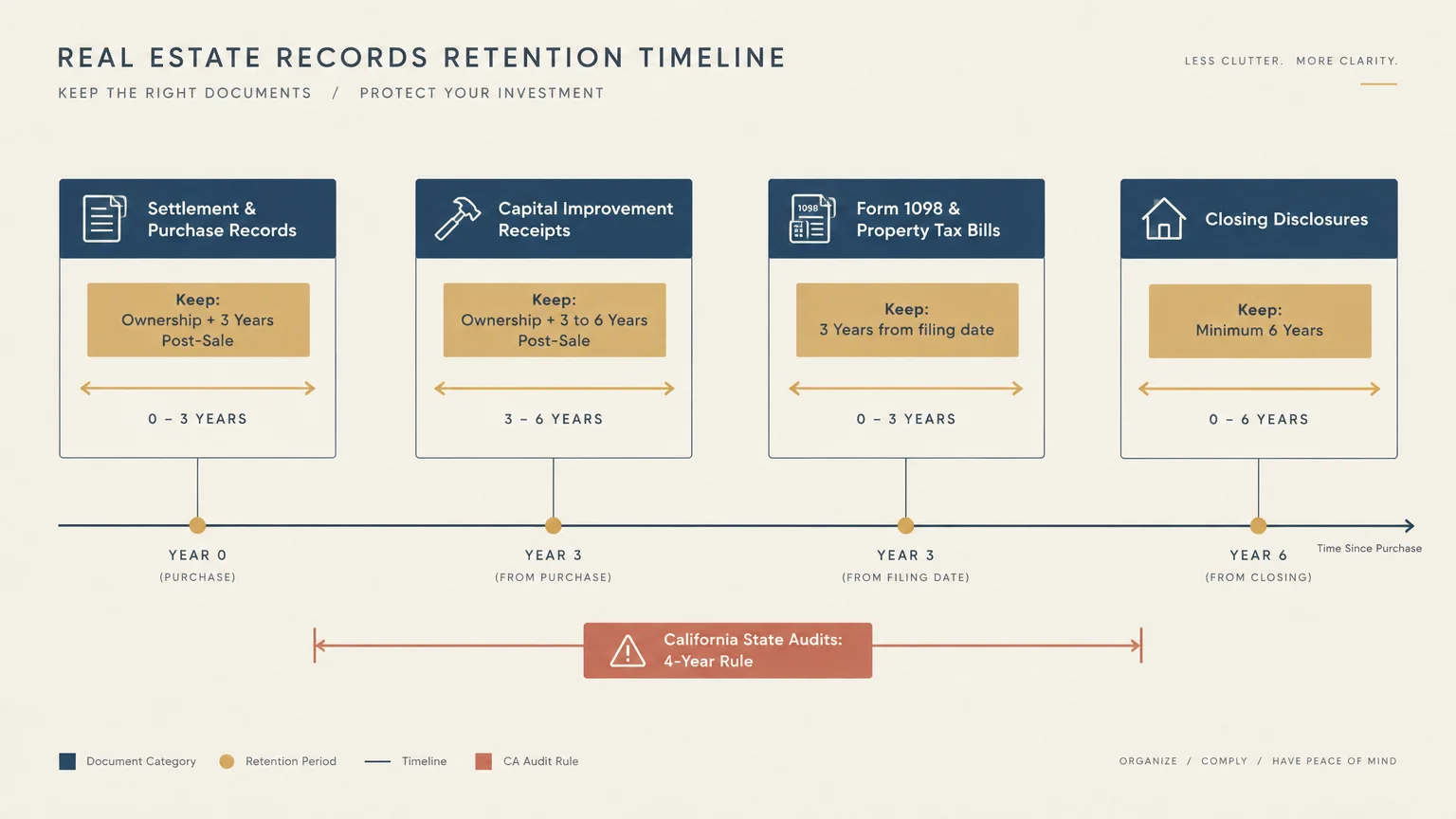
The Essentials: Homeowner Record Timelines at a Glance

Navigating tax record retention does not require saving every hardware store receipt or utility bill. Instead, focus your efforts on documents that determine your cost basis and capital gains liability.

  • Property Purchase and Settlement Records: Retain for the entire period of homeownership plus three years after filing the return for the sale year.
  • Capital Improvement Receipts: Keep contracts, permits, and invoices for the duration of ownership plus three to six years post-sale.
  • Annual Mortgage Interest (Form 1098): Keep for three years after filing the tax return where you claimed the deduction.
  • Property Tax Bills: Retain for three years from the filing date of the return where you deducted state and local taxes.
  • Home Sale Closing Disclosures: Preserve for at least six years following the transaction to guard against extended audit windows.

State tax agencies may enforce longer retention windows than federal guidelines. For example, taxpayers subject to California state audits face a four-year statute of limitations instead of the federal three-year rule.


The General Rule: Ownership Duration Plus Three Years

Under Internal Revenue Code Section 6501(a), the standard federal audit window lasts three years from the date you file your return. That clock begins on your filing date or the mid-April deadline, whichever is later.

Many homeowners assume this general three-year statute applies to all home records from the day of purchase. That misunderstanding creates severe financial consequences when selling a long-held property.

According to Internal Revenue Service Topic 305, property records must be retained until the statute of limitations expires for the tax year in which you dispose of the property. This means you must keep records across decades.

If you purchase a home in 1995 and sell it in 2026, your retention clock expires in 2030. Discarding records before that final three-year post-sale window closes leaves you defenseless during an IRS inquiry.

“Owning a home is a keystone of wealth—both financial affluence and emotional security.” — Suze Orman, Personal Finance Expert

Preserving your property records defends that financial security from avoidable capital gains assessments. Meticulous documentation guarantees that your equity remains where it belongs—in your retirement fund.

Extended Audit Windows: The 6-Year Rule and State Laws

While the standard audit window expires after three years, statutory exceptions frequently double that duration. Home sales attract heightened scrutiny due to the substantial dollar amounts involved.

Under IRC Section 6501(e), the IRS has six years to assess back taxes if a taxpayer omits gross income exceeding 25% of the gross income reported on the return.

If you cannot substantiate capital improvements, the IRS disallows those basis additions and inflates your taxable capital gain. That adjustment can easily trigger the 25% gross income omission threshold.

Once the 25% threshold is breached, the IRS gains three additional years to audit your entire return. Keeping records for six years after the sale protects you against this extended lookback.

State revenue departments also enforce independent statutory limitation periods. For instance, the California Franchise Tax Board operates under a four-year statute of limitations for state income tax examinations.

Homeowners residing in states with longer audit windows must align their record retention schedules with the stricter state standard. Retaining records for six years post-sale covers both federal and state mandates safely.

The Core Purchase Documents: Establishing Your Starting Basis

Your home’s cost basis begins on the date you acquire the deed. Your baseline figure includes the original purchase price plus specific capital expenses paid during the transaction.

The primary document establishing this initial figure is your settlement statement. Homes purchased before October 2015 use the HUD-1 Settlement Statement, while newer transactions use the standard Closing Disclosure.

Guidance from the Consumer Financial Protection Bureau outlines the fees listed on your closing disclosure. Several of these settlement costs add directly to your starting cost basis.

Preserve original statements confirming payment of allowable basis additions:

  • Abstract of title fees, title search expenses, and owner’s title insurance premiums
  • Legal fees for drafting deeds, mortgage contracts, and purchase agreements
  • Survey fees required to establish property boundaries
  • Transfer taxes and local municipal recording charges
  • Utility installation charges paid to connect the home to public municipal grids

Do not confuse these capital closing costs with prepaid deductible items. Prorated property taxes, homeowners insurance premiums, and loan origination fees do not add to your property’s tax basis.

Capital Improvements vs. Routine Repairs: What Paperwork Counts?

Adding capital improvements to your basis represents the most effective legal method to reduce home sale taxes. However, the IRS maintains a clear distinction between capital improvements and routine maintenance.

IRS Publication 523 clarifies that a capital improvement must materially add value to your property, substantially prolong its useful life, or adapt it to entirely new uses.

Routine repairs simply keep your home in an ordinary, efficient operating condition. Money spent on patching drywall, servicing air conditioning compressors, or repairing roof shingles does not increase basis.

If you repair a broken window latch, you have performed routine maintenance. If you replace every single-pane window with modern double-pane energy-efficient units, you have completed a qualifying capital improvement.

Expense Category Qualifies for Basis Adjustment? Examples of Expenses Retention Period
Capital Improvement Yes New roof, room addition, HVAC replacement, swimming pool, perimeter fencing Duration of ownership + 3 to 6 years post-sale
Routine Maintenance No Interior painting, gutter cleaning, fixing leaky faucets, replacing broken window panes 1 year (or until warranty expires)
Major Renovation Repair Yes (as part of project) Painting and patching done as direct components of a full kitchen remodel Duration of ownership + 3 to 6 years post-sale
Energy-Efficient Upgrades Yes (Basis reduced by tax credits) Solar panel installation, heat pump upgrade, energy-efficient exterior doors Duration of ownership + 3 to 6 years post-sale

Notice that routine repairs performed as part of a comprehensive remodeling project become part of the capitalized project cost. Always keep comprehensive contractor contracts that describe the full project scope.

Refinancing Records and Amortization Schedules

Millions of retirees refinanced mortgages over the past two decades to lock in historically low interest rates. Refinancing transactions generate extensive paperwork, but only certain documents require multi-decade retention.

Refinancing fees generally do not add to your home’s capital cost basis. Settlement charges from a refinance relate to securing financing rather than acquiring or improving the real estate.

However, if you paid mortgage points during a refinance, you must deduct those points ratably over the life of the loan. Keep the refinancing closing disclosure until you fully deduct all points.

If you pay off that refinanced mortgage early through a subsequent refinance or home sale, remaining unamortized points become immediately deductible. Retain your prior closing statement to claim that remaining deduction.

Keep Form 1098 statements for at least three years from the date you file each return. For loans originated after December 15, 2017, deductions apply only to interest on up to $750,000 of mortgage debt.

Older mortgages originated on or before December 15, 2017, remain grandfathered under the prior $1,000,000 limit. Keep original promissory notes and closing disclosures to prove grandfathered loan qualification during an audit.

Clean Energy Credits and Basis Adjustments

Federal residential energy tax credits encourage homeowners to install solar panels, heat pumps, and energy-efficient roofs. While these credits lower your annual tax bill, they affect your property basis calculations.

Under tax law, claiming a federal residential clean energy credit requires you to reduce your home’s basis by the dollar value of the credit claimed.

Suppose you spend $30,000 installing a rooftop solar energy system and receive a 30% federal tax credit worth $9,000. Your net addition to your home’s tax basis equals $21,000, not the full $30,000 contract price.

Save IRS Form 5695 alongside paid contractor invoices, equipment manufacturer certification statements, and proof of payment. Hold these records for the life of the property plus three to six years post-sale.

Casualty Losses, Disasters, and Insurance Reimbursements

Severe weather events and accidental damage can trigger insurance payouts or casualty loss tax deductions. These financial events directly alter your home’s tax basis.

When you receive an insurance reimbursement for property damage, that payout reduces your home’s adjusted basis. Conversely, subsequent out-of-pocket expenditures to rebuild or improve the structure increase your basis.

If you experience a federally declared disaster, you may claim a casualty loss deduction on your tax return. Documenting these losses requires meticulous appraisal and insurance records.

Keep insurance adjuster settlement reports, rebuild contracts, and proof of deductible payments. Maintain these documents for your entire ownership tenure plus at least three years after selling the property.

Section 121 Exclusion Rules and Documentation

The Section 121 exclusion offers substantial relief from capital gains taxes when you sell a principal residence. Single filers can exclude up to $250,000 in capital gain, while married couples filing jointly can exclude $500,000.

To qualify, you must pass the two-out-of-five-year ownership and use tests under Internal Revenue Code Section 121. Educational guides on Kiplinger provide detailed breakdowns of these residency rules.

Never assume the exclusion eliminates your need to retain home ownership tax records. Long-term property appreciation across two or three decades frequently pushes net profits well beyond the statutory exclusion amounts.

If a married couple sells a home for an $800,000 gross gain, they must prove at least $300,000 in capital improvements to avoid paying taxes on the excess gain.

Special provisions protect surviving spouses under Internal Revenue Code Section 121(b)(4). A surviving spouse who has not remarried can claim the full $500,000 exclusion if selling within two years of their spouse’s death.

Surviving spouses must retain death certificates and historical deeds proving both spouses satisfied ownership and residency tests before the death occurred. These files guarantee your claim to the higher exclusion limit.

Inherited Homes and Stepped-Up Basis Records

Inheriting a residence brings substantial tax advantages through the stepped-up basis provision under IRC Section 1014. The property’s cost basis resets to fair market value on the decedent’s date of death.

The stepped-up basis wipes away decades of accrued capital gains accumulated by the previous owner. However, heirs must document this new starting valuation accurately.

Obtain a professional real estate appraisal from a licensed appraiser immediately following the decedent’s passing. Estate tax filings on Form 706 also serve as acceptable valuation proof.

Retain that date-of-death appraisal report for as long as you hold the inherited property, plus three to six years after you file the sale return.

“An investment in knowledge pays the best interest.” — Benjamin Franklin, Founding Father & Polymath

Understanding basis step-up rules protects family estates from thousands of dollars in unnecessary capital gains liabilities. Accurate documentation preserves generational wealth during inheritance transitions.

Organizing and Storing Your Home Tax Records Digitally

Paper receipts printed on thermal paper fade within five to seven years, rendering them unreadable during an audit. Modern tax record keeping requires a secure digital preservation strategy.

IRS Revenue Procedure 97-22 confirms that electronic records meet statutory requirements if they are legible, accurate, and easily retrievable. You do not need to preserve boxes of crumbling paper.

Adopt the industry-standard 3-2-1 backup protocol to safeguard your homeowner tax documents:

  • Three Total Copies: Maintain three distinct copies of every property document and capital improvement receipt.
  • Two Different Media Types: Store files across two separate storage media formats, such as an internal hard drive and an external encrypted solid-state drive.
  • One Offsite Location: Safeguard at least one synchronized copy in secure, encrypted cloud storage to protect against fire, flood, or physical theft.

Store original physical deeds, mortgages, and signed closing disclosures in a waterproof, fire-rated home safe. While digital copies satisfy the IRS, title companies and probate courts occasionally require original ink signatures.

Avoiding Common Errors with Home Ownership Tax Records

Minor oversights during ownership can lead to substantial penalties and disallowed deductions decades later. Avoid these common documentation mistakes to protect your home equity.

  • Throwing Away Purchase Documents After Refinancing: Refinancing replaces your mortgage debt, but it never replaces your original purchase settlement statement. Keep your original purchase Closing Disclosure permanently.
  • Claiming Routine Repairs as Capital Basis Additions: Claiming everyday repairs as capital improvements will cause IRS auditors to disallow your basis adjustments. Maintain separate files for routine repairs and genuine capital projects.
  • Failing to Obtain Date-of-Death Appraisals: Relying on municipal property tax assessments to establish inherited basis is a costly mistake. Always commission an independent, certified date-of-death appraisal report.
  • Discarding Invoices for Work Paid in Cash: The IRS routinely disallows handwritten receipts or canceled checks lacking itemized contractor invoices. Ensure all capital improvement invoices detail materials, labor, and completion dates.
  • Purging Records Prematurely During Downsizing Moves: Downsizing into retirement often triggers hasty household purges. Never discard property files until three to six years after filing the final sale return.

Systematic record management prevents these common documentation blunders. Taking time to organize your files annually ensures complete peace of mind when selling your property.

When DIY Isn’t Enough

Straightforward home sales rarely present insurmountable challenges, but certain real estate situations require professional guidance. In these scenarios, independent record keeping often leads to costly reporting errors.

Consult a certified public accountant (CPA) or enrolled agent if you encounter any of these complex circumstances:

  • Converting Your Primary Home into an Income Property: Transitioning your personal home into a rental requires bifurcating your basis between land and building structures. A tax professional tracks depreciation deductions and manages depreciation recapture under IRC Section 1250 upon sale.
  • Claiming Past Home Office Deductions: If you claimed home office depreciation, you must recapture that depreciation at a 25% tax rate when selling. Professional preparation guarantees that depreciation recapture does not compromise your Section 121 capital gains exclusion.
  • Division of Marital Property During Divorce: Transferring real estate under IRC Section 1041 shifts historical cost basis between former spouses without immediate taxation. A financial advisor verifies carryover basis figures to avoid lopsided tax consequences later.
  • Capital Gains Substantially Exceeding Exclusion Limits: Rapid appreciation in high-cost housing markets frequently pushes gains well beyond $250,000 or $500,000 limits. A tax specialist reviews all historical documentation to uncover every legitimate basis addition.

Working with a credentialed tax advisor prevents compliance errors on high-stakes transactions. Professional oversight protects your retirement assets from aggressive state and federal audits.

Frequently Asked Questions

How long should I keep tax records if I own a home?

Keep property records for as long as you own the home plus at least three years after filing the tax return for the sale year. If your capital gain exceeds the 25% underreporting threshold, retain them for six years.

Do I need to keep receipts for routine home maintenance?

No, routine maintenance receipts do not increase your home’s adjusted basis for personal residences. You only need to keep records for capital improvements that add permanent value, prolong structural life, or adapt the space to new uses.

What happens if I lose my original home purchase closing statement?

Contact the title company, closing attorney, or mortgage lender that managed your purchase transaction to request digital copies. You can also obtain historical property deed copies and transfer tax records through your local county recorder.

Can I scan my paper property tax documents and shred the paper originals?

Yes, the IRS accepts legible electronic records under Revenue Procedure 97-22. Ensure your digital scans capture both sides of documents, maintain high clarity, and are backed up securely across multiple storage platforms.

How long should I keep Form 1098 mortgage interest statements?

Retain Form 1098 statements for at least three years from the date you filed your tax return claiming the mortgage interest deduction. If you filed under an extension, count three years from your actual submission date.

Protecting Your Hard-Earned Home Equity

Establishing an orderly homeowner tax record retention system today eliminates stress when you eventually downsize or liquidate property. Gather your purchase disclosures, categorize your improvement receipts, and digitize critical documents into secure folders.

This article provides general retirement education and information only. Every retiree’s situation is unique—what works for others may not work for you. For personalized advice, consider consulting a qualified financial professional such as a CFP or CPA.


Last updated: March 2026. Retirement benefits, tax rules, and healthcare regulations change frequently—verify current details with official sources.

Share this article

Facebook Twitter Pinterest LinkedIn Email

Leave a Reply Cancel reply

Your email address will not be published. Required fields are marked *

Search

Latest Posts

  • Here's How Long You Should Keep Tax Records If You Own a Home
  • 5 States With Extra Payments on Top of Federal Benefits
  • The 10 Best Small Towns for Retirees to Stretch a Social Security Check
  • What Happens to Your Social Security If You Work Part-Time After 65
  • A stressed older couple sits on the floor of an empty living room surrounded by unpacked cardboard moving boxes. 5 States Retirees Regret Moving to, Based on Cost and Lifestyle
  • A smiling senior woman stands outside near a porch surrounded by lush garden greenery, hiking boots, and a warm mug. 12 Things to Do Instead of Watching TV All Day in Retirement
  • Shocked older man holding a landline phone receiver while reviewing financial bills at a kitchen table. 8 Things to Do the Moment You Realize You've Been Scammed
  • A smiling senior woman buys fresh vegetables from a vendor at a bustling outdoor farmers market. Farmers Market Vouchers for Low-Income Seniors
  • Adirondack chairs on a wooden deck overlooking a misty lake with a dock, canoe, and lakeside cabin at sunrise. 7 Lakefront Towns Where Retirees Get More House for Less
  • Senior man sitting at a wooden kitchen table reviewing a Social Security document with a pen, glasses, and calculator. 7 Ways Retirees Waste Their COLA Raise Every Year

Newsletter

Get retirement planning tips, savings strategies, and lifestyle insights delivered to your inbox.

Related Articles

10 Retirement Financial Milestones You Need to Achieve by Age 50

As you approach another one of your birthday milestones, you should take a minute to…

Read More →
A senior man sits at a wooden table reviewing a Social Security Administration statement with a pen and notebook.

Why So Few Retirees Qualify for Social Security’s Biggest Possible Monthly Check

Learn why less than 1% of retirees qualify for the maximum $5,181 Social Security benefit…

Read More →

10 Quick Ways to Earn Some Extra Cash During Retirement

Are you retired or planning to do so in the foreseeable future and want to…

Read More →

10 Stimulus Check Details That Are Crucial for Social Security Recipients

If you’ve been anxiously waiting for the second stimulus check, we don’t blame you. Most…

Read More →
An older couple sitting at a sunlit kitchen table reviewing financial documents together in a warm, candid moment.

How Much You’ll Actually Get From Social Security at Every Age

Discover exact Social Security benefit payouts from age 62 to 70 with 2026 updates, earnings…

Read More →
An older woman practices balance therapy with a physical therapist in a bright, sunlit rehabilitation room.

8 Medicare Rules for Skilled Nursing Facility Stays

Learn the 8 essential Medicare rules for skilled nursing facility stays, including the 3-day rule,…

Read More →

9 401(k) Tips to Get More Money in Retirement

A smiling senior man reads a retirement guide while relaxing in his bright, modern living…

Read More →

These 11 Cities Are Where Seniors Are Most and Least Financially Secure

Discover which 11 cities offer the strongest economic safety nets for retirees and which locations…

Read More →
An editorial gouache illustration showing a stylized Social Security card sliced at the top, revealing gold coins inside.

Could Social Security Taxes Change Again?

Discover the history of Social Security taxation, looming legislative changes ahead of the trust fund…

Read More →
Retired in America

Your Guide to a Confident Retirement

Inedit Agency S.R.L.
Bucharest, Romania

contact@retiredinamerica.com

Trust & Legal

About Us

Editorial Policy

Advertiser Disclosure

Frequently Asked Questions

Contact Us

Disclaimer

Terms and Conditions

Privacy Policy

Subscribe

Unsubscribe

Categories

  • Personal finance
  • Retirement Life
  • Saving & Spending

© 2026 Retired in America. All rights reserved.