
Tax Implications of Working While Collecting Benefits
While the 2027 earnings test limits offer relief, you must still monitor the federal income taxation of your benefits. Earning wages often exposes your monthly benefits to income taxes.
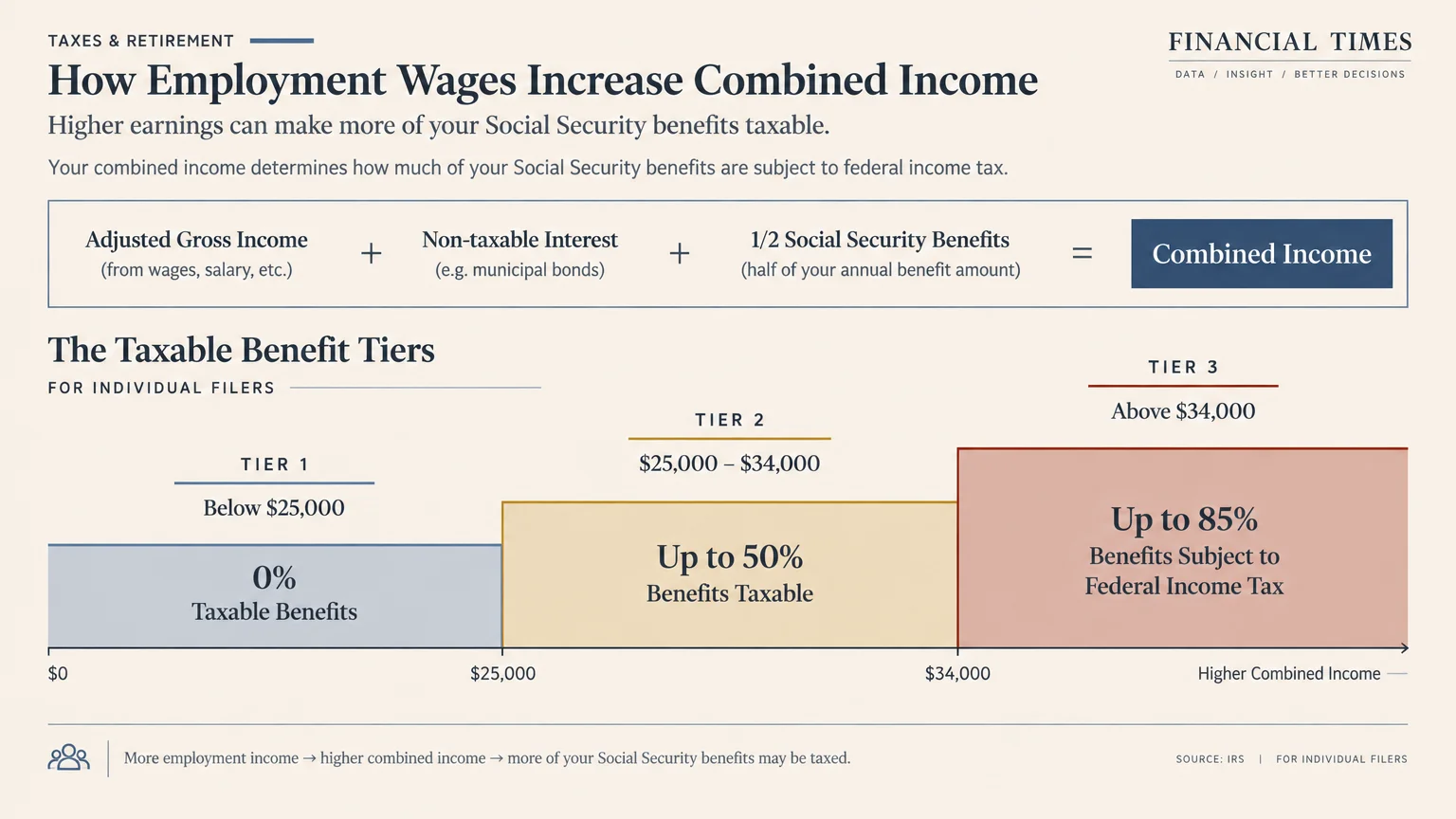
The Internal Revenue Service determines benefit taxation using a metric called provisional income. You calculate provisional income by adding your adjusted gross income, tax-exempt municipal interest, and half of your annual Social Security check.
Federal tax thresholds for provisional income remain unindexed for inflation, making them easy to trigger:
- Single filers with provisional income between $25,000 and $34,000 pay tax on up to 50 percent of their benefits.
- Single filers above $34,000 pay income tax on up to 85 percent of their benefits.
- Married couples filing jointly with provisional income between $32,000 and $44,000 pay tax on up to 50 percent of their benefits.
- Married couples filing jointly above $44,000 pay income tax on up to 85 percent of their benefits.
When you earn wages alongside your benefits, you can quickly cross into the 85 percent taxation tier. This scenario is widely known as the retirement tax torpedo.
To avoid tax season surprises, you can complete Form W-4V to elect voluntary federal withholding from your monthly Social Security check. Setting aside 10 or 12 percent helps maintain predictability.
Medicare Surcharges for Higher-Earning Working Retirees
High earners who work while collecting benefits must also watch out for Medicare premiums. If your wages push your total income upward, you might face the Income-Related Monthly Adjustment Amount, or IRMAA.
IRMAA applies an added surcharge to your standard Medicare Part B and Part D premiums. The program evaluates your modified adjusted gross income using tax returns from two years prior.
Wages earned in 2027 directly impact your Medicare premiums for calendar year 2029. Crossing an IRMAA bracket by even one single dollar triggers the entire surcharge tier for that calendar year.
You can track updated baseline premiums and bracket cutoffs through Medicare.gov as you structure your annual earnings. Combining high wages with benefit claims demands coordinated planning across tax and healthcare systems.