
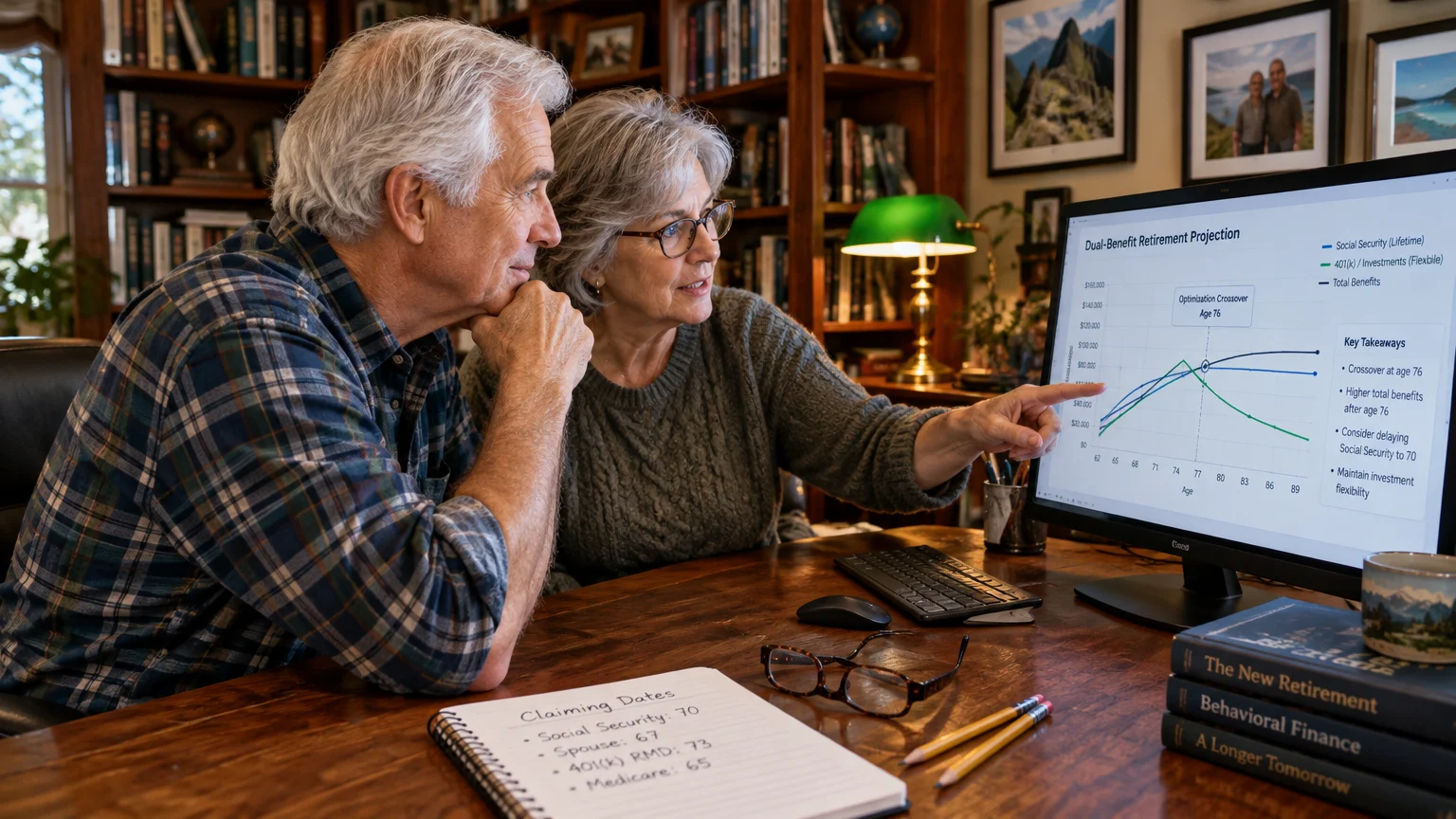
Professional vs. Self-Guided Claiming Strategies
Deciding how to claim spousal benefits depends heavily on the complexity of your household finances. Some couples can handle filing independently, while others benefit significantly from professional advisory services.
Consider a self-guided approach if you and your spouse have similar career earnings and straightforward work histories. Free estimation calculators from the Consumer Financial Protection Bureau help model basic scenarios.
Seek professional guidance if there is a significant age or earnings discrepancy between partners. A fee-only financial planner can optimize claiming ages to protect the lower-earning partner long-term.
Professional advice is essential if you navigate multiple past marriages lasting at least 10 years each. An expert can determine which former partner’s earnings record yields the largest monthly benefit.
Widows and widowers should also consult an expert before claiming any benefits. Strategically staggering personal and survivor payouts requires precise timing to prevent permanent benefit losses.
“Retirement is not the end of the road, but a change in the road.” — Mitch Anthony, Retirement Educator
Frequently Asked Questions
Can I collect spousal benefits if my spouse has not filed yet?
Your current spouse must file for their own retirement benefits before you can receive spousal payments. The only exception applies to divorced spouses who have been divorced for at least two continuous years.
How does divorce affect my spousal Social Security benefits?
Divorce does not eliminate your auxiliary benefits if your marriage lasted at least 10 consecutive years. You must remain unmarried and be at least 62 years old to qualify.
Can I collect spousal benefits and switch to my own benefit later?
Under universal deemed filing rules, you cannot claim a standard spousal benefit first and let your own benefit grow. However, surviving spouses claiming survivor benefits can execute this switching strategy.
Does my spousal benefit increase if my spouse waits until age 70 to file?
No, your living spousal benefit tops out at 50 percent of your partner’s base Full Retirement Age amount. However, if your spouse passes away, you will inherit their full enhanced benefit at age 70.
Taking Action on Your Spousal Benefits
Taking time to evaluate spousal benefit rules protects your household against unnecessary financial stress during retirement. Review your earnings records together and establish a coordinated claiming roadmap before contacting the Social Security Administration.
This is educational content based on general retirement and financial principles; individual results vary based on your situation. Always verify current benefit rules, tax laws, and eligibility requirements with official sources like SSA, Medicare.gov, or the IRS.
Last updated: March 2026. Retirement benefits, tax rules, and healthcare regulations change frequently—verify current details with official sources.





I want to receive this info. Very informative!
Can you send a link to the appropriate page for me to check out spousal benefits? Thank you
Send the link for spousal benefits
Very helpful
How do we get the link to get more information