
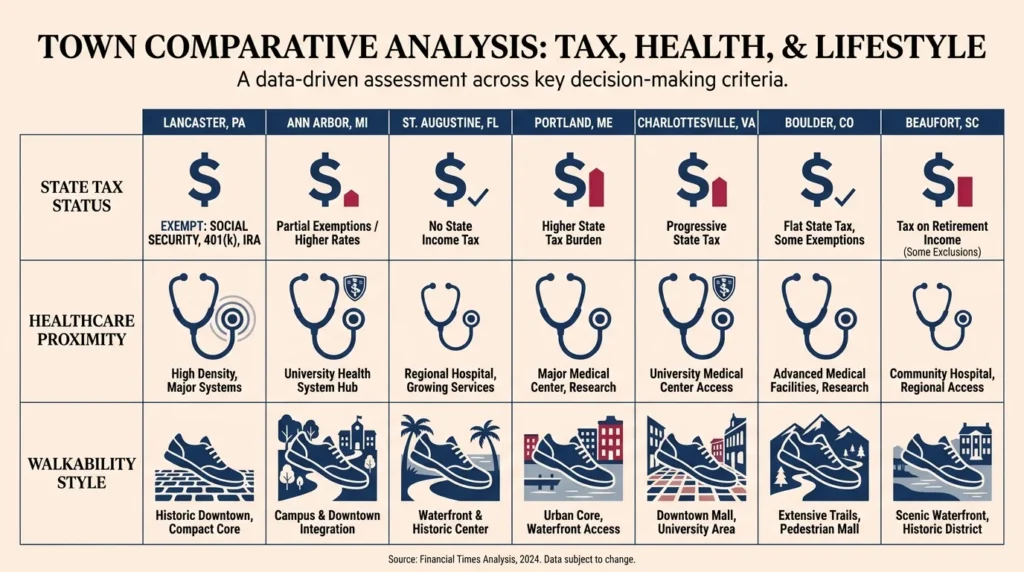
Comparing Your Walkable Relocation Options
When weighing these destinations, consider how the climate, cost of living, and healthcare infrastructure align with your specific retirement goals.
| Retirement Town | Walkability Highlight | Climate / Terrain | Primary Healthcare System |
|---|---|---|---|
| Lancaster, PA | Central Market & Grid Layout | Four Seasons / Flat | Penn Medicine Lancaster Gen. |
| Ann Arbor, MI | Kerrytown & Campus Proximity | Cold Winters / Mostly Flat | Univ. of Michigan Health |
| St. Augustine, FL | St. George Pedestrian Street | Hot, Humid / Extremely Flat | Flagler Hospital |
| Portland, ME | Compact Peninsula Living | Cold Winters / Moderate Hills | Maine Medical Center |
| Charlottesville, VA | 8-Block Downtown Mall | Moderate Seasons / Hilly | UVA Health System |
| Boulder, CO | Extensive Multi-Use Paths | Sunny, Snowy / High Altitude | Boulder Community Health |
| Beaufort, SC | Waterfront Park & Bay Street | Warm, Humid / Flat Coastal | Beaufort Memorial Hospital |
Don’t Make These Mistakes When Relocating
Moving to a new city in retirement is a massive logistical and financial undertaking. To ensure your walkable dream does not turn into a frustrating reality, avoid these common missteps.
- Confusing “Charming” with “Accessible”: Historic cobblestone streets look beautiful in photographs, but they present significant trip hazards and make using a walker or wheelchair incredibly difficult. Look for smooth, well-paved sidewalks with proper curb cuts at intersections.
- Ignoring the Winter Reality: A town with a high Walk Score in July might become unnavigable in February. If you are looking at northern towns like Portland or Ann Arbor, research the municipality’s snow removal ordinances. Do they clear public paths quickly, or are homeowners responsible for their own sidewalks?
- Buying Before Renting: Never purchase a home in a new town based solely on a weekend vacation. Rent a property for three to six months—ideally during the region’s worst weather season—to test the true walkability. Attempt to live your daily life, carry groceries home, and navigate to the pharmacy on foot before committing your capital.
- Overlooking the “Aging in Place” Trajectory: Walking two miles to the grocery store might feel invigorating at age 65, but it could become a daunting barrier at 82. Ensure that essential services—pharmacy, basic groceries, and primary care—are within a flat, manageable half-mile radius of your chosen home.
Navigating Healthcare and Benefits in a New State
Relocating across state lines requires more than just forwarding your mail; it demands a thorough review of your healthcare coverage. Original Medicare (Parts A and B) travels with you seamlessly anywhere in the United States. However, if you utilize a Medicare Advantage plan (Part C) or a standalone prescription drug plan (Part D), your coverage is strictly tied to your specific county or zip code.
When you move to a new town, you trigger a Special Enrollment Period. You must use this window to switch to a plan that operates in your new service area. Waiting too long can result in coverage gaps or steep out-of-network medical bills. You can easily compare plans available in your new walkable town using the official Medicare.gov plan finder tool before you officially change your address.
Additionally, investigate the local aging support infrastructure. Every region in the United States is served by an Area Agency on Aging, which coordinates local services like transportation, meal delivery, and in-home support. Before making a final decision on a town, use the Eldercare Locator, provided by the Administration for Community Living, to identify the local agency and evaluate the community resources available to older adults.
Frequently Asked Questions
What is a good Walk Score for a retirement destination?
Walk Score is a popular metric ranging from 0 to 100. For true pedestrian independence in retirement, look for neighborhoods with a score of 70 or higher (indicating most errands can be accomplished on foot). Scores above 90 represent a “Walker’s Paradise” where daily errands do not require a car at all.
Are highly walkable towns more expensive for retirees?
Generally, yes. Real estate data consistently shows a “walkability premium,” meaning homes in highly walkable neighborhoods cost more per square foot than car-dependent suburban counterparts. However, you must offset this higher housing cost against the massive financial savings of eliminating car payments, auto insurance, gas, and vehicle maintenance.
How do I evaluate a town’s pedestrian safety?
When you visit, pay attention to the infrastructure. Are the sidewalks wide and set back from the road? Do crosswalks provide audio signals and adequate countdown timers for slower walkers? Are there streetlights for evening visibility, and mature trees to provide shade during the summer? Lastly, look for public benches—having places to rest is crucial for long-term mobility.
Choosing to embrace a pedestrian-oriented lifestyle is an investment in your physical health, your social life, and your independence. Take the time to visit these communities, walk their streets, and visualize your daily routine. By selecting a town that supports your mobility naturally, you ensure your retirement years remain active, engaged, and deeply fulfilling.
Retirement rules and benefit amounts vary based on individual work history, income, and circumstances. This article provides general guidance only. Consult a SHIP counselor, financial advisor, or elder law attorney for advice specific to your situation.
Last updated: February 2026. Medicare and Social Security rules change annually—always verify current details at official government sources.









Leave a Reply