
Turning 65 marks a crucial financial transition as Medicare eligibility alters your health insurance rights and responsibilities. Missing key enrollment dates during this milestone can trigger permanent financial penalties and lifetime coverage gaps. Whether you plan to continue working past 65 or retire immediately, understanding how your birth month governs your choices is essential. The timing of your application dictates when your coverage begins, whether you face Part B late penalties, and how your Health Savings Account operates. By mastering the strict federal deadlines surrounding your 65th birthday, you protect both your retirement savings and your long-term medical care from costly regulatory surprises.
The Essentials
-
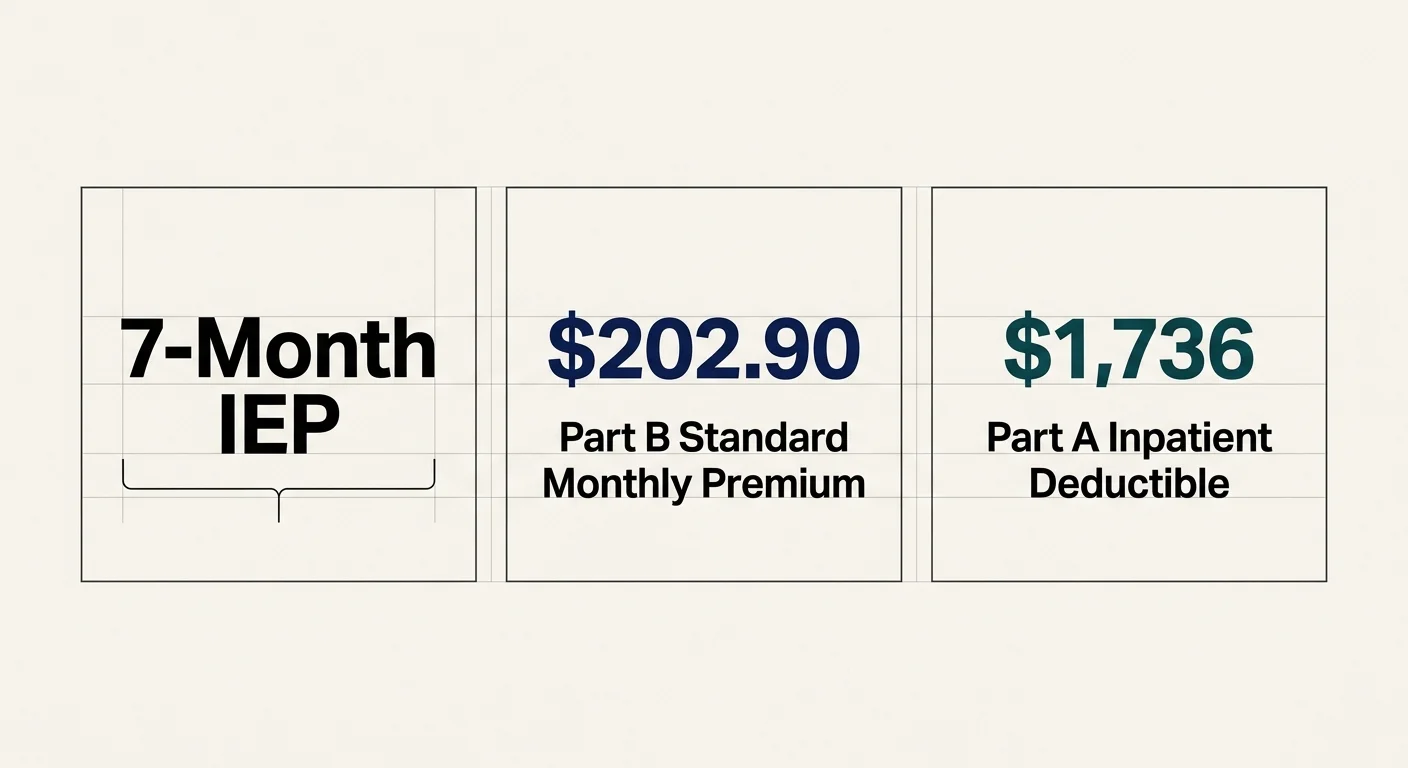
7-Month Window: Your Initial Enrollment Period spans seven months—three months before your 65th birthday month, your birth month, and three months after.
Automatic vs. Manual: Social Security recipients enroll automatically in Parts A and B, but if you have not claimed Social Security benefits yet, you must apply manually.
2026 Cost Benchmarks: The standard Medicare Part B monthly premium is $202.90, the Part B annual deductible is $283, and the Part A inpatient deductible is $1,736 per benefit period.
The First-of-the-Month Rule: If your birthday falls on the first day of any month, federal rules move your entire timeline and enrollment window back by one full calendar month.
The HSA Retroactive Trap: Enrolling in Part A past age 65 triggers up to six months of retroactive coverage, which invalidates concurrent Health Savings Account contributions and creates tax penalties if uncorrected.


The 65th Birthday Milestone: Why This Date Rewrites Your Healthcare Blueprint
Your 65th birthday represents much more than a personal celebration; it serves as the official threshold for medicare age eligibility under federal law. Up to this point, commercial insurance, employer plans, or ACA marketplace policies dictated your coverage terms, out-of-pocket maximums, and network restrictions. Once you hit this milestone, the federal government steps in to establish a standardized framework for your healthcare funding. Understanding the operational mechanics of this milestone ensures that you transition smoothly without facing unexpected interruptions in treatment or sudden spikes in out-of-pocket expenses.
A common misconception among pre-retirees involves the belief that Medicare enrollment happens automatically for everyone. The federal government links automatic Medicare enrollment directly to your Social Security status. If you already receive Social Security retirement benefits or Railroad Retirement Board benefits at least four months before turning 65, the government automatically enrolls you in Medicare Part A (Hospital Insurance) and Medicare Part B (Medical Insurance). The Social Security Administration mails your red, white, and blue Medicare card to you roughly three months before your birthday month.
However, if you choose to delay claiming Social Security benefits past age 65—a strategy frequently used to maximize monthly lifetime payouts—you will not receive automatic enrollment. You must proactively submit an application for Medicare through the Social Security Administration or online at Medicare.gov. Ignoring this active step during your medicare enrollment age 65 window can result in severe coverage gaps and lifelong premium surcharges that erode your financial security throughout retirement.
“Medicare isn’t just a health choice; it’s a core wealth protection decision that requires precise timing.” — Suze Orman, Financial Author and Host
The stakes surrounding turning 65 medicare decisions involve far more than picking a plan off a shelf. You are selecting a lifetime health coverage structure. The decisions you make during this window dictate whether you can consult any physician in the country or remain restricted to regional managed care networks. Furthermore, these choices determine whether you carry uncapped 20% coinsurance liability or lock in predictable monthly out-of-pocket limits. Treating your 65th birthday as a major financial event allows you to take control of your long-term health outcome.

Decoding the 7-Month Initial Enrollment Period (IEP)
Federal regulations build your primary window for signing up around your birth month. This period, known officially as the medicare initial enrollment period (IEP), lasts for seven full calendar months. It begins three months before the month you turn 65, includes your birth month, and concludes three months after your birth month ends. Mapping these dates on your calendar ensures that you execute your paperwork with complete precision.
To visualize this timeline, consider an individual celebrating a birthday on July 14th. Their seven-month medicare enrollment birthday window opens on April 1st, spans May, June, July (the birth month), August, September, and officially closes on October 31st. Applying during the initial three months (April, May, or June) guarantees that Medicare Part A and Part B take effect on the very first day of July. Applying during the birth month or the three months after will still secure coverage, but processing times can create temporary delays in card issuance.
A critical statutory exception applies to anyone born on the very first day of any month. If your birthday falls on June 1st, federal regulations treat you as though you reached age 65 in the preceding month (May). Consequently, your entire seven-month initial enrollment period shifts back by one calendar month. For a June 1st birthday, your window opens February 1st, includes May as your effective milestone month, and closes August 31st. Your coverage becomes effective on May 1st, a full month before your calendar birthday.
| Enrollment Submission Timing | Effective Date of Coverage | Processing Considerations |
|---|---|---|
| 3 Months Before Birth Month | 1st Day of Birth Month | Optimal window; ensures seamless transition with no insurance lapse. |
| 2 Months Before Birth Month | 1st Day of Birth Month | Prevents coverage gaps; ID card arrives prior to effective date. |
| 1 Month Before Birth Month | 1st Day of Birth Month | Sufficient timing, though plan materials may arrive shortly after start date. |
| During Birth Month | 1st Day of Following Month | Coverage starts the next month; medical claims before that date use prior coverage. |
| 1 to 3 Months After Birth Month | 1st Day of Following Month | Valid IEP enrollment, but requires careful handling of temporary care needs. |
Failing to enroll during this seven-month window without qualifying employer health coverage forces you to wait for the General Enrollment Period (GEP), which runs annually from January 1st to March 31st. Enrolling during the GEP means your coverage starts the first day of the month after you sign up. However, you will incur cumulative lifetime financial penalties for late enrollment, which the federal government permanently adds to your monthly insurance premiums.

The True Cost of Medicare in 2026: Premiums, Deductibles, and Coinsurance
Budgeting accurately for healthcare in retirement requires a complete understanding of statutory Medicare costs. Federal health insurance is not free; it operates through a combination of monthly premiums, annual deductibles, and coinsurance obligations. The Centers for Medicare & Medicaid Services (CMS) adjusts these statutory figures annually based on national healthcare expenditure shifts.
Medicare Part A covers inpatient hospital stays, skilled nursing facility care, hospice care, and home healthcare services. Most Americans do not pay a monthly premium for Part A. If you or your spouse worked and paid Medicare payroll taxes for at least 10 years (40 quarters), you receive premium-free Part A. If you fall short of this work history, you can purchase Part A in 2026 for either $311 or $565 per month, depending on whether you accumulated between 30 and 39 work quarters. For inpatient hospital admissions in 2026, the Part A deductible stands at $1,736 per benefit period. A benefit period begins the day you enter a hospital and ends when you have received no inpatient care for 60 consecutive days.
Medicare Part B covers doctor visits, outpatient care, medical equipment, preventive services, and lab tests. For 2026, the standard Part B monthly premium is $202.90 per beneficiary. In addition to the monthly premium, you must satisfy an annual Part B deductible of $283 before Medicare begins paying its share. Once you meet the deductible, Original Medicare generally pays 80% of Medicare-approved amounts for covered services, leaving you responsible for the remaining 20% coinsurance with no annual out-of-pocket upper limit.
High-income earners face additional surcharges known as the Income-Related Monthly Adjustment Amount (IRMAA). The Social Security Administration evaluates your modified adjusted gross income (MAGI) from your federal tax return from two years prior (using 2024 tax returns to calculate 2026 premiums) to determine if you must pay higher Part B and Part D premiums.
| 2024 MAGI – Single Return | 2024 MAGI – Joint Return | 2026 Part B Monthly Premium | 2026 Part D Monthly Surcharge |
|---|---|---|---|
| $106,000 or less | $212,000 or less | $202.90 | $0.00 |
| $106,001 to $133,000 | $212,001 to $266,000 | $284.10 | $13.70 + plan premium |
| $133,001 to $161,000 | $266,001 to $322,000 | $405.80 | $35.30 + plan premium |
| $161,001 to $193,000 | $322,001 to $386,000 | $527.50 | $57.00 + plan premium |
| $193,001 to $499,999 | $386,001 to $749,999 | $649.20 | $78.60 + plan premium |
| $500,000 or more | $750,000 or more | $689.90 | $85.80 + plan premium |
Part D drug coverage operates through private insurance companies approved by Medicare. Out-of-pocket drug costs feature statutory caps under federal law, but you must select a plan that covers your specific prescription medication list (formulary) to minimize your drug expenditures effectively.

The Fork in the Road: Original Medicare vs. Medicare Advantage
When reaching your 65th birthday, you must choose between two primary pathways for receiving your benefits: Original Medicare combined with supplemental coverage, or a Medicare Advantage plan (Medicare Part C).
Original Medicare consists of government-administered Part A and Part B. Under Original Medicare, you can consult any physician, specialist, or healthcare facility across the United States that accepts Medicare, without needing primary care doctor referrals or prior authorizations. Because Original Medicare leaves you exposed to a 20% coinsurance liability without a financial cap, most beneficiaries add a private Medicare Supplement Insurance policy (Medigap) alongside a standalone Part D prescription drug plan. Medigap policies pay for out-of-pocket costs like copayments, coinsurance, and deductibles.
Medicare Advantage (Part C) serves as a private insurance alternative to Original Medicare. Private insurance plans contract with Medicare to deliver your Part A and Part B benefits, usually bundling Part D prescription coverage and minor vision, hearing, or dental perks into a single policy. However, Medicare Advantage plans operate through restricted provider networks (such as HMOs or PPOs), require primary care referrals for specialists, and utilize pre-authorization requirements before approving complex medical procedures.
“Understanding your healthcare costs in retirement is just as critical as managing your investment portfolio.” — Jean Chatzky, Financial Journalist and CEO of HerMoney
| Feature | Original Medicare + Medigap + Part D | Medicare Advantage (Part C) |
|---|---|---|
| Provider Choice | Nationwide access; see any doctor accepting Medicare. | Restricted to local/regional HMO or PPO network providers. |
| Specialist Access | Direct access; no primary care physician referral required. | Usually requires referrals from a primary care doctor. |
| Prior Authorization | Rarely required for covered medical procedures. | Mandatory for many treatments, scans, and specialist visits. |
| Monthly Costs | Higher fixed monthly costs (Part B + Medigap + Part D premiums). | Lower monthly plan premiums (often $0 beyond Part B premium). |
| Out-of-Pocket Risk | Low and predictable; Medigap covers most copays/coinsurance. | Variable copayments until meeting annual out-of-pocket maximums. |
| Travel Coverage | Comprehensive coverage anywhere within the United States. | Emergency care only outside local plan service area. |
Your 65th birthday triggers a one-time six-month Medigap Open Enrollment Period that begins the exact month your Medicare Part B becomes active. During this six-month window, federal law grants you guaranteed issue rights. Insurance carriers cannot deny you a Medigap policy, exclude pre-existing health conditions, or charge you higher monthly premiums based on your medical history. If you bypass this window and try to switch from Medicare Advantage back to Original Medicare with a Medigap policy years later, insurers in most states can perform medical underwriting, charge higher rates, or reject your application outright due to existing health conditions.

Working Past 65: Active Coverage, COBRA, and the HSA Trap
Many individuals continue working past age 65, maintaining active group health insurance through their employer or a spouse’s employer. If you fall into this category, you do not automatically need to enroll in Medicare Part B at age 65, but you must evaluate employer plan size to prevent statutory penalties.
Federal rules differentiate employer group health plans based on company size:
- 20 or More Employees: The employer group health plan acts as your primary insurance coverage, while Medicare acts as secondary payer. You can defer Medicare Part B without penalty as long as you maintain active employer coverage. When you eventually retire or drop that coverage, you qualify for an eight-month Special Enrollment Period (SEP) to enroll in Part B without incurring late fees.
- Fewer Than 20 Employees: Medicare acts as your primary insurance provider, and the small business group policy acts as secondary insurance. If you fail to enroll in Part B at 65, your employer policy can refuse to pay for outpatient medical expenses, leaving you personally responsible for 80% of your care bills.
A widespread and expensive error involves confusing COBRA continuation coverage or retiree medical plans with active employment coverage. The federal government does not consider COBRA or retiree health plans creditable coverage for Medicare Part B. If you stop working at 65 and take COBRA, your eight-month Special Enrollment Period begins the month your employment ends—not when your COBRA coverage expires. Waiting until COBRA runs out to enroll in Part B results in late penalties and substantial coverage gaps.
If you contribute to a Health Savings Account (HSA), turning 65 introduces a major tax trap. Internal Revenue Code dictates that once you enroll in any part of Medicare (including Part A), you lose legal eligibility to make or receive tax-advantaged contributions to an HSA. While you can continue spending accumulated HSA dollars tax-free on qualified medical expenses indefinitely, ongoing contributions must cease.
The danger multiplies if you decide to delay Medicare past age 65 and apply later. When you claim Medicare Part A after reaching 65, the federal government automatically backdates your Part A coverage start date up to six months (but no earlier than the first day of your 65th birth month). Any HSA contributions deposited into your account during those retroactive six months become excess contributions under IRS rules. The IRS levies an annual 6% excise tax penalty on these excess funds until you withdraw them along with net earnings prior to your tax filing deadline. To avoid this financial trap, you must stop all HSA contributions at least six full calendar months before applying for Medicare Part A or claiming Social Security benefits past age 65.

Avoiding Common Errors: Expensive Medicare Pitfalls
Navigating healthcare rules requires strict attention to statutory deadlines and definitions. Review these frequent enrollment mistakes to protect your financial plan:
- Ignoring the Part B Late Enrollment Penalty: If you miss your initial window without qualifying active group employer coverage, you incur a 10% premium penalty for each full 12-month period you were eligible but failed to enroll. This surcharge gets permanently added to your monthly Part B premium for life. For example, delaying enrollment for three years results in a 30% lifetime penalty tacked onto your baseline Part B cost every single month.
- Miscalculating Part D Prescription Penalties: Late enrollment penalties also apply to prescription drug coverage. If you go without creditable drug coverage for 63 continuous days or longer after your IEP closes, Medicare assesses a permanent penalty equal to 1% of the national base beneficiary premium multiplied by the number of uncovered full months.
- Assuming Social Security Claims Automate Everything: Assuming that Medicare and Social Security run on an identical track is a common trap. While Social Security full retirement age now sits between 66 and 67, your medicare age eligibility remains fixed at age 65. Waiting until your Social Security full retirement age to look at Medicare options leads directly to insurance lapses and steep financial penalties.
- Confusing Advantage Open Enrollment with Medigap Rights: Believing you can easily buy a Medigap plan at any time in the future is a risky assumption. Outside your initial six-month Medigap Open Enrollment window or specific qualifying events, insurance carriers can use full medical underwriting to reject your application based on pre-existing conditions.
- Failing to Check Annual Drug Formularies: Part D plans and Medicare Advantage plans modify their drug coverage lists (formularies) and preferred pharmacy networks every calendar year. Failing to review your coverage during the annual Medicare Open Enrollment Period (October 15 to December 7) can result in dramatic cost increases for maintenance prescriptions.

When DIY Isn’t Enough: Complex Scenarios Requiring Professional Guidance
While standard Medicare enrollment appears straightforward for standard retirees, individual financial and medical realities frequently complicate decisions. In complex scenarios, working with an independent fee-only financial advisor, a Medicare specialist, or a State Health Insurance Assistance Program (SHIP) counselor helps prevent catastrophic coverage errors.
- Transitioning off Small Employer Plans: If you work for an organization with under 20 employees, determining whether your employer coverage remains primary or secondary requires formal plan documentation analysis. Misinterpreting primary payer status can cause insurance claims to be retroactively denied, leaving you holding thousands of dollars in medical debt.
- Coordinating Military or Federal Benefits: Managing Medicare alongside military benefits (TRICARE For Life), Federal Employees Health Benefits (FEHB), or Department of Veterans Affairs (VA) healthcare requires advanced plan coordination. For instance, while VA healthcare provides prescription coverage, it does not count as primary coverage for outpatient care under Medicare Part B rules, exposing non-enrollees to lifetime penalties if they ever decide to drop VA care.
- Navigating High-Income IRMAA Surcharges: If a recent life-changing event—such as retirement, marriage, divorce, or loss of income-producing property—has significantly reduced your income compared to your tax return from two years prior, you should not simply accept an elevated IRMAA surcharge. You can file Form SSA-44 with the Social Security Administration to request a official premium reduction based on your current financial status.
- Managing Chronic Health Conditions During Transitions: If you take specialized medications or require continuous care from specific medical specialists, self-selecting a managed care network without professional formulary analysis can disrupt your treatment plan. A specialist verifies that your essential physicians and prescribed drug regimens remain covered before you execute a plan selection.
Frequently Asked Questions About Medicare Age Eligibility
Can I keep my Health Savings Account (HSA) after I turn 65?
Yes, you can keep your existing HSA account and spend accumulated funds completely tax-free on qualified medical expenses, medical copays, and Medicare Part B premiums. However, once you enroll in any portion of Medicare (Part A or Part B), you can no longer make new contributions to the HSA without incurring an IRS 6% excise tax penalty.
What happens if I turn 65 but my spouse is younger and covered under my plan?
Medicare does not offer family or spousal coverage; every individual policy belongs solely to one person. If you drop your active employer plan to switch to Medicare at 65, your younger spouse loses their group health coverage. In this situation, your spouse must obtain interim coverage through COBRA continuation, an individual ACA Marketplace policy, or their own employer plan until reaching age 65.
Do I have to sign up for Medicare if I am 65 and still working?
If your employer has 20 or more active employees and you maintain primary group health coverage through your job, you can safely delay Medicare Part B without incurring penalties. You will receive an eight-month Special Enrollment Period (SEP) to sign up for Part B when your active employment or health coverage ends, whichever occurs first.
Is Medicare Part A completely free when I turn 65?
Part A is premium-free only if you or your spouse paid Medicare payroll taxes for at least 40 calendar quarters (10 years) of qualifying employment. If you do not meet this threshold, you must pay a monthly Part A premium of either $311 or $565 in 2026, depending on your total accumulated work history.
Taking Control of Your Medicare Transition
Your 65th birthday marks a permanent shift in how you navigate, manage, and finance your medical care. By mapping your Initial Enrollment Period six months before your birth month, evaluating whether your active employment health plan qualifies as primary coverage, and analyzing out-of-pocket exposure under Original Medicare versus Medicare Advantage, you protect both your health and your retirement portfolio. Take action early, verify all coverage rules with official entities, and approach this milestone with clear, documented strategic choices.
This is educational content based on general retirement and financial principles. Individual results vary based on your situation. Always verify current benefit rules, tax laws, and eligibility requirements with official sources like SSA, Medicare.gov, or the IRS.
Last updated: March 2026. Retirement benefits, tax rules, and healthcare regulations change frequently—verify current details with official sources.

Leave a Reply