
The True Cost of Medicare in 2026: Premiums, Deductibles, and Coinsurance
Budgeting accurately for healthcare in retirement requires a complete understanding of statutory Medicare costs. Federal health insurance is not free; it operates through a combination of monthly premiums, annual deductibles, and coinsurance obligations. The Centers for Medicare & Medicaid Services (CMS) adjusts these statutory figures annually based on national healthcare expenditure shifts.
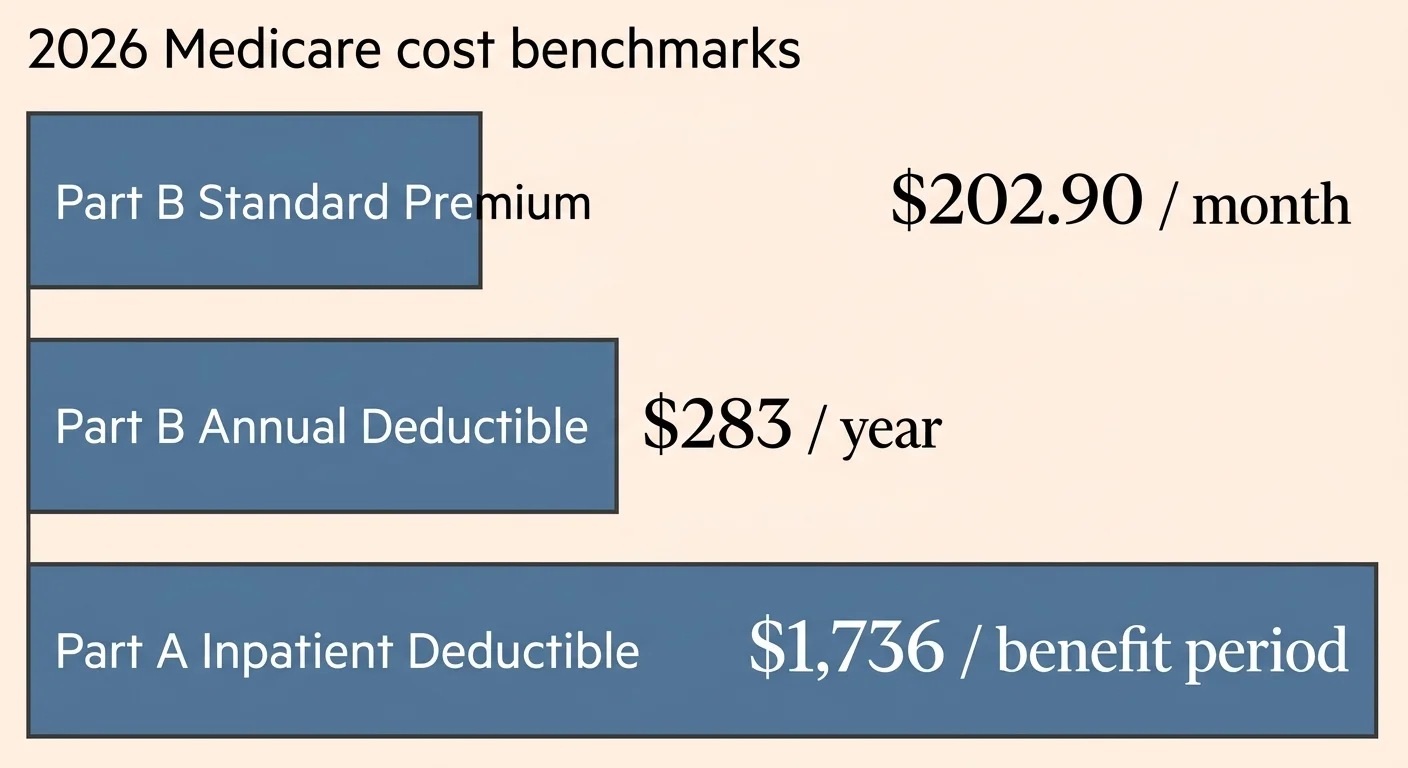
Medicare Part A covers inpatient hospital stays, skilled nursing facility care, hospice care, and home healthcare services. Most Americans do not pay a monthly premium for Part A. If you or your spouse worked and paid Medicare payroll taxes for at least 10 years (40 quarters), you receive premium-free Part A. If you fall short of this work history, you can purchase Part A in 2026 for either $311 or $565 per month, depending on whether you accumulated between 30 and 39 work quarters. For inpatient hospital admissions in 2026, the Part A deductible stands at $1,736 per benefit period. A benefit period begins the day you enter a hospital and ends when you have received no inpatient care for 60 consecutive days.
Medicare Part B covers doctor visits, outpatient care, medical equipment, preventive services, and lab tests. For 2026, the standard Part B monthly premium is $202.90 per beneficiary. In addition to the monthly premium, you must satisfy an annual Part B deductible of $283 before Medicare begins paying its share. Once you meet the deductible, Original Medicare generally pays 80% of Medicare-approved amounts for covered services, leaving you responsible for the remaining 20% coinsurance with no annual out-of-pocket upper limit.
High-income earners face additional surcharges known as the Income-Related Monthly Adjustment Amount (IRMAA). The Social Security Administration evaluates your modified adjusted gross income (MAGI) from your federal tax return from two years prior (using 2024 tax returns to calculate 2026 premiums) to determine if you must pay higher Part B and Part D premiums.
| 2024 MAGI – Single Return | 2024 MAGI – Joint Return | 2026 Part B Monthly Premium | 2026 Part D Monthly Surcharge |
|---|---|---|---|
| $106,000 or less | $212,000 or less | $202.90 | $0.00 |
| $106,001 to $133,000 | $212,001 to $266,000 | $284.10 | $13.70 + plan premium |
| $133,001 to $161,000 | $266,001 to $322,000 | $405.80 | $35.30 + plan premium |
| $161,001 to $193,000 | $322,001 to $386,000 | $527.50 | $57.00 + plan premium |
| $193,001 to $499,999 | $386,001 to $749,999 | $649.20 | $78.60 + plan premium |
| $500,000 or more | $750,000 or more | $689.90 | $85.80 + plan premium |
Part D drug coverage operates through private insurance companies approved by Medicare. Out-of-pocket drug costs feature statutory caps under federal law, but you must select a plan that covers your specific prescription medication list (formulary) to minimize your drug expenditures effectively.









Leave a Reply