
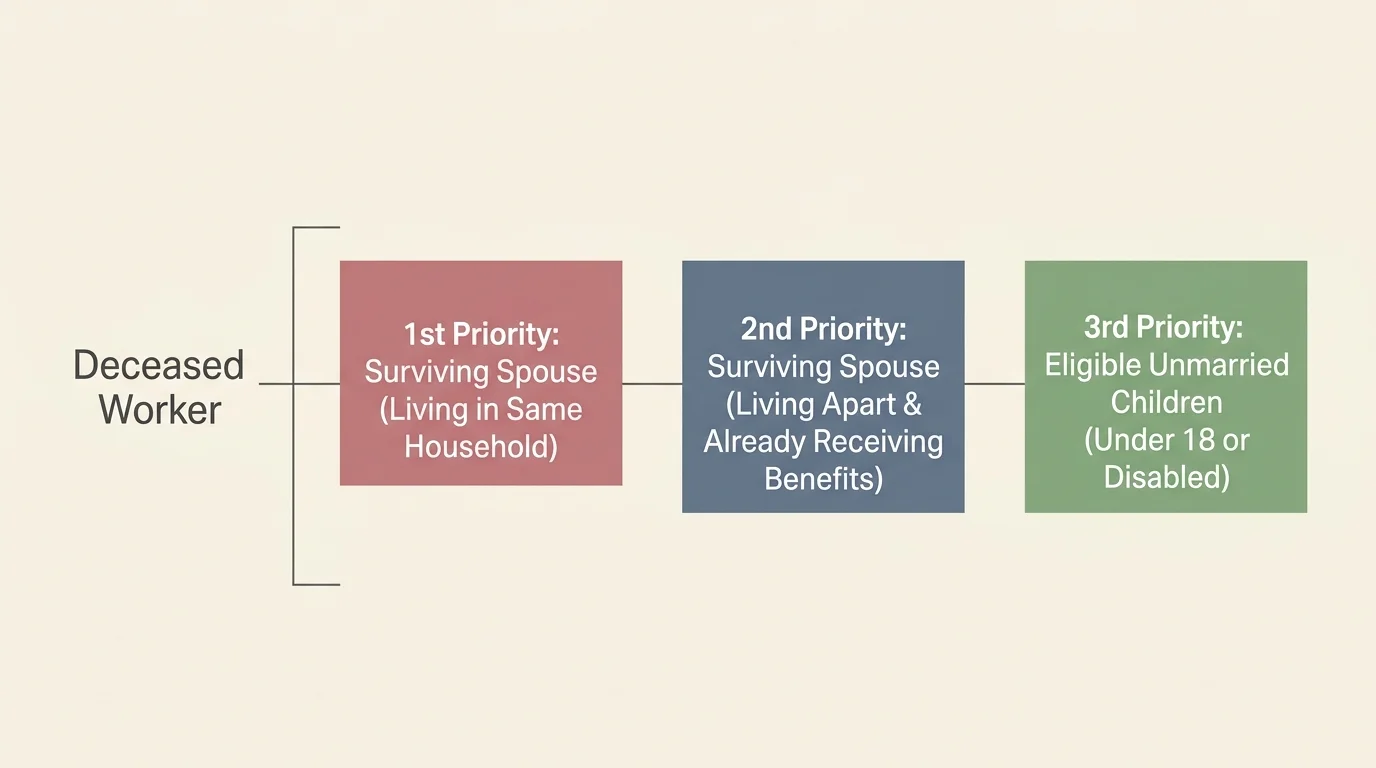
2. Strict Eligibility Priority Rules Dictate Who Receives Payment
Federal law does not treat the $255 death benefit as an asset of the deceased person’s estate. You cannot transfer this payment through a last will and testament, nor can the Social Security Administration issue it directly to an estate administrator or funeral facility. Instead, the Social Security Act establishes a strict hierarchy of eligible individual beneficiaries.
The Social Security Administration evaluates potential claimants according to three primary tiers of priority:
- First Priority (Surviving Spouse Living in the Same Household): A surviving spouse who was living in the same household as the deceased worker at the time of death receives first priority. The SSA considers a spouse to be living in the same household even if temporary separations occurred due to medical care in a nursing home, hospital stay, or active military service.
- Second Priority (Surviving Spouse Living Apart): If the surviving spouse lived in a separate residence, they qualify only if they were already receiving spousal benefits on the worker’s record or became eligible for monthly survivor benefits upon the worker’s death.
- Third Priority (Eligible Dependent Children): If no qualifying surviving spouse exists, the payment goes to the worker’s eligible unmarried children. To qualify, a child must be under age 18, age 18–19 and attending elementary or secondary school full-time, or age 18 or older with a qualifying disability that began before age 22.
If multiple qualifying children exist, the Social Security Administration divides the $255 equally among them. For example, if three minor children qualify, each child receives $85. If no qualifying spouse or dependent child exists, the federal government does not pay the $255 benefit to anyone.









$255 death benefit