
American retirees face an escalating financial burden, with the average household over age 65 spending nearly $60,000 per year according to the U.S. Bureau of Labor Statistics. However, moving abroad offers a dramatic financial reset where you can enjoy world-class European healthcare, temperate coastal weather, and high living standards for roughly half that amount. Portugal stands out as the premier destination offering an accessible path for expat retirees Europe bound, alongside cheap retirement countries Europe has to offer like Spain, Greece, and Italy. By leveraging predictable passive income such as Social Security or pensions, you can easily secure residency, unlock an affordable European retirement, and stretch your hard-earned nest egg twice as far without compromising your quality of life.

The Essentials: Retire in Europe on a Budget
If you want to stretch your retirement savings while enjoying a high quality of life, moving to Southern or Eastern Europe offers one of the most effective strategies available today. Here are the core facts you need to know before planning your move:
- Massive Monthly Savings: While average American retirees spend between $4,800 and $5,000 per month, couples can live comfortably in Portugal, Spain, or Greece for $2,000 to $2,500 per month.
- Accessible Passive Income Visas: Countries like Portugal and Spain offer clear residency pathways based on your existing Social Security, pension, or investment distributions without requiring real estate investments.
- Affordable Private Healthcare: Comprehensive private health insurance in Europe typically costs between $100 and $250 per month per person, providing top-tier medical care at a fraction of U.S. out-of-pocket costs.
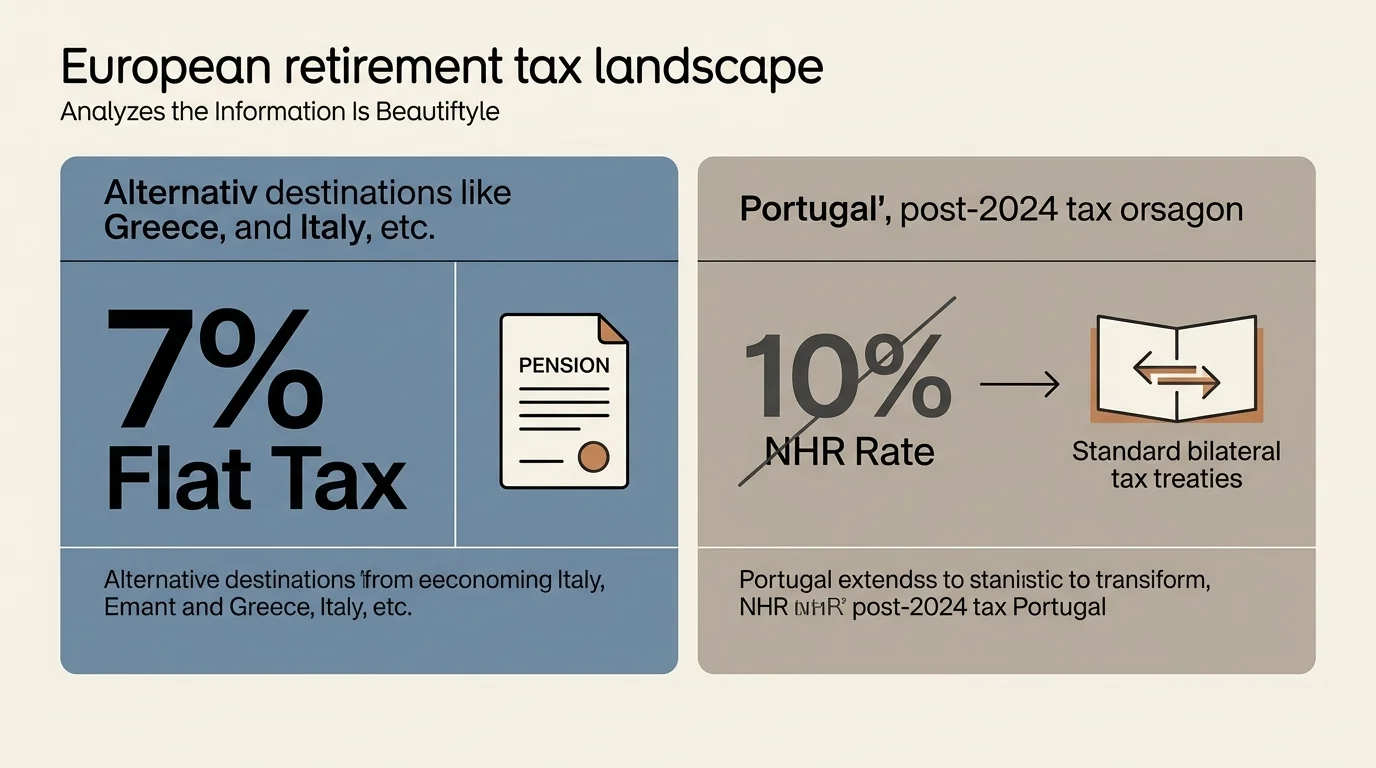
- Updated Tax Rules: Portugal ended its legacy 10% Non-Habitual Resident (NHR) tax rate for standard foreign retirees in January 2024, making foreign income taxation reliant on standard bilateral treaties; however, alternative nations like Greece and Italy still offer flat 7% foreign pension tax regimes.

Why Portugal Is the Premier Choice for Budget-Conscious Retirees
Portugal continuously ranks at the top of list for an affordable European retirement, and for good reason. The country combines high safety standards, excellent infrastructure, friendly locals, and a cost of living retirement abroad that feels remarkably light on your wallet. While housing costs in Lisbon and Porto have risen over recent years, smaller cities like Coimbra, Castelo Branco, Braga, and the picturesque towns along the Silver Coast offer modern apartments and charming homes for under $900 per month.
A typical retired couple in Portugal can easily manage total monthly expenses on a budget of $2,000 to $2,400. Dining out is an daily joy rather than a special occasion; a three-course lunch with wine at a local tasca often costs between €10 and €15 per person. Grocery bills are similarly modest, as fresh produce, regional cheeses, seafood, and local wines are priced far lower than equivalent items in American supermarkets.
“You must be realistic about your cash flow in retirement; living where your money goes further isn’t just a luxury, it’s smart risk management.” — Suze Orman, Financial Expert
Beyond raw dollars and cents, Portugal provides an unbeatable lifestyle. Ranked among the safest countries in the world, it boasts over 300 days of sunshine annually in Southern regions, an extensive public transportation network, and widespread English fluency, particularly among medical professionals and younger generations. This combination of physical safety, weather, and low overhead creates an ideal environment to retire in Europe on a budget.
Understanding Portugal’s D7 Passive Income Visa
Portugal’s D7 Visa remains one of the most straightforward pathways for non-EU citizens seeking residency. Designed specifically for retirees and individuals who live on passive income, this visa does not require you to buy expensive property or make major corporate investments.
To qualify for the D7 Visa, you must demonstrate a guaranteed, stable passive income stream. The Portuguese government pegs this requirement to its national monthly minimum wage. Here is how the legal income requirements break down:
- Primary Applicant: You must prove a minimum monthly passive income equal to 100% of the national minimum wage, which stands at €920 per month (€11,040 annually).
- Spouse or Partner: You must add 50% of the base amount, equal to €460 per month (€5,520 annually).
- Dependent Children: You must add 30% of the base amount per child, equal to €276 per month (€3,312 annually).
- Bank Deposit Buffer: Authorities require you to open a Portuguese bank account and deposit a cash buffer equal to 12 months of minimum wage—approximately €11,040 for a single applicant or €16,560 for a couple.
Acceptable passive income sources include U.S. Social Security benefits, private pensions, annuity payouts, real estate rental income, and regular dividend distributions. You can verify your benefit statements directly through the Social Security Administration to fulfill visa documentation requirements. Once approved, the D7 Visa provides an initial two-year residency permit, which you can renew for an additional three years before applying for permanent residency or citizenship.
Navigating Taxes: What You Must Know About the NHR Update
Tax planning requires careful attention when moving overseas. For years, Portugal attracted international expats through its Non-Habitual Resident (NHR) program, which offered a flat 10% tax rate on foreign pension income for a decade. However, the Portuguese government officially closed the original NHR framework to new applicants in January 2024, replacing it with the IFICI framework (often called NHR 2.0), which specifically targets scientific research, tech innovation, and corporate startups rather than standard foreign retirees.
If you move to Portugal today, your U.S. retirement distributions—including 401(k) withdrawals, traditional IRAs, and Social Security—are subject to standard progressive Portuguese income tax rates unless specific treaty protections apply. Fortunately, the double taxation agreement between the United States and Portugal prevents you from paying tax on the exact same income twice. You can review tax treaty mechanics and rules for foreign tax credits directly through the Internal Revenue Service.
Even without the original NHR tax incentive, Portugal’s low cost of living frequently offsets the higher tax brackets. However, if minimizing income taxes on pension distributions is your top priority, other European countries offer alternative incentives designed specifically to attract foreign retirees.

Comparing Cost of Living and Residency Across Top European Nations
Choosing the right destination requires comparing legal income requirements, monthly living costs, and tax policies side by side. The table below outlines how Portugal compares to other popular cheap retirement countries Europe features for expat retirees Europe bound, using typical spending data for a retired couple.
| Country | Avg Monthly Budget (Couple) | Primary Visa Option | Min Income Requirement | Key Tax Feature |
|---|---|---|---|---|
| United States | $4,800 – $5,000 | N/A (Home Country) | N/A | Standard Federal/State Tax |
| Portugal | $2,000 – $2,500 | D7 Passive Income Visa | €920/mo (+50% spouse) | Progressive Tax Rates |
| Spain | $2,200 – $2,700 | Non-Lucrative Visa (NLV) | €2,400/mo (400% IPREM) | Progressive Regional Tax |
| Greece | $1,800 – $2,300 | Independent Means Visa | €2,000/mo (+20% spouse) | 7% Flat Tax (15 years) |
| Italy | $1,900 – $2,400 | Elective Residence Visa | ~€2,570/mo (€31,000/yr) | 7% South Tax (10 years) |
| Bulgaria | $900 – $1,400 | Type D Retirement Visa | ~€500/mo (Local Min Wage) | 10% Flat National Tax |

Exploring Top Alternative European Havens
While Portugal remains a standout choice, neighboring countries present compelling benefits depending on your personal healthcare needs, budget, and lifestyle preferences.
Spain: Culture, Sun, and the Non-Lucrative Visa
Spain offers vibrant cultural traditions, modern transportation, and top-tier medical facilities. Following Spain’s phase-out of its real estate Golden Visa route, the Non-Lucrative Visa (NLV) has become the main residency pathway for non-working retirees. The legal financial requirement relies on Spain’s IPREM index; single applicants must prove 400% of the IPREM indicator, which equates to roughly €2,400 per month (€28,800 annually), plus €600 per month for a dependent spouse. Spain’s healthcare system consistently ranks among the best globally, making it a favorite for long-term health management.
Greece: Picturesque Islands and a 7% Flat Tax
Greece presents one of the most attractive tax deals in Europe for foreign retirees. Under current Greek tax law, retirees who transfer their tax residence to Greece can qualify for a flat 7% tax rate on foreign pension income, IRAs, and 401(k) distributions for up to 15 years. To qualify, you must not have been a Greek tax resident in five of the previous six years, and your country of origin must maintain an active tax treaty with Greece. Combined with low local rents outside central Athens, Greece offers a Mediterranean retirement lifestyle on a modest budget.
“Retirement isn’t the end of your financial life; it’s the beginning of a new chapter where managing expenses wisely creates freedom.” — Jean Chatzky, Financial Journalist and Author
Italy: Southern Charm and Special Tax Zones
Italy appeals deeply to retirees seeking culture, history, and culinary excellence. While living in Florence or Rome can strain a modest budget, Italy offers a specialized tax incentive to revitalize smaller Southern towns. If you move your tax residence to a municipality with fewer than 20,000 residents in qualified Southern regions—such as Sicily, Calabria, Puglia, Abruzzo, or Campania—you can lock in a flat 7% tax rate on foreign retirement income for up to 10 years.
Bulgaria: Eastern Europe’s Unbeatable Budget Destination
For retirees prioritizing raw savings above all else, Bulgaria stands as the most affordable EU country. A retired couple can live comfortably in charming cities like Plovdiv or Veliko Tarnovo for between $900 and $1,400 per month, inclusive of housing, utilities, food, and private medical insurance. Bulgaria maintains a flat 10% personal income tax rate, and foreign retirees can apply for a Type D visa by simply demonstrating proof of a pension meeting local minimum standards.

Healthcare Overseas: Managing Costs Without Medicare
Healthcare planning is a essential component of retiring abroad. A critical factor many American expats overlook is that U.S. Medicare does not cover medical expenses incurred outside the United States. You can read details regarding coverage limits directly on Medicare.gov. Fortunately, health insurance in Europe is remarkably affordable compared to domestic U.S. premiums.
When applying for your initial European residency visa (such as Portugal’s D7 or Spain’s NLV), you must show proof of comprehensive private health insurance with zero deductible and full coverage in your destination country. For an expat in their mid-60s, a robust private plan from European providers like Cigna Global, Allianz, or local leaders like Médis or Sanitas generally costs between $100 and $250 per month per person.
Once you establish legal permanent residency—usually after five years of legal residence—many European countries grant you access to their public healthcare systems. Public healthcare is funded through local taxation, providing comprehensive emergency and ongoing medical services for nominal fees or no out-of-pocket cost. Many retirees choose to maintain a dual approach: keeping private insurance for quick access to specialists and English-speaking doctors while relying on the national public system for major medical emergencies.
If you decide to maintain U.S. Medicare Part A (which is premium-free for most workers) while living abroad, you preserve your right to return to the U.S. for emergency or major medical treatments. However, if you drop Medicare Part B to save on monthly premiums and decide to re-enroll years later, you will face lifetime late-enrollment penalties. Weighing this trade-off is an essential part of your pre-departure planning process, as noted in senior transition guides published by organizations like AARP.
What Can Go Wrong: Critical Mistakes to Avoid
Moving abroad can offer financial relief and new adventures, but jumping in without adequate preparation leads to costly errors. Pay close attention to these common pitfalls:
- Ignoring Foreign Exchange Risk: Your Social Security check and U.S. retirement distributions arrive in U.S. Dollars, but your daily expenses in Europe will be priced in Euros. If the dollar weakens relative to the euro, your purchasing power drops. Maintaining a dedicated cash buffer equal to 12 to 18 months of living expenses in Euros protects you from sudden currency fluctuations.
- Buying Real Estate Too Quickly: Many retirees make the mistake of purchasing a home during their first few months abroad. It takes time to understand local neighborhoods, weather patterns, and seasonal changes. Rent for at least 12 to 18 months before committing to real estate.
- Failing to Plan for U.S. Tax Filing Requirements: Moving abroad does not eliminate your duty to file annual U.S. tax returns. The U.S. taxes citizens on worldwide income regardless of where they reside. Failing to file foreign bank account reports (FBAR) and IRS Form 8938 can result in severe financial penalties.
- Underestimating Cultural and Language Integration: Moving to a non-English speaking country without learning basic phrases can lead to isolation. Engaging with local expat groups, taking language courses, and participating in community events helps turn an overseas relocation into a fulfilling home.

When to Consult a Professional
While researching online provides a strong foundation, relocating internationally involves complex legal and financial frameworks. You should seek qualified professional assistance in the following scenarios:
- Cross-Border Tax Planning: Work with a Certified Public Accountant (CPA) or tax attorney who specializes in international U.S. expat taxation. They ensure proper application of the Foreign Tax Credit, prevent double taxation, and maintain FBAR compliance.
- Immigration and Visa Processing: Retain an experienced immigration lawyer in your target country. Visa requirements, document apostilling, and local consular rules change frequently; professional legal counsel streamlines residency approval.
- Estate Planning Across Borders: Draft a local will in your target destination alongside your U.S. estate documents. Inheritance laws in countries like Portugal, France, and Spain feature “forced heirship” rules that differ dramatically from U.S. probate law.
- Real Estate Acquisition: If you eventually decide to purchase property, hire an independent local real estate lawyer who represents your interests exclusively—never rely solely on the real estate agent’s legal team.
Frequently Asked Questions
Can I still receive my U.S. Social Security benefits while living in Europe?
Yes, U.S. citizens can receive Social Security payments while living in almost all European countries. You can have your monthly payments direct-deposited into a U.S. bank account or transferred directly into a local European bank account through international direct deposit services.
Do I have to pay taxes in both the U.S. and my host European country?
Because the U.S. taxes its citizens on worldwide income, you must file a U.S. tax return every year regardless of where you live. However, bilateral tax treaties and mechanisms like the U.S. Foreign Tax Credit generally protect you from paying taxes twice on the exact same dollar of income.
What happens to my Medicare coverage when I move to Europe?
U.S. Medicare does not cover medical treatment incurred overseas. Most expat retirees choose to purchase private health insurance in Europe, which costs between $100 and $250 per month. Many retain premium-free Medicare Part A just in case they return to the U.S. for emergency care, while opting out of Part B to save on premiums.
How much income do I need to qualify for Portugal’s D7 Visa?
For a primary applicant, you must prove stable passive monthly income equal to 100% of Portugal’s minimum wage (€920 per month or €11,040 annually). If you are applying with a spouse, you must add an additional 50% (€460 per month), bringing the combined minimum passive income requirement to €1,380 per month (€16,560 annually).
Next Steps for Your European Retirement Plan
Transitioning to an overseas retirement requires careful execution, but the payoff can be life-changing. By reducing your cost of living by up to 50%, you remove financial anxiety, safeguard your long-term savings, and gain access to a rich cultural lifestyle. Start by auditing your current fixed retirement income, exploring target towns through temporary exploratory visits, and scheduling consultations with international tax specialists. With clear goals and early planning, living comfortably in Europe can rapidly transform from a dream into your everyday reality.
This article provides general retirement education and information only. Every retiree’s situation is unique—what works for others may not work for you. For personalized advice, consider consulting a qualified financial professional such as a CFP or CPA.
Last updated: March 2026. Retirement benefits, tax rules, and healthcare regulations change frequently—verify current details with official sources.









Leave a Reply