
Step 4: Map Out Different Claiming Ages
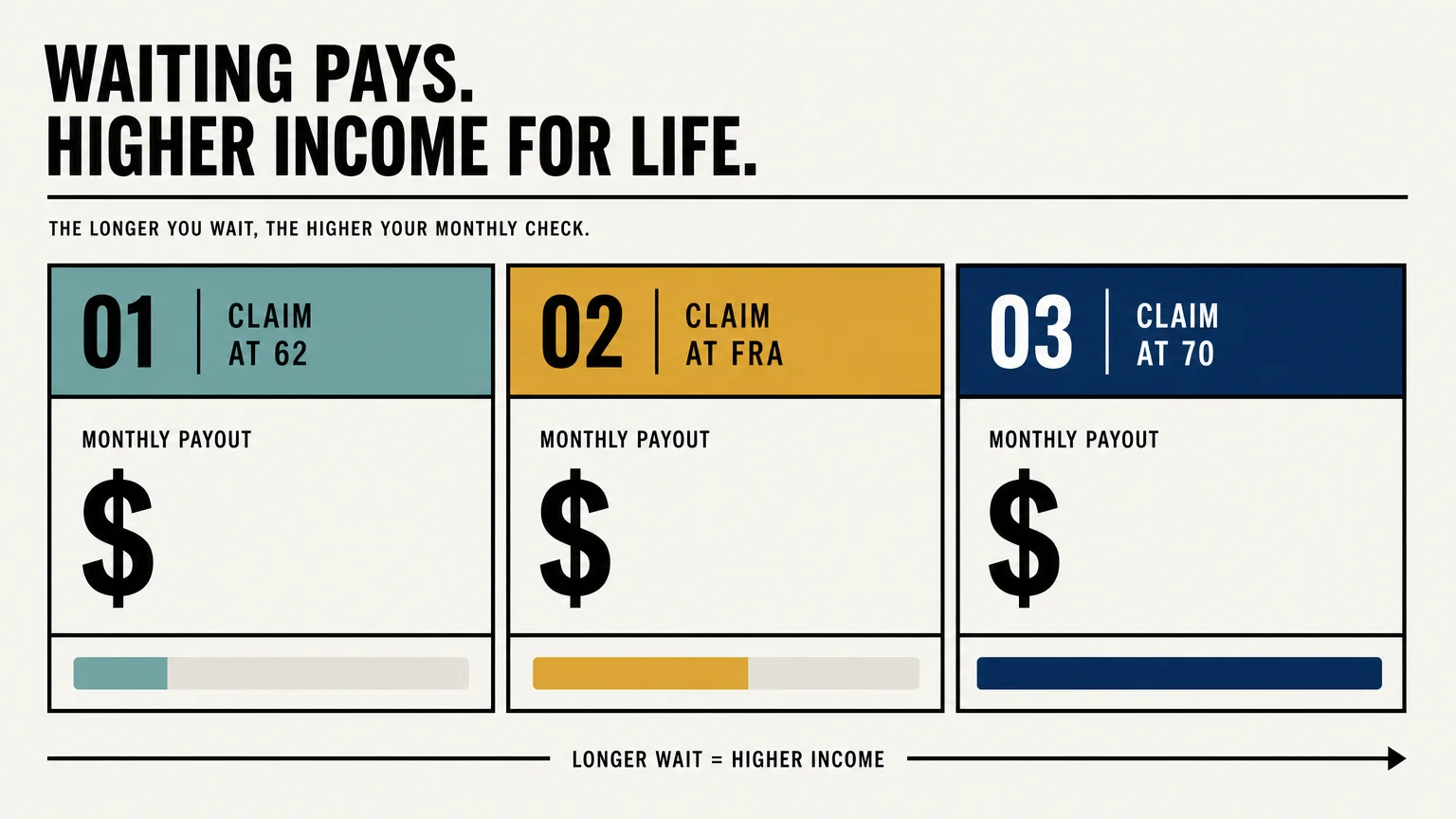
You control the lever on when your benefits begin, and that decision dictates the size of your monthly check for the rest of your life. The earliest you can claim Social Security retirement benefits is age 62, but doing so comes at a steep cost. If your FRA is 67 and you claim at 62, your monthly benefit suffers a permanent 30% reduction. This penalty locks in for life; your checks do not suddenly increase to the full amount once you reach your FRA.
Conversely, the system heavily incentivizes patience. For every year you delay claiming past your FRA, you earn Delayed Retirement Credits. These credits increase your baseline benefit by 8% per year, capping out at age 70. Delaying from age 67 to age 70 results in a 24% permanent boost to your monthly income, offering a guaranteed, inflation-adjusted return that is nearly impossible to replicate in the private bond market.
To visualize how claiming age impacts your bottom line, consider a hypothetical retiree born in 1960 whose baseline benefit at age 67 is exactly $2,000 per month. The table below illustrates the permanent financial impact of their claiming decision.
| Claiming Age | Percentage of FRA Benefit | Estimated Monthly Benefit | Impact on Income |
|---|---|---|---|
| Age 62 | 70% | $1,400 | Permanent 30% Reduction |
| Age 63 | 75% | $1,500 | Permanent 25% Reduction |
| Age 64 | 80% | $1,600 | Permanent 20% Reduction |
| Age 65 | 86.7% | $1,734 | Permanent 13.3% Reduction |
| Age 66 | 93.3% | $1,866 | Permanent 6.7% Reduction |
| Age 67 (FRA) | 100% | $2,000 | Baseline Amount |
| Age 68 | 108% | $2,160 | Permanent 8% Increase |
| Age 69 | 116% | $2,320 | Permanent 16% Increase |
| Age 70 | 124% | $2,480 | Permanent 24% Increase |
When you estimate Social Security benefits, run the numbers for multiple ages. Weigh the guaranteed 8% annual growth against your current health, family longevity history, and immediate need for cash flow.









I have read this email and i honestly don’t understand what am supposed to do at this time
Start at Step 1: Set up an account.
They don’t want you to understand. That’s more money left in the system
Control control control