Other 2027 Social Security Rules That Affect Working Retirees and High Earners
Your 2027 COLA interacts with several other federal thresholds that change every January. If you still work part-time, consult, or earn significant investment income, these updated limits directly shape how much you keep.
Higher 2027 Retirement Earnings Test Limits
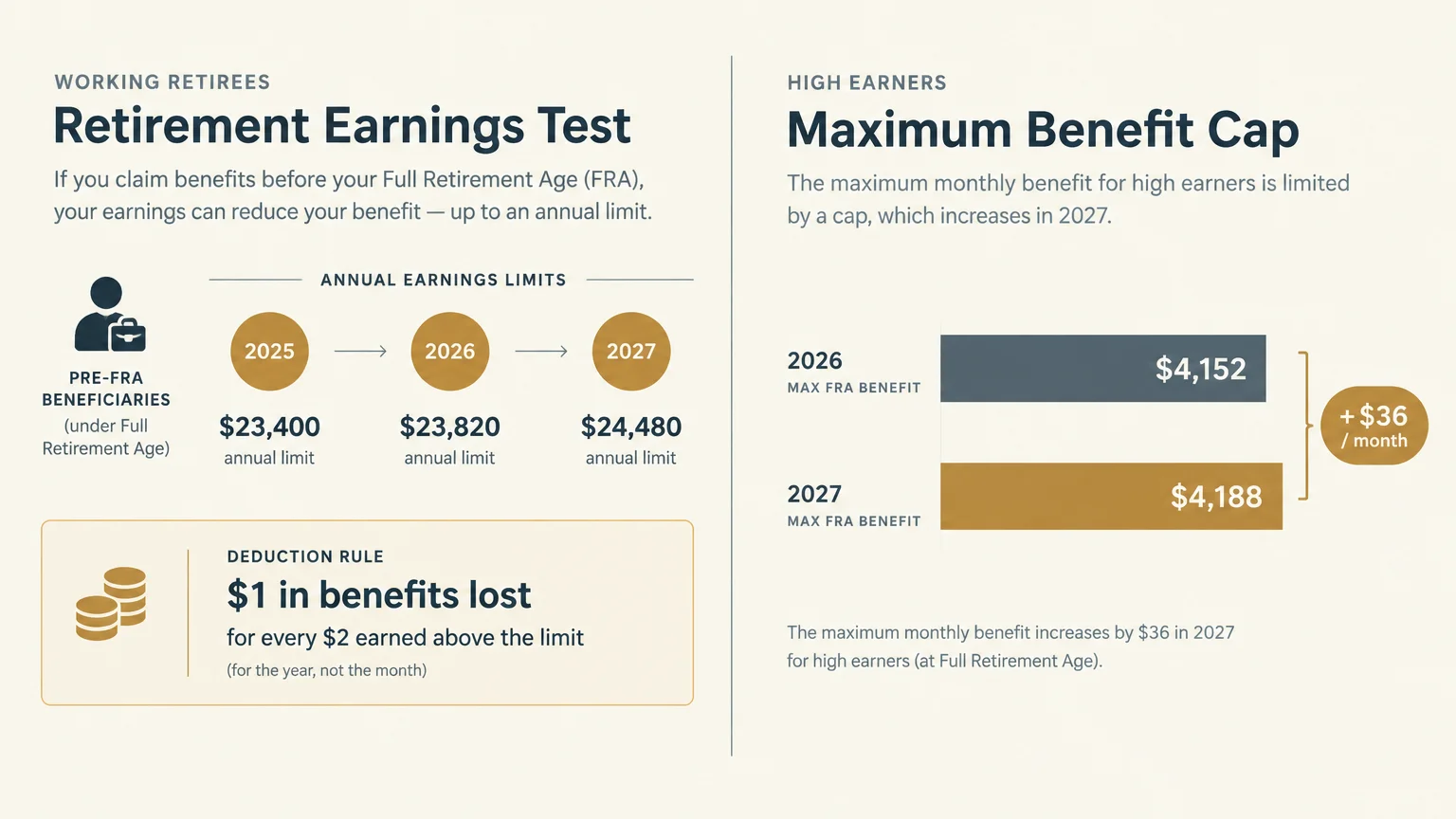
Working while collecting Social Security before your Full Retirement Age can temporarily reduce your monthly checks if your wages cross strict thresholds. Fortunately, those earnings limits rise alongside the 2027 COLA.
- Under Full Retirement Age All Year: You can earn up to $25,560 per year, or $2,130 per month, up from $24,480 in 2026. Social Security withholds $1 in benefits for every $2 you earn above that cap.
- Reaching Full Retirement Age During 2027: The limit rises to $67,920 per year, or $5,660 per month, up from $65,160 in 2026. In months before your birthday milestone, Social Security withholds $1 for every $3 earned above the ceiling.
- Full Retirement Age and Beyond: Starting in the month you reach Full Retirement Age, there is no earnings limit at all. You can earn unlimited wages without triggering benefit reductions.
Remember that benefits withheld under the earnings test are not lost forever. Once you reach Full Retirement Age, Social Security recalculates your monthly check upward to credit back the months of withheld payments.
Payroll Taxes and the 2027 Taxable Earnings Cap
If you continue working in retirement or own a business, you still pay payroll taxes on earned wages. In 2027, the maximum earnings subject to Social Security tax rises from $184,500 to $192,300.
Payroll tax rates remain unchanged for 2027. Employees pay 7.65%—consisting of 6.2% for Social Security up to $192,300 plus 1.45% for Medicare on all earnings—while self-employed workers pay the combined 15.30% rate.
High earners also face the 0.9% Additional Medicare Tax on earned income exceeding $200,000 for single filers or $250,000 for married couples filing jointly. Adjusting your quarterly estimated payments early prevents unpleasant surprises next spring.
The Two-Year IRMAA Lookback for 2027
Higher-income retirees face Income-Related Monthly Adjustment Amount surcharges on both Medicare Part B and Part D. For 2027 premiums, CMS determines your IRMAA tier using your 2025 Modified Adjusted Gross Income.
Official 2027 IRMAA income brackets are pending CMS’s fall announcement. As a reference point, 2026 surcharges began once Modified Adjusted Gross Income exceeded $109,000 for single filers or $218,000 for married couples filing jointly.
If you sold property, completed a large Roth conversion, or took significant capital gains in 2025, an IRMAA surcharge can erase the benefit of a mild standard Part B increase. Check your 2025 tax return now so an unexpected surcharge does not catch you off guard in January.
Avoiding Common Errors With Your 2027 Benefit Increase
Higher benefit numbers often tempt retirees to relax their spending habits or ignore annual paperwork. Watch out for five common mistakes that can undermine your 2027 raise.
- Spending the Gross Raise Before Part B Is Finalized: Until CMS formally publishes 2027 Part B premiums and deductibles, treat the $209.50 figure as a planning estimate. Wait to lock in new recurring expenses until your December COLA letter confirms your exact net deposit.
- Falling for $90 Rebate or COLA Impersonation Scams: Scammers routinely target retirees every autumn with fake texts or calls claiming you must confirm bank details to claim your COLA or $90 rebate. Neither Social Security nor Medicare will call demanding fees, gift cards, or account passwords to release official payments.
- Overlooking Late-Year Income Decisions That Trigger Future IRMAA Cliffs: While your 2025 tax return sets your 2027 Medicare surcharges, moves you make in late 2026 will determine your 2028 premiums. Review planned IRA withdrawals or asset sales carefully before year-end so one extra dollar of income does not push you into a higher surcharge tier.
- Ignoring Work Withholding After Reaching the Earnings Limit: If you expect your 2027 wages to pass $25,560 before Full Retirement Age, notify Social Security immediately. Waiting until tax season to report higher earnings can result in sudden overpayment notices that halt your monthly checks entirely.
- Assuming COLAs Guarantee Long-Term Purchasing Power Without Savings: Polling from Gallup over the past 25 years shows 80% to 90% of retirees depend on Social Security for at least part of their living costs. Meanwhile, the 2026 Social Security Trustees Report warns that the retirement trust fund could face depletion as early as the fourth quarter of 2032 without congressional action, making personal cash reserves essential.
Taking thirty minutes this month to verify your online accounts and check your income projections protects you from every one of these pitfalls. Proactive housekeeping keeps your retirement plan resilient regardless of policy shifts in Washington.