
Choosing safe places to retire protects your nest egg, your physical health, and your daily peace of mind. Strong neighborhood watch programs provide an organized layer of protection that deters property crime and keeps neighborhoods connected.
Communities with active citizen patrols bridge the gap between municipal police forces and watchful residents. Knowing your neighbors look out for open garage doors or suspicious solicitations lets you travel or relax worry-free.
Across the country, standout retirement destinations have turned community safety into a collaborative art form. Here are twelve exceptional retirement towns where structured watch programs keep retirees safe and engaged.
Why Neighborhood Watch Matters in Retirement Planning
Safety ranks alongside healthcare and cost of living when retirees evaluate new communities. A dedicated neighborhood watch program provides immediate security and connection that standard municipal services cannot always deliver.
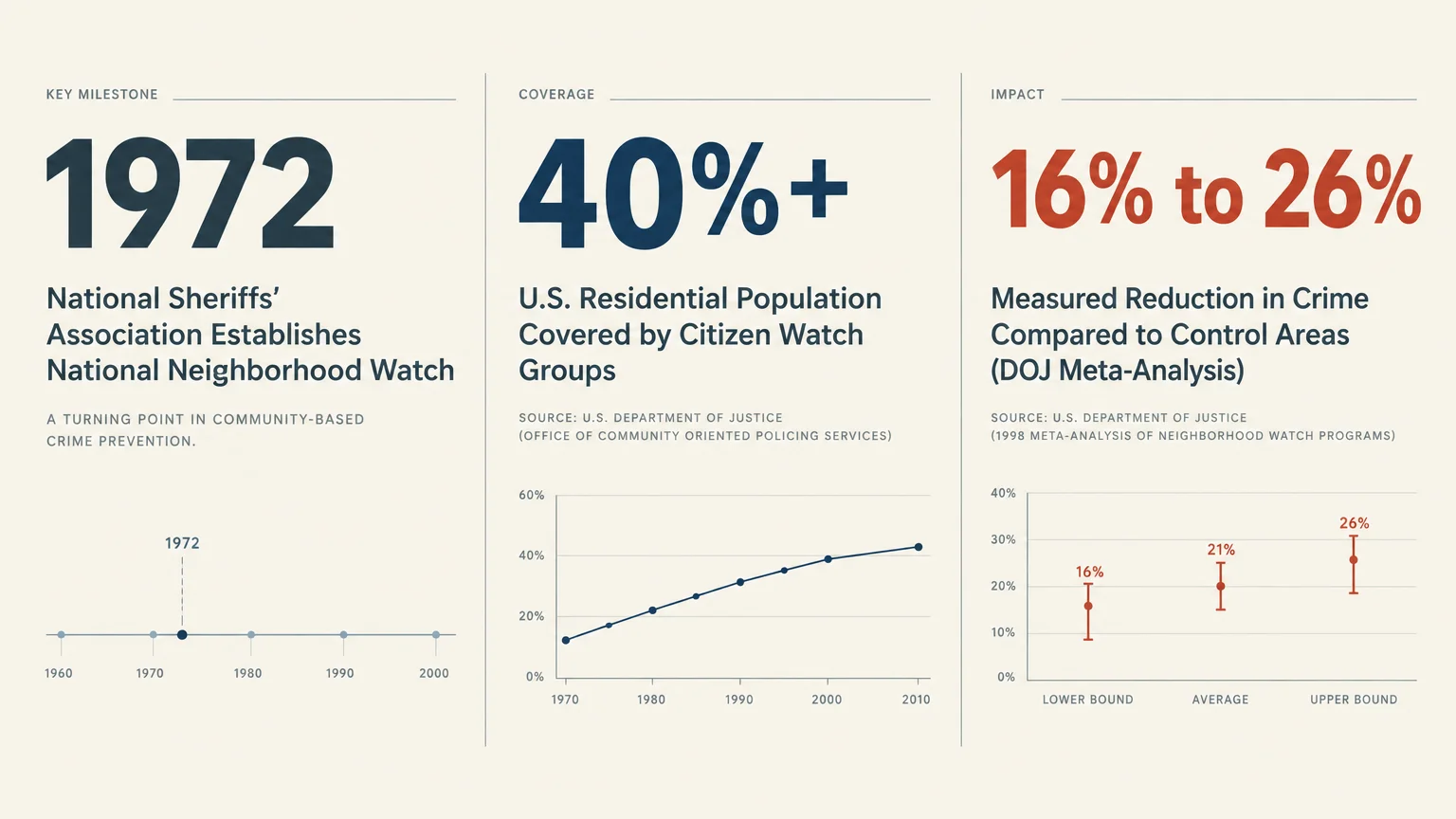
According to U.S. Department of Justice data, more than 40% of the U.S. residential population lives in areas covered by a watch group. These programs trace their modern origins to 1972, when the National Sheriffs’ Association founded the National Neighborhood Watch program.
The measurable impact of these volunteer programs remains substantial. A benchmark Department of Justice meta-analysis revealed that communities with active watch programs experience a 16% to 26% reduction in crime compared to control areas.
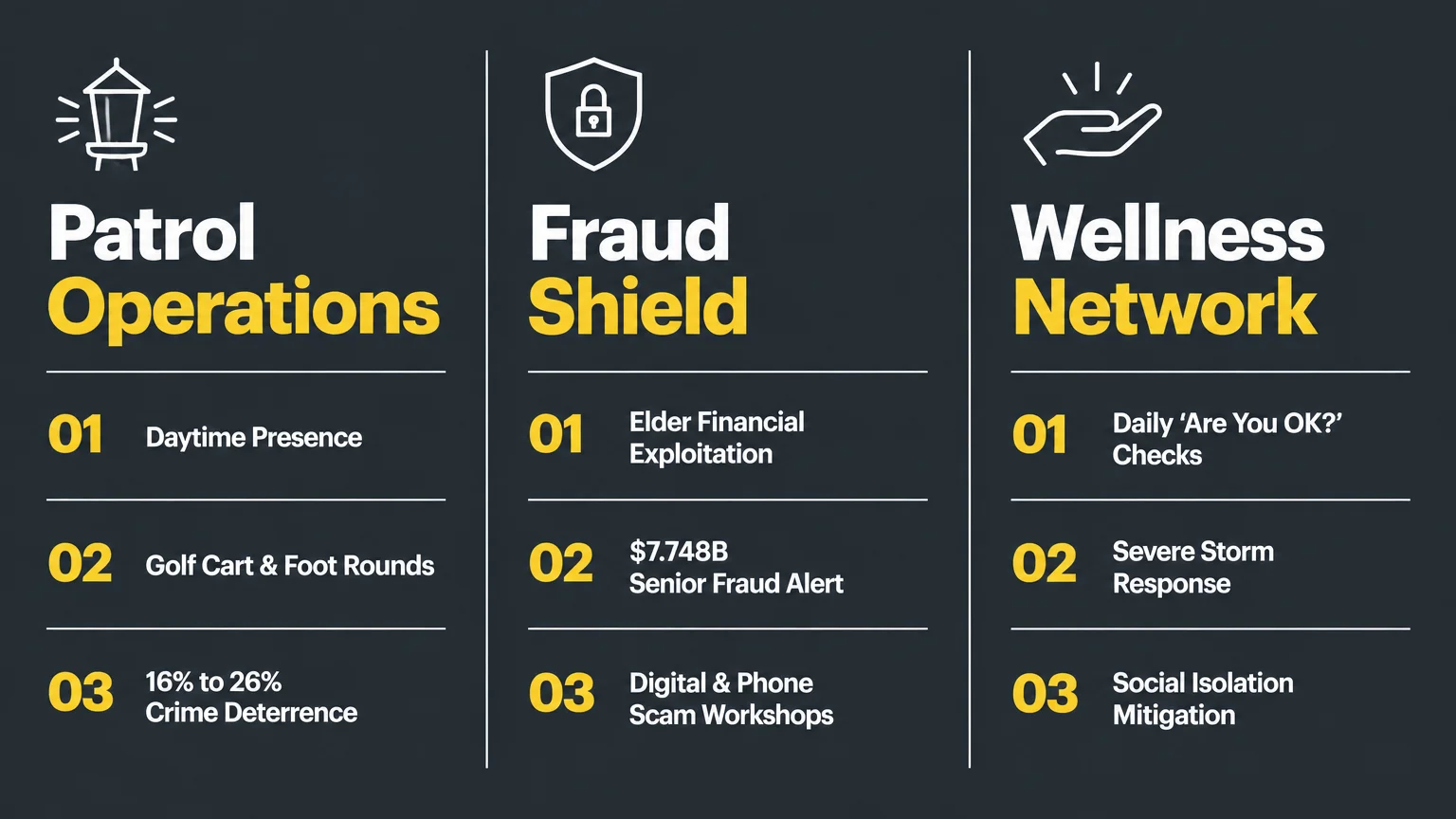
Retired residents often have flexible daytime schedules that support attentive neighborhood observation. This daytime presence creates an organic deterrent against opportunistic property thefts and daytime burglaries.
Community watch initiatives have evolved far beyond checking gate latches and noting unfamiliar vehicles. Modern programs now address elder financial exploitation, storm response, and social isolation among older adults.
Physical street crime remains remarkably low in most master-planned retirement havens. However, deceptive digital solicitations and phone scams have surged across the nation.
Federal Bureau of Investigation data showed that reported financial fraud losses for victims age 60 and older reached $7.748 billion in 2025. Progressive neighborhood watch groups now coordinate fraud alerts and safety workshops to protect resident savings.
“An ounce of prevention is worth a pound of cure.” — Benjamin Franklin, Statesman and Author

How Active Watch Programs Impact Insurance and Property Values
Living in low crime towns delivers tangible financial benefits alongside daily security. While insurance carriers rarely discount a policy solely for volunteer watch participation, the indirect financial dividends are substantial.
Homeowners insurance carriers assess regional claim histories when setting base rates for specific ZIP codes. Lower local burglary and property theft rates keep baseline insurance premiums lower for the entire community.
You can research regional property insurance trends through consumer tools on Bankrate to gauge local carrying costs before moving. Lower risk profiles translate into ongoing savings for fixed-income retirees.
Direct premium discounts typically range from 5% to 15% when combined with community physical features. Insurers actively reward gated perimeters, 24-hour security patrols, and centrally monitored home alarm systems.
Neighborhood stability also bolsters resale value when you decide to transition or downsize. Buyers consistently pay a premium for neighborhoods with visible safety infrastructure and proactive community associations.
12 Retirement Towns With Exceptional Community Watch Programs
1. The Villages, Florida: Continuous Community Watch and Adult Care
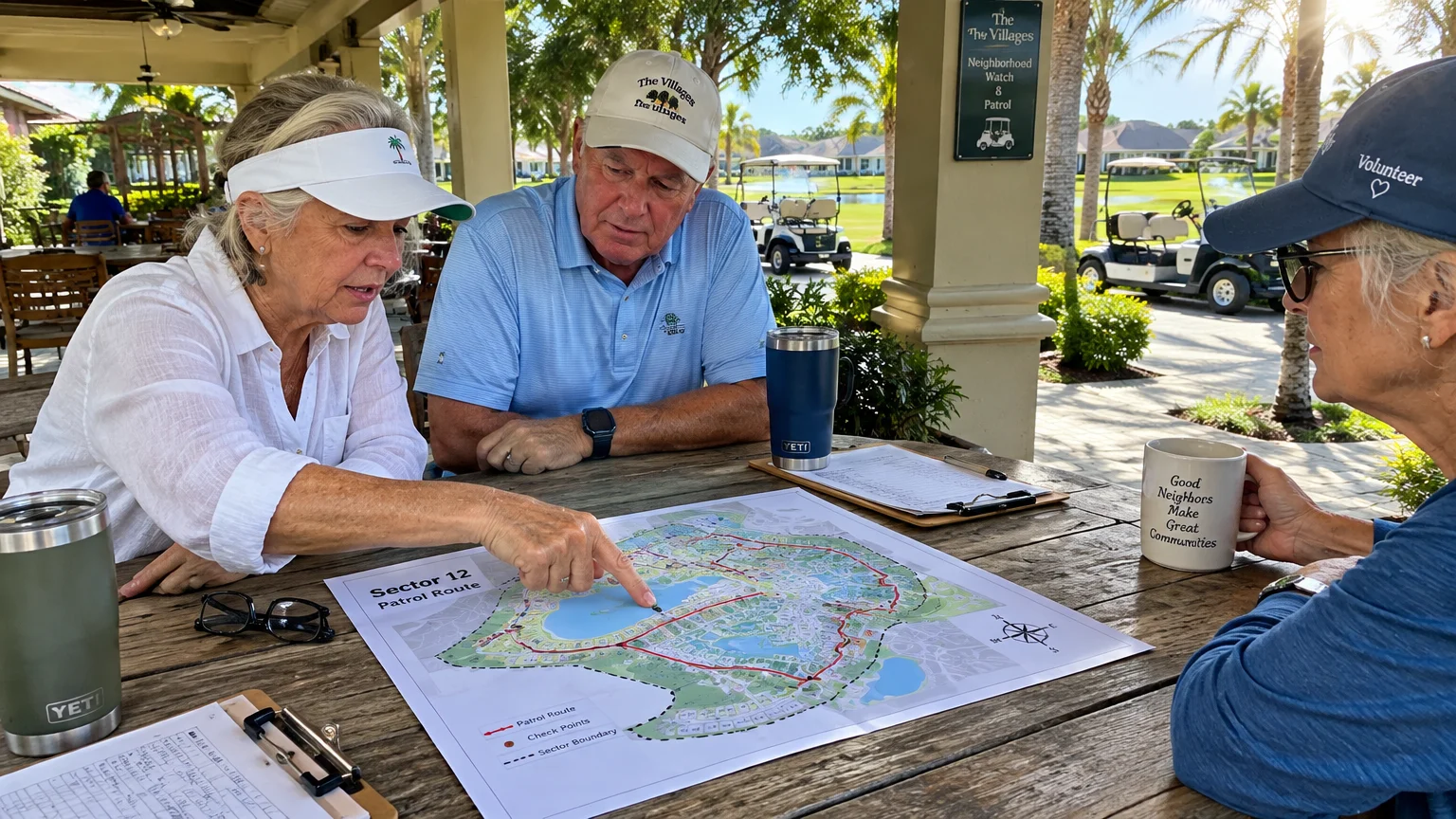
The Villages represents one of the most comprehensive community safety operations in the nation. Its Community Watch division operates 24 hours a day across more than 110 distinct neighborhoods.
The system deploys 54 patrol drivers during every 24-hour cycle. These dedicated units complete over 113,000 neighborhood patrols and handle more than 54,000 service requests annually.
The community houses Florida’s first accredited non-911 Public Safety Answering Point call center. This specialized dispatch facility manages gate operations, resident inquiries, and non-emergency patrol dispatches.
Safety extends into private homes through the popular Adult Watch program. Dispatchers complete more than 40,000 scheduled wellness calls each year to confirm the health of residents living alone.
These coordinated efforts maintain an exceptionally secure environment for over 150,000 residents. The combined violent and property crime rate is roughly 2.97 per 1,000 residents, making it safer than 81% of American cities.
2. Sun City, Arizona: The Pioneer Volunteer Posse
Sun City established the benchmark for citizen patrols when it formed the Sun City Posse in 1977. This nonprofit organization operates completely independently of municipal tax dollars.
The organization relies entirely on annual resident donations and grants of roughly $517,000 to $528,000. Volunteers work closely alongside the Maricopa County Sheriff’s Office to maintain local safety.
The operational dedication of these volunteers is substantial. In 2024, Posse members logged 67,919 total service hours, including 24,132 hours dedicated strictly to uniformed vehicle patrols.
Through August 2026, the Posse logged 47,976 total calls. These activities included 27,122 neighborhood drive-bys, 14,226 vacation home security checks, and 192 welfare checks for vulnerable residents.
Volunteers patrol in marked cruisers that deter opportunistic thieves. Their visible presence provides reassurance while offering immediate aid to stranded golf cart drivers and disoriented seniors.
3. Green Valley, Arizona: Sheriff’s Auxiliary Volunteers and TeleCare
Located south of Tucson, Green Valley is a desert haven where roughly 80% of residents are age 65 or older. Community safety relies heavily on the Sheriff’s Auxiliary Volunteers, known as the SAV.
The group originated in 1978 as Citizen Bear before incorporating in 1982. Today, the organization provides vital operational support to the Pima County Sheriff’s Department.
SAV members conduct vehicle, bicycle, and park patrols across local neighborhoods. They also coordinate a specialized Scam Squad that educates retirees against aggressive telephone and internet fraud schemes.
Green Valley provides an exceptional daily safety net through its TeleCare program. Trained volunteers call enrolled seniors living alone every morning between 7:30 a.m. and 8:30 a.m. to verify their well-being.
If a resident does not answer after multiple attempts, patrol volunteers dispatch immediately to the residence. This morning protocol routinely saves lives by identifying medical distress before conditions turn tragic.
4. Sun City West, Arizona: Keyholder Protection and Snowbird Security
Sun City West pairs mobile patrols with property monitoring managed by the Sheriff’s Posse of Sun City West. This volunteer corps provides comprehensive coverage across every residential street.
The Posse maintains an encrypted resident and keyholder database designed specifically for snowbirds and solo retirees. Residents register trusted contacts and spare key locations directly with the dispatch office.
This registry proves invaluable during desert monsoons, pipe freezes, or medical emergencies. Patrol teams contact designated keyholders to permit emergency entry without damaging doors or windows.
Volunteers conduct constant patrols in marked cruisers, checking vacant residences and reporting suspicious activity. The organization also hosts regular community forums to review neighborhood crime trends and prevention tactics.
5. Georgetown, Texas: Sun City Texas Citizen Police Integration
Georgetown sits in the Texas Hill Country and features Sun City Texas, a premier master-planned enclave. Safety thrives on an intimate partnership between residents and the Georgetown Police Department.
Residents take an active role by completing the Georgetown Citizen Police Academy. Graduates join the Community Action Patrol, assisting local officers with traffic control, park checks, and non-enforcement tasks.
Neighborhood watch block captains coordinate street-level communication across individual neighborhoods. These leaders hold regular driveway meetings to discuss local concerns, street lighting, and vehicle speeds.
The police department assigns dedicated liaison officers to attend these neighborhood gatherings. This direct communication ensures prompt municipal attention to code enforcement, traffic safety, and unsolicited door-to-door salesmen.
6. Hot Springs Village, Arkansas: Gated Forest Vigilance
Hot Springs Village is the largest gated community in North America, covering over 26,000 wooded acres. The enclave balances secluded natural beauty with a tightly organized neighborhood watch framework.
The community operates staffed gate points alongside a dedicated full-time police force. Complementing this official presence is a network of neighborhood watch volunteers who monitor scenic residential cul-de-sacs.
Volunteers report trail maintenance hazards, trespassing near private lakes, and unusual vehicle activity to central dispatch. They also manage comprehensive vacation house-check services when property owners travel.
Because homes sit among dense pine forests, neighbors maintain active communication trees. This network ensures rapid assistance during severe winter storms, fallen tree incidents, and unexpected utility outages.
7. Laguna Woods, California: Integrated Multi-Tier Security
Laguna Woods Village houses more than 18,000 older adults across Orange County rolling hills. The community incorporates an impressive multi-layered approach to neighborhood watch and resident safety.
The Golden Rain Foundation coordinates a professional security division that operates gate access and round-the-clock roving patrols. Working alongside them is an active resident Disaster Preparedness and Community Watch committee.
Volunteers serve as building and division captains, organizing safety education and coordinating localized evacuation plans for wildfire risks. Their localized presence reduces opportunistic theft across condominium carports and shared recreational spaces.
The city contracts directly with the Orange County Sheriff’s Department for municipal policing. This close relationship allows resident watch leaders to receive real-time crime updates and tactical safety briefings.
8. Punta Gorda, Florida: Canal and Neighborhood Waterfront Watches
Punta Gorda sits along Charlotte Harbor, featuring miles of navigable residential canals and quiet streets. The city maintains an award-winning Neighborhood Watch program that covers both dry land and waterfront waterways.
The Punta Gorda Police Department actively trains neighborhood captains and citizen volunteers. Watch groups hold regular informational sessions on marine dock security, golf cart safety, and residential target hardening.
A specialized volunteer Marine Patrol supports city officers by monitoring boat traffic and residential canal basins. These volunteers check for unsecured vessels, dock break-ins, and environmental hazards.
The department also runs an active Volunteer Partners program where retirees handle administrative tasks, vacation home checks, and public education. These civic efforts contribute to Punta Gorda’s standing as one of Florida’s safest coastal cities.
9. Bluffton, South Carolina: Lowcountry Community Coordination
Bluffton is a premier retirement destination in the South Carolina Lowcountry, anchored by expansive communities like Sun City Hilton Head. Safety is maintained through strong community associations working with county deputies.
The community utilizes an integrated security department that collaborates with resident-led neighborhood watch sections. Each distinct neighborhood maintains block representatives who monitor local traffic patterns and contractor activities.
These volunteers verify that external contractors display valid passes and adhere to community work hours. They also identify exterior lighting failures and assist residents in reporting suspicious digital scams.
Regular safety briefings keep retirees informed about common scams targeting coastal newcomers. This unified approach has kept property crime rates in Sun City Hilton Head far below national benchmarks.
10. Bella Vista, Arkansas: Ozark Trail and Neighborhood Networks
Bella Vista began as a recreational retirement destination in the Ozark Mountains and maintains a strong community identity. The municipal police department maintains a formalized Neighborhood Watch network across its rugged terrain.
The varied mountain topography makes routine police visibility difficult across every winding hollow. Consequently, the city relies heavily on alert residents who act as extra eyes and ears for local officers.
Block captains communicate through secure digital networks to share verified reports about trespassers and suspicious vehicles. The Bella Vista Police Department hosts bi-monthly intelligence meetings with these volunteer captains.
Retirees also participate in volunteer court monitoring and community safety education. This close cooperation allows Bella Vista to boast violent crime rates that are among the lowest in Arkansas.
11. Tellico Village, Tennessee: Lakeside Volunteer Coalitions
Tellico Village sits along the clear waters of Tellico Lake in Loudon County, Tennessee. The planned retirement community covers thousands of acres, requiring a decentralized approach to resident security.
The community partners with the Loudon County Sheriff’s Office to run an active Neighborhood Watch liaison system. Neighborhood captains oversee individual pods of homes, maintaining updated contact lists and checking on seasonal residents.
Volunteers work with the local fire department and emergency medical services to ensure clear house numbering for rapid ambulance access. They also coordinate with lake patrols to monitor community marinas and boat slips.
Regular community workshops focus on safe driving for older adults and identifying contractor fraud after regional windstorms. This civic vigilance creates an environment where personal property crimes remain virtually nonexistent.
12. SaddleBrooke, Arizona: High-Desert Community Vigilance
Nestled at the base of the Santa Catalina Mountains north of Tucson, SaddleBrooke offers an active lifestyle. Safety is anchored by the SaddleBrooke Patrol and an organized neighborhood watch network.
Trained patrol officers perform 24-hour vehicle rounds, verifying that garage doors are secured and community amenities remain protected. Resident watch coordinators supplement these patrols by monitoring street activity during peak walking hours.
The community coordinates directly with the Pinal County Sheriff’s Office for criminal investigations and emergency responses. Watch volunteers also assist neighbors who need temporary assistance with house checks during summer travel.
The neighborhood watch committee organizes seasonal defense workshops and fraud seminars. By pairing physical patrols with ongoing resident education, SaddleBrooke maintains an enviable standard of community safety.
Comparing Watch Features Across Leading Retirement Towns
Evaluating different retirement towns requires comparing how they approach volunteer policing, dispatch operations, and personal wellness checks. The right fit depends on the level of safety infrastructure you desire.
Some communities rely entirely on self-funded volunteer squads, while others operate municipal divisions funded by community improvement district fees. Review the specific attributes of these premier safe retirement towns below.
| Retirement Town | Primary Safety Organization | Patrol Structure | Signature Safety Service |
|---|---|---|---|
| The Villages, FL | Community Watch Division | 24/7 Professional Driver Patrols | Adult Watch Daily Wellness Checks |
| Sun City, AZ | Sun City Posse | All-Volunteer Marked Vehicle Patrols | Vacation Watch & Welfare Checks |
| Green Valley, AZ | Sheriff’s Auxiliary Volunteers | Vehicle, Bike, and Foot Patrols | TeleCare Morning Calls & Scam Squad |
| Sun City West, AZ | Sheriff’s Posse of Sun City West | Volunteer Patrol Units | Confidential Keyholder Emergency Database |
| Georgetown, TX | Citizen Police Academy Alumni | Community Action Patrols | Police Liaison Neighborhood Meetings |
| Hot Springs Village, AR | Neighborhood Watch Committee | Gate Security & Volunteer Monitors | Forest Emergency Phone Trees |
| Laguna Woods, CA | Disaster Prep & Watch Committee | Manned Gates & Mobile Patrols | Wildfire Evacuation & Carport Checks |
| Punta Gorda, FL | Volunteer Partners & Marine Patrol | Waterway and Street Patrols | Canal Security & Dock Monitoring |
Beyond Street Patrols: Scam Squads and Daily Wellness Checks
Traditional neighborhood watch programs were founded primarily to spot broken windows and unlatched gates. Today, retirement watch organizations have shifted significant resources toward combating modern non-physical threats.
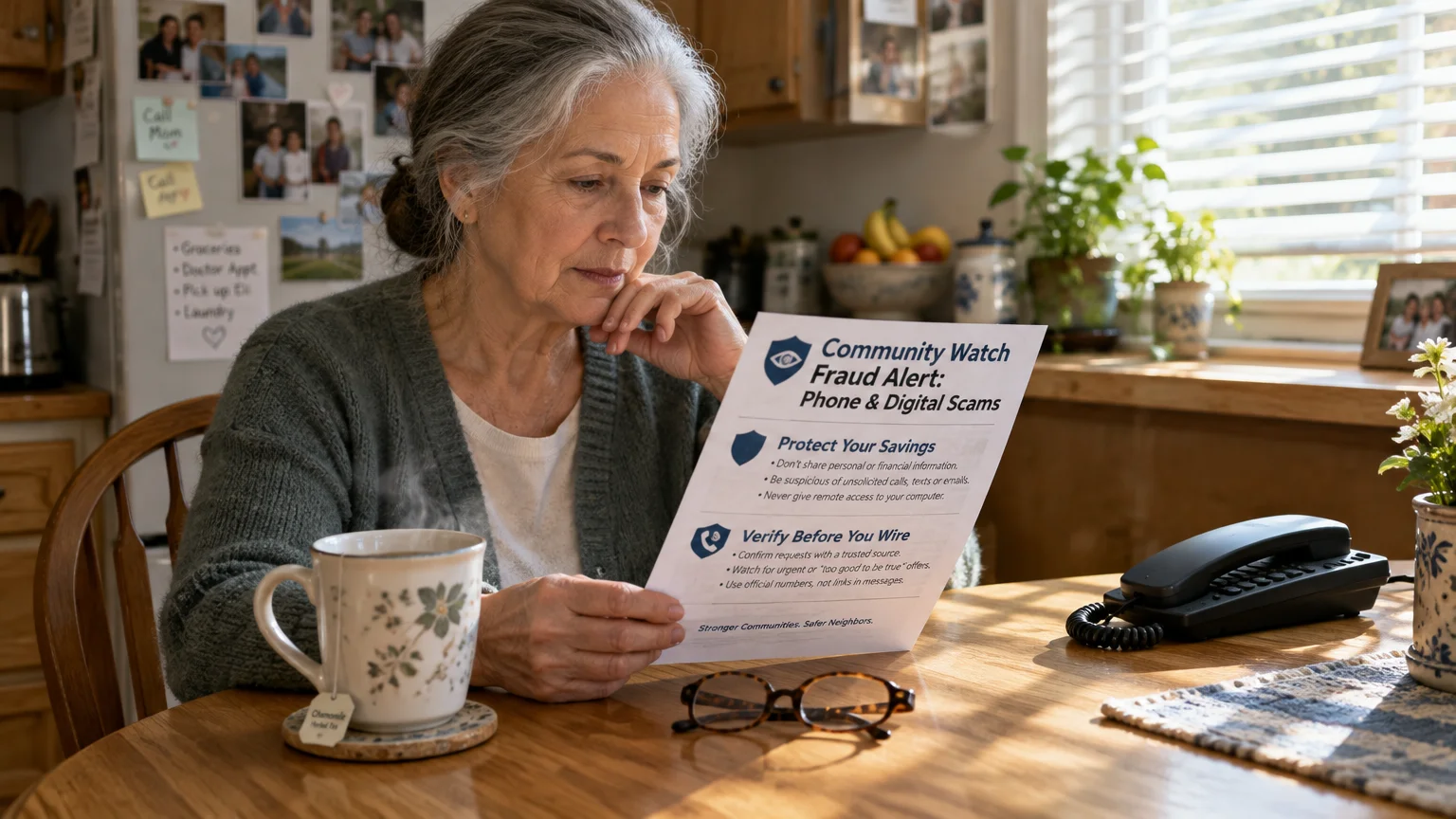
Older Americans face persistent targeting from sophisticated overseas fraud rings and aggressive telemarketers. The Consumer Financial Protection Bureau provides detailed fraud-prevention tools to help retirees protect against financial exploitation.
Volunteer groups like Green Valley’s SAV Scam Squad review suspicious solicitations brought in by confused residents. These volunteers prevent catastrophic financial losses by intervening before victims transfer retirement funds or purchase gift cards.
Wellness check programs represent another revolutionary expansion of neighborhood watch responsibilities. Programs like Adult Watch in The Villages and TeleCare in Green Valley provide daily communication for seniors who live alone.
These daily morning calls ensure that a medical crisis does not go undetected behind closed doors. Knowing someone will notice your absence provides immense reassurance to both retirees and their adult children living out of state.
Watch organizations also build community solidarity by participating in major national civic observances. These annual events reinforce bonds between retirees, neighborhood volunteers, and municipal police forces.
National Night Out, sponsored by the National Association of Town Watch, occurs on the first Tuesday of August each year. Communities celebrated on August 4, 2026, and will observe the next annual event on August 3, 2027.
In addition, communities observe Celebrate Safe Communities during the first Thursday through Saturday of October. Launched by the National Sheriffs’ Association and the National Crime Prevention Council, this event launches Crime Prevention Month.
“True financial security is about building a life where you feel safe, supported, and confident in your surroundings.” — Jean Chatzky, Financial Educator and Author
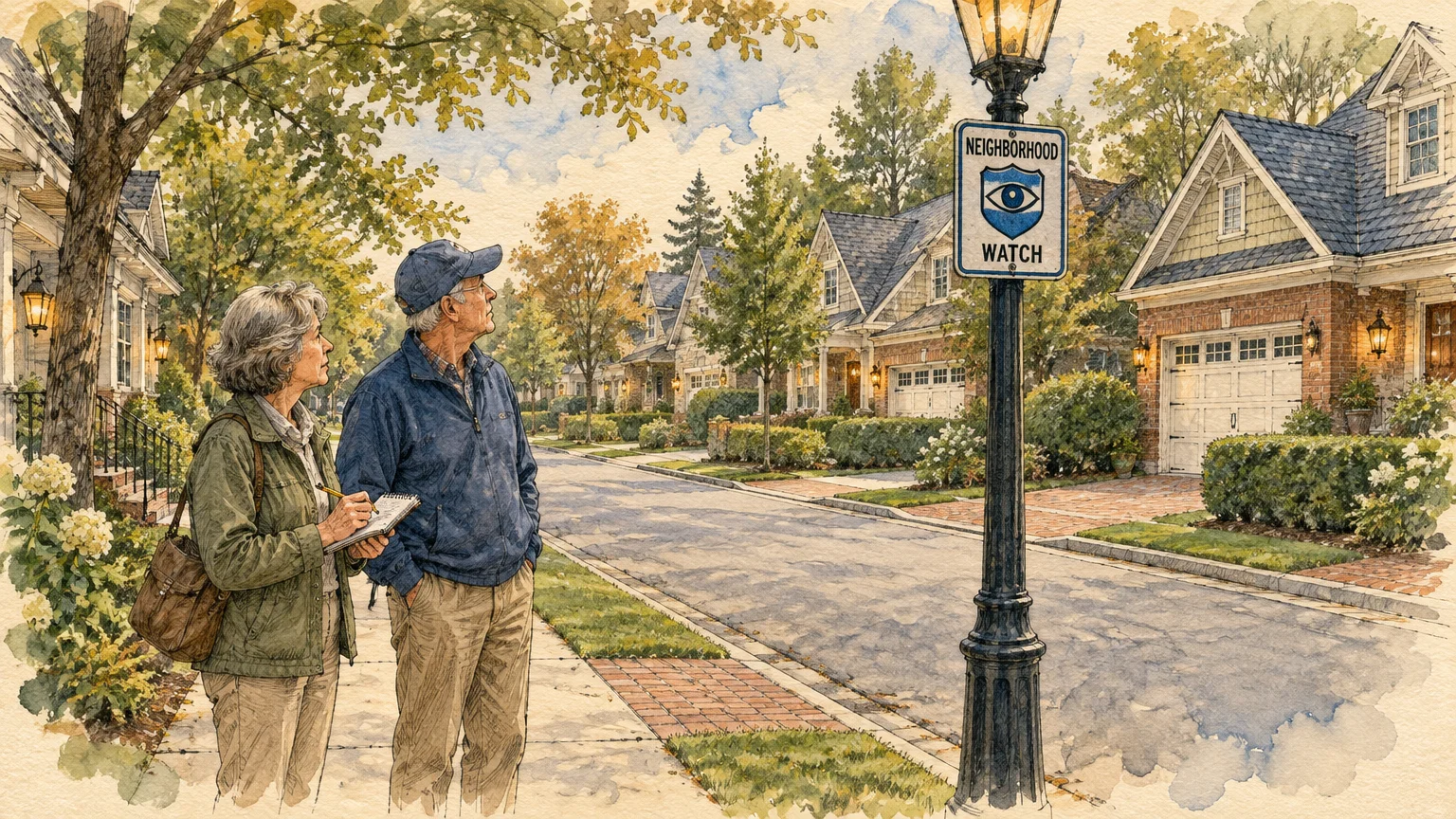
How to Evaluate a Community’s Safety Culture Before Buying
Never rely solely on glossy real estate brochures when judging the actual security of a prospective retirement town. You must investigate the depth and consistency of local community safety initiatives before placing an earnest money deposit.
Start by requesting recent police incident logs from the local municipal police department or county sheriff’s office. Examine call frequencies for burglaries, vandalism, domestic disturbances, and response times for emergency calls.
Schedule a face-to-face meeting with a local neighborhood watch captain or volunteer patrol leader during your visit. Ask how many active volunteers patrol the streets and how often block meetings occur.
You can also review independent lifestyle and retirement guides on AARP to compare livability and safety metrics across different regions. Proactive communities always welcome inquiries from prospective homebuyers who prioritize neighborhood safety.
Key Questions to Ask Watch Coordinators
- Does the neighborhood watch coordinate regular vacation house checks when you travel?
- How does the organization communicate urgent safety alerts to residents?
- What specific training do citizen patrol volunteers receive before going into the field?
- Does the watch program maintain a daily wellness check service for residents living alone?
- How closely does the volunteer organization interface with county or municipal emergency dispatch?
What Can Go Wrong With Community Watch Programs
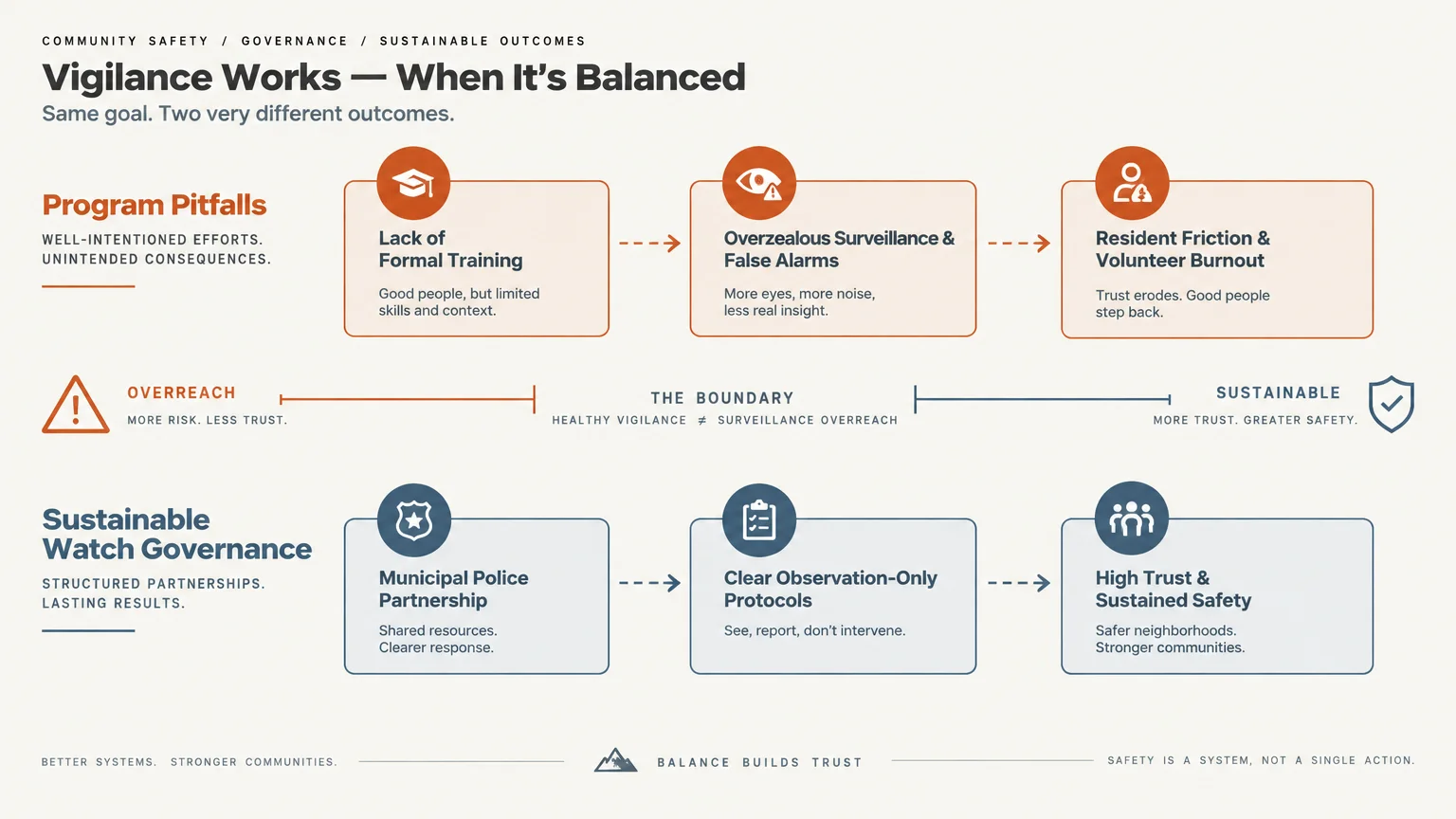
While neighborhood watch programs offer extensive advantages, poorly managed groups can introduce unnecessary frustration and social friction. Recognizing these potential pitfalls helps you select a balanced and professional community.
Overzealous volunteers who misunderstand their legal role represent a serious concern in unmonitored watch programs. Citizen watch members are trained solely to observe and report, never to detain, confront, or pursue individuals.
When volunteers attempt to act as amateur law enforcement, confrontations can escalate rapidly. Quality programs mandate strict codes of conduct that forbid volunteers from carrying weapons or confronting suspects directly.
Volunteer burnout is another persistent challenge facing senior safety organizations. When organizations rely on a shrinking core of aging volunteers without recruiting younger retirees, patrol consistency deteriorates quickly.
A strong watch program can also create a false sense of security among complacent homeowners. Residents may neglect to lock exterior doors, set burglar alarms, or secure patio gates because they assume patrols protect everything.
Finally, poorly moderated neighborhood social apps and watch groups can devolve into rumor mills and petty squabbling. Hyper-vigilant residents may post unfounded accusations against delivery drivers or landscapers, generating unnecessary fear.
Frequently Asked Questions
Does joining a neighborhood watch program reduce homeowners insurance premiums?
Joining a volunteer watch group does not usually trigger a direct line-item discount on your policy. However, lower neighborhood burglary claims help stabilize baseline insurance rates across your ZIP code over time.
Insurers do offer direct discounts of 5% to 15% for communities with 24-hour manned gates, professional security patrols, or centrally monitored home security systems.
What is the legal authority of volunteer neighborhood watch members?
Volunteer watch members possess no law enforcement authority beyond that of any private citizen. They are strictly trained to observe and report suspicious activity directly to sworn police dispatchers.
Legitimate watch programs strictly prohibit members from carrying weapons, confronting suspicious individuals, or conducting vehicle pursuits while on duty.
How can I verify the crime rate of a retirement community before moving?
You can contact the local municipal police department or county sheriff to request historical Uniform Crime Reporting statistics. Many police departments also publish interactive crime mapping tools online.
Additionally, speak directly with neighborhood watch block captains and attend an open community meeting during your prospective visit to gauge community transparency.
What services do modern retirement watch groups provide beyond crime prevention?
Modern retirement watch programs routinely offer vacation house checks, daily phone wellness checks for solo seniors, and keyholder emergency access programs. Many groups also host specialized fraud prevention seminars to protect residents against financial scams.
Taking Action for a Safer Retirement
A thriving neighborhood watch program transforms a collection of houses into a genuine, supportive community. When neighbors watch out for one another, retirees enjoy freedom, safety, and meaningful daily peace of mind.
As you tour prospective retirement towns, make community safety a central priority in your decision-making process. Speak with local volunteers, review local crime trends, and choose an enclave that matches your desired lifestyle.
This is educational content based on general retirement and financial principles. Individual results vary based on your situation. Always verify current benefit rules, tax laws, and eligibility requirements with official sources like SSA, Medicare.gov, or the IRS.
Last updated: October 2026. Retirement benefits, tax rules, and healthcare regulations change frequently—verify current details with official sources.









Leave a Reply