

Leaving a full-time career before age 65 often creates an expensive healthcare gap. Finding part time jobs with benefits lets you bridge that gap without draining your retirement accounts.
Nearly 1 in 5 Americans age 65 and older remained in the labor force in 2025, according to U.S. Bureau of Labor Statistics (BLS) data. Many older adults work shorter schedules specifically for medical coverage, structure, and extra savings.
Knowing which companies insure part-timers—and how wages interact with Medicare and Social Security—protects both your health and your nest egg.
Why Part-Time Employer Coverage Matters More Than Ever Before Age 65
Buying individual health insurance part time workers can afford has grown significantly harder since enhanced Affordable Care Act (ACA) premium tax credits expired at the end of 2025. Without those extra subsidies, out-of-pocket premiums surged for adults in their early sixties.
Roughly 5.5 million of the approximately 24 million ACA Marketplace enrollees in early 2026 were ages 55 to 64. Benchmark silver plan premiums jumped 26% on average from 2025 to 2026 and are rising another 13% for 2027, per KFF.
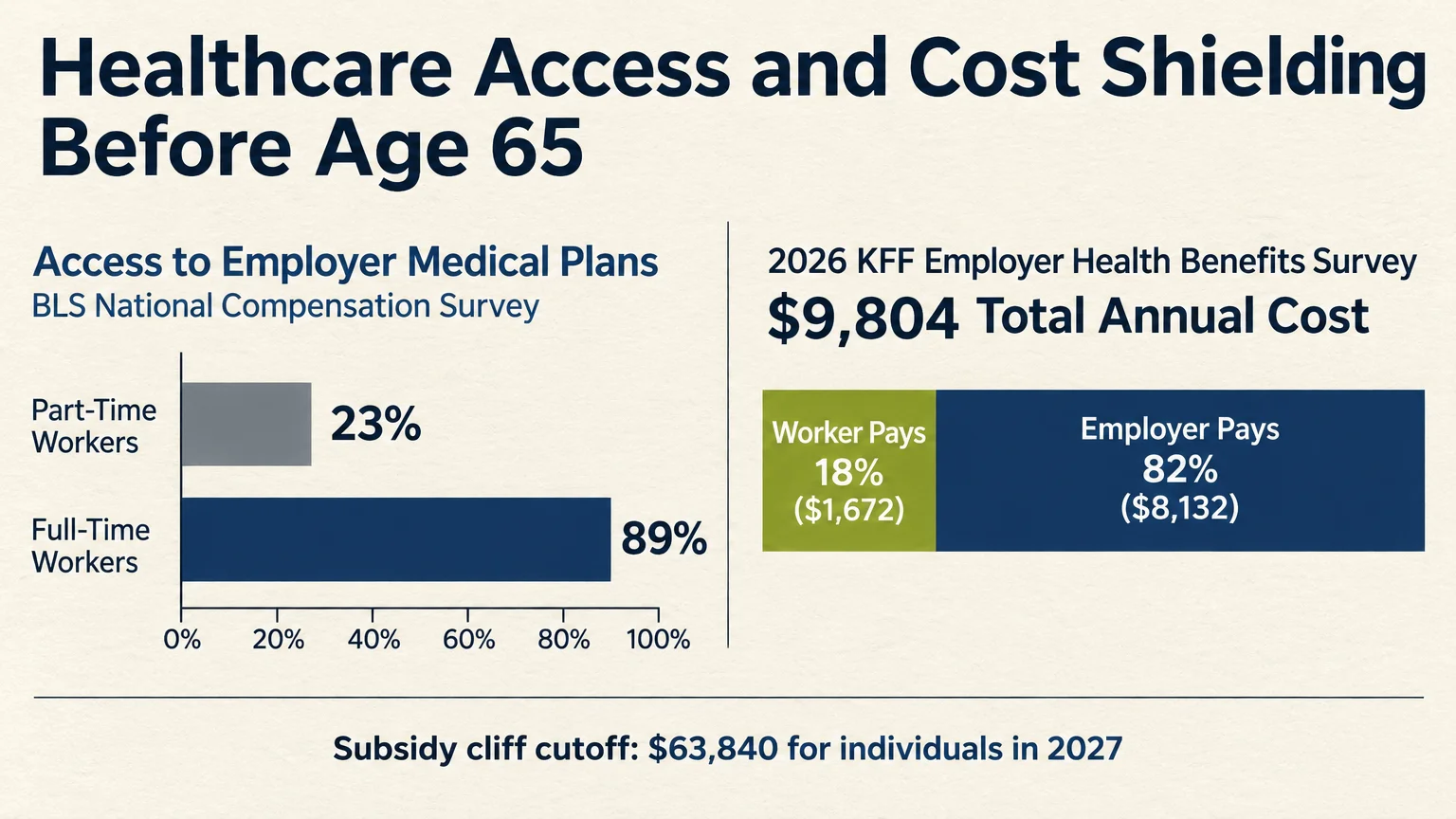
The 400% Federal Poverty Level subsidy cliff also returned in 2026 and continues in 2027. Federal subsidies cut off completely once a single person’s income exceeds $63,840 in 2027, except in Connecticut, New Jersey, New Mexico, and Rhode Island.
Employer-sponsored group coverage shields you from that steep age-based pricing. According to the 2026 KFF Employer Health Benefits Survey, annual employer premiums averaged $9,804 for single coverage, yet workers paid only $1,672—just 18% of the total cost.
Securing one of these bridge jobs before Medicare takes strategic targeting because most part-time positions still lack medical benefits. BLS National Compensation Survey data as of March 2026 shows only 23% of part-time civilian workers have access to employer medical plans, compared with 89% of full-time workers.
Company size also changes how much you pay out of pocket. KFF reports that workers at large firms with 200 or more employees averaged a $1,772 single deductible in 2026, compared with $2,624 at smaller firms.
Top Employers Offering Health Insurance for Part-Time Workers
Several national employers buck the industry trend by offering comprehensive health insurance to part-time staff. Targeting these companies narrows your job search to roles that actually solve your coverage puzzle.
- Starbucks: Part-time baristas and shift supervisors qualify for medical, dental, and vision insurance by averaging 20 hours per week. You become eligible after working 240 total hours across three full consecutive months, with coverage starting on the first day of the second month after qualifying.
- Target: Hourly team members qualify for medical, dental, and vision plans at an average of 25 hours per week. Target also provides day-one free virtual care and a 401(k) match up to 5%, per Target’s official benefits disclosures.
- Costco: More than 94% of Costco’s U.S. employees are eligible for medical, dental, vision, and pharmacy coverage, per its 2025 Sustainability Report. Entry-level U.S. pay starts at $20.00 or more per hour, and employee benefits guides cite roughly 24 weekly hours after about 180 days.
- REI and JPMorgan Chase: Highlighted by AARP and 2026 employer benefit roundups, both companies extend health benefits to part-timers working 20 or more hours per week.
- UPS: Part-time package handlers can qualify for medical coverage through the Teamsters union health plan after completing an initial waiting period.
- Walmart and Trader Joe’s: Walmart offers medical coverage to most hourly associates averaging 30 hours weekly over a 60-day measurement period, or 24 hours weekly for part-time pharmacists, nurse practitioners, and field supply chain roles. Trader Joe’s provides medical plans starting as low as $25 monthly, with roundups citing a 30-hour threshold.
- Lowe’s: Regular part-time associates can access medical coverage options alongside a 401(k) match up to 4.25% and starting wages of $15 per hour.
Before submitting applications, compare how weekly hour rules and waiting periods differ across major chains.
| Employer | Typical Hours Needed | Waiting Period | Notable Extra Benefits |
|---|---|---|---|
| Starbucks | 20 hours/week | 240 hours over 3 full consecutive months | 401(k) with 4% match, dental, vision |
| REI | 20+ hours/week | Varies by role and tenure | Gear discounts, retirement plan |
| JPMorgan Chase | 20+ hours/week | Varies | Corporate schedule, 401(k) match |
| Costco | ~24 hours/week (guides) | ~180 days / 450 hours (guides) | $20+/hr starting pay, pharmacy, 401(k) |
| Target | 25 hours/week | Standard benefit measurement period | Day-one virtual care, 5% 401(k) match |
| Walmart | 30 hours/week (24 for select roles) | 60-day measurement; starts month of day 89 | 401(k) match, dental, vision |
| Trader Joe’s | ~30 hours/week (roundups) | ~3 months (roundups) | Low monthly employee premiums, PTO |
Be cautious about outdated online lists when searching for jobs with benefits over 60. Many third-party blogs still mistakenly list The Home Depot as offering part-time comprehensive medical insurance.
The Home Depot’s official careers page clarifies that major medical insurance is strictly for full-time associates. Part-time hourly workers there receive dental, basic vision, short-term disability, and limited medical payment plans—not comprehensive major medical coverage.
How the ACA 30-Hour Rule Shapes Your Job Search
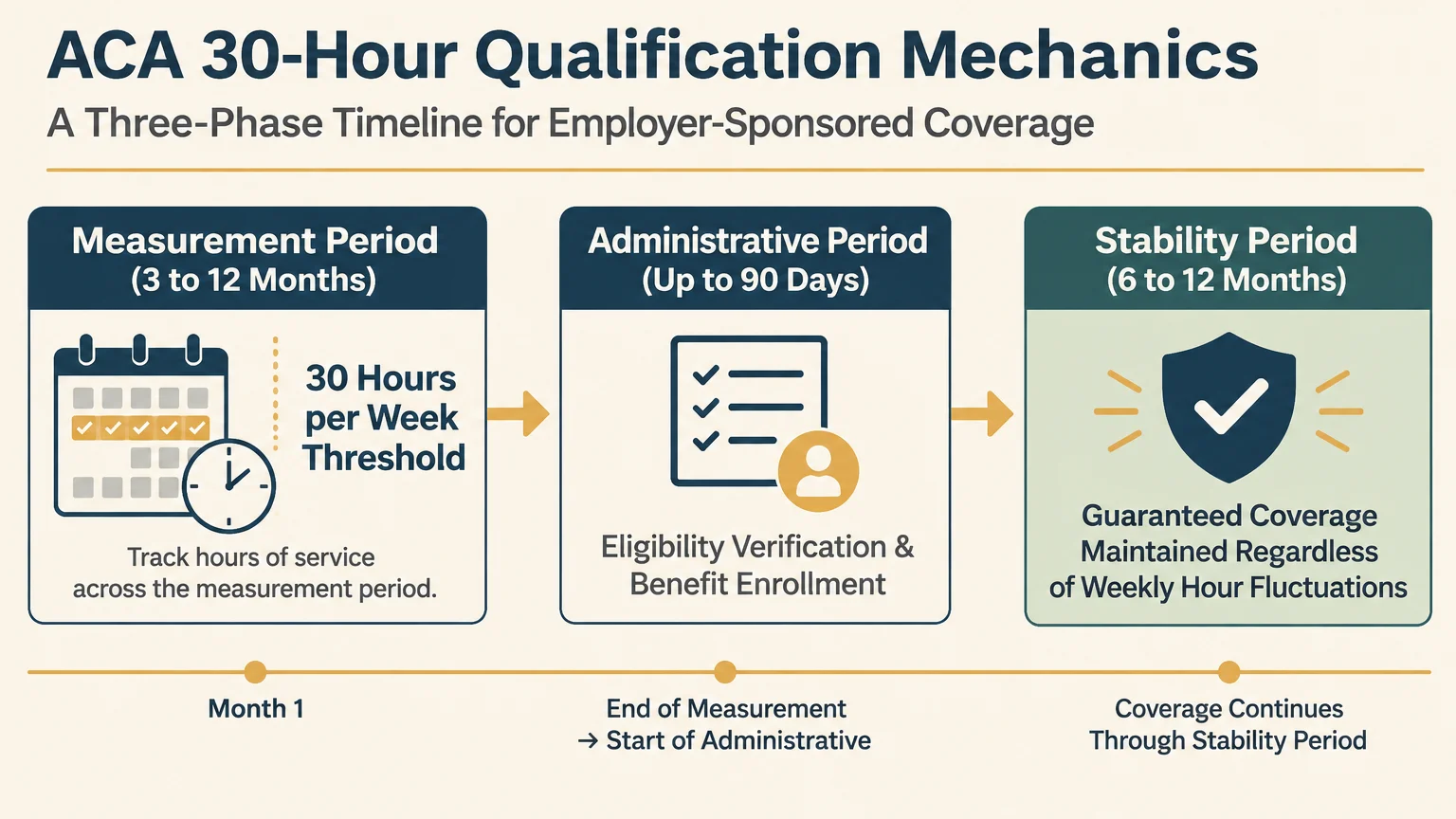
Understanding federal law explains why some companies strictly cap part-time schedules while others welcome older workers. Under Internal Revenue Code Section 4980H, Applicable Large Employers with 50 or more full-time equivalent staff must offer coverage to 95% of full-time employees.
Federal rules from the Internal Revenue Service (IRS) and KFF define full-time as averaging at least 30 hours per week, or 130 hours per month. Because employers face no federal mandate below that line, many businesses cap part-timers below 30 hours to avoid benefit costs.
Companies like Starbucks, Target, REI, and Costco voluntarily set lower thresholds—between 20 and 25 hours—to attract reliable talent. For 2027, employer self-only plans satisfy ACA affordability rules if the worker’s premium share stays at or below 10.22% of household income.
When interviewing for retiree jobs benefits packages, ask specific scheduling questions before accepting an offer:
- Ask whether benefits depend on scheduled hours or actual hours worked during a measurement window.
- Confirm whether managers regularly schedule part-time staff above the minimum eligibility threshold during slower seasons.
- Verify the exact waiting period so you can arrange temporary COBRA or Marketplace coverage during the gap.
- Ask for the Summary of Benefits and Coverage to check deductibles, prescription tiers, and out-of-pocket maximums.
Getting written clarity on hours prevents an unpleasant surprise three months into a new job. A dip of just two hours per week during a slow retail month could push your average below the eligibility cutoff.
Working Past 65: Coordinating Part-Time Benefits With Medicare
Once you turn 65, keeping or dropping an employer plan depends on how many people work for your company. The Centers for Medicare & Medicaid Services (CMS) enforces strict Medicare Secondary Payer rules based on employer headcount.
If your employer has 20 or more workers, the group plan pays primary and you can safely delay Medicare Part B without late penalties. If your employer has fewer than 20 workers, Medicare pays primary and you generally must enroll in Part B at 65.
Skipping Part B when working for a small business with under 20 employees can leave you uninsured for major bills and trigger lifelong late penalties. CMS also stepped up compliance enforcement of these secondary payer rules in 2026.
Checking current Medicare costs helps you decide whether staying on an employer plan saves money. On November 17, 2026, CMS announced the standard Medicare Part B monthly premium will rise 3.2%, from $202.90 in 2026 to $209.40 in 2027.
The annual Part B deductible also climbs from $283 in 2026 to $292 in 2027, while the Part A hospital deductible rises to $1,776 in 2027. Higher-income workers subject to income-related adjustments can pay up to $711.80 monthly for Part B in 2027.
Most people with 40 or more work quarters pay $0 for Part A hospital insurance. Those with 30 to 39 quarters pay $311 monthly in 2026 and $328 monthly in 2027.
Remember that COBRA continuation coverage—which applies to private employers with 20 or more employees under U.S. Department of Labor rules—does not count as current employment for Medicare. Visit Medicare.gov during your eight-month Special Enrollment Period after leaving a job to avoid Part B penalties.
Balancing Paychecks, Social Security, HSAs, and 401(k) Catch-Ups
Taking a part-time job in your sixties affects more than healthcare; it directly interacts with Social Security checks and tax-advantaged accounts. Planning those interactions keeps more of your paycheck in your pocket.
Social Security Earnings Limits Before Age 67
For anyone born on January 2, 1960, or later, Full Retirement Age (FRA) is 67, per the Social Security Administration (SSA). If you claim benefits before age 67 while working, the Retirement Earnings Test temporarily reduces checks above annual thresholds.
- Under FRA all year: The earnings limit is $24,480 in 2026 ($2,040 per month) and $25,560 in 2027 ($2,130 per month). SSA withholds $1 in benefits for every $2 you earn above the limit.
- In the year you reach FRA: The limit rises to $65,160 in 2026 ($5,430 per month) and $67,920 in 2027 ($5,660 per month) for pre-FRA months. SSA withholds $1 for every $3 earned over that cap.
- At FRA and older: Earnings limits disappear completely, allowing unlimited wages alongside full benefits.
Withheld benefits are not lost forever; SSA recalculates and increases your monthly check once you reach FRA. Social Security benefits will also receive a 3.6% cost-of-living adjustment in 2027, adding roughly $75 per month for the average retired worker.
The HSA and Medicare Conflict
Many employer part-time plans pair a High-Deductible Health Plan with a Health Savings Account (HSA). In 2027, qualifying plans require a minimum deductible of $1,750 for self-only coverage or $3,500 for family coverage.
HSA contribution limits rise from $4,400 self-only and $8,750 family in 2026 to $4,500 and $9,000 in 2027, plus a $1,000 catch-up if you are 55 or older. However, IRS rules forbid HSA contributions the moment you enroll in any part of Medicare, including Part A.
If you apply for Social Security after 65, Medicare Part A coverage automatically backdates up to six months. Stop HSA contributions at least six months before filing for Social Security or Medicare to prevent excess-contribution tax penalties.
401(k) and SECURE 2.0 Super Catch-Up Rules
Working part-time at a company with a 401(k) match lets you supercharge late-career savings. On November 18, 2026, the IRS raised the standard 401(k) elective deferral limit from $24,500 in 2026 to $25,500 in 2027.
The standard age 50-plus catch-up contribution climbs from $8,000 in 2026 to $8,500 in 2027. Workers ages 60, 61, 62, and 63 get an even bigger boost under SECURE 2.0: an enhanced catch-up of $11,250 in 2026 and $11,750 in 2027.
If your employer does not offer a workplace retirement plan, Individual Retirement Account (IRA) limits remain $7,500 in 2027 with a $1,100 catch-up for savers age 50 and older.
Common Mistakes to Avoid
Small misunderstandings around benefit deadlines and income caps can erase thousands of dollars in value from a part-time job. Watch closely for these frequent missteps.
- Ignoring the waiting period gap: Even generous plans like Starbucks or Costco require three to six months on the payroll before insurance activates. Line up COBRA or an ACA plan for those initial months, noting that the 2027 HHS payment rule expanded catastrophic plans and tightened income verification.
- Crossing the ACA subsidy cliff mid-year: If you use an ACA Marketplace plan while waiting for employer benefits, monitor your modified adjusted gross income carefully. Earning just one dollar over $63,840 as a single filer in 2027 eliminates federal subsidies in most states.
- Mistaking limited plans for major medical: Discount cards, hospital indemnity policies, or limited medical payment plans—like those offered to part-timers at The Home Depot—do not cap catastrophic hospital bills. Always confirm the plan provides ACA-compliant minimum essential coverage.
- Assuming employer coverage always pauses Medicare: Working part-time for a neighborhood shop with 12 employees does not allow you to skip Medicare Part B at 65. Verify headcount with human resources in writing before delaying enrollment.
Professional vs. Self-Guided
You can manage a straightforward job transition yourself, yet certain retirement crossroads warrant personalized guidance. Match your approach to the complexity of your household finances.
- Self-guided works well for single pre-Medicare bridges: If you are single, ages 60 to 64, and moving directly onto a large retailer’s 20-hour health plan before claiming Social Security, you can usually compare deductibles and premiums directly using employer benefit sheets.
- Seek a fee-only financial planner for ACA cliff planning: If you rely on Marketplace subsidies while working part-time and drawing from retirement accounts, a planner can model Roth conversions or pre-tax 401(k) contributions to keep income below $63,840.
- Consult a State Health Insurance Assistance Program (SHIP) counselor at 65: If you or your spouse are turning 65 while working part-time—especially when one spouse is younger and relies on the employer plan—a free Medicare counselor can verify Secondary Payer rules and Part B timing.
- Work with a CPA for HSA backdating and Social Security taxes: If you contributed to an HSA past age 65 or earned over the Social Security limit while claiming early, a tax professional can calculate prorated HSA limits and prevent IRS penalties.
Frequently Asked Questions
Can you get health insurance working 20 hours a week after age 60?
Yes, several major U.S. employers—including Starbucks, REI, and JPMorgan Chase—offer comprehensive medical insurance to employees averaging 20 hours per week. Others, like Costco and Target, set eligibility near 24 to 25 hours weekly after an initial waiting period.
Should I drop my part-time employer health plan when I turn 65?
Compare the total annual cost of your employer plan’s premiums and deductible against Medicare Part B ($209.40 monthly in 2027) plus a supplemental plan. If your employer has fewer than 20 workers, you generally must enroll in Medicare Part B at 65 regardless.
Does working part-time affect my Social Security benefits before age 67?
Yes, if you claim benefits before Full Retirement Age (67 for those born January 2, 1960, or later) and earn over $24,480 in 2026 or $25,560 in 2027. SSA temporarily withholds $1 for every $2 above the limit, then credits those withheld amounts back at age 67.
Can I still contribute to an HSA if I work part-time after 65?
You can contribute to an HSA after 65 only if you delay enrolling in both Medicare Part A and Part B and stay in an eligible High-Deductible Health Plan. Remember to stop contributions six months before claiming Social Security because Part A backdates automatically.

Taking Your Next Step
Start by listing your target weekly hours, current monthly healthcare costs, and exact distance to age 65 or 67. Request written benefit summaries from two or three target employers in your area so you can verify waiting periods, deductibles, and 401(k) matches side by side before applying.
This is educational content based on general retirement and financial principles. Individual results vary based on your situation. Always verify current benefit rules, tax laws, and eligibility requirements with official sources like SSA, Medicare.gov, or the IRS.
Last updated: November 2026. Retirement benefits, tax rules, and healthcare regulations change frequently—verify current details with official sources.