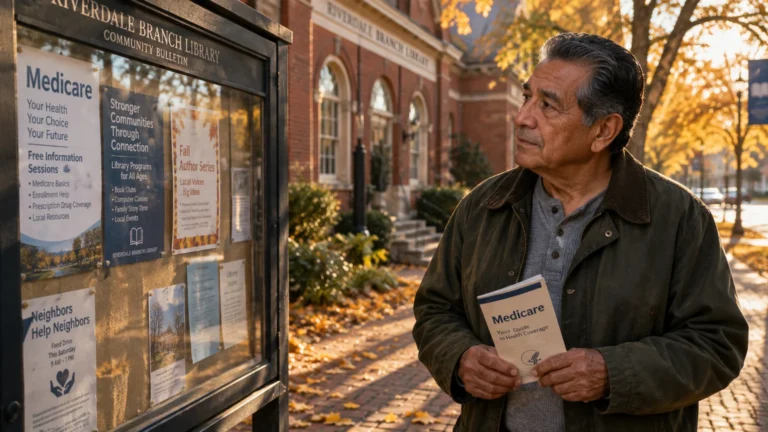
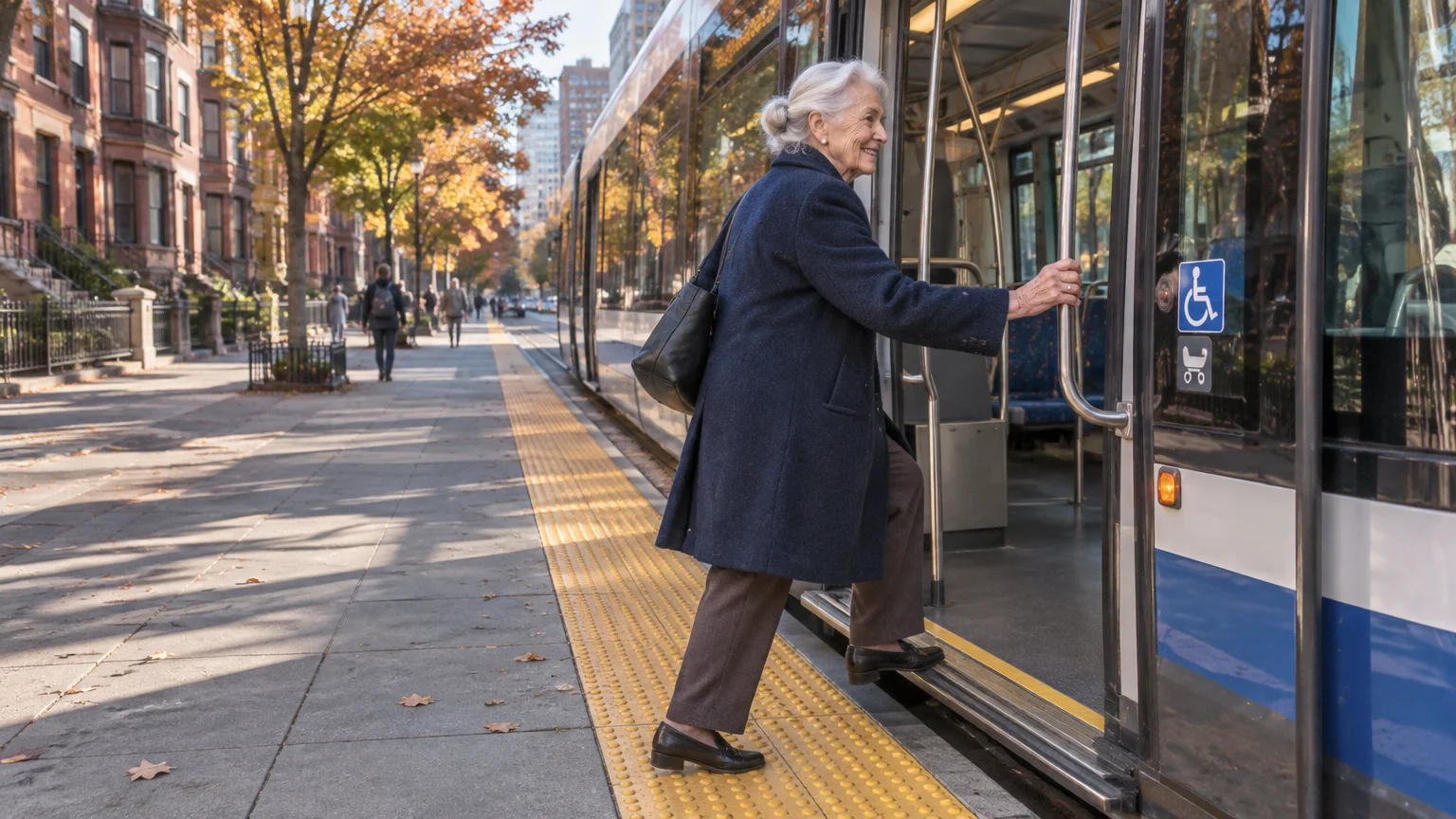
Your priorities change dramatically once you reach your eighties. Golf courses and warm beaches matter far less than reliable public transit, single-story housing, and fast access to specialized hospital care.
Finding the best cities for retirees over 80 requires looking past early-retirement rankings. You need a community built to support mobility, daily independence, and manageable care costs as your needs evolve.
This guide ranks ten U.S. cities based on livability benchmarks, healthcare access, state tax rules, and regional long-term care affordability. Use these rankings to evaluate where your lifestyle and budget fit best.
At a Glance: What Matters Most in Your 80s
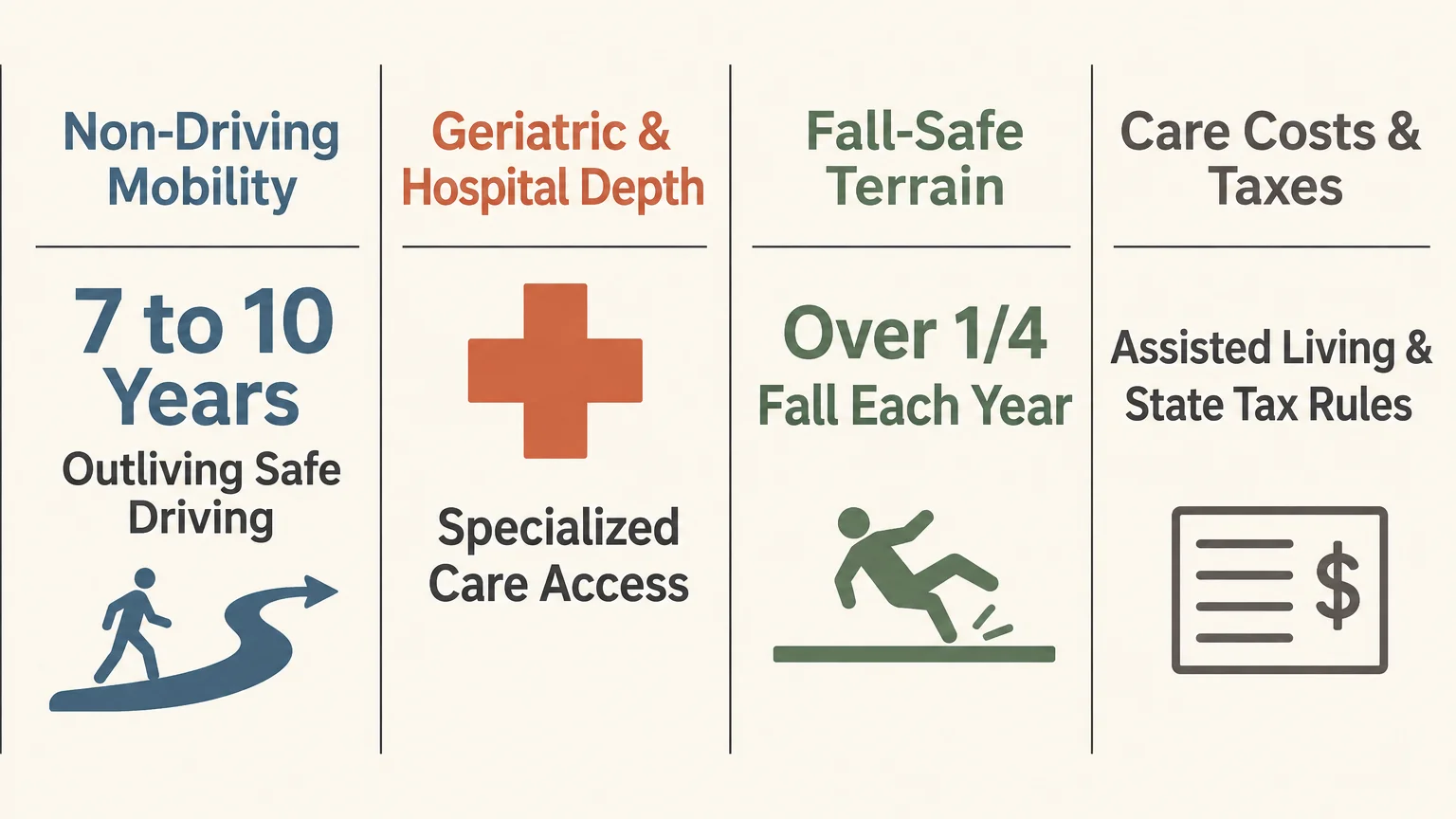
Successful retirement living in your 80s depends on infrastructure that steps in when driving or home upkeep becomes harder. Keep these four core factors at the center of your search:
- Non-driving mobility: Most adults outlive their safe-driving years by 7 to 10 years, making walkable blocks and senior transit essential.
- Geriatric and hospital depth: The nation faces a shortage of geriatric specialists, so living near major hospital networks protects your access to care.
- Fall-safe housing and terrain: Over a quarter of adults 65 and older report falling each year, making flat neighborhoods and step-free layouts critical.
- Regional care costs and taxes: Assisted living medians vary by thousands of dollars per month across states, and eight states still tax Social Security benefits.
Why Choosing a City at 80 Looks Different Than at 65
At 65, many retirees choose a destination for scenery, recreation, or lower property taxes. By 80, daily logistics and medical proximity determine how long you can live independently.
According to U.S. Census Bureau estimates for July 2025, 7,041,036 Americans were age 85 and older. Another 119,182 have reached age 100 or beyond, marking a 48.7% jump since 2020.
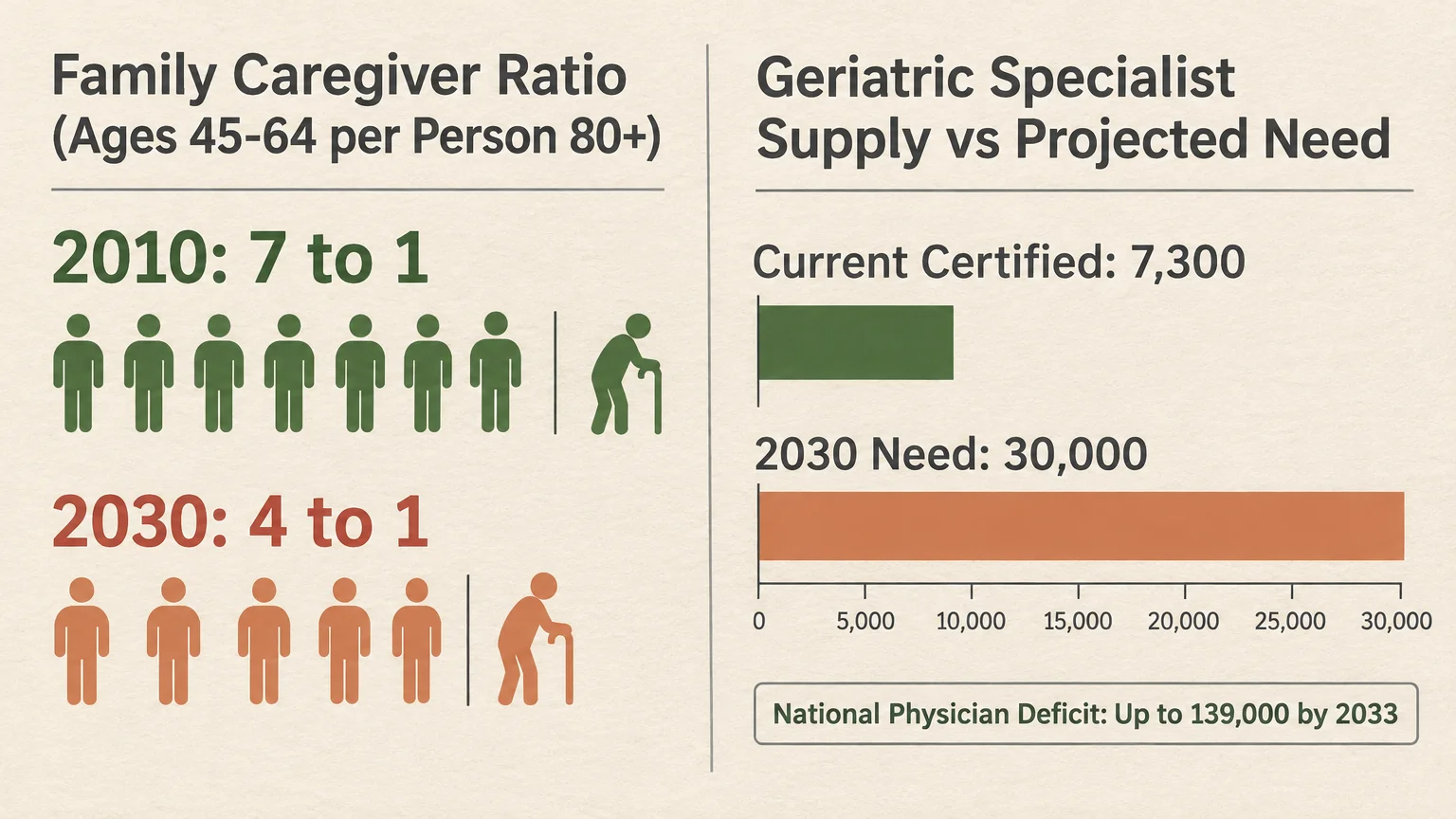
Living longer also changes family dynamics. Population Reference Bureau projections from July 2026 show the ratio of potential family caregivers ages 45 to 64 for each person 80 and older will drop from roughly 7-to-1 in 2010 to 4-to-1 by 2030.
Meanwhile, a 2024 AARP survey found that 75% of adults 50 and older want to stay in their current homes. Another 73% want to stay in their local communities even if they downsize.
Research from AAA cited by AARP shows that older adults typically outlive their ability to drive safely by 7 to 10 years, turning neighborhood walkability and transit into lifelines rather than conveniences.
Healthcare supply adds another layer of urgency when selecting aging in place cities. The American Geriatrics Society notes the United States has only about 7,300 certified geriatricians against a projected need of 30,000 by 2030.
Overall physician supply is tightening as well. The Association of American Medical Colleges projects a national shortage of up to 139,000 physicians by 2033, making established medical hubs far safer bets than isolated rural towns.
To evaluate senior friendly cities objectively, this ranking draws on the AARP Livability Index alongside state care-cost data and tax rules. The AARP Livability Index scores communities on a 0-to-100 scale across seven categories while intentionally excluding weather.

10 Best Cities for Retirees Over 80, Ranked
The first seven cities below hold verified AARP Livability Index scores ranging from 55 to 59, placing them among top large metros for housing, transit, and civic engagement. The final three cities offer distinct trade-offs in specialized medicine or climate.
1. Cincinnati, Ohio
Cincinnati earns a top AARP Livability Index score of 59, reflecting strong neighborhood access, healthcare infrastructure, and community engagement. Ohio also exempts Social Security benefits from state income tax, helping fixed budgets stretch further.
Neighborhoods near major medical campuses give you quick access to primary care, cardiology, and orthopedic rehabilitation. Public buses and local paratransit programs help you reach appointments once you step back from driving.
Midwestern winters do require planning for icy sidewalks and snow removal. Look for condo associations or continuing care communities that handle exterior maintenance year-round.
2. Columbus, Ohio
Columbus follows closely with an AARP Livability Index score of 58 and the same Social Security tax exemption as Cincinnati. Its flat central neighborhoods make walking with a cane or rollator much easier than hilly terrain.
A major university medical center anchors strong healthcare access for seniors managing complex chronic conditions. You will also find wide selections of single-story patio homes and senior living communities across suburban ring towns.
Check transit boundaries carefully before signing a lease or buying a home. Core urban corridors offer reliable bus access, while outer suburbs still require ride-hailing or private senior shuttles.
3. Buffalo, New York
Buffalo matches Columbus with an AARP Livability Index score of 58 and provides dense, accessible neighborhood layouts. New York does not tax Social Security benefits, protecting a major slice of your monthly income.
Compact city blocks place pharmacies, grocery stores, and clinics close to residential streets. Strong local hospital networks also coordinate well with post-hospital home health services.
Snowy winters pose real fall hazards for octogenarians. If you choose Buffalo, prioritize indoor garage parking, elevator buildings, and covered drop-off zones to reduce outdoor slip risks.
4. Sarasota, Florida
Sarasota posts an AARP Livability Index score of 56 and remains a benchmark for retirement living in your 80s. Florida levies no state income tax on Social Security or retirement account withdrawals.
CareScout’s 2025 Cost of Care Survey shows Florida’s median assisted living cost at $5,610 per month, noticeably below the national median of $6,200. That regional pricing gap matters greatly if you transition into supportive housing later.
Flat terrain and abundant senior-focused clinics support year-round outdoor walking and balance classes. Verify hurricane evacuation zones and building generator backup systems before committing to a coastal residence.
5. Miami, Florida
Miami also scores 56 on the AARP Livability Index, driven by dense public transit corridors and extensive medical centers. Elevated rail lines, metro buses, and accessible sidewalks give non-drivers multiple ways to stay independent.
High-rise condominiums dominate many neighborhoods, offering step-free elevator access, on-site security, and maintenance-free living. Major academic and specialty hospitals provide multilingual care teams experienced in treating older adults.
Insurance premiums and condominium association fees can climb rapidly in coastal towers. Review reserve funding and special assessment histories carefully before purchasing a unit.
6. Orlando, Florida
Orlando earns an AARP Livability Index score of 55 and combines Florida’s $5,610 monthly assisted living median with expansive senior housing options. Because the metro sits inland, you face fewer storm-surge risks than on the coast.
Expanding hospital networks serve growing retiree populations across central Florida, improving appointment availability for routine and specialty visits. Warm weather allows daily morning walks without winter ice hazards.
Sprawling suburban developments can isolate residents who no longer drive. Focus your search on walkable town centers, senior shuttle communities, or neighborhoods near medical plazas.
7. Fort Lauderdale, Florida
Fort Lauderdale rounds out the cited AARP Livability Index group with a score of 55. Like other Florida cities, it pairs no state tax on Social Security with moderate assisted living medians relative to coastal northern states.
Flat streets, accessible beachfront promenades, and dense pharmacies make errands straightforward for older residents. Multiple hospital systems operate within short driving distances of central residential districts.
Humidity and heavy summer rainstorms can still limit midday outings. Choose residences with shaded walkways, indoor recreation rooms, and easy ride-share pickup areas.
8. Pittsburgh, Pennsylvania
Pittsburgh stands out for deep healthcare access for seniors, anchored by major teaching hospitals and geriatric specialty clinics. Pennsylvania does not tax Social Security benefits, keeping your federal benefit check free from state withholding.
Established neighborhoods offer walkable business districts, regional rail lines, and bus routes well suited for non-drivers. Older housing stock, however, frequently features steep front steps and narrow staircases.
Focus on renovated elevator apartments or single-level homes in flatter valleys rather than hillside houses. Confirm hospital system participation with your Medicare plan before relocating.
9. Rochester, Minnesota
Rochester attracts octogenarians facing complex heart, neurological, or mobility conditions because of its globally recognized specialty clinic ecosystem. Care coordination between specialists, primary doctors, and rehabilitation therapists runs unusually smoothly here.
Subterranean pedestrian walkways and enclosed skyways connect downtown hotels, clinics, and shops, shielding you from winter ice. Local transit routes specifically serve major medical campuses throughout the day.
Budget carefully for state taxes if you move here. Minnesota is one of only eight states that still tax Social Security benefits in 2026, though income and age exemptions can reduce the bill.
10. San Diego, California
San Diego offers mild, dry weather nearly every month of the year, removing both snow hazards and extreme summer heat. Flat coastal neighborhoods and paved boardwalks make gentle daily exercise easy to maintain.
Strong academic and regional health systems give older residents ready access to geriatric care and outpatient surgery centers. California also exempts Social Security benefits from state income tax.
The primary trade-off is care affordability. CareScout’s survey puts California’s median assisted living cost at $7,000 per month, making substantial savings or family support essential before moving.
Side-by-Side Comparison of the Top 10 Cities
Comparing livability scores, state tax rules, and regional strengths side by side helps narrow your shortlist quickly. Review how each ranked city balances daily mobility against long-term financial realities.
| Rank and City | Primary Advantage Over 80 | State Taxes Social Security (2026) | Key Planning Note |
|---|---|---|---|
| 1. Cincinnati, OH | AARP Livability score of 59; balanced transit and healthcare | No | Plan for winter ice and snow clearing |
| 2. Columbus, OH | AARP Livability score of 58; flat terrain and university hospital | No | Stick near core bus corridors for non-drivers |
| 3. Buffalo, NY | AARP Livability score of 58; compact walkable blocks | No | Seek elevator condos with indoor parking |
| 4. Sarasota, FL | AARP Livability score of 56; FL assisted living median $5,610/mo | No | Verify storm zones and backup power |
| 5. Miami, FL | AARP Livability score of 56; rail transit and condo living | No | Audit HOA fees and building reserves |
| 6. Orlando, FL | AARP Livability score of 55; inland location and growing clinics | No | Avoid car-dependent outer subdivisions |
| 7. Fort Lauderdale, FL | AARP Livability score of 55; accessible coastal amenities | No | Confirm shaded access and clinic proximity |
| 8. Pittsburgh, PA | Deep hospital networks and established bus transit | No | Watch for steep hills and multi-story stairs |
| 9. Rochester, MN | Elite specialty medical hub and enclosed skyways | Yes (with exemptions) | Factor state Social Security tax rules |
| 10. San Diego, CA | Mild year-round climate reducing weather fall risks | No | Budget for $7,000/mo CA assisted living median |
Healthcare, Long-Term Care, and 2027 Budget Realities
Where you live shapes what you pay when daily assistance becomes necessary. Data from CareScout and the Administration for Community Living shows that 7 in 10 people—or 56% of Americans turning 65—will need long-term care during their lifetime.
CareScout’s Cost of Care Survey, released in March 2026, highlights steep price differences between care settings and states. Knowing these national benchmarks helps you stress-test your housing budget before moving:
- Non-medical in-home caregiver: National median sits at $35 per hour, or $80,080 per year for 44 hours weekly.
- Assisted living community: National median reaches $6,200 per month ($74,400 per year), ranging from $4,369 in Mississippi and $5,610 in Florida to $7,000 in California, $9,600 in Massachusetts, and $12,096 in Hawaii.
- Nursing home care: National median hits $315 per day ($114,975 per year) for a semi-private room and $355 per day ($129,575 per year) for a private room.
- Adult day health and private nursing: Adult day health averages $95 per day, while private-duty skilled nursing averages $90 per hour or $160 per visit.
Many retirees assume Medicare covers assisted living or daily home aides, yet Medicare.gov rules remain strict. Original Medicare covers short-term post-hospital skilled nursing or home health—used by over 3 million beneficiaries annually—rather than long-term custodial care.
Notice the financial crossover point as well. CareScout notes that hiring an in-home caregiver becomes more expensive than median assisted living once you need roughly 41 hours of help per week.
Federal benefit adjustments for 2027 also affect your monthly cash flow. The Social Security Administration announced a 3.6% cost-of-living adjustment starting January 2027, adding roughly $75 per month on average across nearly 72 million beneficiaries.
Rising Medicare costs absorb a portion of that raise. Standard Medicare Part B premiums climb from $202.90 in 2026 to $209.40 in 2027, leaving an average net gain near $68.50 per month.
Other 2027 Medicare cost-sharing updates require extra cash reserves in your chosen city:
- Part B deductible and surcharges: The annual Part B deductible rises from $283 to $292, and IRMAA surcharges apply above $112,000 single or $224,000 joint income, reaching up to $711.80 monthly.
- Hospital and skilled nursing costs: The Part A inpatient deductible rises from $1,736 to $1,776, and skilled nursing facility coinsurance for days 21 through 100 climbs from $217 to $222 per day.
- Prescription and Medigap limits: The Part D out-of-pocket spending cap rises from $2,100 in 2026 to $2,400 in 2027, while high-deductible Medigap Plans F and G deductibles move from $2,950 to $3,050.
Tax planning offers meaningful relief if you coordinate withdrawals carefully. Under federal rules for 2025 through 2028, taxpayers age 65 and older receive an extra $6,000 enhanced senior deduction ($12,000 for joint filers both 65 or older) regardless of itemizing.
That enhanced deduction phases out between $75,000 and $175,000 of modified adjusted gross income for single filers, or $150,000 to $250,000 for married couples. Meanwhile, IRA owners age 70½ and older can use Qualified Charitable Distributions up to $111,000 in 2026 to satisfy required minimum distributions tax-free.
State taxes vary widely too. Only eight states—Colorado, Connecticut, Minnesota, Montana, New Mexico, Rhode Island, Utah, and Vermont—still tax Social Security benefits in 2026.

What Can Go Wrong When Relocating in Your 80s
Moving to a highly ranked city can still backfire if you overlook everyday health and support risks. Watch out for these common pitfalls before putting your home on the market:
- Leaving nearby family caregivers: Moving hundreds of miles away for better weather can strain support systems when 56% of older voters already worry about lacking family caregiving help.
- Ignoring fall risks inside the home: America’s Health Rankings reports that 27.8% of adults 65 and older fall, and non-fatal falls cost $80 billion annually—29% paid out of pocket.
- Overlooking nursing home staffing strains: An American Health Care Association survey found staffing problems worsened at 60% of nursing homes since early 2022, making facility quality checks vital before picking a town.
- Underestimating cognitive care needs: Roughly 7.4 million Americans 65 and older live with dementia in 2026, so choosing a city without memory-care units or adult day programs can force a second move later.
Even if you stay put or choose a new city, ask your doctor for an annual fall-risk screening. The American Geriatrics Society recommends yearly gait checks and medication reviews for every adult 65 and older.
When to Consult a Professional
Relocating or redesigning your housing in your 80s connects health, taxes, and estate plans all at once. Schedule guidance from qualified specialists in these four scenarios:
- Before buying into a continuing care community: Have an elder law attorney review entrance-fee refund clauses, healthcare guarantees, and Medicaid rules in your target state.
- When selling a long-time family home: Consult a Certified Financial Planner or tax professional to measure capital gains, IRMAA Medicare surcharges, and eligibility for the $6,000 or $12,000 senior tax deduction.
- If you notice mobility or balance changes: Ask an occupational therapist to audit doorways, bathroom grab bars, lighting, and step entries before you sign a new lease.
- When comparing complex health plans across states: Work with a licensed Medicare broker or State Health Insurance Assistance Program counselor to verify hospital and specialist network access.
Frequently Asked Questions
What makes a city ideal for retirees over 80?
The best cities for retirees over 80 combine reliable non-driving transit, single-level housing, and fast access to major hospitals. Low fall hazards, nearby pharmacies, and manageable assisted living costs matter far more than entertainment or nightlife.
Should you move closer to family or stay in your current city?
Staying near trusted doctors and family caregivers often preserves independence longer than chasing a warmer climate. If your current home has steep stairs and poor transit, downsizing to an elevator apartment in the same community frequently works best.
How much does assisted living cost in top retirement states?
CareScout’s 2025 survey puts the national assisted living median at $6,200 per month, or $74,400 per year. State medians range widely, from $5,610 per month in Florida to $7,000 in California and $9,600 in Massachusetts.
Do Medicare Advantage plans transfer smoothly when you move?
Moving out of your plan’s service area triggers a Special Enrollment Period to pick a new local plan or switch coverage. Check hospital and geriatrician participation in your new city before finalizing a move, especially if you rely on Original Medicare plus Medigap.

Planning Your Next Step
Start by touring your top two or three cities during their toughest weather month rather than peak spring. Ride the local bus or paratransit service, visit a nearby primary care clinic, and tour one assisted living campus to check waitlists and monthly rates.
The information in this guide is meant for educational purposes. Your specific circumstances—including income, health needs, tax situation, and goals—may require different approaches. When in doubt, consult a licensed professional.
Last updated: November 2026. Retirement benefits, tax rules, and healthcare regulations change frequently—verify current details with official sources.