
From Saver’s Credit to Saver’s Match: What Changed Under SECURE 2.0
Congress fundamentally restructured federal retirement incentives by passing the SECURE 2.0 Act of 2022. That landmark legislation created Internal Revenue Code Section 6433, establishing the Saver’s Match.
For decades, qualifying workers relied on the traditional Saver’s Credit to lower their annual tax liabilities. However, that older program had a structural flaw that limited its effectiveness for lower earners.
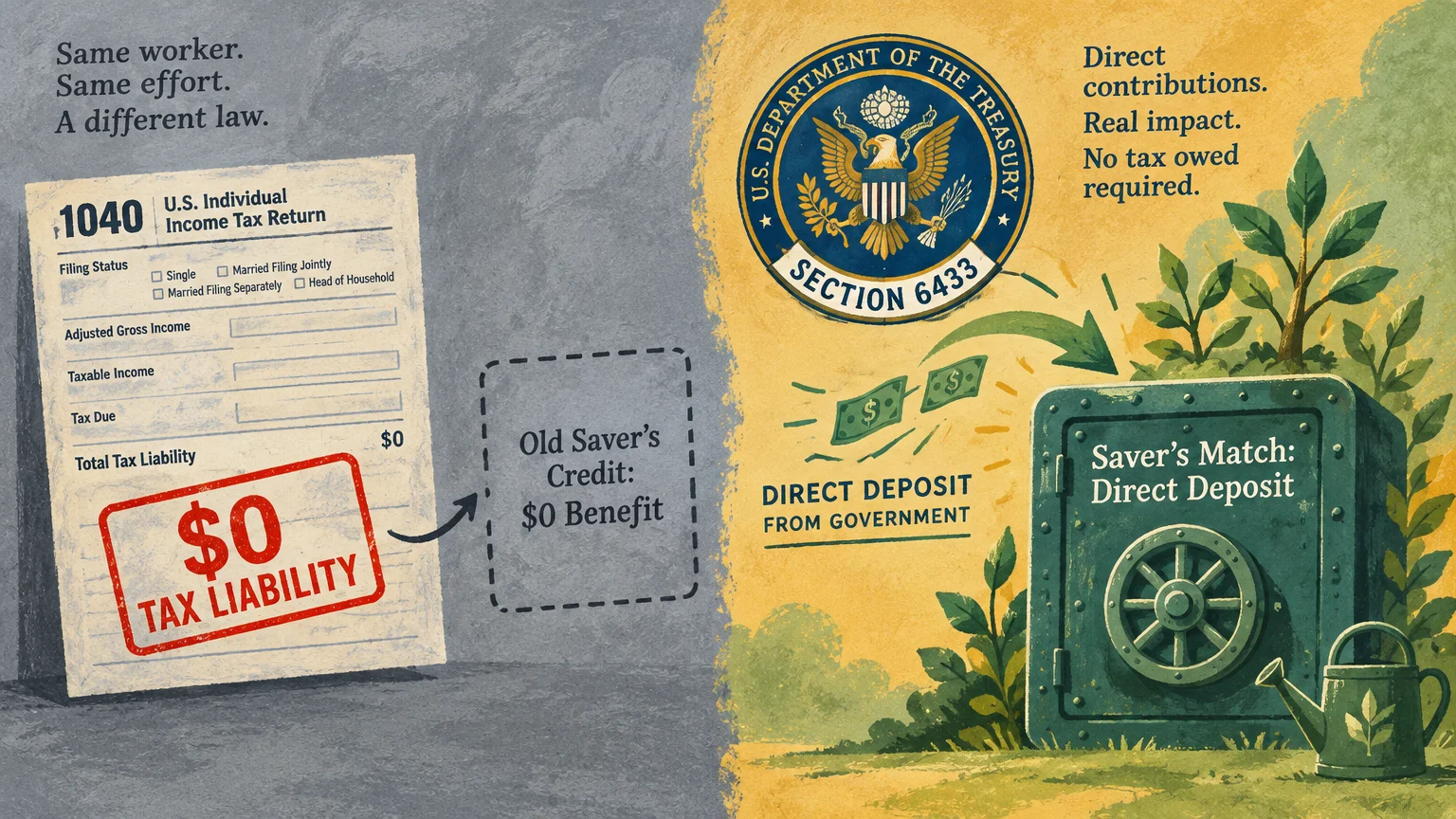
The traditional Saver’s Credit functioned as a nonrefundable tax credit. A nonrefundable credit reduces your tax bill down to zero, but it cannot deliver extra money beyond what you owe.
Millions of modest-income workers and retirees working part-time owe zero dollars in federal income tax. As a result, those individuals received zero financial benefit from saving money under the old credit.
The Saver’s Match eliminates that unfair barrier entirely. Under the updated law, the government stops discounting your tax bill and instead deposits tangible cash into your retirement fund.
Because the match operates as a direct government contribution, your tax liability no longer matters. You qualify for the full matching deposit even when your federal income tax balance stands at exactly zero.
The existing Saver’s Credit remains active for the 2026 tax year. Furthermore, the credit format will continue operating indefinitely for individuals making contributions to specialized ABLE accounts.









Leave a Reply