

Auto insurance costs remain roughly 55% higher than late 2020 levels, putting real pressure on fixed retirement budgets. Fortunately, leaving the daily commute behind unlocks targeted discounts and policy adjustments that can lower your car insurance in 2027.
Policyholders who switch carriers save a median of $461 per year for the same protection. Better yet, combining mature-driver credits, mileage changes, and smart deductible choices can trim your bill even further.
Below are six practical ways to save on car insurance in 2027 without leaving your retirement savings exposed to major accident claims.
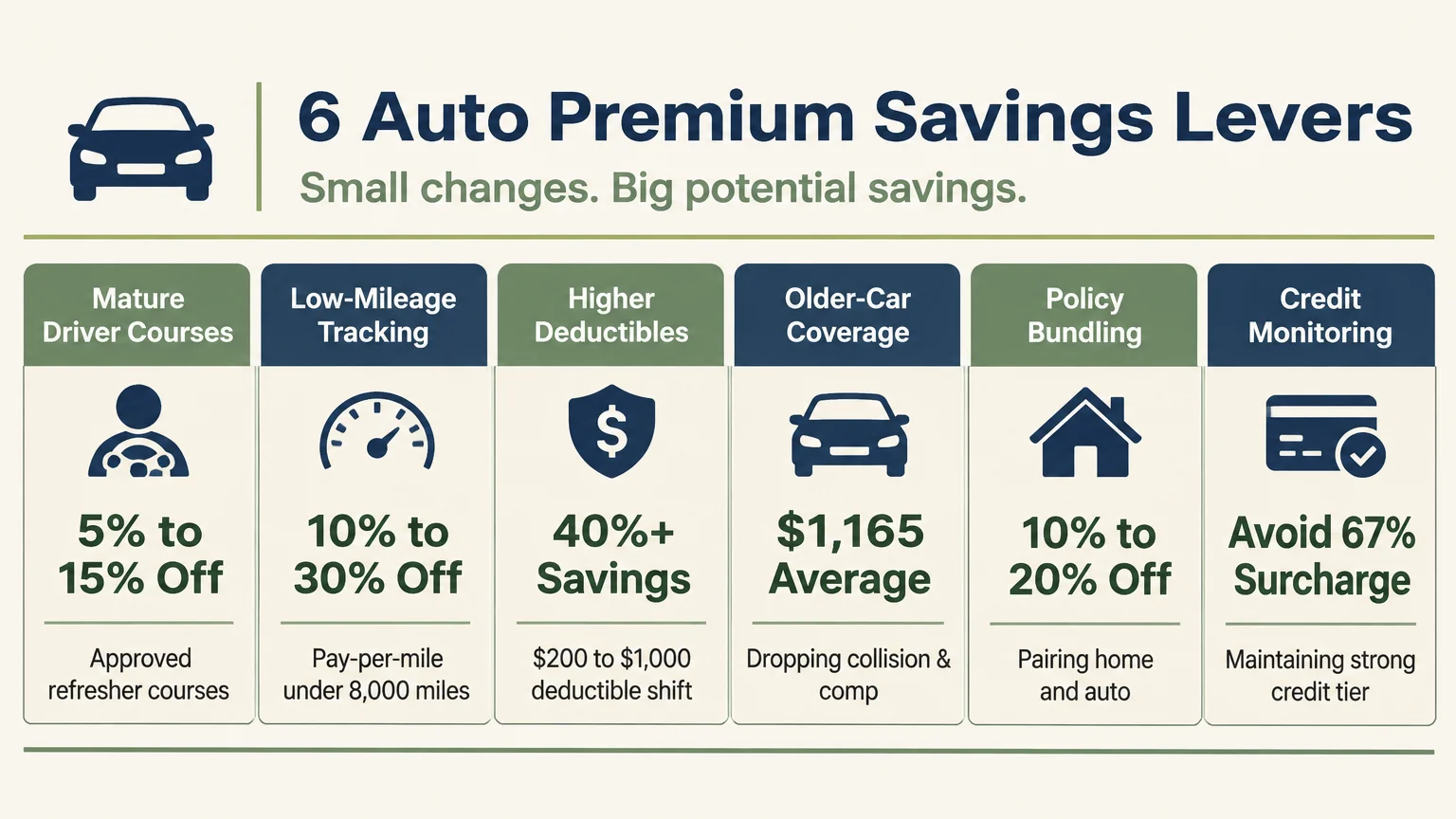
At a Glance: Six Ways to Cut Your 2027 Auto Premium
Every retiree drives differently, so your biggest savings depend on your annual mileage, vehicle age, and location. Review these six levers to spot the fastest wins for your policy:
- Mature driver courses: Earn 5% to 15% off—and up to 20% in some states—by completing an approved refresher course.
- Low-mileage and telematics programs: Save 10% to 30% with usage-based tracking, or 40% to 60% with pay-per-mile plans if you drive under 8,000 miles yearly.
- Higher deductibles: Moving collision and comprehensive deductibles from $200 to $1,000 can cut those coverages by 40% or more.
- Trimming older-car coverage: Dropping collision and comprehensive on a paid-off car saves an average of $1,165 per year.
- Policy bundling: Pairing home and auto insurance typically reduces both policies by 10% to 20%, though standalone comparisons still matter.
- Credit score monitoring: Maintaining strong credit avoids the 67% to 69% surcharge drivers with poor credit face in most states.
What Is Driving Auto Insurance Costs for Retirees in 2027
After steep inflation peaked at 22.6% year-over-year in April 2024, auto insurance price growth finally cooled. Bureau of Labor Statistics data showed motor vehicle insurance prices 5.0% lower year-over-year in September 2026.
Still, relief remains uneven across the country as vehicle repair costs ticked up 0.9% in October 2026. Insurify data from November 2026 puts average full coverage at $2,243 per year, while AutoInsurance.com reports $2,660 per year.
Those national benchmarks hide sharp swings based on your age and state. Only California, Hawaii, and Massachusetts ban insurers from using age to set auto rates, leaving seniors elsewhere exposed to steep increases later in retirement.
Forbes Advisor figures from June 2026 show full-coverage averages dipping to $2,109 per year at age 60 before climbing to $2,302 at age 70. By age 80, average full-coverage premiums reach $2,823 per year.
MoneyGeek data from November 2026 shows a similar pattern, with drivers 65 and older paying an average of $157 per month for full coverage. Rates hold steady in your mid-60s, then rise 8% to 15% between ages 65 and 75.
Insurance Institute for Highway Safety data explains why premiums climb after 70. Drivers aged 65 to 69 post the lowest collision and property damage claim rates, but fatal crash rates per mile rise starting at ages 70 to 74 due to greater injury vulnerability.
Upcoming legal changes will also reshape minimum coverage bills in 2027. Starting October 1, 2027, Washington, D.C. raises its mandatory minimum liability limits to 50/100/20—$50,000 bodily injury per person, $100,000 per accident, and $20,000 for property damage.
Several states—including California, Virginia, North Carolina, Utah, and Massachusetts—already enacted higher liability minimums during 2025 and 2026. If you live in those states, your renewal notices already reflect higher baseline coverage requirements.
Before you touch any coverage line, remember how wildly carriers price identical drivers. Insurance Rate Guard reported in August 2026 that the gap between the cheapest and priciest insurer in a state often runs 60% to 130%.
Shopping your policy every year or two remains your single strongest habit. A Consumer Reports survey of 40,566 policyholders found that switching carriers delivered a median savings of $461 annually.
01 Take a State-Mandated Defensive Driving Discount Course
One of the easiest car insurance discounts for seniors requires just a few hours at your computer or a local classroom. Currently, 34 states and Washington, D.C. require insurers to offer discounts to mature drivers who pass an approved defensive driving course.
Rules and age thresholds vary depending on where you live. Five states—California, Florida, Maine, Minnesota, and Washington—mandate discounts by statute starting at age 55, with Minnesota requiring at least a 10% reduction.
Pennsylvania law similarly guarantees a minimum 5% discount for drivers 55 and older. Even in states without a legal mandate, most major insurers voluntarily apply a mature-driver credit when you submit a completion certificate.
Typical defensive driving discount savings range from 5% to 15% off eligible coverages, and can reach 20% with certain carriers. Once applied, the discount usually stays on your policy for three years, or two years in Washington.
The upfront cost is modest compared with the multi-year payout. Online courses generally run $15 to $40, and California caps approved mature-driver course fees at $30 plus $1 for the certificate.
For example, the AARP Smart Driver online course cost $27 for members and $30 for non-members as of November 2026. Even a modest 10% savings on a $1,800 policy returns $180 a year—more than $500 over three years.
Follow these quick steps to make sure your certificate counts:
- Call your insurer or check your state department of insurance website to verify which course providers qualify.
- Ask whether every listed driver on your policy must complete the course to earn the full discount.
- Submit your completion certificate immediately and set a calendar reminder three months before it expires.
02 Switch to Low-Mileage, Pay-Per-Mile, or Telematics Programs
Stopping a daily work commute transforms your risk profile overnight. Federal Highway Administration data shows drivers 65 and older average roughly 7,646 miles per year, compared with the overall U.S. average of 13,476 miles.
If your insurer still rates you at 12,000 or 15,000 annual miles, you are likely overpaying. Most carriers define low mileage as driving under 7,500 to 10,000 miles per year, with steeper pricing tiers below 7,000 or 5,000 miles.
Insure.com analysis from November 2026 shows drivers logging 20,000 or more miles per year pay 36% more than those driving 5,000 miles or fewer. However, a simple low-mileage declaration alone often yields a flat discount of 5% or less.
To unlock larger savings on auto insurance in 2027, consider pairing low mileage with usage-based insurance (UBI) or a pay-per-mile plan. AutoInsurance.com reports that low-mileage or telematics discounts can push full-coverage averages down to roughly $2,100 per year.
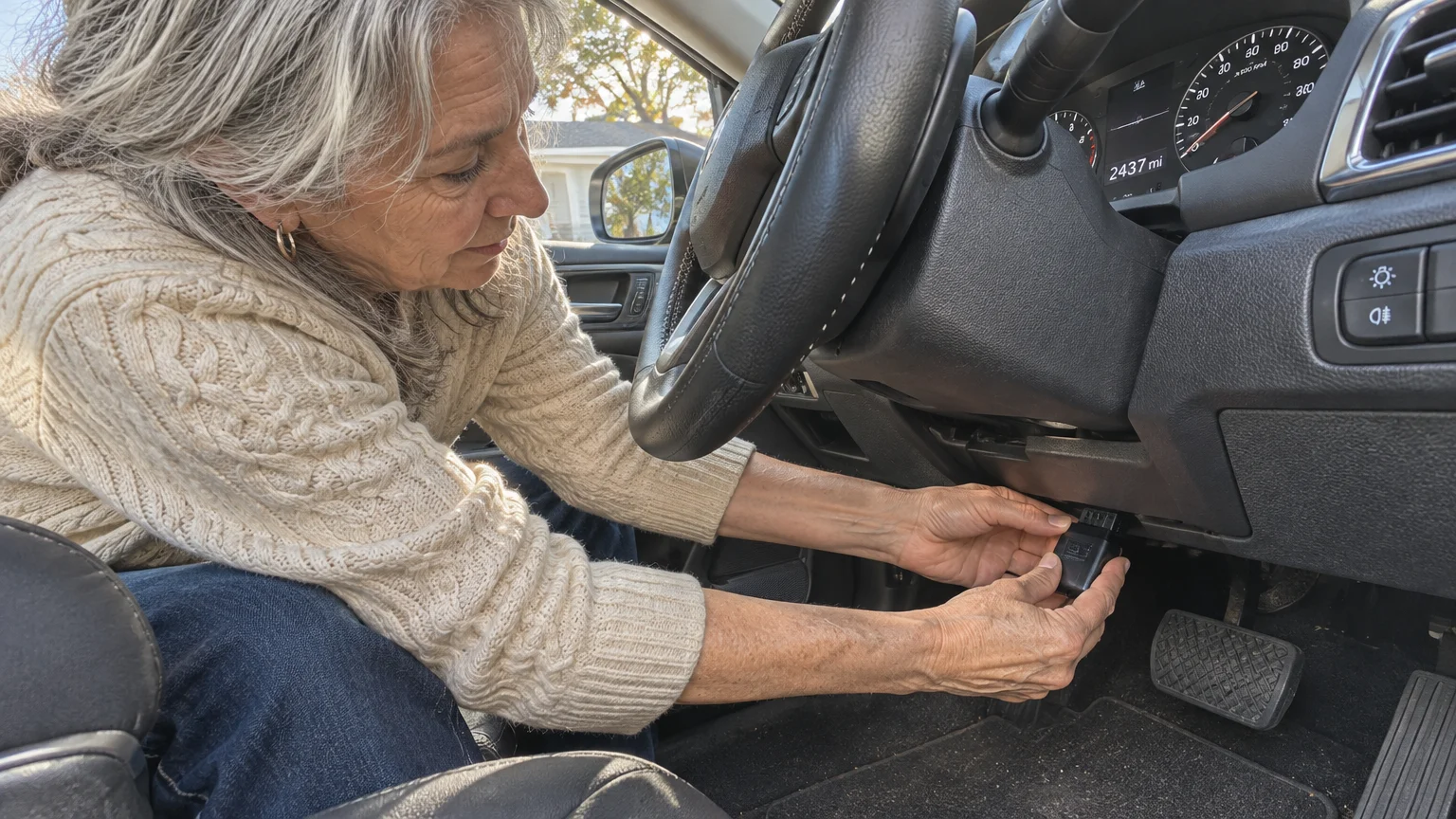
Telematics programs use a smartphone app or small plug-in device to track mileage, braking, speed, and time of day. Safe retirees who avoid rush-hour traffic and late-night trips typically save 10% to 30%, and up to 40% with carriers like Allstate and Nationwide.
Pay-per-mile insurance goes a step further by charging a small monthly base rate plus a few cents per mile driven. Drivers logging fewer than 8,000 miles per year can save 40% to 60% compared with standard flat-rate policies.
Before enrolling, check whether your chosen telematics program can raise your bill. According to Bankrate and InsureMojo figures, Progressive Snapshot saves participants an average of $94 at sign-up and $231 per year after monitoring.
Yet roughly 20%—about two in ten—of Snapshot participants actually receive a rate increase for habits like hard braking or frequent nighttime driving. By contrast, discount-only options like State Farm Drive Safe & Save and Nationwide SmartRide will not penalize your rate.
Consumer Reports survey data found a median telematics savings of $120 per year across all policyholders. If you dislike constant driving apps, a strict pay-per-mile plan that tracks odometer readings without scoring your braking may suit you better.
03 Raise Your Collision and Comprehensive Deductibles
Reviewing your deductibles offers immediate savings without changing how you drive or who insures you. Your deductible is the amount you pay out of pocket before collision or comprehensive coverage pays for repairs.
Many retirees keep low $200 or $250 deductibles out of habit from decades ago. Shifting that risk slightly toward your cash reserves forces your insurer to charge less every six months.
According to the Insurance Information Institute, raising collision and comprehensive deductibles from $200 to $500 can reduce the cost of those coverages by 15% to 30%. Pushing your deductible to $1,000 can cut collision and comprehensive premiums by 40% or more.
When measured against your entire full-coverage policy, the total discount remains substantial. Moving from a $500 to a $1,000 deductible trims average full-coverage premiums by roughly 11%, and benchmarks cited by the Insurance Information Institute show savings up to 20% to 25%.
Insure.com analysis from March 2026 shows that raising your deductible further to $2,000 yields roughly 22% in total full-coverage savings. Still, a deductible only makes sense if you can comfortably cover that amount tomorrow without raiding retirement accounts.
Treat your higher deductible as a self-insurance trade-off backed by your liquid emergency fund. If a $1,000 repair bill would force you onto a credit card or trigger an unplanned IRA withdrawal, stick with $500.
Ask your agent to quote the exact dollar savings for $500, $1,000, and $2,000 deductibles side by side. Divide the higher out-of-pocket risk by your annual premium savings to see how many claim-free years it takes to break even.
04 Drop Collision and Comprehensive on Paid-Off Older Vehicles
Retirees frequently keep vehicles well past the final loan payment. S&P Global data showed the average age of vehicles on U.S. roads reached a record 12.6 years in 2024.
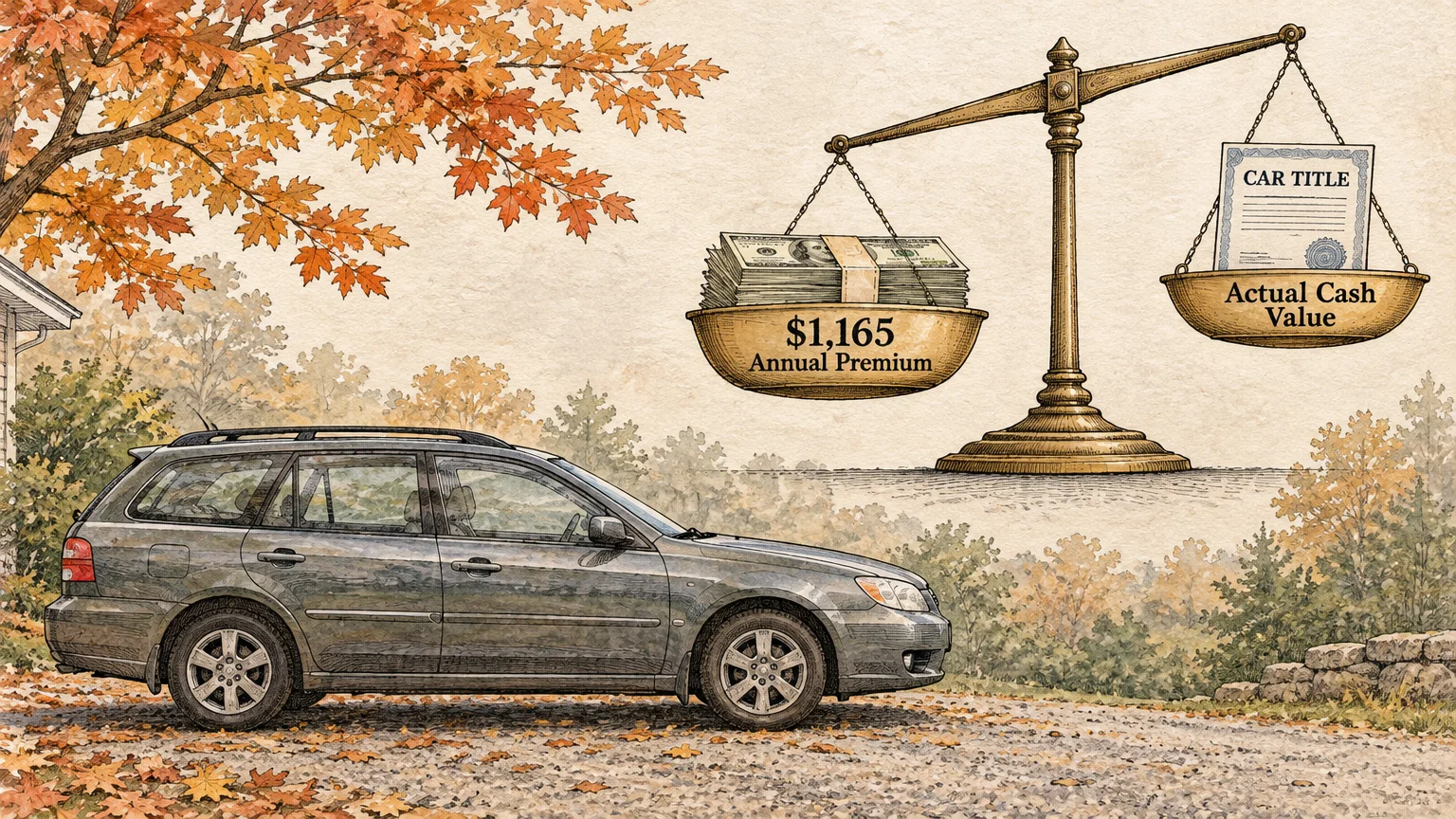
Once your auto loan or lease ends, no lender can force you to carry collision and comprehensive coverage. Keeping full coverage on an aging sedan can quietly cost more than the car is worth after a deductible.
Consumer Reports recommends a straightforward benchmark before removing physical damage coverage from an older vehicle:
The 10% Decision Rule: Add your annual collision and comprehensive premiums together. When that combined annual cost exceeds 10% of your car’s current market value minus your deductible, consider dropping collision coverage and banking the savings.
Suppose your paid-off car has a private-party value of $5,500 and you carry a $500 deductible, leaving a maximum payout of $5,000. Ten percent of that net payout equals $500 per year.
If your declarations page shows $750 per year for collision and comprehensive combined, you are paying well past the 10% threshold. Consumer Reports estimates drivers who drop collision and comprehensive on older vehicles save an average of $1,165 per year.
You do not have to drop both coverages on the exact same day. Comprehensive coverage—which pays for cracked windshields, theft, hail, flood damage, and deer strikes—often costs much less than collision.
Consumer Reports advises keeping comprehensive slightly longer if the price fits your budget, especially if you park outdoors or live in storm-prone areas. Before dropping any coverage, verify that your savings account could replace your car with cash if a crash totaled it tomorrow.
05 Bundle Home and Auto Policies—and Stack Retiree Discounts
Consolidating your policies under one roof remains a reliable way for retirees to trim fixed bills. MoneyGeek data from November 2026 shows bundling home and auto insurance typically cuts 10% to 20% off both policies.
For an average senior paying $157 per month for full-coverage auto insurance, a 15% bundle discount saves roughly $282 per year on the car policy alone. You also gain the convenience of one renewal date and a single billing portal.
However, do not assume a bundle automatically beats two separate carriers. Progressive reports an average auto savings of 5% for home-auto bundlers in most states, which can easily be erased if the insurer’s homeowners rate runs high.
That caution matters more than ever because home insurance costs have jumped dramatically. Insurify reported average homeowners premiums hit $3,012 in the first half of 2026 and projected $3,057 by year-end.
Always request two sets of quotes: one bundled quote from a single company, and two standalone quotes from top-rated home and auto specialists. Choose whichever combination delivers the lowest combined annual total for identical coverage limits.
Beyond bundling, stack every eligible administrative and lifestyle discount on your auto policy:
- Clean-record discounts: Maintaining three to five years without at-fault accidents or moving violations often triggers automatic tier savings.
- Paid-in-full savings: Paying your six-month or annual premium upfront eliminates monthly installment fees and earns a lump-sum discount.
- Autopay and paperless billing: Switching to electronic statements and automatic bank drafts frequently trims a few percent off your renewal.
- Membership affiliations: Organizations such as AARP and AAA partner with major insurers to provide member-only pricing and extra perks like accident forgiveness.
06 Protect and Monitor Your Credit-Based Insurance Score
Many retirees focus solely on their driving record and forget that insurers also price financial risk. In most states, auto carriers use credit-based insurance scores—derived from your credit history—to predict claim frequency.
The financial penalty for damaged credit can dwarf almost every discount on the market. According to NerdWallet rate analysis from 2026, drivers with poor credit pay 67% to 69% more for full coverage on average than drivers with good credit—roughly $3,936 versus $2,356 per year.
AutoInsurance.com data from November 2026 shows a similar gap, placing average full coverage for drivers with low credit at $4,056 per year. That figure stands 52% above its national average.
Only four states—California, Hawaii, Massachusetts, and Michigan—prohibit insurers from using credit scores to set auto premiums, though Michigan still allows credit checks for installment payment plans. Maryland, Oregon, and Utah also restrict how insurers use credit, such as barring cancellations based solely on credit changes.
Lawmakers in Iowa, New York, Oklahoma, and Pennsylvania also had bills pending in 2026 to ban credit-based insurance scoring. Until your state changes its laws, keeping your credit clean directly protects your auto budget.
Retirement transitions sometimes cause accidental credit dips, especially when closing old cards or letting small medical bills slip past due. Paying every bill on time and keeping credit utilization low helps steady your insurance tier.
You can pull free credit reports and review dispute steps through the Consumer Financial Protection Bureau (CFPB). If you spot and fix an error, call your insurer and ask for a mid-term or renewal re-scoring.
Best of all, shopping around for car insurance never hurts your credit. Obtaining auto quotes generates a soft inquiry rather than a hard credit pull, so you can compare dozens of carriers without affecting your score.
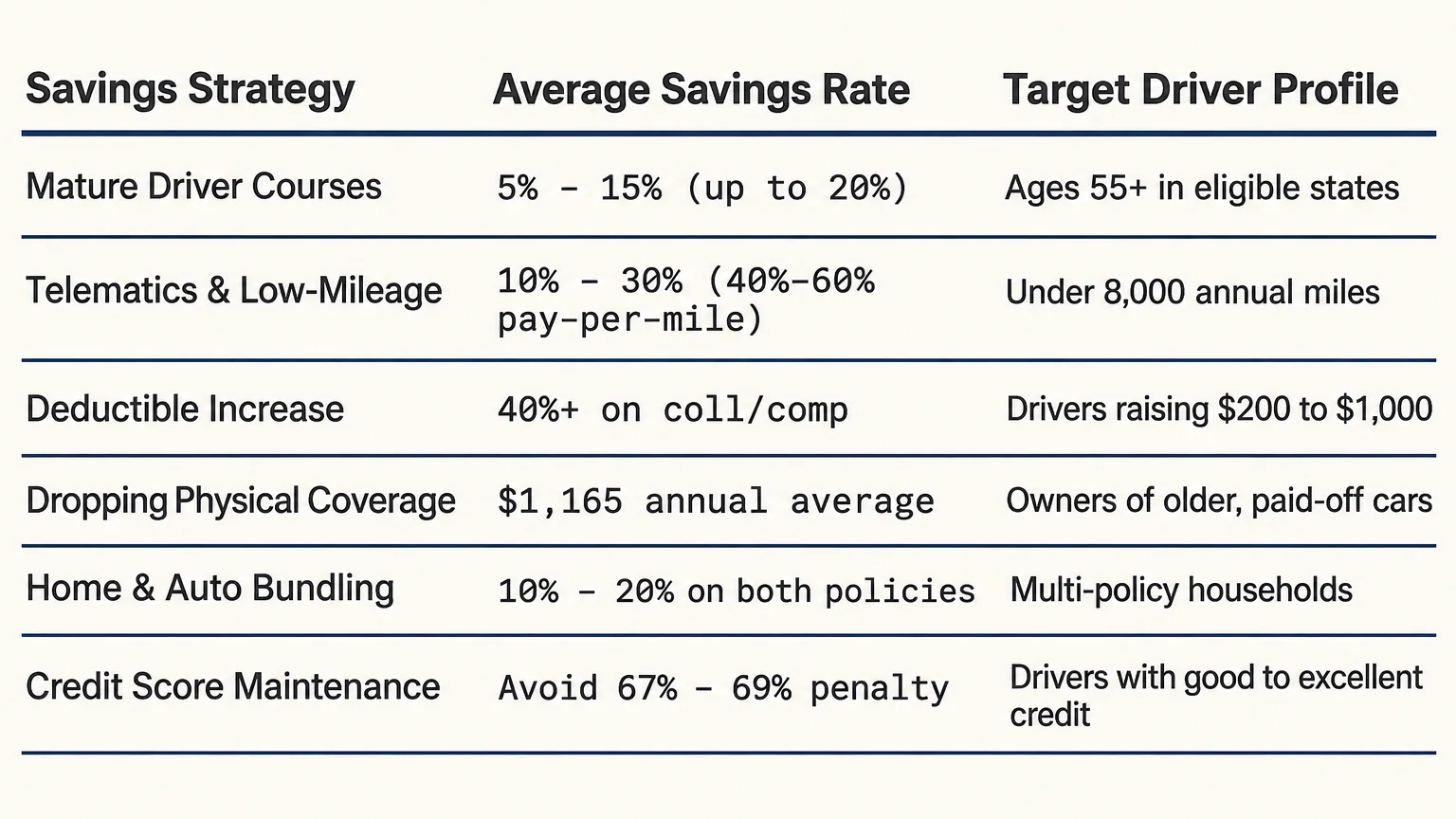
Comparing the 6 Strategies at a Glance
Use this side-by-side table to prioritize which steps match your vehicle, driving habits, and budget goals in 2027:
| Savings Strategy | Typical Savings Potential | Best Suited For | Key Watch-Out |
|---|---|---|---|
| Mature driver defensive course | 5%–15% (up to 20% in select states) | Drivers 55+ with clean records wanting fast, guaranteed discounts | Certificates expire every 2–3 years and require a refresher |
| Low-mileage, telematics, or pay-per-mile | 10%–30% (UBI) or 40%–60% (pay-per-mile under 8,000 miles) | Retirees driving under 8,000 miles per year in daylight hours | Some UBI programs surcharge 20% of drivers for risky habits |
| Raising deductibles ($500 to $1,000+) | 15%–40%+ on collision/comp; ~11%–25% on full coverage | Retirees with solid cash reserves who rarely file small claims | Ensure your emergency fund covers the deductible without debt |
| Dropping collision and comprehensive | Average ~$1,165/year | Paid-off vehicles over 10 years old failing the 10% rule | You absorb total loss costs; keep comprehensive if affordable |
| Home-auto bundling and stacking | 10%–20% on both policies (~$282/year auto savings) | Homeowners carrying mid-to-high value home and auto policies | Compare bundled totals against separate standalone quotes |
| Improving credit-based insurance score | Avoids 52%–69% credit-tier surcharges | Retirees outside CA, HI, MA, and MI with recent credit dips | Ask your insurer to re-rate your policy after fixing credit errors |
Avoiding Common Errors When Cutting Your Auto Coverage
Lowering your premium works best when you trim waste rather than vital financial protection. Guard against these frequent mistakes as you update your policy for 2027:
- Slashing liability limits to state minimums: Both Consumer Reports and the Insurance Information Institute recommend carrying at least 100/300/100 in liability protection rather than state minimums. With the average bodily injury claim hitting $28,278 in 2024, state minimums leave your retirement savings exposed to lawsuits.
- Overlooking state minimum increases: If you live in Washington, D.C., prepare for the jump to 50/100/20 on October 1, 2027, and verify your limits already meet recent increases in states like California, Virginia, and North Carolina.
- Enrolling in surcharge-risk telematics without reading the rules: Check whether a monitoring app can raise your renewal rate before installing it, especially if you frequently drive after dark or visit congested areas.
- Letting discount clocks run out: Defensive driving certificates typically lapse after three years, and insurers rarely send loud reminders before removing your 5% to 15% credit.
- Assuming loyalty pays off automatically: Insurers rarely reward decades of continuous coverage with their lowest rate, so benchmark your renewal against at least three competitors every one to two years.
Frequently Asked Questions
Do car insurance rates automatically go down when you retire?
No, insurers do not automatically drop your rate when you leave the workforce. You must call your agent or update your online profile to switch your vehicle usage from commuting to pleasure and lower your annual mileage estimate.
At what age do senior car insurance rates start rising?
Rates typically hit their lowest point in your early-to-mid 60s—averaging $2,109 per year at age 60—and hold fairly steady through age 69. Premiums generally climb 8% to 15% between ages 65 and 75, reaching an average of $2,823 per year by age 80.
Will shopping for cheaper car insurance hurt my credit score?
No, requesting auto insurance quotes uses a soft credit inquiry that never lowers your credit score. Even in states where insurers check credit-based insurance scores, you can request quotes from multiple carriers without penalty.
Should I drop comprehensive coverage at the same time I drop collision?
Not necessarily, because comprehensive coverage protects against non-crash events like theft, hail, falling branches, cracked windshields, and animal strikes. If comprehensive adds only a modest amount to your bill, keeping it while dropping collision often strikes the best balance.

Putting Your 2027 Savings Plan Into Action
You do not need to overhaul every policy detail in a single afternoon to lower car insurance in retirement. Pick one quick win this week—such as updating your annual mileage, enrolling in an approved defensive driving course, or requesting three competing quotes with 100/300/100 liability limits.
This article provides general retirement education and information only. Every retiree’s situation is unique—what works for others may not work for you.
For personalized advice, consider consulting a qualified financial professional such as a CFP or CPA.
Last updated: November 2026. Retirement benefits, tax rules, and healthcare regulations change frequently—verify current details with official sources.