
Losing a partner brings profound emotional grief, but an unexpected surge in your property tax bill can quickly cause financial panic. County tax assessors frequently cancel exemptions as soon as an owner passes away.
Without prompt intervention, this bureaucratic reset can remove assessment caps and double your annual housing costs. Surviving partners often discover the problem only when an inflated tax bill arrives in the mail.
You can protect your financial stability by understanding how survivor tax rules work. Filing timely paperwork with your county appraiser ensures you retain vital tax breaks before statutory deadlines expire.
Why Your Property Tax Bill Surges After a Partner Dies
Most states provide property tax relief through a primary residence homestead exemption or assessment caps. These provisions shield seniors from runaway taxes by capping how much assessed values can rise each year.
When an owner dies, county computer systems flag the recorded deed change or death certificate. Assessors often strip the existing exemptions and reset the property’s taxable value to full fair market value.
According to ATTOM data, the average single-family property tax bill across the nation reached $4,427 in 2025. When assessment caps disappear, your bill can jump by thousands of dollars virtually overnight.

The Hidden Risk for Unmarried Cohabiting Partners
Unmarried couples face the steepest tax risks after losing a partner. More than 4.2 million Americans aged 50 and older live with an unmarried partner, according to Census data.
While married spouses receive automatic statutory protections in many states, unmarried survivors rarely qualify for spousal exclusions. Without proper estate titling, a surviving cohabitant is legally treated as an unrelated buyer.
In November 2026, 83-year-old Bob Johnson of Hillsborough County, Florida, saw his property taxes jump from $1,777 to $3,804. His tax bill more than doubled after his partner of 18 years passed away.
Under Florida law, homestead benefits terminate upon death unless claimed by a legally married surviving spouse or an eligible joint tenant. Johnson eventually restored his $50,000 senior exemption only after submitting detailed proof of income.
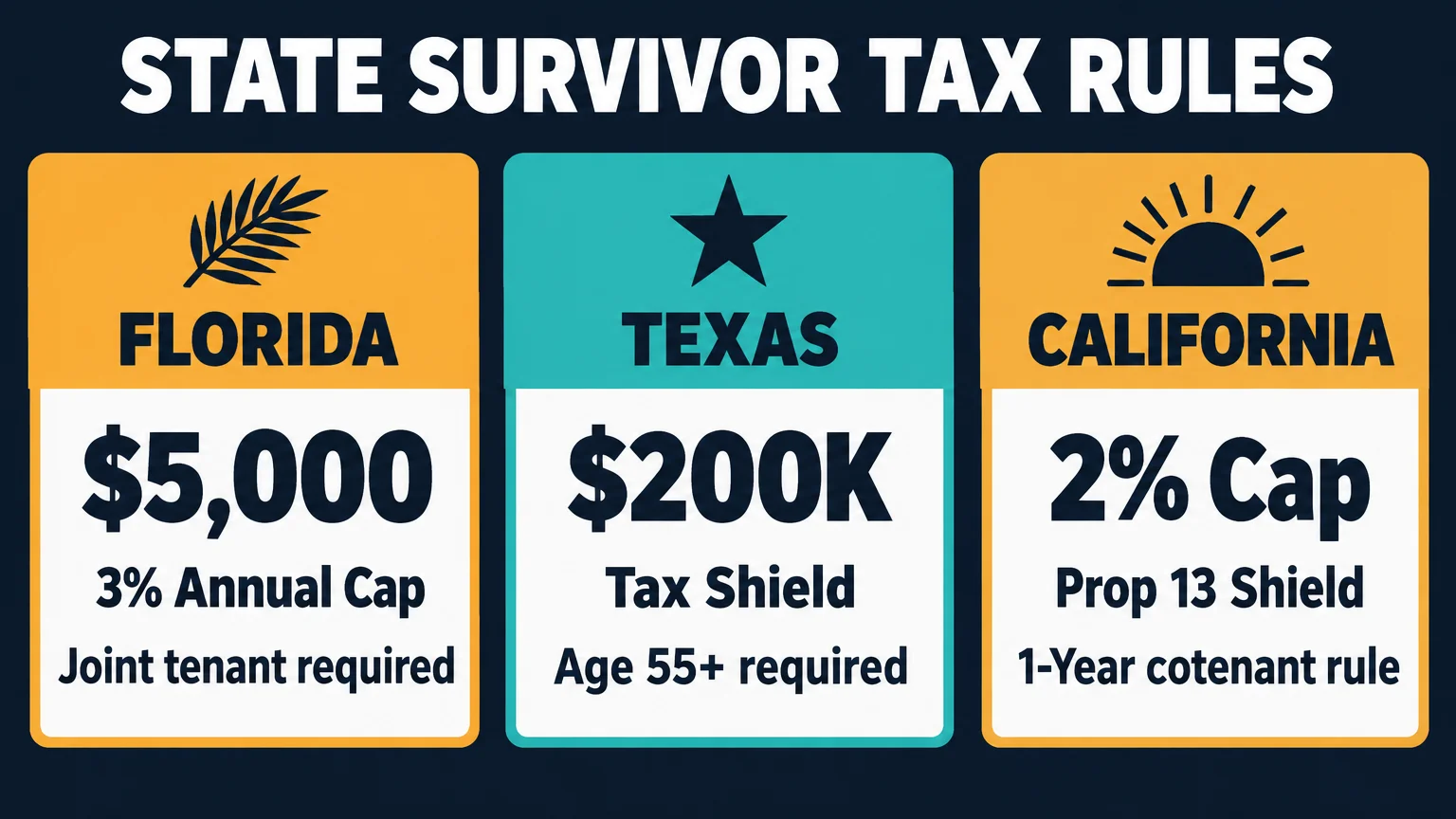
California imposes similarly strict rules under Proposition 13. Unmarried partners must file Form BOE-58-H for a cotenancy exclusion and prove one year of continuous joint residency to avoid reassessment.
State Rules, Age Traps, and Exemption Deadlines
State laws govern surviving spouse relief, and many enforce strict age restrictions. If a surviving spouse is too young when their partner dies, key exemptions vanish permanently.
In Texas, a surviving spouse must be at least 55 on the date of death to retain the over-65 school tax ceiling. In Cook County, Illinois, survivors under 65 lose senior exemptions after the year of death.
The table below highlights how selected states handle property tax exemptions and survivor protections:
| State | Primary Tax Shield | Surviving Spouse Rule | Unmarried Partner Risk |
|---|---|---|---|
| Florida | Save Our Homes (3% cap) | Retains cap if married or joint tenant; $5,000 widow benefit | Cap resets to market value on Jan. 1 without joint tenancy |
| Texas | $200,000 combined exemption | Must be age 55+ on date of death to retain school tax ceiling | Loses exemption and tax ceiling entirely |
| California | Prop 13 (2% annual cap) | Automatic spousal exclusion under Revenue and Taxation Code § 63 | Reassessed to market value unless cotenant for 1 year (BOE-58-H) |
| Michigan | Taxable value cap | Surviving spouse exempt under MCL 211.27a | Taxable value uncaps; Form 2766 due within 45 days |
| New York | Enhanced STAR & § 467 | Must be age 62+ by Dec. 31 to keep Enhanced STAR | Full reassessment and loss of local senior deductions |
The Compounding Pressure of the Widow Tax Trap
A higher property tax bill often arrives just as your federal tax liability spikes. Financial planners describe this painful convergence as the widow tax trap.
Federal tax brackets compress when you switch from married filing jointly to single status. For 2026, the basic standard deduction drops from $32,200 for joint filers to just $16,100 for single taxpayers.
The federal State and Local Tax (SALT) itemized deduction caps at $40,400 in 2026, according to the Internal Revenue Service. Losing spousal standard deductions makes a doubled real estate levy even harder to absorb.
Furthermore, temporary senior tax deductions drop from $12,000 to $6,000 for a single survivor. Your household income declines after losing a Social Security check, yet your total tax burden surges.
“Estate planning is an act of love. It preserves your hard-earned assets for the people who matter most to you.” — Suze Orman, Author and Financial Expert

Immediate Survivor Paperwork: Step-by-Step Filing Checklist
County tax assessors will not fix your tax status automatically. You must file specific documents with your local appraisal district to secure senior property tax relief.
- Obtain certified death certificates: Order at least ten official copies immediately from your county vital records department.
- Audit your property deed: Verify whether your title designates joint tenancy with rights of survivorship or tenancy in common.
- File post-death reporting forms: Submit mandatory notices promptly, such as California Form BOE-502-D within 150 days of death.
- Reapply for homestead status: Submit a fresh homestead exemption application in your sole name before state cutoffs.
- Claim survivor and senior exemptions: Apply for specific widow benefits, such as Florida’s $5,000 assessed-value deduction.
Pitfalls to Watch For
Failing to update your county records correctly can trigger back taxes and penalties. Watch out for these critical missteps:
- Assuming deeds update automatically: Recording a deed change or transferring real estate into a revocable trust requires submitting a new homestead application.
- Missing statutory deadlines: Florida requires applications by March 1, Texas mandates filing before May 1, and Michigan requires Form 2766 within 45 days.
- Ignoring income limits: Senior freezes in states like Arizona cap single-owner income lower than two-owner households, which can void your assessment freeze.
- Overlooking deed changes: Removing a deceased partner’s name from title without refiling exemption forms often triggers an automatic reassessment.
Getting Expert Help
Navigating real estate transfers while grieving can feel overwhelming. Consult qualified guidance from resources such as AARP or professional advisers in the following situations:
- Unmarried co-ownership: Seek an estate planning attorney to establish proper titling or a registered domestic partnership before a partner passes away.
- Trust ownership transfers: Consult a real estate attorney if you transfer property into or out of a trust following a death.
- Sudden reassessment notices: Work with an enrolled agent or property tax consultant to file an immediate appeal with your local appraisal review board.
Frequently Asked Questions
Does my property tax automatically go up when my spouse dies?
Not automatically, but assessors remove benefits once they process a death record or title transfer. Surviving spouses must file updated paperwork to retain tax caps and senior exemptions.
Can an unmarried surviving partner keep a homestead exemption?
Most jurisdictions treat unmarried partners as unrelated co-owners. Unless you qualify under narrow cotenancy rules or hold title with survivorship rights, the county will likely reassess the property to full market value.
What happens if I miss my county’s exemption filing deadline?
Missing a statutory filing deadline can cause your bill to double for that tax year. Many jurisdictions allow late appeals within a limited window or grant partial refunds once you provide proof of eligibility.
Protecting Your Housing Security
Review your county assessment records today to confirm your current exemptions remain active. A quick call to your local assessor can prevent a devastating financial shock next tax season.
This educational content relies on general retirement principles, and individual results vary based on your personal situation. Always verify current benefit rules, tax laws, and eligibility requirements with official sources like SSA, Medicare.gov, or the IRS.
Last updated: November 2026. Retirement benefits, tax rules, and healthcare regulations change frequently—verify current details with official sources.