

Receiving a Social Security overpayment notice can rattle your retirement budget, especially when automatic withholding cuts your monthly check in half. You have clear legal rights to pause those deductions, challenge the math, or ask for debt forgiveness.
Roughly 2 million Americans receive one of these notices each year, and federal audits show many contain errors. Taking action within your first 30 days keeps your full benefit intact while the Social Security Administration reviews your case.
This guide shows you how to verify the letter, choose between an appeal, a waiver request, or a lower payment plan, and protect your household income.
The Essentials: Your First 30 Days
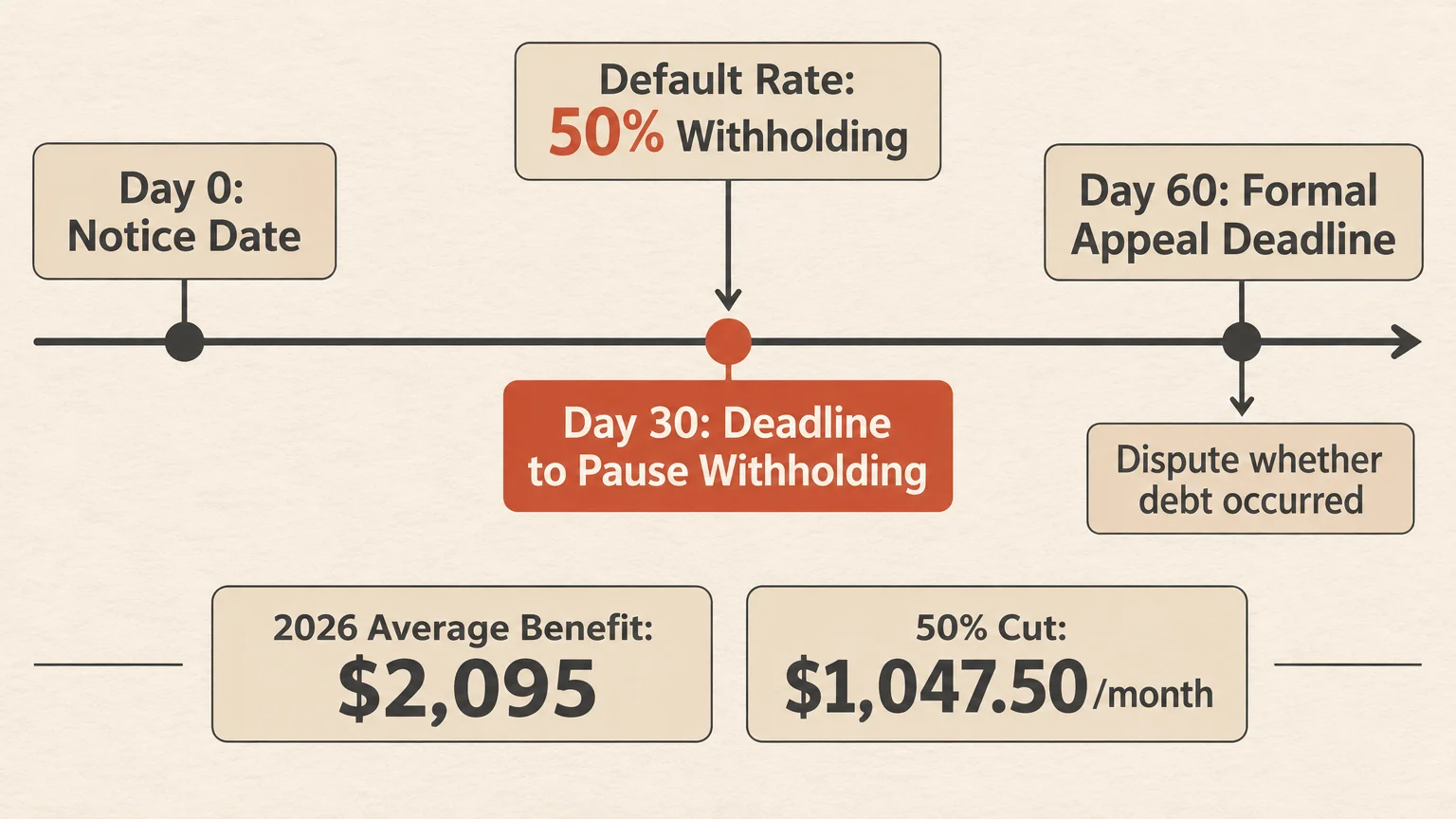
The date printed at the top of your overpayment notice starts two critical legal clocks. Acting quickly protects your monthly cash flow before automatic deductions begin.
Under current rules at the Social Security Administration, the agency waits at least 30 days after mailing a notice before withholding money from your benefit. If you file a formal appeal or waiver request within that 30-day window, collection pauses until the agency makes an initial decision.
Timing matters more now than it did a few years ago because default withholding rates shifted sharply between 2024 and 2025. For new retirement, survivor, family, and disability overpayment notices issued on or after April 25, 2025, the default withholding rate is 50% of your monthly check.
Consider what that means for an average household budget. With the estimated average retired worker benefit sitting at $2,095 per month in 2026 and rising to $2,170 per month in 2027 after the 3.6% cost-of-living adjustment, a 50% cut removes roughly $1,047.50 to $1,085 every month.
Not every beneficiary faces that 50% deduction, so check your notice date and benefit type right away:
- Pre-April 25, 2025 retirement or disability notices: Older Title II overpayments generally remain capped at a 10% monthly withholding rate, unless you incur a new overpayment that pulls all outstanding debts up to 50%.
- Supplemental Security Income (SSI) notices: Title XVI overpayments stay capped at 10% of your monthly income or the maximum federal benefit rate—$994 for an individual and $1,491 for a couple in 2026, rising to $1,029 and $1,544 in 2027.
- Fraud or similar fault findings: If the agency determines an overpayment resulted from intentional fraud or similar fault, it can withhold 100% of your monthly benefit.
While the 30-day window stops immediate withholding, you also hold a 60-day deadline to dispute whether the overpayment actually happened. The agency assumes you received the letter five days after the date printed on it unless you prove a later delivery.
If you need a waiver or a lower monthly social security repayment plan rather than a dispute, there is no deadline to apply. Still, filing within 30 days prevents the financial shock of losing half your check while your paperwork sits in a queue.

Step 1: Verify the Overpayment Notice Before You Pay a Cent
Never assume the dollar figure on your letter is accurate. Federal oversight data reveals widespread administrative mistakes in how these bills are calculated and explained.
In a September 1, 2026 audit, the agency’s Office of the Inspector General found that 46% of sampled retirement, survivors, and disability overpayment notices violated agency policy. Those letters often omitted when or how the overpayment occurred, left out appeal rights, or stated inaccurate balances.
The same September 2026 audit reported that staff mishandled 63% of beneficiary requests for an explanation, leaving some cases unresolved for more than 900 days. Because errors happen frequently, your first job is to audit the agency’s math against your own records.
Gather these documents before you call or submit any forms:
- The original notice and envelope: Keep the postmarked envelope if the letter arrived late, because it proves when your five-day mailing presumption actually started.
- Your payment and earnings history: Log in to your online my Social Security account to pull your benefit payment ledger, W-2s, and self-employment tax filings.
- Past change-of-status confirmations: Collect receipts, fax confirmations, or certified mail slips showing when you reported work, marriage, divorce, or living arrangement updates.
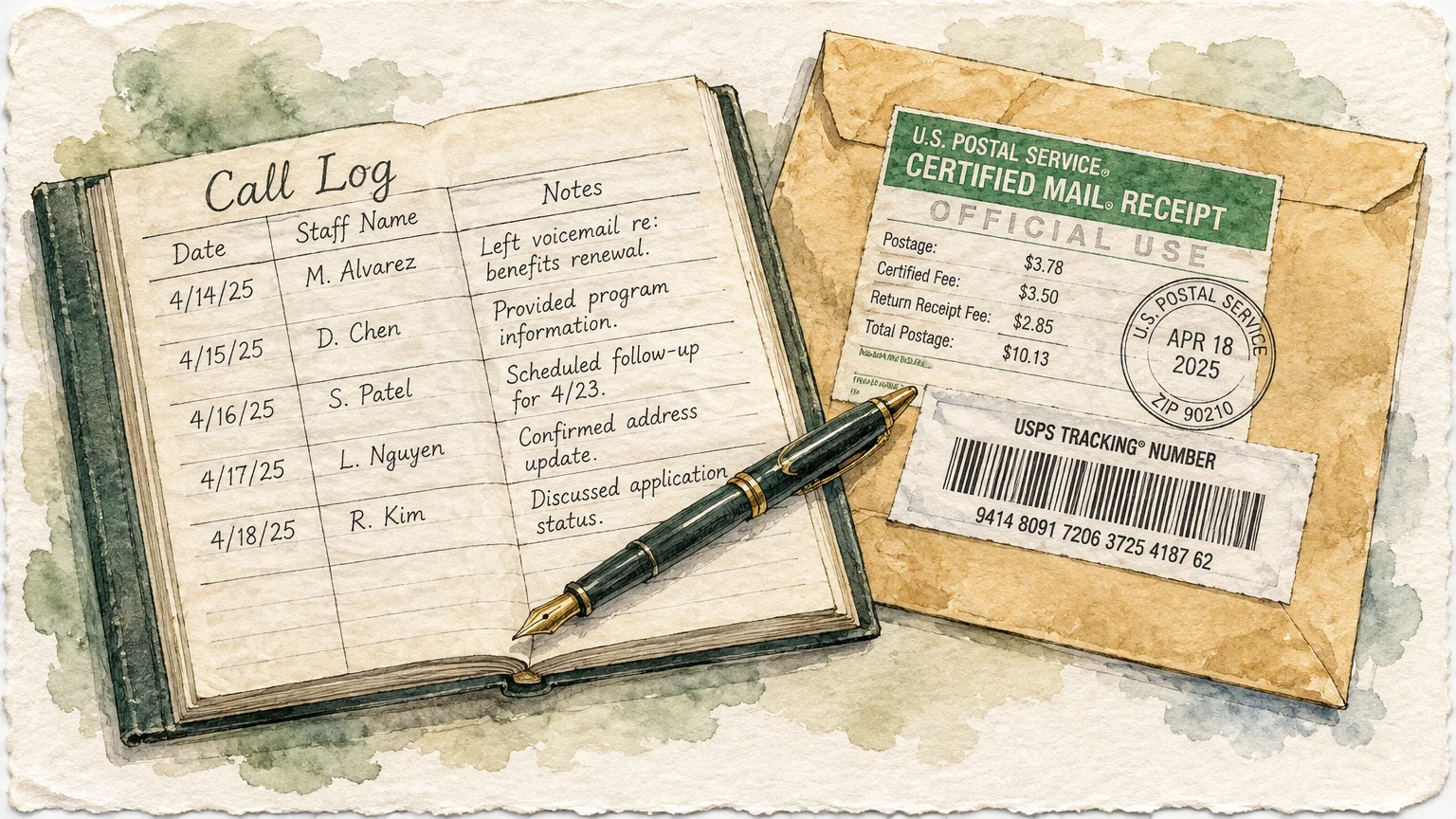
- A written call log: Record the date, time, representative name, and summary of every phone conversation you have with the agency.
For retirees, one trigger causes far more overpayments than any other: working while claiming benefits before reaching Full Retirement Age. Under the Retirement Earnings Test, earning more than the annual limit temporarily reduces your benefits.
If your actual wages exceed what you estimated earlier in the year, the agency recalculates your entitlement and bills you for the difference. In 2026, the annual earnings limit is $24,480 for retirees under Full Retirement Age all year, with $1 withheld for every $2 earned above that threshold.
That threshold increases to $25,560 in 2027. During the calendar year you reach Full Retirement Age, a higher limit applies—$65,160 in 2026 and $67,920 in 2027—with $1 withheld for every $3 over the cap.
Once the month you reach Full Retirement Age arrives, the earnings limit disappears completely. Check whether the agency mistakenly counted income earned after your Full Retirement Age month or included non-wage investment income that does not count toward the earnings test.
Step 2: Compare Your Three Main Options
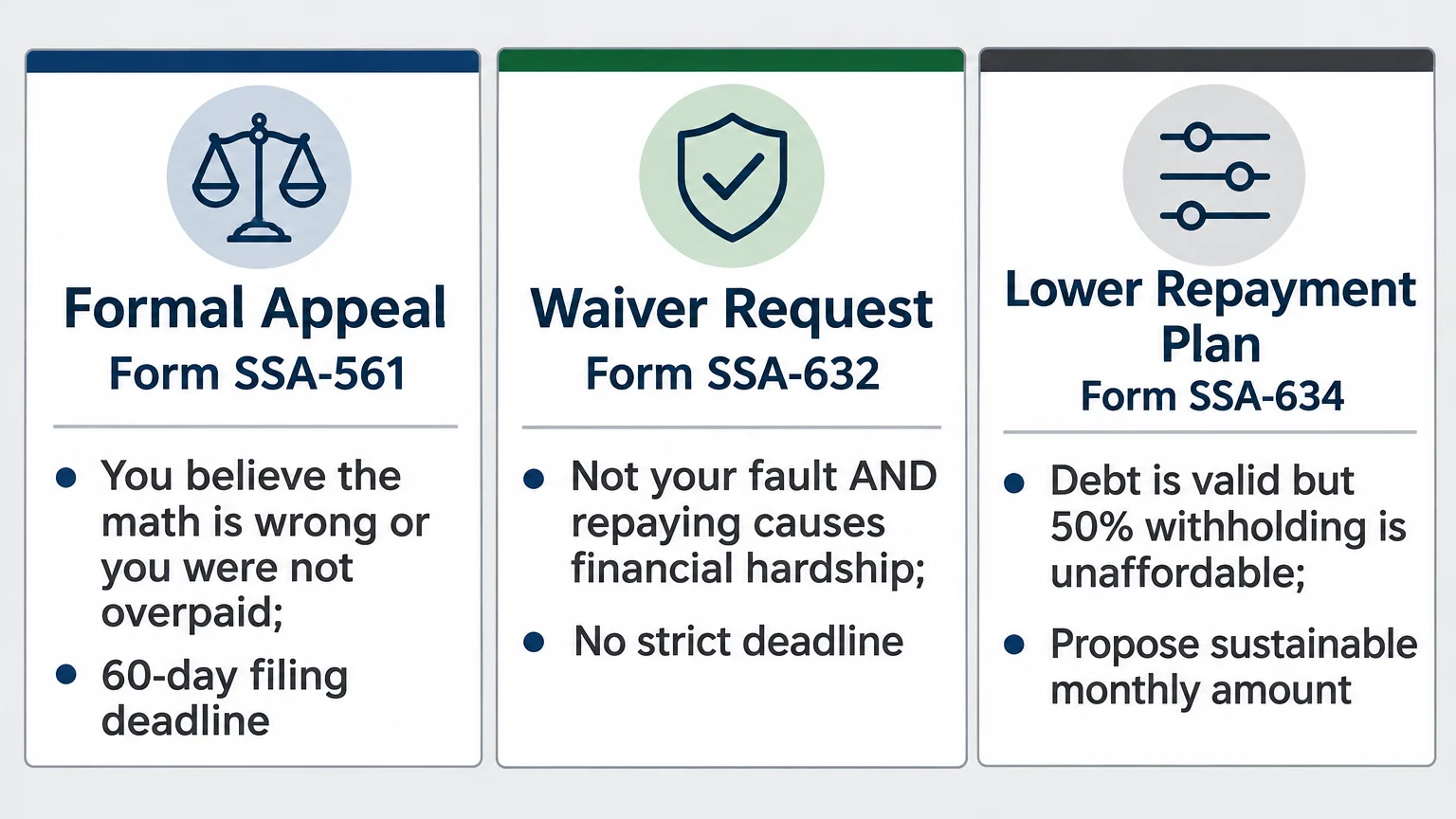
Once you review your records, you can choose from three formal paths to resolve the debt. You can even combine strategies—for example, appealing the amount while requesting a waiver or lower rate if the debt stands.
| Resolution Path | Best Used When | Required Form | Filing Deadline | Effect on Withholding |
|---|---|---|---|---|
| Appeal Overpayment | You were not overpaid, or the dollar calculation is wrong. | Form SSA-561-U2 | 60 days from receipt (30 days to pause collection) | Pauses collection if filed within 30 days until a decision is made. |
| Waiver Request | The overpayment happened, but it was not your fault and repayment hurts you. | Form SSA-632-BK (or phone call if $2,000 or less) | No deadline (30 days to pause collection) | Pauses collection if filed within 30 days until a decision is made. |
| Lower Repayment Rate | You owe the money, cannot get a waiver, and need smaller monthly payments. | Form SSA-634-BK (only if repayment exceeds 60 months) | No deadline | Replaces the 50% default deduction with a negotiated monthly amount. |
Filing an Appeal (Form SSA-561-U2)
If your records show the agency miscalculated your earnings, ignored a prior report, or billed you twice, file an appeal overpayment request. In agency terms, this first level of appeal is called a Request for Reconsideration.
You can submit Form SSA-561-U2 online through the agency website, by mail, or in person at a local field office. Attach copies—never originals—of your W-2s, pay stubs, or confirmation letters that prove the calculation error.
File within 30 days of the notice date to keep your monthly check at 100% during the review. If you miss the 30-day mark, you still have up to 60 days from receiving the letter to preserve your appeal rights.
Appeals filed after 60 days require you to show good cause for the delay, such as a serious illness, hospitalization, or a death in the family. If your notice omitted clear instructions on how the debt occurred, point directly to that missing explanation in your filing.
Requesting a Waiver (Form SSA-632-BK or the $2,000 Rule)
When the agency’s math is correct—or even if you are unsure—you can ask the government to forgive the entire balance through a waiver request. Under Section 204(b) of the Social Security Act, the agency must waive recovery when you meet two strict tests.
First, you must prove you were without fault in causing the overpayment. Second, you must show that repaying the money would either defeat the purpose of the Social Security program or be against equity and good conscience.
Being without fault means you gave accurate information, reported required changes on time, and did not accept payments you knew—or reasonably should have known—were incorrect.
Before you spend hours filling out financial worksheets, check the original dollar amount of your overpayment. Under a simplified rule updated in May 2024, if the original overpayment was $2,000 or less and there is no evidence of fault, the agency presumes you are not at fault.
For eligible debts of $2,000 or less, you do not need to submit Form SSA-632-BK at all. You can call 1-800-772-1213 and request an administrative tolerance waiver verbally over the phone.
Note that this $2,000 threshold applies to the original overpayment balance, not a larger debt that you already paid down below $2,000. If your original notice exceeds $2,000, you will submit Form SSA-632-BK online via my Social Security, by mail, fax, or in person.
To satisfy the financial hardship standard—known as defeating the purpose of the Act—you must show that you need your full benefit to cover ordinary and necessary living expenses. Agency guidelines set specific income and asset benchmarks for this test:
- Monthly income margin: Your household’s monthly income cannot exceed ordinary and necessary living expenses—including housing, food, utilities, medical bills, and insurance—by more than $250.
- Countable resource cap for individuals: An individual beneficiary cannot hold more than $6,000 in countable cash, bank accounts, or liquid investments.
- Countable resource cap for households: A beneficiary living with one family member cannot exceed $10,000 in countable resources, plus $1,200 for each additional family member.
Since November 2024, the agency also applies an automatic hardship rule for lower-income households. You are automatically deemed unable to repay if you or a household member receive needs-based aid—such as SSI, SNAP, TANF, a needs-based VA disability pension, or Medicare Part D Extra Help.
You also qualify automatically if your household income sits at or below 150% of the Federal Poverty Level and your savings fall within the resource caps above. In both cases, you still must establish that you were without fault.
What if your retirement savings exceed $6,000 or $10,000, making you ineligible for financial hardship? You can still qualify under the second legal prong: proving that collection goes against equity and good conscience.
This rule carries no income or asset limits whatsoever. You meet it by showing that you relied on the agency’s payments or written notice and changed your financial position for the worse—such as signing a lease, retiring early, or giving up a valuable right like private aid.
When you file Form SSA-632-BK, keep copies of every bank statement, utility bill, and prescription receipt you attach.
Negotiating a Lower Repayment Rate (Form SSA-634-BK)
If you owe the overpayment and do not qualify for a waiver, you do not have to accept the 50% default withholding rate. You can negotiate a smaller monthly social security repayment schedule that fits your retirement budget.
Under agency policy updated in February and October 2024, representatives can approve a 12-month repayment plan without asking for any financial disclosures. If you need more time, they can stretch payments up to 60 months—an expansion from the older 36-month limit.
Form SSA-634-BK, the Request for Change in Overpayment Recovery Rate, is only mandatory when your proposed payment plan takes longer than 60 months to clear the balance. When financial hardship prevents larger deductions, the agency can accept monthly payments as low as $10.
If you prefer to settle a balance directly rather than reducing your monthly benefit check, you have flexible payment options. You can pay via Pay.gov using a bank account or debit or credit card, send money through your bank’s online bill pay, or mail a check.
What Happens if You Ignore the Notice or Stop Receiving Benefits
Doing nothing is the costliest mistake a retiree can make after receiving an overpayment notice. Once 30 days pass without an appeal or waiver filing, the agency automatically begins deducting 50% of your monthly Title II benefit—or 10% for SSI checks.
Those automatic deductions continue month after month until the debt reaches zero. Even if you later file a waiver, you only stop future deductions while waiting for a decision; getting back money already withheld takes extra time.
Leaving the Social Security rolls does not erase the debt either. If you suspend your benefits, transition off disability, or become delinquent on a direct repayment plan, the agency turns to aggressive external collection tools.
Across all programs in fiscal year 2026, the agency carried $29.54 billion in overpayment receivables and collected $6.39 billion—including $573 million seized through Treasury offsets. Those same collection powers allow the government to garnish private wages, intercept federal tax refunds and certain state payments, and report delinquent balances to credit bureaus.
Overpayments can also follow a beneficiary’s family after death. An August 12, 2026 Inspector General audit identified 17,979 adult beneficiaries who died between December 2022 and December 2024 with roughly $240 million in unpaid overpayments, noting the agency failed to follow its recovery rules in 47% of sampled cases.
When a beneficiary dies owing a balance, the agency can withhold lump-sum death payments, pursue contingently liable survivors receiving benefits on the same record, or file a claim against the deceased person’s estate. Resolving disputed balances while you are alive spares your spouse or executor from sorting through decades-old benefit records.
Lawmakers are actively debating reforms to curb aggressive lookbacks and protect families. On November 19, 2026, Representatives Jared Golden and Don Bacon introduced bipartisan House legislation that would bar the agency from recouping parental disability overpayments from dependent children and set a six-year statute of limitations for collecting Social Security and SSI overpayments.
Until Congress passes new statutory limits, however, no general statute of limitations blocks the agency from deducting overpayments from your ongoing monthly benefits. That makes timely administrative action your strongest shield.
Avoiding Common Errors
Most retirees lose money on overpayment cases not because they lack valid defenses, but because they make avoidable procedural mistakes. Keep these six pitfalls off your record:
- Paying the balance immediately out of panic: Sending a check right away can waive leverage and make it harder to recover funds if the notice was wrong; verify the calculation first.
- Waiting for a phone callback before the 30-day clock expires: Phone lines routinely back up, so submit Form SSA-561-U2 or Form SSA-632-BK in writing or online before day 30 to freeze collections.
- Assuming a waiver has a 60-day deadline: Only appeals carry the 60-day cutoff; you can file a waiver request or ask for a lower repayment rate at any time, even after withholding begins.
- Filling out long financial forms for small debts: If your original overpayment is $2,000 or less and you were without fault, call 1-800-772-1213 to request an administrative tolerance waiver without filing Form SSA-632-BK.
- Dropping paperwork in the mail without proof: Always use certified mail with a return receipt, keep your online confirmation screen, or get a date-stamped copy when handing forms to a local office.
- Ignoring how Retirement Earnings Test estimates carry over: Update your annual earnings estimate promptly whenever you take on consulting work, bonuses, or part-time shifts before Full Retirement Age.
If a local representative tells you verbally that you cannot file a waiver or appeal, politely insist on submitting your written forms anyway. Agency staff must accept your written filings and issue a formal written determination that preserves your right to review.

When DIY Isn’t Enough
You can handle most straightforward billing errors, $2,000 waivers, and 12-month repayment plans on your own. However, four specific scenarios warrant professional legal or financial help:
- Large or multi-year overpayments threatening basic needs: When a five-figure bill threatens your mortgage, rent, or prescription coverage, an elder law attorney or accredited representative can build a detailed budget defense and protect exempt assets.
- Allegations of fraud or similar fault: Fraud findings trigger 100% benefit withholding and potential civil penalties, requiring immediate representation from an experienced Social Security attorney before you make any statements.
- Denied waivers heading to an Administrative Law Judge: If the agency denies both your paper waiver and your personal conference, formal hearing rules apply; legal aid or a disability and retirement advocate can examine your file and cross-examine agency records.
- Complex survivor, estate, or auxiliary claims: When the agency seeks repayment from a surviving spouse, an estate executor, or benefits tied to a former spouse’s record, specialized guidance helps separate individual liability from household obligations.
If you cannot afford a private attorney, check free consumer and senior advocacy directories before paying upfront fees. Resources from the National Council on Aging, AARP, and the Consumer Financial Protection Bureau connect older adults with local legal aid programs and financial counseling.
Frequently Asked Questions About Social Security Overpayments
How much can Social Security take from my check in 2026?
For new retirement, survivor, and disability overpayment notices issued on or after April 25, 2025, the default withholding rate is 50% of your monthly check. Older pre-April 25, 2025 notices generally stay at 10%, SSI overpayments remain capped at 10%, and fraud findings allow 100% withholding.
Can I get a Social Security overpayment waived if it is $2,000 or less?
Yes, if the original overpayment was $2,000 or less and there is no evidence of fault on your part. You can request this simplified administrative tolerance waiver verbally by calling 1-800-772-1213 without completing Form SSA-632-BK.
Does requesting a waiver stop Social Security from taking my money?
Filing a waiver request or an appeal within 30 days of the notice date pauses automatic withholding until the agency makes an initial decision. If you file after 30 days, withholding may continue during the review.
What happens if I miss the 60-day appeal deadline?
If more than 60 days pass after you receive the notice, you must include a written statement explaining good cause for filing late. Even if an appeal is time-barred, you still face no deadline to request a waiver or a lower monthly repayment rate.
Do I still owe an overpayment if I reported my income on time?
Reporting your wages on time does not automatically erase an overpayment, because the agency may still adjust your entitlement under the Retirement Earnings Test. However, documented proof that you reported changes promptly is powerful evidence that you were without fault when you apply for a waiver.

Protecting Your Retirement Income Going Forward
An overpayment notice feels overwhelming at first, yet the system gives you structured tools to protect your monthly check. Open the letter immediately, mark your 30-day and 60-day deadlines on your calendar, verify the agency’s math, and submit the form that fits your case.
This article provides general retirement education and information only. Every retiree’s situation is unique—what works for others may not work for you.
For personalized advice, consider consulting a qualified financial professional such as a CFP or CPA.
Last updated: November 2026. Retirement benefits, tax rules, and healthcare regulations change frequently—verify current details with official sources.