

Returning to a paycheck or keeping a part-time role while collecting Social Security raises a practical question for 2027: how much can you earn before the Social Security Administration reduces your monthly deposit?
The social security earnings limit 2027 rises alongside a 3.6% cost-of-living adjustment, giving early claimers more breathing room. You can also avoid surprise reductions altogether once you understand how age and timing change the math.
Reviewing these updated numbers before accepting extra hours helps you prevent unexpected Social Security withholding, higher Medicare premiums, and avoidable tax bills.
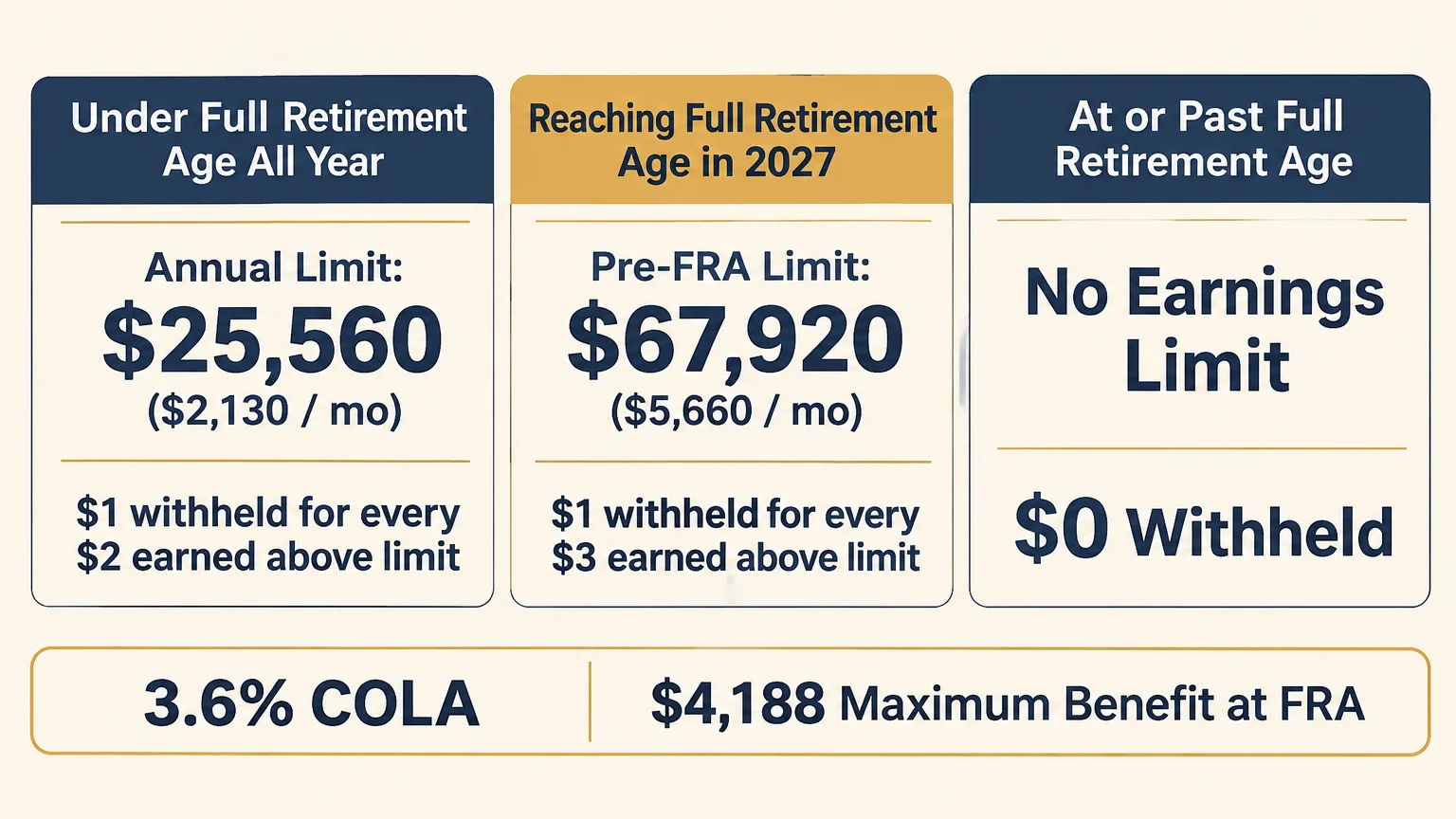
2027 Social Security Earnings Limits and Withholding Rules
Working while collecting Social Security does not automatically shrink your check. Whether your benefits face a temporary reduction depends on your age relative to full retirement age and how much you earn from a job or self-employment.
The Social Security Administration (SSA) applies the retirement earnings test to anyone receiving retirement benefits before reaching full retirement age. Once you cross your full retirement age month, the earnings test disappears completely.
In 2027, every retired beneficiary receives a 3.6% cost-of-living adjustment (COLA) starting with January 2027 payments, adding roughly $75 per month to the average retired-worker check. Supplemental Security Income (SSI) recipients see that adjustment on December 31, 2026.
Meanwhile, the maximum monthly benefit at full retirement age climbs to $4,188 in 2027, up from $4,152 in 2026. Higher earnings limits move in tandem with these inflation updates so working seniors keep more of their paychecks.
| Your Age Status in 2027 | 2026 Annual / Monthly Limit | 2027 Annual / Monthly Limit | 2027 Benefit Withholding Rate |
|---|---|---|---|
| Under full retirement age all of 2027 | $24,480 / year ($2,040 / month) | $25,560 / year ($2,130 / month) | $1 withheld for every $2 earned above $25,560 |
| Reaching full retirement age during 2027 (months prior to FRA) | $65,160 / year ($5,430 / month) | $67,920 / year ($5,660 / month) | $1 withheld for every $3 earned above $67,920 |
| At or past full retirement age | No earnings limit | No earnings limit | $0 withheld regardless of income |
Consider how the lower threshold works if you stay under full retirement age for all of 2027. Suppose your job pays $35,560 in gross wages for the year, placing you $10,000 above the $25,560 limit.
Under the $1-for-$2 rule, the SSA withholds $5,000 in annual benefits. If you earn $25,560 or less during the entire calendar year, zero benefits are withheld.
Now look at the higher tier if you hit full retirement age partway through 2027. Only wages earned in the calendar months before the month you reach full retirement age count toward the $67,920 ceiling.
If you earn $73,920 during those pre-birthday months, you sit $6,000 over the threshold. Because the SSA withholds $1 for every $3 above $67,920 in that transition year, your temporary reduction totals $2,000.
Reporting your estimated 2027 wages early prevents overpayments that you would later have to pay back. Updating your earnings estimate through your online SSA account keeps your monthly deposits accurate throughout the year.
Full Retirement Age in 2027 and Why Your Birth Year Matters
Your birth year dictates both your full retirement age and which social security earnings limit 2027 rules govern your paycheck. Even a difference of a few months changes whether you face the $25,560 cap or the $67,920 cap.
For people born in 1959, full retirement age is 66 and 10 months. Anyone born in 1960 or later has a full retirement age of 67, though people born on January 1 follow the prior year’s schedule.
That calendar milestone makes 2027 a pivotal year for the 1960 birth cohort. Workers born in 1960 after January 1 reach age 67—and full retirement age—during 2027.
Suppose you were born in August 1960 and already started collecting benefits earlier. From January through July 2027, your earnings fall under the generous $67,920 limit, and starting in August 2027, you can earn any amount with zero withholding.
Reaching full retirement age changes the math overnight: every dollar you earn from that birthday month forward stays yours without triggering a single penny of Social Security withholding.
Keep in mind that Social Security full retirement age and Medicare eligibility operate on separate clocks. Even though full retirement age reaches 67 for 1960-and-later births, Medicare eligibility still begins at age 65.
If you keep working at 65 while delaying or collecting Social Security, verify your employer coverage rules early. Missing initial Medicare enrollment windows can trigger late penalties unless you hold qualifying group health coverage.
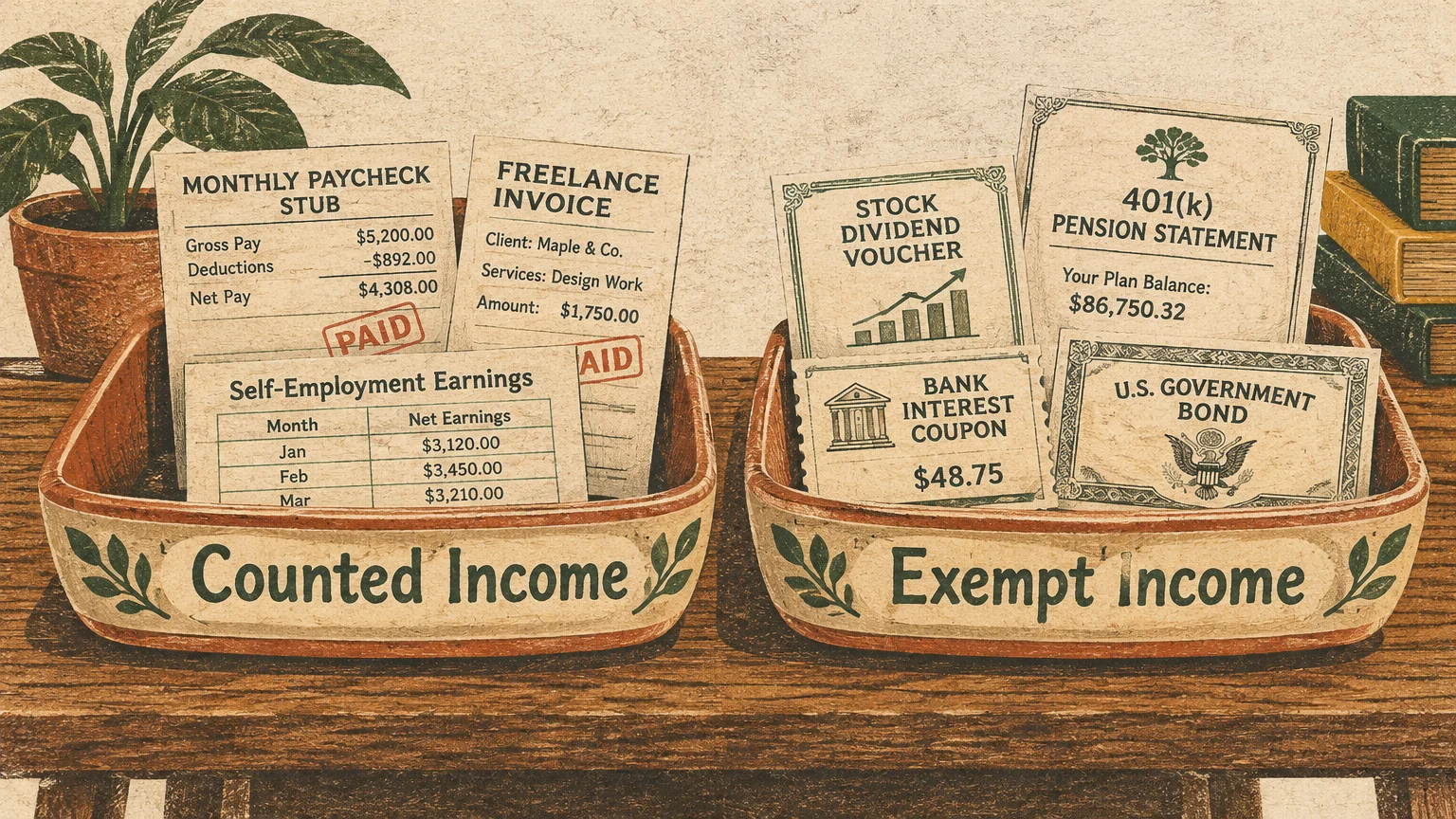
What Income Counts—and What Stays Exempt—Under the Retirement Earnings Test
Many retirees worry that pulling money from a retirement account or selling stocks will trigger Social Security withholding. Fortunately, the retirement earnings test targets earned work income only, leaving most retirement cash flow untouched.
According to SSA Publication No. 05-10069, only gross wages from employment and net earnings from self-employment count toward the annual thresholds. Wages count when you earn them, not when your employer issues the paycheck.
That timing detail catches people off guard when bonuses, vacation payouts, or retirement plan contributions appear on a pay stub. Employee contributions to a workplace retirement or pension plan still count if they are included in your gross wages.
Net self-employment earnings generally count in the year you receive payment, rather than when you perform the work. Keeping clean invoices and business expense records ensures you measure net profit accurately rather than gross receipts.
- Income that counts toward the 2027 limit: gross salaries, hourly wages, bonuses, commissions, employee retirement deferrals included in gross pay, and net profit from self-employment or consulting.
- Income that does not count toward the 2027 limit: pension checks, annuity payouts, IRA or 401(k) distributions, stock dividends, capital gains, bank interest, and other government benefits.
If you retire mid-year in 2027 after earning well above $25,560 between January and May, a special first-year monthly rule can protect your checks. For one calendar year—usually your first year of retirement—the SSA lets you receive full benefits for any whole month you count as retired.
To qualify as retired during a given month in 2027, your monthly wages cannot exceed $2,130 if you stay under full retirement age all year. If you reach full retirement age in 2027, that monthly wage ceiling rises to $5,660 before your birthday month.
Self-employed workers face an hours test in addition to the income cap during that special first year. Working more than 45 hours in a month generally disqualifies that month from receiving a full check.
Even working between 15 and 45 hours in a month can disqualify a self-employed retiree if the work occurs in a highly skilled occupation or sizable business. After that first year passes, the monthly exception expires and only the annual earnings limit applies.
Two special groups should double-check how these rules apply to their situations in 2027:
- Public-pension workers: Even following the Social Security Fairness Act repeal of the Windfall Elimination Provision and Government Pension Offset, early-claiming reductions and the retirement earnings test still apply to your benefits.
- Disability beneficiaries (SSDI): Social Security Disability Insurance follows separate rules rather than the retirement earnings test, with 2027 Substantial Gainful Activity set at $1,770 per month (non-blind) or $2,950 per month (blind) and the Trial Work Period trigger at $1,270 per month.

How Withheld Benefits Return—and How Working Can Raise Your Check
Seeing a temporary pause in your Social Security deposits can feel discouraging, especially when you re-enter the workforce to pad your savings. Yet dollars held back under the retirement earnings test are not confiscated permanently.
Once you reach full retirement age, the SSA automatically recalculates your monthly payment upward. The agency credits back the months in which benefits were withheld, effectively shrinking the reduction penalty you originally took for claiming early.
Suppose you claimed benefits at 62 and accepted a permanent early-claiming reduction. If the SSA later withholds 12 months of checks because you worked between ages 63 and 65, your benefit gets adjusted at full retirement age as if you had claimed later.
There is one notable exception to this automatic adjustment rule. Spouses and survivors receiving benefits solely because they care for a minor or disabled child do not receive an upward recalculation at full retirement age.
Working above the limit can also ripple across your household if family members collect benefits on your work record. Excess earnings on your part reduce both your check and the auxiliary benefits paid to your spouse or children.
By contrast, if your spouse or child works a job of their own, their wages affect only their own monthly payment. Your personal benefit remains untouched by a family member’s paycheck.
Beyond returning withheld months, staying on the payroll in 2027 can permanently boost your base benefit through annual recomputation. Each year, the SSA reviews your newest taxable earnings to see how they stack up against your career history.
Social Security calculates retirement benefits using your highest 35 years of indexed earnings. If your 2027 wages replace a lower-earning year—or fill in a zero-earning year from earlier in life—your monthly check rises permanently.
Even modest part-time work builds credits if you still need to reach the 40-credit threshold for eligibility. In 2027, you earn one Quarter of Coverage for every $1,970 in covered wages, up from $1,890 in 2026, with a maximum of four credits per year.
2027 Payroll Taxes, the $6,000 Senior Deduction, and Medicare Costs
The retirement earnings test is only half the story when evaluating a paycheck in retirement. Earned income in 2027 also triggers payroll taxes, shifts your federal income tax exposure, and can influence future Medicare premiums.
Age does not exempt you from FICA or SECA payroll taxes while you work. Employees pay 7.65% on covered wages—split between 6.2% for Social Security and 1.45% for Medicare—while employers match that amount.
Self-employed retirees pay both halves at a combined 15.30% rate, covering 12.4% for Social Security and 2.9% for Medicare. Those payroll contributions are exactly what feed your annual Social Security earnings record for potential benefit recomputations.
In 2027, the Social Security taxable wage cap climbs to $192,300, up from $184,500 in 2026, putting the maximum employee Social Security tax at $11,922.60. Medicare taxes carry no wage cap, and workers earning above $200,000 (single) or $250,000 (married filing jointly) owe an extra 0.9% Additional Medicare Tax.
On the federal income tax side, working seniors age 65 and older receive welcome relief under the One Big Beautiful Bill Act for tax years 2025 through 2028. Eligible taxpayers with a valid Social Security number who do not file Married Filing Separately can claim an extra $6,000 senior deduction.
Married couples filing jointly qualify for a $12,000 deduction when both spouses are 65 or older. Per Internal Revenue Service (IRS) guidance, this deduction stacks on top of both the regular standard deduction and existing age-65-plus additional standard deductions, and applies even if you itemize.
Income phaseouts do limit this break for higher-earning working retirees. The enhanced deduction shrinks by 6% of modified adjusted gross income (MAGI) above $75,000 for single filers or $150,000 for joint filers, vanishing completely above $175,000 (single) or $250,000 (joint).
Importantly, the $6,000 senior deduction reduces your overall taxable income without changing the underlying tax formula on Social Security benefits. Up to 85% of your Social Security benefits can still face federal income tax depending on your combined income—adjusted gross income plus nontaxable interest plus half your benefits.
Healthcare premiums deserve equal attention when projecting your net gain from working in 2027. Announced by the Centers for Medicare & Medicaid Services (CMS), the standard 2027 Medicare Part B premium rises $6.50 to $209.40 per month, and the annual Part B deductible increases from $283 to $292.
Higher-earning retirees may also encounter Income-Related Monthly Adjustment Amount (IRMAA) surcharges on Part B and Part D coverage. Those surcharges rely on a two-year lookback, meaning your 2025 tax return sets your 2027 Medicare brackets.
| 2027 Tax or Medicare Item | Official 2027 Figure | Key Rule for Working Retirees |
|---|---|---|
| Employee FICA Payroll Tax | 7.65% (6.2% OASDI + 1.45% Medicare) | Applies to all covered wages; self-employed pay 15.30% |
| Social Security Wage Cap | $192,300 | Max employee OASDI tax is $11,922.60; 0.9% extra Medicare tax over $200,000 / $250,000 |
| Enhanced Senior Tax Deduction (Age 65+) | $6,000 ($12,000 joint if both 65+) | Phases out at 6% above $75,000 MAGI ($150,000 joint); ends at $175,000 / $250,000 |
| Standard Medicare Part B Premium / Deductible | $209.40 / month; $292 deductible | Applies to standard enrollees in 2027 |
| 2027 IRMAA Trigger (2025 MAGI) | Above $112,000 single / $224,000 joint | Part B totals up to $711.80 / month; Part D adds $15.40–$96.40 / month |
If your 2025 income pushed you into an IRMAA bracket because you were still working full time back then, you do not have to accept the surcharge passively. Stepping down to part-time work or fully retiring qualifies as a life-changing event, letting you request a lower premium via Form SSA-44.
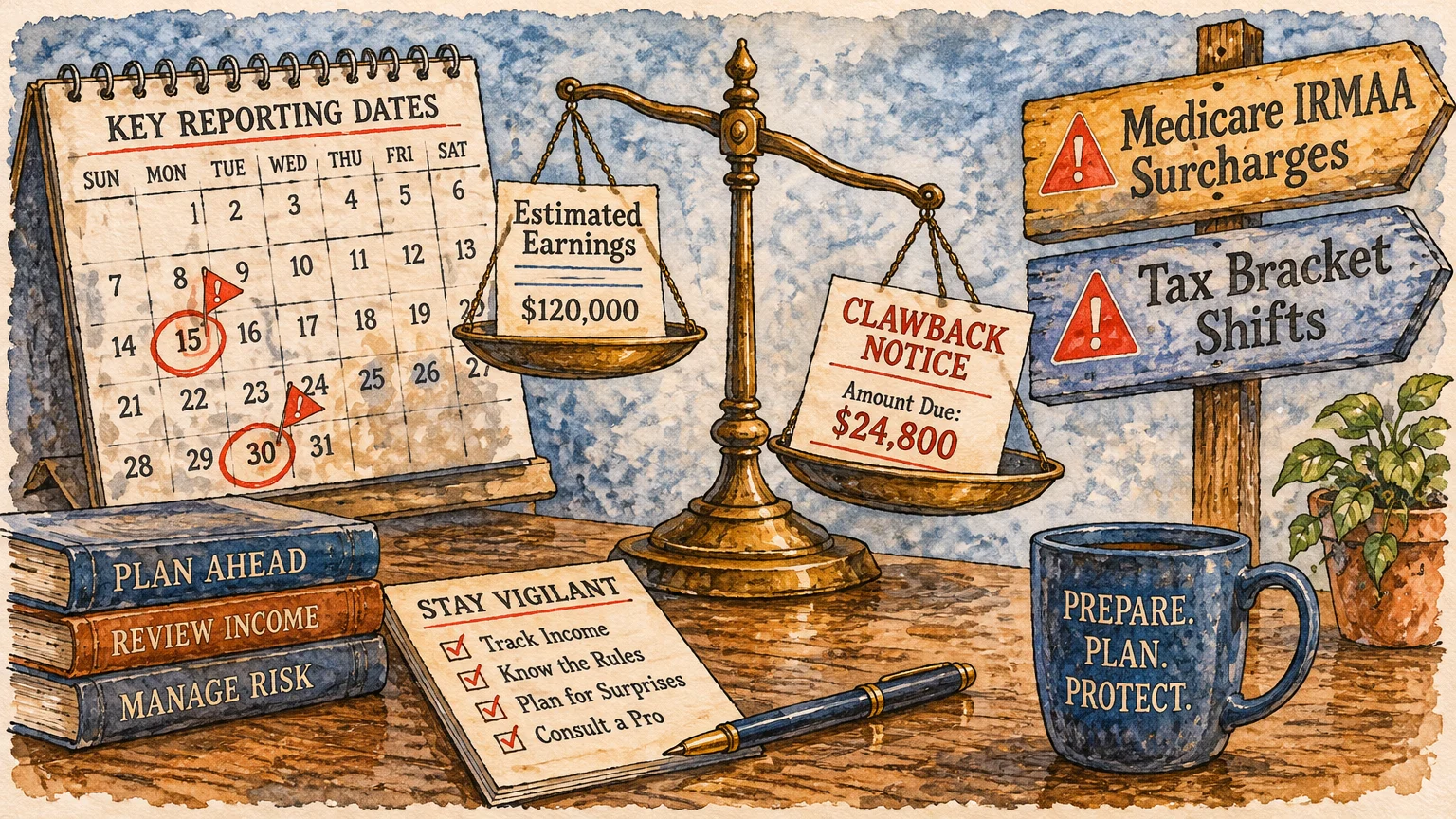
Common Mistakes to Avoid
Small misunderstandings around how the SSA measures earnings and taxes can turn a helpful extra paycheck into an administrative headache. Watch out for these frequent pitfalls when planning your 2027 work schedule:
- Tracking net take-home pay instead of gross wages: The retirement earnings test counts gross pay before tax withholdings and before employee 401(k) contributions, so looking only at your direct deposit amount can push you past the $25,560 cap unexpectedly.
- Ignoring self-employment hours during your first retirement year: Even if net business profits look modest in a given month, logging more than 45 hours—or 15 to 45 hours in a skilled role—can disqualify you from receiving a full check under the monthly rule.
- Overlooking family benefit reductions: If a spouse or dependent child collects benefits on your record, earning past the 2027 limit trims their checks alongside yours.
- Waiting until 67 to check Medicare rules: Full retirement age shifting to 67 for those born in 1960 or later does not move Medicare’s age-65 enrollment rules.
- Assuming the $6,000 senior deduction erases all benefit taxes: While the deduction lowers taxable income for qualifying filers 65 and older, combined income calculations can still leave up to 85% of Social Security benefits taxable.
- Paying avoidable IRMAA surcharges without appealing: If your 2025 MAGI exceeded $112,000 (single) or $224,000 (joint) before you reduced your hours or retired, skipping Form SSA-44 leaves hundreds of dollars per month on the table.

Professional vs. Self-Guided
Many working retirees can manage Social Security reporting on their own using official federal calculators and online accounts. Still, overlapping tax brackets, self-employment hours, and Medicare surcharges sometimes justify working with a credentialed advisor found through the Certified Financial Planner Board or a certified public accountant.
Scenario 1: Part-time W-2 wages safely below $25,560 (Self-Guided). If you hold a steady hourly or salaried job paying well under the 2027 threshold and have straightforward retirement income, you can easily track gross pay stubs yourself. Checking your year-to-date gross earnings quarterly keeps you comfortably clear of withholding.
Scenario 2: Retiring mid-year in 2027 with bonuses or consulting income (Professional Guidance). Leaving a career mid-year while earning deferred compensation, unused vacation payouts, or consulting fees creates tricky timing questions under the first-year monthly rule. A CPA or CFP can verify which payments count toward 2027 limits and help structure self-employment hours cleanly.
Scenario 3: Balancing wages, IRA withdrawals, and the $6,000 senior deduction phaseout (Professional Guidance). When part-time earnings push your MAGI near $75,000 (single) or $150,000 (joint), every extra dollar can simultaneously trim your senior deduction and expose up to 85% of Social Security benefits to federal tax. Tax projection software or a CPA helps sequence Roth conversions and withdrawals efficiently.
Scenario 4: Appealing 2027 IRMAA surcharges after reducing work hours (Self-Guided or Targeted Review). If a high-earning 2025 triggered Part B or Part D IRMAA notices for 2027, submitting Form SSA-44 with proof of reduced work or retirement is straightforward on your own. However, if your income drop stems from business restructuring or uneven capital events, a brief tax review ensures your documentation matches SSA standards.
Frequently Asked Questions About Working While Collecting Social Security in 2027
What is the Social Security earnings limit for 2027?
If you stay under full retirement age all year, the 2027 limit is $25,560 ($2,130 per month), with $1 withheld for every $2 earned above that mark. If you reach full retirement age during 2027, the limit for months prior to your birthday month is $67,920 ($5,660 per month), with $1 withheld for every $3 over.
Do pensions, IRA withdrawals, or investment dividends count toward the 2027 earnings limit?
No, only gross wages from employment and net earnings from self-employment count toward the retirement earnings test. Pensions, annuities, IRA or 401(k) distributions, interest, dividends, capital gains, and other government benefits never trigger Social Security withholding.
Will I lose my withheld Social Security benefits permanently if I earn above the limit?
No, withheld retirement benefits are credited back once you reach full retirement age through a permanent upward recalculation of your monthly check. One exception applies to spouses or survivors collecting benefits solely because they care for a minor or disabled child, as those benefits do not receive the full-retirement-age adjustment.
Does working at age 67 reduce my Social Security check in 2027?
For anyone born in 1960 after January 1, age 67 marks full retirement age in 2027, meaning $0 is withheld starting with your birthday month regardless of how much you earn. Before that birthday month arrives, only earnings above $67,920 trigger temporary withholding.
Before locking in your 2027 work hours, confirm your full retirement age, project your gross wages, and log into your SSA account to verify your earnings history. A quick check today protects both your monthly cash flow and your long-term retirement benefit.
This article provides general retirement education and information only. Every retiree’s situation is unique—what works for others may not work for you.
For personalized advice, consider consulting a qualified financial professional such as a CFP or CPA.
Last updated: November 2026. Retirement benefits, tax rules, and healthcare regulations change frequently—verify current details with official sources.