

Crossing the U.S. border or boarding a cruise ship changes your health coverage immediately. Most Medicare members assume their domestic plan follows them everywhere, only to face uncovered hospital bills abroad.
Understanding how Medicare coverage abroad works protects both your health and your retirement savings. These six travel insurance rules show where Medicare stops, what supplemental plans cover, and when private travel medical insurance seniors need becomes essential.
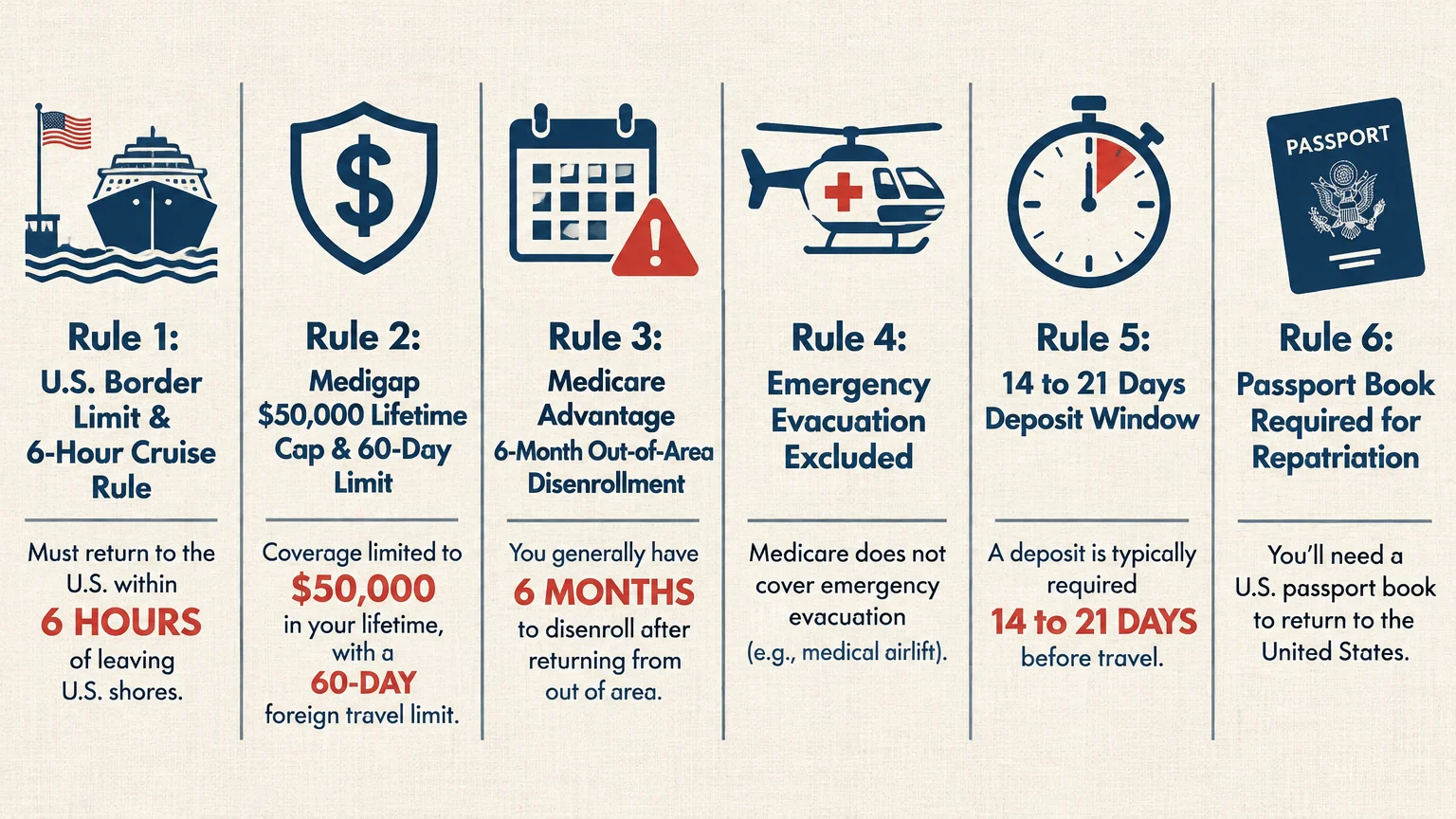
At a Glance: The 6 Medicare Travel Rules
Before you book flights or pay a cruise deposit, keep these six core rules in mind. Each rule addresses a gap that catches retirees off guard.
- Rule 1: Original Medicare stops at U.S. borders except in three rare emergencies and within six hours of a U.S. port on cruises.
- Rule 2: Medigap foreign travel benefits apply only to specific plans, cap trips at 60 days, and stop at $50,000 for life.
- Rule 3: Medicare Advantage travel benefits are shrinking in 2027, and staying out of area past six months can trigger disenrollment.
- Rule 4: Neither Original Medicare nor Medigap typically pays for emergency medical evacuation, which requires separate coverage and insurer pre-approval.
- Rule 5: Buying private travel insurance within 14 to 21 days of your first deposit unlocks vital pre-existing condition waivers.
- Rule 6: Closed-loop cruise travelers still need a valid passport book in case an overseas illness forces an emergency flight home.
Rule 1: Original Medicare Stops Almost Entirely at U.S. Borders
Original Medicare covers you well inside the United States. According to the Centers for Medicare & Medicaid Services (CMS Publication No. 11037), Part A and Part B cover care across all 50 states and the District of Columbia.
That domestic protection also extends to U.S. territories. You receive coverage in Puerto Rico, the U.S. Virgin Islands, Guam, American Samoa, and the Northern Mariana Islands at any provider that accepts Medicare.
Standard domestic cost-sharing still applies when you travel inside the U.S. In 2026, the Part A hospital deductible is $1,736, and the Part B annual deductible is $283 alongside a standard $202.90 monthly premium (rising to $292 and $209.40 in 2027).
Outside U.S. borders, Original Medicare coverage drops to nearly zero. Both CMS and the CDC Yellow Book (2026 edition) confirm that Medicare generally refuses payment for healthcare or medical supplies outside the United States.
The Three Narrow Foreign Exceptions
CMS allows foreign billing under Original Medicare in only three tightly defined situations. You cannot use these exceptions for planned care or routine vacation illnesses.
- Closer foreign emergency hospital: You have a medical emergency while in the U.S., and a foreign hospital in Canada or Mexico is closer than the nearest U.S. hospital equipped to treat you.
- Direct Alaska travel through Canada: You are traveling a direct route between Alaska and another U.S. state through Canada without unreasonable delay, and a Canadian hospital is closer during an emergency.
- Living near a foreign hospital: You live in the U.S. and a foreign hospital is closer to your home than the nearest U.S. hospital, which applies even for non-emergency care.
The Cruise Ship 6-Hour Rule and Part D Abroad
Cruise vacations create one of the most expensive misunderstandings for retirees. Per CMS Publication No. 11037, Original Medicare covers medically necessary care from a ship doctor only when the vessel is in a U.S. port or within six hours of one.
Once your ship sails more than six hours away from a U.S. port in U.S. territorial waters, Medicare stops paying onboard medical bills. Even a brief visit to the ship infirmary becomes an out-of-pocket expense.
Prescription drug plans follow an equally strict boundary. Medicare Part D does not cover medications purchased outside the United States, forcing you to pay 100% of foreign pharmacy costs yourself.
Domestically, Part D caps your out-of-pocket spending for covered drugs at $2,100 in 2026 and $2,400 in 2027, according to AARP. None of those domestic protections follow you across international borders.
Rule 2: Medigap Foreign Coverage Has Strict Dollar and Time Caps
Many retirees buy a Medicare Supplement policy assuming it provides unlimited worldwide protection. While Medigap foreign travel coverage helps, it carries strict limits that leave major gaps on long or costly trips.
Only six currently standardized Medigap options—Plans C, D, F, G, M, and N—include a Foreign Travel Emergency benefit. Legacy Plans E, H, I, and J also include this benefit for policyholders who kept older coverage.
Plans A, B, K, and L provide $0 in foreign travel coverage. Additionally, per CMS rules, Plans C and F are closed to anyone who became eligible for Medicare on or after January 1, 2020, making Plan G and Plan N the main choices for newer enrollees.
Four Limits You Must Track Under Medigap
According to CMS and Medicare.gov, Medigap foreign emergency coverage only pays when care meets all four of the following rules:
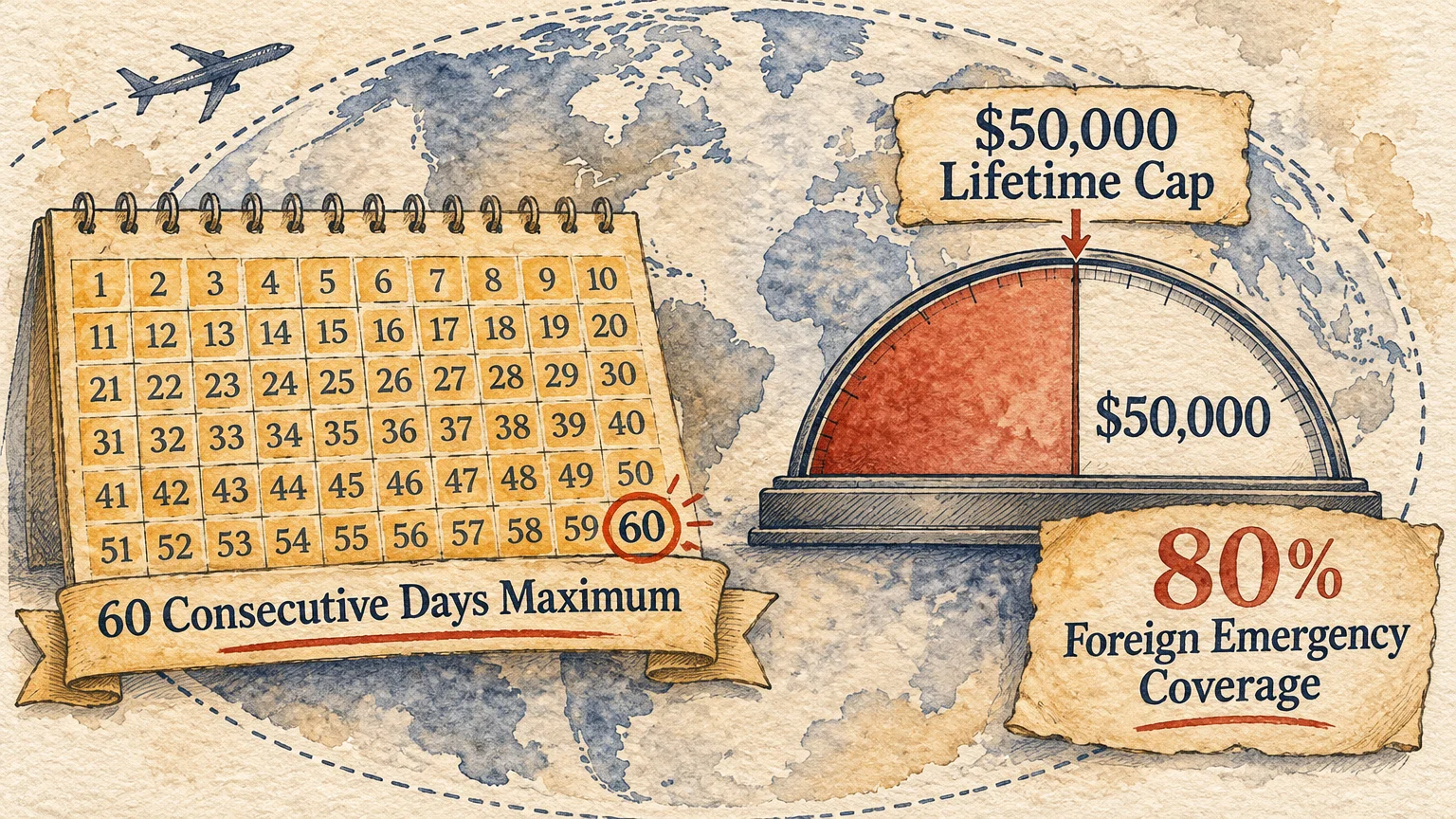
- 60-day trip cap: Medigap covers medically necessary emergency care only if it begins during the first 60 days of each trip outside the U.S.
- Separate $250 deductible: You must pay a separate $250 yearly deductible before foreign benefits begin.
- 80% coinsurance split: After the deductible, your plan pays 80% of billed emergency charges, leaving you responsible for the remaining 20%.
- $50,000 lifetime cap: Benefits max out at $50,000 over your entire lifetime, not per trip or per calendar year.
High-deductible Medigap options require even closer attention before you travel. CMS set the annual out-of-pocket deductible for High-Deductible Plans F, G, and J at $2,950 in 2026 and $3,050 starting January 1, 2027.
Medicare guidance also notes the separate $250 annual foreign travel emergency deductible alongside those plan terms. Remember too that per the CDC Yellow Book (2026), you cannot pair a Medigap policy with a Medicare Advantage plan.
A $50,000 lifetime Medigap cap sounds generous until a serious overseas surgery or extended intensive care stay wipes out that limit on a single trip.
Rule 3: Medicare Advantage Travel Benefits Are Changing Fast
More than half of eligible beneficiaries rely on private Medicare Advantage plans. KFF reports that 55% of eligible Medicare members were enrolled in Medicare Advantage in 2026.
When you travel inside the United States, federal rules protect you during sudden health scares. Every Medicare Advantage plan must cover emergency and urgent care anywhere in the U.S. at in-network cost-sharing rates, even at out-of-network hospitals.
Routine non-emergency care works very differently when you leave your plan service area. HMOs generally refuse routine out-of-area care, while PPOs impose higher out-of-network cost-sharing up to federal caps of $9,250 in-network and $13,900 combined in 2026.
The average combined in- and out-of-network PPO limit in 2026 was $9,825, according to KFF. Knowing your plan type before visiting family across the country prevents unexpected specialist bills.
The 6-Month Continuous Travel Disenrollment Trap
Extended snowbird stays and long trips abroad carry an administrative risk many travelers miss. According to Medicare Interactive and the National Council on Aging (NCOA), traveling outside your service area for over six consecutive months triggers disenrollment.
Most Medicare Advantage plans must drop you from coverage after six continuous months away and return you to Original Medicare. That move triggers a Special Enrollment Period, though some plans offer formal domestic visitor programs allowing up to 12 months inside the U.S.
Worldwide Emergency Coverage Is Dropping in 2027
Unlike domestic emergencies, worldwide emergency care is an optional supplemental benefit under Medicare Advantage travel rules. Insurers can reduce or eliminate this benefit every single plan year.
An October 2026 analysis of CMS plan data reported by ExpatInsure revealed a sharp contraction coming in 2027. The share of individual Medicare Advantage plans offering worldwide emergency coverage drops from 95.2% in 2026 to 80.1% in 2027.
Specifically, 5,330 of 5,599 plans offered worldwide emergency care in 2026, compared with 4,453 of 5,561 plans in 2027. Across the country, 696 plans dropped the benefit entirely while 507 plans worsened their coverage terms.
Many retirees assume they can simply drop Medicare Advantage and buy Medigap later if their travel needs grow. KFF data shows that 74% of Medicare Advantage enrollees have a pre-existing condition—rising to 88% at age 85 and older—which can trigger Medigap underwriting denials.
Guaranteed-issue protections vary sharply by state and circumstance. Outside of a 12-month trial right, only a handful of states—such as Connecticut, Massachusetts, Maine, New York, Rhode Island, Delaware (since 2025), and Minnesota for ages 65 to 70 (since August 2026)—offer broad guaranteed-issue Medigap windows.
Rule 4: Medical Evacuation Requires Separate Insurance and Prior Approval
Standard medical coverage pays doctors and hospitals where you are treated, not the cost to fly you home. Both CMS and the CDC Yellow Book (2026) state clearly that Original Medicare does not cover emergency medical evacuation from abroad.
Medigap foreign travel benefits typically exclude medical evacuation back to the United States as well. Even if a Medigap plan covers 80% of your foreign hospital bill, it leaves you to pay for an air ambulance alone.
Those evacuation bills can devastate a retirement portfolio. The CDC Yellow Book (2026 edition) estimates medical evacuation costs from $25,000 within North America to more than $250,000 from distant or remote regions.
The U.S. Department of State similarly warns that remote evacuations can top $200,000, as cited by Squaremouth. Cruise emergencies at sea or injuries in developing medical systems often require specialized aircraft and onboard medical teams.
Buying evacuation coverage also comes with a strict procedural rule you cannot ignore. Per the CDC Yellow Book (2026) and insurer policy terms reported by HelloSafe in October 2026, the insurer decides when evacuation is medically necessary.
You or your travel companion must call the policy’s 24/7 assistance line for prior approval before arranging transport. If you book an emergency charter flight on your own without insurer sign-off, the policy will not reimburse you.
Rule 5: Private Travel Insurance Timing Controls Pre-Existing Condition Waivers
Filling Medicare’s international gaps with travel insurance requires understanding both pricing and strict purchase deadlines. Waiting until the week before departure can strip away coverage for your biggest health risks.
Travelers typically choose between comprehensive trip policies and travel medical-only policies. Money.com reported in November 2026 that comprehensive plans usually cost 4% to 12% of total trip cost overall, while Forbes noted in June 2026 that seniors often pay 6% to 15%.
The CDC Yellow Book (2026) notes similar ranges, with standard cancellation coverage running up to 8% of trip cost and Cancel For Any Reason upgrades reaching 15%. Based on Squaremouth sales data through November 2026, the average insured trip costs $7,246 with a $480 average comprehensive premium.
If you only want medical protection without trip cancellation, travel medical-only plans cost far less. Squaremouth data shows travel medical-only policies average $5 per day and run 81% cheaper than comprehensive plans, though travelers over age 70 pay at least 51% more than younger groups.
How to Secure a Pre-Existing Condition Waiver
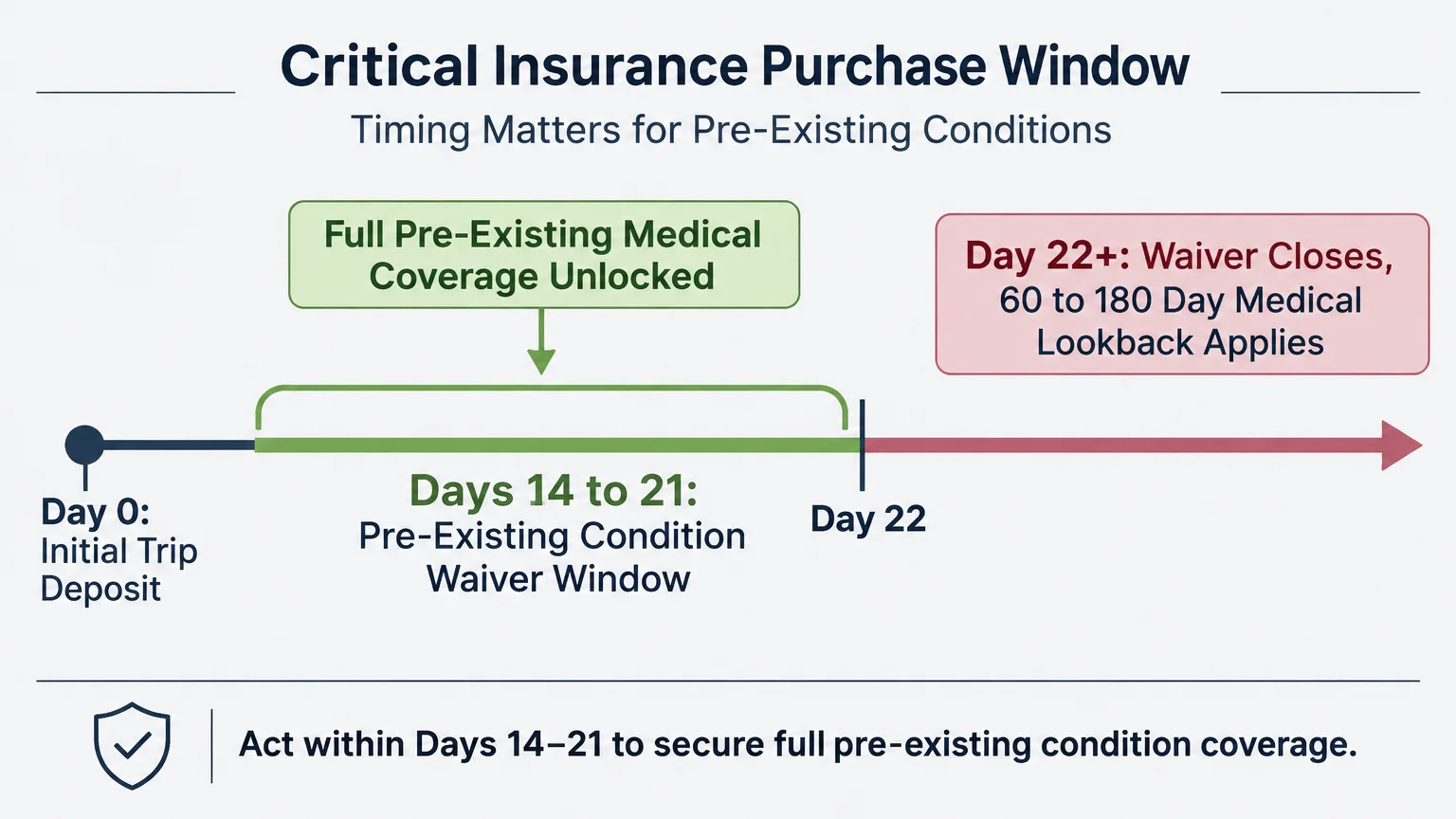
Most standard travel insurance policies apply a 60- to 180-day lookback period before your purchase date. Any condition diagnosed, treated, or subject to a medication change during that window is excluded unless you earn a waiver.
According to Squaremouth and InsureMyTrip, insurers typically grant a pre-existing condition waiver only when you meet three strict conditions:
- Meet the early purchase window: Buy your policy within 14 to 21 days of making your initial trip deposit.
- Insure full trip costs: Cover 100% of your prepaid, nonrefundable trip expenses under the policy.
- Be fit to travel: You must be medically able to travel on the day you purchase the plan.
You should also check whether a private policy provides primary or secondary coverage. Primary coverage pays eligible claims first without asking Medicare or Medigap to process paperwork, while secondary coverage coordinates only after your other plans pay.
For international senior travel, industry benchmarks cited by Squaremouth set a floor of $50,000 in medical coverage and $100,000 in evacuation coverage for basic trips. Industry benchmarks for international senior travel commonly recommend $100,000 to $250,000 in emergency medical limits and $250,000 to $500,000 for medical evacuation.
Comparing Your Medicare and Travel Coverage Options
The table below compares how Original Medicare, Medigap, Medicare Advantage, and private travel medical plans handle care away from home.
| Coverage Type | U.S. Domestic Travel | Foreign Emergency Care | Cruise Beyond 6 Hours | Medical Evacuation | Key Limit or Rule |
|---|---|---|---|---|---|
| Original Medicare | Covered nationwide | 3 rare exceptions only | Not covered | Not covered | Part D pays $0 abroad |
| Medigap (Plans C, D, F, G, M, N) | Covered nationwide | 80% after $250 deductible | Covered as foreign emergency | Typically excluded | 60-day cap; $50,000 lifetime max |
| Medicare Advantage (Part C) | Emergency/urgent nationwide | Optional; varies by plan | Depends on plan worldwide benefit | Rarely included | Share offering worldwide care drops to 80.1% in 2027 |
| Private Travel Medical Insurance | Optional / secondary | Covered up to policy limit | Covered onboard and in port | Included up to policy limit | Requires 14–21 day purchase for pre-existing waivers |
Rule 6: Carry a Passport Book Even on Closed-Loop Cruises
Many cruise lines let U.S. citizens board closed-loop cruises—sailings that begin and end at the same U.S. port—using a birth certificate or a passport card. Relying on those documents creates a serious hazard if a medical emergency strikes mid-voyage.
Guidance issued by the U.S. Department of State in June 2026 strongly advises every cruise passenger to carry a valid passport book. Your passport book should remain valid for at least six months beyond your planned return date.
A passport card works only at land borders and seaports, never for international flights. If an injury or sudden illness forces you into a foreign port hospital or onto a medical evacuation flight home, a passport card will not get you through airport immigration.
Without a passport book, you or your family could face days of embassy delays before you can fly back to U.S. doctors. Securing a passport book months ahead eliminates a preventable barrier during a medical crisis.

Avoiding Common Errors When Buying Travel Coverage
Even careful planners make costly assumptions when pairing travel insurance with Medicare. Watch out for these five common mistakes before finalizing your trip:
- Assuming 2027 Medicare Advantage matches 2026: Nearly 700 Medicare Advantage plans are dropping worldwide emergency care in 2027, so read your Annual Notice of Change carefully.
- Missing the pre-existing condition deadline: Putting down a cruise deposit and waiting a month to shop for insurance usually forfeits your pre-existing condition waiver.
- Relying on Medigap for long trips: Once day 61 of an international trip arrives, Medigap’s foreign emergency benefit ends completely.
- Booking your own emergency flight: Paying for an air ambulance or commercial medical escort without 24/7 insurer authorization voids evacuation reimbursement.
- Forgetting prescription backup: Because Part D pays nothing abroad, running short on medication due to a flight delay forces you to pay full cash price overseas.
When DIY Isn’t Enough: Getting Help With Complex Travel Coverage
Standard comparison websites work well for a one-week European river cruise or a short Caribbean trip. Certain retirement travel situations call for guidance from a licensed insurance broker or State Health Insurance Assistance Program (SHIP) counselor.
- Snowbirds away longer than six months: If you split the year between states or travel abroad past the six-month mark, an advisor can help you avoid involuntary Medicare Advantage disenrollment.
- Travelers over age 70 with recent health changes: A recent diagnosis or medication adjustment during the 60- to 180-day lookback period requires careful policy matching to protect waiver eligibility.
- Medicare Advantage members eyeing Medigap: Because 74% of Medicare Advantage enrollees have pre-existing conditions, an independent broker can check whether state guaranteed-issue rules or trial rights apply before you switch.
- Multi-month or remote expeditions: Trips lasting beyond Medigap’s 60-day cap or visiting remote areas where evacuations exceed $250,000 require specialized high-limit travel medical policies.
Frequently Asked Questions
Does Medicare cover me on a cruise to Alaska or the Caribbean?
Original Medicare covers onboard medical care only while the ship is in a U.S. port or within six hours of a U.S. port. Once your ship sails past six hours or docks in Canada or the Caribbean, Original Medicare stops paying.
Is Medigap Plan G enough for international travel?
Medigap Plan G covers 80% of emergency care during the first 60 days abroad after a $250 deductible, up to a $50,000 lifetime cap. It usually excludes medical evacuation, so adding a private travel medical policy fills major gaps.
What happens if I lose worldwide emergency coverage on Medicare Advantage in 2027?
You remain responsible for 100% of foreign medical bills unless you buy private travel medical insurance or switch plans during Open Enrollment. Always check your plan’s Evidence of Coverage each autumn before booking international travel for the coming year.
Should I buy primary or secondary travel medical insurance with Medicare?
Primary travel medical coverage is usually simpler for retirees because it pays first without requiring claim denials from Medicare or Medigap. It speeds up overseas hospital billing and helps preserve your Medigap $50,000 lifetime foreign emergency allowance.
Your Next Steps Before You Book
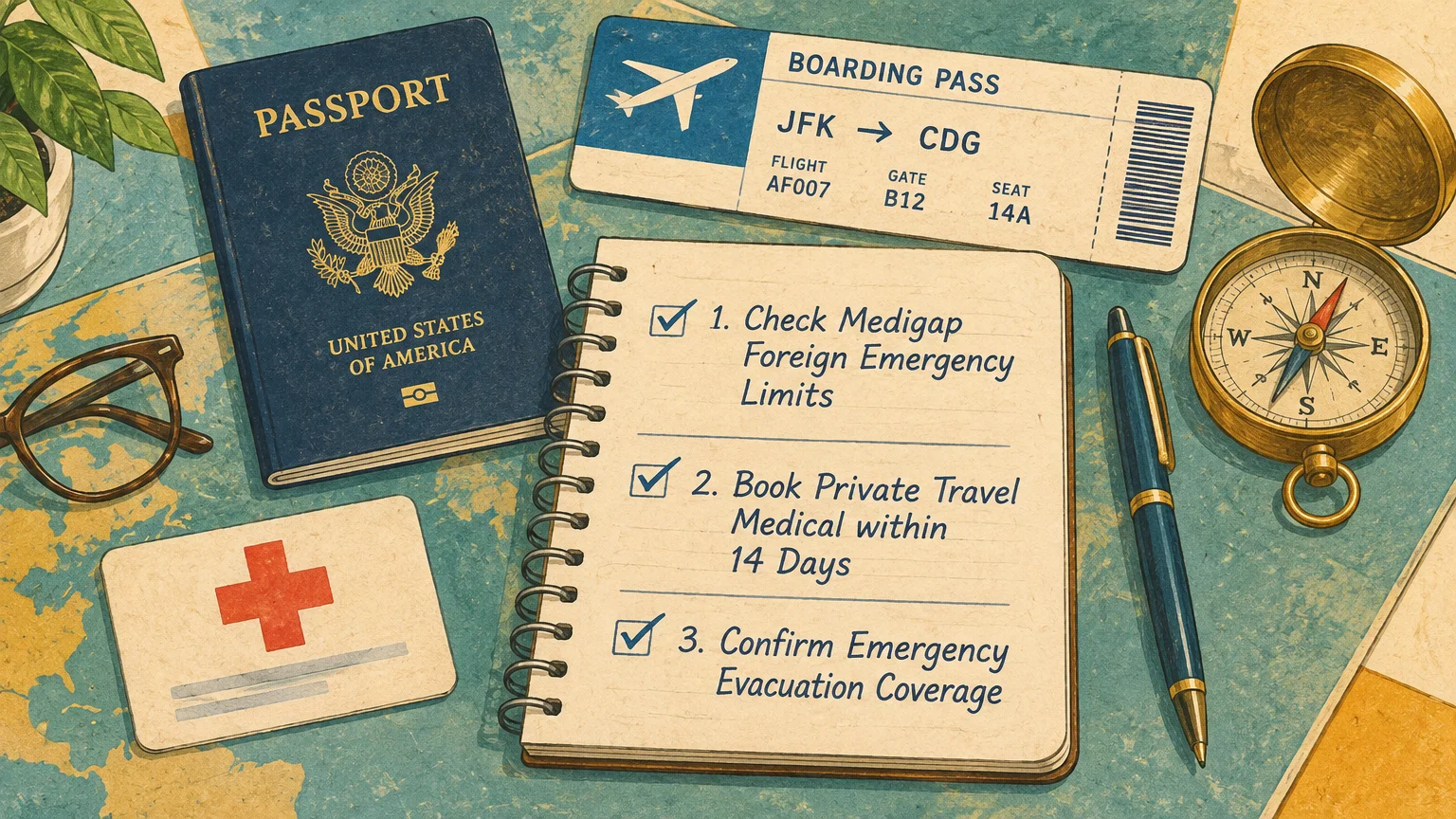
Start by pulling your Medicare card, checking your exact Medigap letter or 2027 Medicare Advantage Evidence of Coverage, and confirming your passport book expiration date. Knowing what you already have prevents both dangerous gaps and duplicate spending.
When you place your next international or cruise deposit, compare primary travel medical policies within 14 days so you lock in pre-existing condition protection and high medical evacuation limits. A few careful checks today let you travel with genuine peace of mind.
This is educational content based on general retirement and financial principles. Individual results vary based on your situation. Always verify current benefit rules, tax laws, and eligibility requirements with official sources like SSA, Medicare.gov, or the IRS.
Last updated: November 2026. Retirement benefits, tax rules, and healthcare regulations change frequently—verify current details with official sources.