

Receiving a surprise demand letter from the Social Security Administration can disrupt your retirement budget overnight. Filing an appeal within 60 days protects your legal rights to challenge an incorrect overpayment or unfair benefit reduction.
Missing this critical federal deadline allows the government to begin clawing back your monthly payments automatically. Acting promptly preserves your dispute and keeps you in control of your benefits.
Here is how the 60-day rule works, which forms you must file, and the shorter timelines you need to protect your monthly income.
Understanding the 60-Day Appeal Clock and the 5-Day Mailing Rule
Federal regulation 20 CFR § 404.909 gives you 60 days to request reconsideration when you disagree with an agency decision. You formally file this appeal using Form SSA-561-U2.
The clock does not start on the day the agency prints your letter. Under 20 CFR § 404.901, the government presumes you receive the notice five days after the mailing date.
This administrative grace period gives you a total of 65 days from the date on the letter to submit your paperwork. You can file by mail or directly through Social Security Administration online portals.
If illness, hospitalization, or lost mail prevents you from meeting the deadline, you can request an extension under 20 CFR § 404.911. You must submit written proof of good cause to preserve your claim.
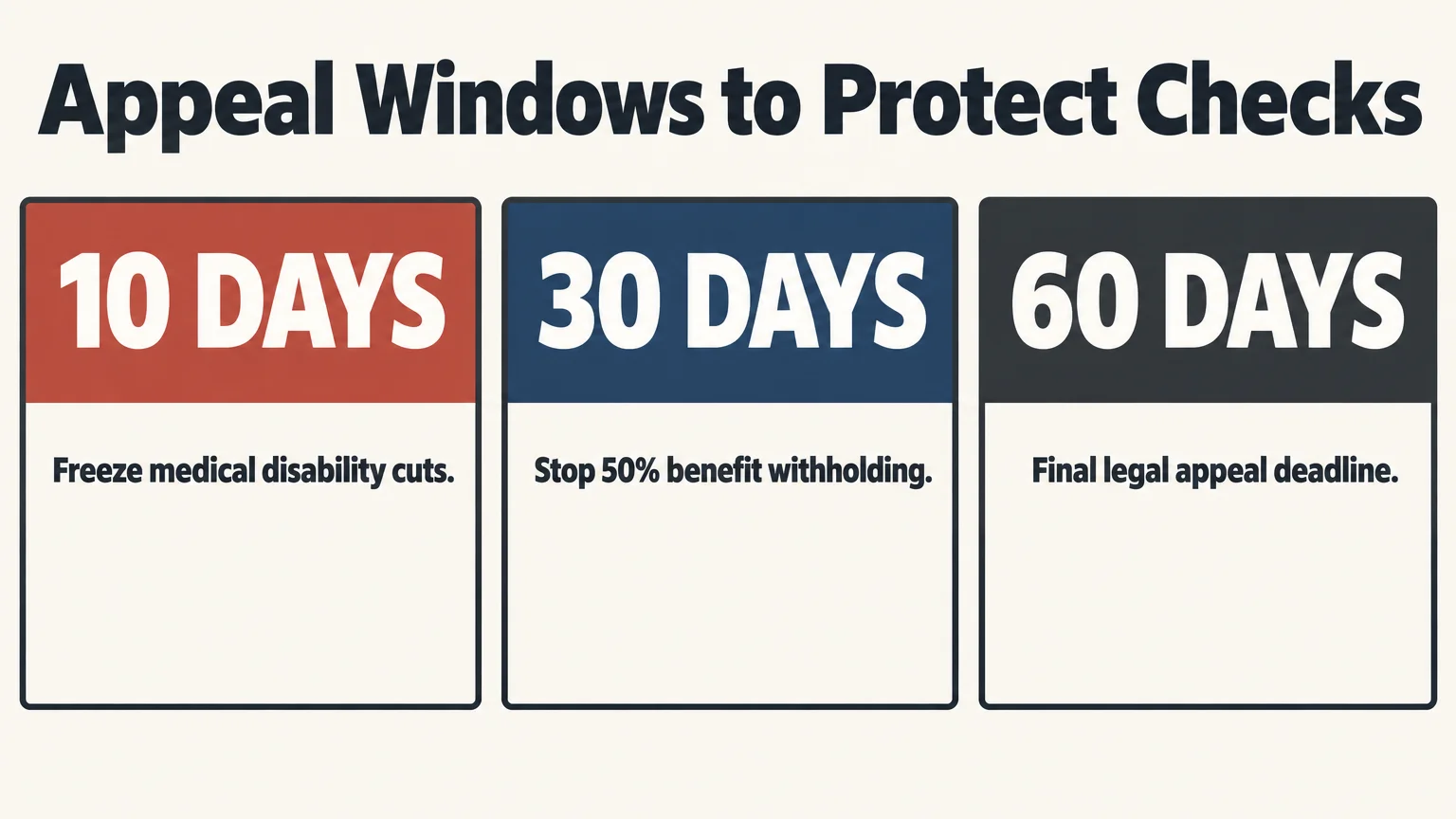
The Critical 30-Day and 10-Day Windows to Freeze Reductions
While you have 60 days to appeal, waiting that long can leave your monthly cash flow vulnerable. Filing within 60 days preserves your dispute, but it does not guarantee immediate payment protection.
Under current policy, the agency defaults to withholding 50% of your monthly Title II retirement or disability check to recover alleged debts. Supplemental Security Income (SSI) withholdings remain capped at 10%.
To stop overpayment withholding before it begins, you should submit Form SSA-561 within 30 days of receiving the notice. This timely filing triggers an administrative pause while officials review your records.
Benefit cuts involving medical disability cessations require even faster action. You must appeal and elect Statutory Benefit Continuation within 10 days of receiving the letter using Form SSA-792.
Similarly, SSI recipients facing non-medical reductions must file within 10 days to maintain uninterrupted Goldberg-Kelly payments during review.
“Retirement security is about a promise we made to older Americans that they will have a baseline of dignity and stability.” — Elizabeth Warren, U.S. Senator
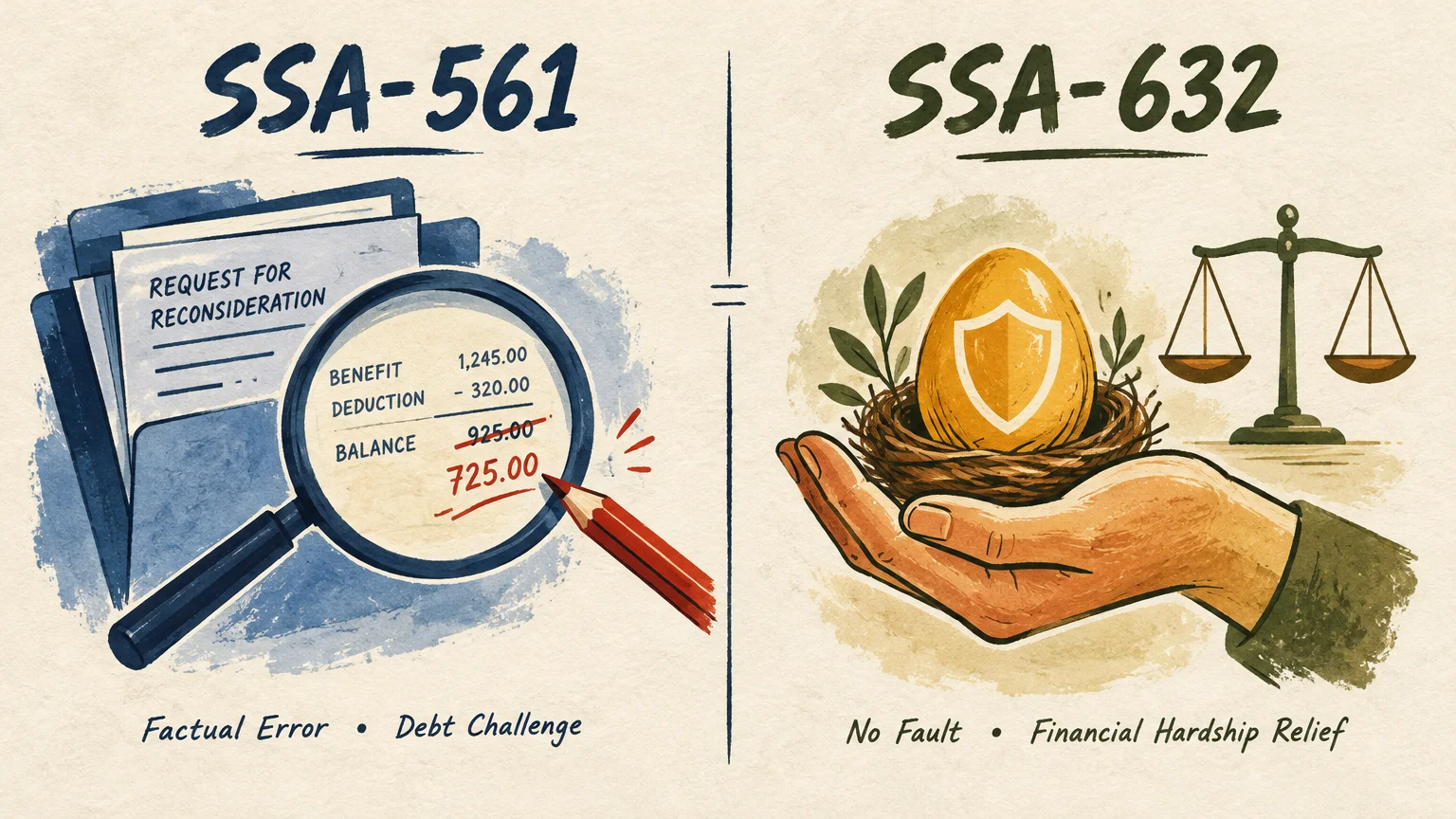
Form SSA-561 vs. Form SSA-632: Choose the Right Path
You must identify whether you are challenging the existence of the debt or requesting forgiveness. Using the wrong form can cause months of costly delays.
Submit Form SSA-561 (Request for Reconsideration) if you believe the agency calculated your earnings incorrectly or fabricated the debt entirely. This form attacks the factual accuracy of the government’s claim.
File Form SSA-632 (Request for Waiver of Overpayment Recovery) if the overpayment is accurate but occurred through no fault of your own. Unlike appeals, waiver requests carry no 60-day filing deadline.
To qualify for a waiver, you must prove you lacked fault and show that repayment causes severe financial hardship. The agency generally defines hardship as having less than $6,000 in personal assets.
If your original total overpayment is $2,000 or less, call the agency to request an administrative waiver. Officials can often waive balances under this threshold over the phone without extensive financial documentation.
When you cannot dispute the debt or obtain a waiver, submit Form SSA-634 to negotiate a lower monthly payment. You can often reduce withholdings to as low as $10 per month.
| Form Name | Primary Purpose | Filing Deadline | Impact on Withholding |
|---|---|---|---|
| Form SSA-561 | Dispute debt accuracy or benefit cut | 60 days (30 days to halt withholding) | Pauses collection during reconsideration |
| Form SSA-632 | Request no-fault debt forgiveness | No deadline (file anytime) | Pauses collection while reviewed |
| Form SSA-634 | Negotiate affordable repayment plan | No deadline (file anytime) | Replaces 50% default rate |
| Form SSA-792 | Continue disability benefits during appeal | 10 days from receipt (15 days total) | Maintains monthly check during review |
What Can Go Wrong: Critical Mistakes to Avoid
Beneficiaries frequently miscalculate their filing deadlines by ignoring the date stamped on the notice envelope. Always save your postmarked envelope as evidence if your notice arrived unusually late.
Many retirees also assume that filing a waiver automatically disputes the underlying debt. If you dispute the math, file Form SSA-561 alongside Form SSA-632 rather than choosing only one.
Never send original documentation to a local field office without keeping complete duplicates. Always mail paperwork using certified mail with return receipt requested, or obtain a stamped date receipt in person.
Be alert to predatory scammers posing as federal agents demanding immediate wire transfers or gift cards. Guidance from the Consumer Financial Protection Bureau reminds retirees that legitimate government agencies never demand untraceable funds.

When to Consult a Professional
While you can handle basic appeals independently, certain complex situations warrant professional guidance from an accredited representative or attorney.
- Substantial overpayment debts: If the government demands repayment exceeding tens of thousands of dollars, an attorney can pinpoint accounting flaws.
- Retirement earnings test conflicts: If the agency misattributed wages or corporate dividends to your early retirement years, a tax professional or legal advocate can untangle the records.
- Administrative Law Judge hearings: If the agency rejects your initial reconsideration, an experienced representative substantially improves your odds at a formal hearing.
- Complex asset calculations: If you own modest property or emergency savings that complicate your waiver hardship evaluation, consult an elder law attorney.
Frequently Asked Questions
Does filing an appeal guarantee my benefits will not drop?
No. Filing Form SSA-561 preserves your legal right to dispute the agency’s findings, but you must meet tight 10-day or 30-day windows to maintain active cash flow.
Can I request an overpayment waiver after 60 days have passed?
Yes. Form SSA-632 has no statutory deadline. You can submit a waiver request months or years after receiving the initial overpayment notice.
What is the default monthly overpayment withholding rate?
The default withholding rate for Title II benefits is 50% of your monthly check for notices issued on or after April 25, 2025. SSI withholdings remain capped at 10%.
Where can I check the status of my appeal?
You can track the progress of your reconsideration through your personal account on the AARP-recommended agency portal or by calling your local field office.
Next Steps for Your Appeal
Do not let a sudden notice jeopardize your financial security. Check the date on your letter immediately, gather your supporting financial records, and file your paperwork within the required deadlines.
The information in this guide is meant for educational purposes. Your specific circumstances—including income, health needs, tax situation, and goals—may require different approaches; when in doubt, consult a licensed professional.
Last updated: November 2026. Retirement benefits, tax rules, and healthcare regulations change frequently—verify current details with official sources.