

A new federal law eliminates the term “full retirement age” from Social Security communications to prevent Americans from leaving money on the table. The Claiming Age Clarity Act replaces misleading labels with straightforward descriptions of how filing dates dictate your monthly checks.
Signed into law on November 20, 2026, this legislation requires the government to overhaul its benefit descriptions by November 20, 2027. The shift aims to ensure you clearly understand the steep cost of claiming your benefits too early.
While the terminology changes completely, your actual benefit formulas and claiming windows remain identical. Here is what the new law means for your retirement timeline and monthly income.
Why Congress Passed the Claiming Age Clarity Act
For decades, the phrase “full retirement age” misled millions of workers into believing they would receive their maximum possible payout at age 66 or 67.
In reality, waiting until age 70 produces significantly higher monthly income.
Nearly 60% of new claimants collect benefits before reaching their standard claiming age, while more than 25% claim immediately at age 62.
A 2019 University of Southern California study revealed that outdated jargon caused many seniors to misunderstand the permanent penalties of claiming early.
Bipartisan lawmakers responded by passing H.R. 5284, sponsored by Representative Lloyd Smucker and Senator Bill Cassidy, to make benefit trade-offs transparent.

The New Terminology: What the Labels Mean
Under the Claiming Age Clarity Act, the Social Security Administration must update all print and online materials by November 20, 2027.
The new terms replace confusing bureaucratic categories with direct, dollar-focused descriptions of your options.
| Old SSA Term | New Statutory Term | Claiming Age | Monthly Benefit Impact |
|---|---|---|---|
| Early Eligibility Age | Minimum Monthly Benefit Age | Age 62 | Permanent reduction up to 30% |
| Full / Normal Retirement Age | Standard Monthly Benefit Age | Age 66 to 67 (Age 67 for born 1960+) | 100% of baseline monthly benefit |
| Delayed Retirement Credit | Maximum Monthly Benefit Age | Age 70 | Permanent increase of 24% over standard |
The law explicitly prohibits the phrase “delayed retirement credit” in public agency guides.
Instead, referring to age 70 as your “maximum monthly benefit age” clarifies that your monthly check stops growing after that birthday.
What Stays Exactly the Same for Your Benefits
This social security bill changes terminology, not the underlying statutory formulas or payout structures.
Your claiming window still opens at age 62 and offers payment increases through age 70.
Workers born in 1960 or later still reach their standard monthly benefit age at 67, beginning in 2027.
Medicare eligibility also remains pegged to age 65, completely separate from your Social Security decisions.
Furthermore, these benefit changes do not solve the broader funding deficit highlighted in the June 2026 Social Security Trustees Report.
Trustees project the Old-Age and Survivors Insurance reserve will deplete in late 2032 without further congressional action.
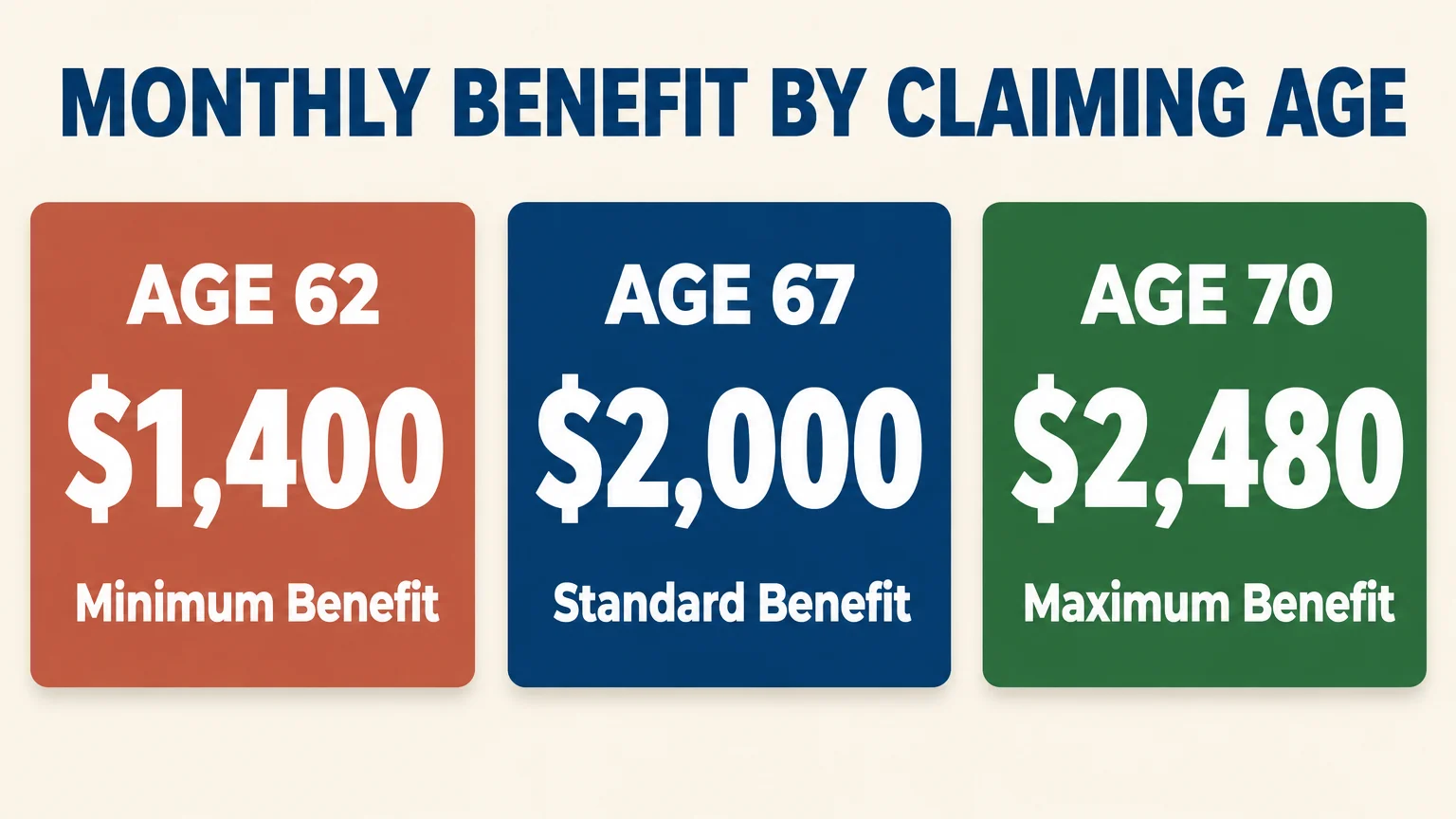
The Financial Math: Comparing Your Payout at 62, 67, and 70
Claiming at your minimum monthly benefit age of 62 permanently shrinks your check by up to 30%.
Conversely, delaying past your standard age adds two-thirds of 1% each month, generating an 8% annual increase.
Consider a worker eligible for a $2,000 standard monthly benefit at age 67.
Filing at age 62 slashes that payment to $1,400 each month.
Waiting until age 70 boosts the payment to $2,480 per month.
That choice creates a difference of $1,080 per month, or $12,960 every year, for the rest of your life.
Meanwhile, starting in January 2027, a 3.6% cost-of-living adjustment will raise the average monthly benefit from $2,095 to $2,170.
Personal finance authority Suze Orman has long stressed the value of patient claiming.
“If you can afford to wait until age 70 to collect Social Security, do it. Every year you wait after your full retirement age gives you an 8% guaranteed return on your benefit.” — Suze Orman, Personal Finance Author & Host
Avoiding Common Errors Under the New Rules
Clearer words help you steer clear of expensive traps when organizing your retirement income.
- Assuming standard age gives you the highest payout: Many retirees stop waiting at age 67, missing out on guaranteed 8% annual delayed increases through age 70.
- Ignoring the retirement earnings test: Working while collecting benefits before your standard age triggers temporary withholding once your earnings exceed $25,560 in 2027.
- Confusing Medicare with Social Security: You must still enroll in Medicare around your 65th birthday, even if you delay Social Security until age 70.
- Rushing to file out of solvency fears: Claiming early locks in a permanently reduced monthly base payment, regardless of future policy fixes.

When DIY Isn’t Enough
While the law simplifies Social Security labels, coordinating retirement accounts requires careful planning.
You should consider consulting a credentialed advisor in these situations:
- Coordinating spousal benefits: Complex dual-earner rules require deliberate timing to optimize household survivor income.
- Balancing traditional IRA withdrawals: Strategic claiming can prevent aggressive tax bracket creep during your early retirement years.
- Navigating chronic health issues: Life expectancy projections alter the mathematical break-even point between age 62 and age 70.
- Transitioning into part-time consulting: Managing the earnings test alongside self-employment taxes demands precise accounting.
Organizations like the Consumer Financial Protection Bureau and AARP provide tools to help evaluate your personal claiming timetable.
Frequently Asked Questions
Does the Claiming Age Clarity Act change how much money I receive?
No, the law changes only public terminology and labels. Your actual benefit calculations, deduction percentages, and delay credits remain exactly as established by previous law.
When will Social Security update its website and statements?
The agency must complete all terminology updates across its forms, publications, and online portals by November 20, 2027.
What is the new name for full retirement age?
Social Security will now refer to full retirement age as your “standard monthly benefit age.”
Can I still claim Social Security benefits at age 62?
Yes, you can still claim benefits at age 62, which Social Security now calls your “minimum monthly benefit age.”
Next Steps for Your Claiming Strategy
Log into your personal account on the Social Security website to review your updated earnings record.
Compare your projected monthly checks at your minimum, standard, and maximum ages before finalizing your retirement timeline.
This article provides general retirement education and information only; every retiree’s situation is unique—what works for others may not work for you.
For personalized advice, consider consulting a qualified financial professional such as a CFP or CPA.
Last updated: November 2026. Retirement benefits, tax rules, and healthcare regulations change frequently—verify current details with official sources.