
Generating retirement side income should never feel like a return to the daily corporate grind. The right high paying side hustles allow you to monetize decades of hard-earned experience on your own schedule.
Whether you want to offset rising living costs or fund travel, choosing an elite gig protects both your time and energy. You do not need entry-level hourly wages when your professional expertise commands top dollar.
Here are the ten best-paying side gigs for retirees looking to maximize their earning power without sacrificing personal freedom. Each role provides flexibility, intellectual engagement, and meaningful financial rewards.
Why High-Paying Side Gigs Make Sense for Modern Retirees
Retirement today looks far different than it did for prior generations. Increasing numbers of older adults choose to stay professionally active while controlling their weekly commitments.
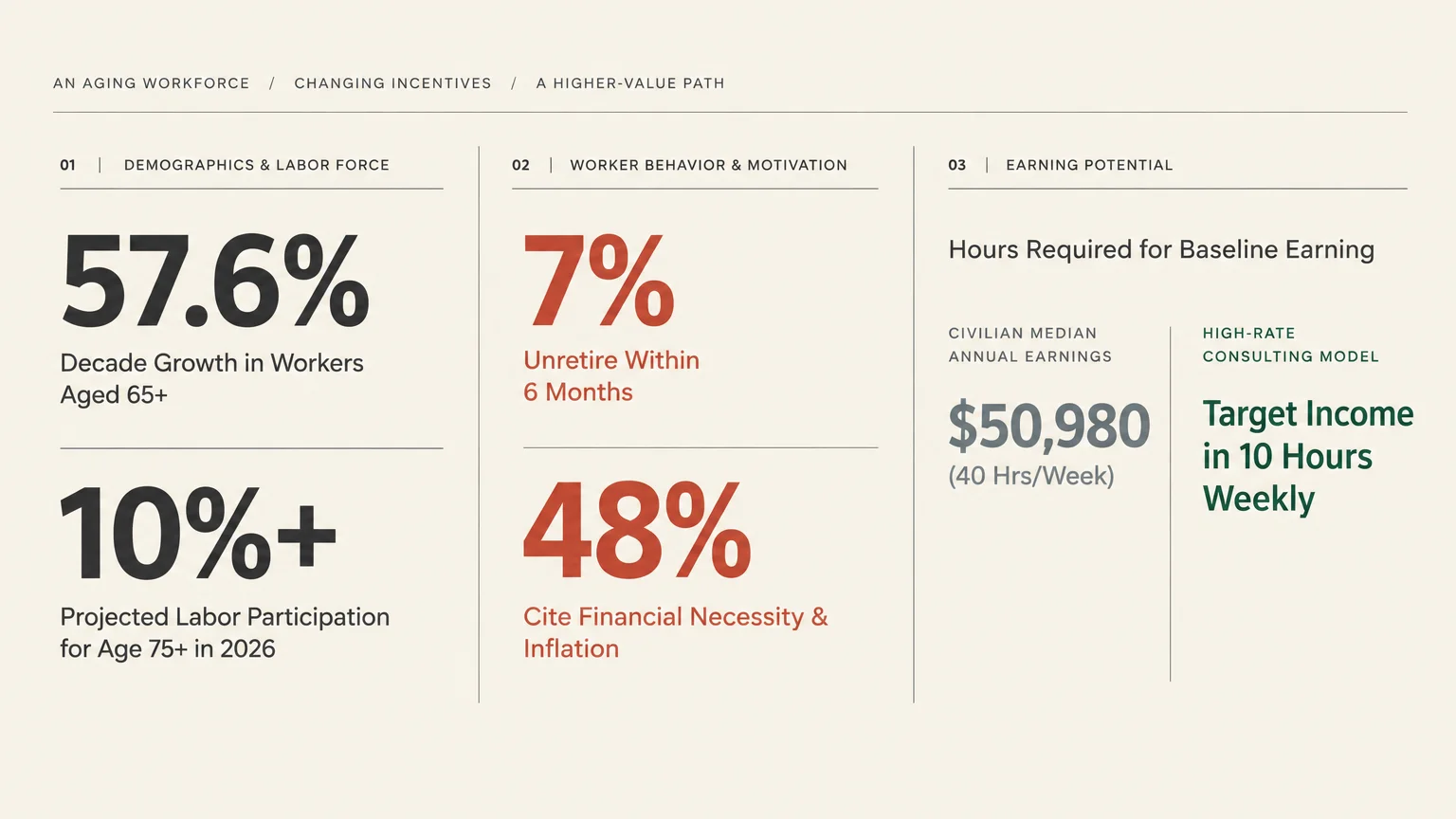
According to an AARP study, 7% of retirees unretired within a six-month window, with 48% citing financial necessity and inflation as primary drivers. Working part-time offers a resilient buffer against market volatility.
Labor data reveals a massive demographic shift. Projections show the labor force participation rate for Americans aged 75 and older will exceed 10% in 2026.
The total volume of workers aged 65 and older expanded by 57.6% over the preceding decade. These individuals are not taking low-wage shifts; they are leveraging specialized skills for premium rates.
The national median wage across all civilian occupations stands at $50,980 per year. High-level side jobs for seniors can easily exceed this baseline while requiring only a fraction of the hours.
“Retirement is not the end of the road, but a change of direction to something that gives you purpose and joy.” — Mitch Anthony, Retirement Author and Educator
Selecting lucrative side engagements preserves your physical energy. High-hourly-rate consulting or advisory work produces substantial income in ten hours a week, leaving ample room for leisure.

The 10 Best-Paying Side Gigs for Retirees
To qualify as a superior option, a side gig must offer flexibility, high compensation, and independence. The following ten roles deliver exceptional earning potential for experienced professionals.
1. Executive and Management Consulting
Companies routinely face operational challenges that require seasoned judgment without the overhead of a full-time executive. Independent management analysts solve complex problems, streamline organizational workflows, and mentor emerging leaders.
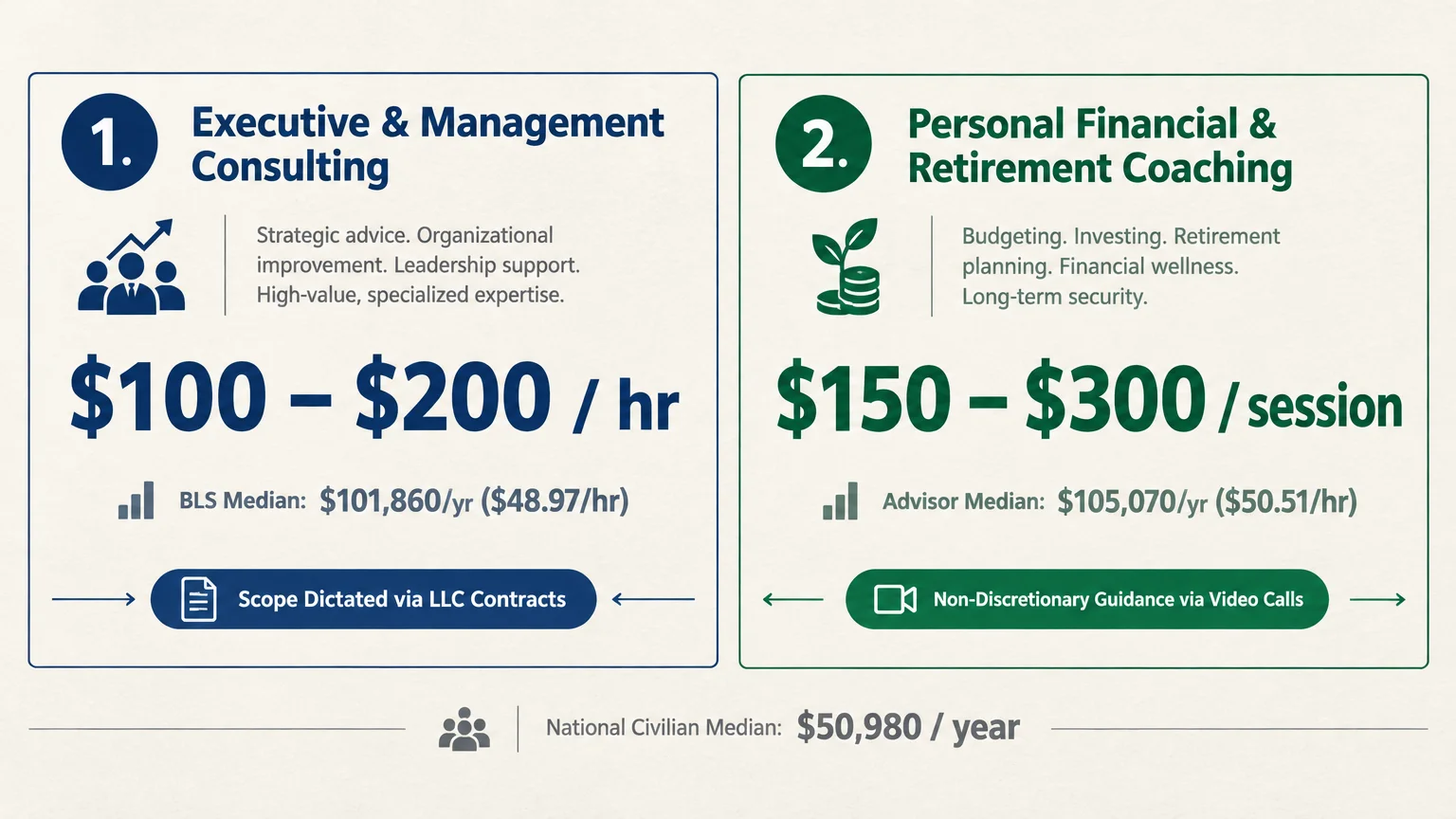
Data from the Bureau of Labor Statistics indicates management analysts earn a median annual wage of $101,860, which translates to roughly $48.97 per hour. Independent consultants with specialized industry backgrounds frequently bill $100 to $200 per hour.
You can package your career accomplishments into defined advisory services. Setting up contracts through an LLC allows you to dictate project scope and avoid ongoing office politics.
2. Personal Financial and Retirement Coaching
Many individuals entering their fifties and sixties seek guidance on budgeting, lifestyle transitions, and debt management. While comprehensive investment management requires specific licenses, non-discretionary financial coaching focuses on financial literacy, habits, and retirement transitions.
Personal financial advisors command a median annual salary of $105,070, or approximately $50.51 per hour. Independent coaches operating advisory practices often charge flat fees between $150 and $300 for individual planning sessions.
You can share essential money management strategies through video calls from home. Consult resources on Investor.gov to ensure your educational services comply with federal investment advisory boundaries.
3. Contract Project Management
Organizations often lack internal bandwidth to manage major IT rollouts, process updates, or product launches. Certified or experienced project managers bridge this operational gap on fixed-term contracts.
Project management specialists earn a median compensation of $102,320 annually, equating to $49.19 per hour. Retirees who hold industry credentials or direct leadership experience can easily command higher project-based fees.
This role offers predictable milestones and firm end dates. You can accept a four-month contract, finish the delivery, and take the following three months off entirely.
4. Adjunct Higher Education Teaching
Colleges, community colleges, and graduate universities actively recruit working professionals and retirees to teach specialized coursework. Institutions value practical career insight because it directly enriches classroom discussion.
Postsecondary teachers earn a median annual wage of $85,330 across full-time and part-time categories. While per-course adjunct compensation varies by region, specialized master’s-level courses offer predictable, rewarding semester stipends.
Many universities now deliver programs through hybrid or fully remote formats. Online teaching eliminates commuting and lets you grade assignments and host seminars from anywhere.
5. Specialized Tax Preparation and Bookkeeping
Small businesses and sole proprietors consistently struggle with tax compliance and orderly balance sheets. Retirees with finance or accounting experience provide indispensable relief during tax season and quarterly reporting cycles.
Accountants and auditors earn a median pay of $83,680 per year ($40.23 per hour). Specialized tax preparers earn a median of $62,370, while top-tier independent preparers earn over $114,550 annually.
Standard bookkeeping clerks achieve median wages of $50,670, with the top 10% earning over $74,550. This flexibility allows you to intensify hours from January through April and maintain minimal workloads the rest of the year.
6. Corporate Freelance Writing and Editing
B2B corporations, trade journals, and healthcare agencies need clear, authoritative content written by individuals who understand industry nuances. If you have spent decades writing reports or proposals, commercial writing offers high hourly returns.
Professional editors earn a median wage of $77,920 annually ($37.46 per hour), while professional writers earn $76,910 ($36.98 per hour). Niche freelance copywriters often bill $75 to $125 per hour for technical white papers.
Freelance writing lets you work whenever inspiration strikes. You can set deadlines with clients, complete assignments from a home office, and avoid real-time corporate interruptions.
“The goal isn’t just to make money; it’s to build a resilient financial cushion that protects your independence as you age.” — Jean Chatzky, Financial Journalist and Author
7. Public Relations and Communications Consulting
Reputation management, corporate messaging, and crisis communications demand calm experience and clear perspective. Former corporate communications leaders and media professionals are exceptionally well-suited for advisory PR retainers.
Public relations specialists earn a median wage of $74,750 per year, or approximately $35.94 per hour. Seasoned media strategists providing crisis counsel often charge premium retainers well above standard corporate rates.
Most boutique PR tasks require phone consultations, email outreach, and strategy decks. The remote nature of this work gives you complete control over your geographical location.
8. Real Estate Advisory and Referral Brokering
If you already possess a real estate sales license, you can generate considerable revenue without hosting weekend open houses. Many retired real estate agents operate solely through client referrals.
Licensed real estate brokers earn a median annual income of $73,220, while sales agents make $52,830. By connecting past clients with active agents, you can earn a 25% to 35% referral fee on completed transactions.
This approach transforms your professional network into ongoing retirement side income. You handle introductory correspondence and let the receiving agent manage showings, inspections, and closing paperwork.
9. Boutique Corporate Event Planning
Companies and non-profit boards organize regional conferences, executive retreats, and annual donor galas. These organizations frequently contract external planners rather than carrying permanent in-house event teams.
Meeting, convention, and event planners earn a median compensation of $61,160 per year ($29.40 per hour). Independent event consultants managing high-budget corporate gatherings often negotiate flat fees that yield significantly higher effective hourly earnings.
You can choose to oversee just one or two signature conferences per year. This project-based model ensures long stretches of total downtime between major event deliveries.
10. High-End Test Prep and Academic Tutoring
Families and university students invest heavily in private instruction for college admissions exams, professional certifications, and STEM coursework. Tutors who understand test formats and complex curricula generate lucrative extra income.
While the overall median pay for tutors is $43,350 annually ($20.84 per hour), specialized test-prep instructors in the top 10% earn more than $75,990 annually ($36.53 per hour). Private SAT, ACT, and GRE coaches in metropolitan regions frequently charge $80 to $150 per hour.
Virtual tutoring platforms allow you to conduct 60-minute sessions from your living room. You can take on as few as two students a week to maintain an effortless supplementary income stream.
Side Gig Compensation and Flexibility Breakdown
Evaluating potential side hustles requires balancing income potential with schedule autonomy. The comparison table below highlights median earnings and working dynamics across the top ten options.
| Side Gig Role | BLS Median Hourly Pay | Primary Schedule Flexibility | Recommended Background |
|---|---|---|---|
| Financial & Retirement Coaching | $50.51 / hr | High (Self-determined) | Finance, Wealth Management |
| Contract Project Management | $49.19 / hr | Moderate (Deadline-driven) | Operations, IT, Engineering |
| Executive & Business Consulting | $48.97 / hr | High (Project retainers) | Corporate Leadership |
| Specialized Tax Preparation | $40.23 / hr | Seasonal (Intense in Spring) | Accounting, Certified Prep |
| Corporate Freelance Writing | $37.46 / hr | High (Async delivery) | Communications, Journalism |
| PR & Strategic Communications | $35.94 / hr | Moderate (On-call advisory) | Media Relations, Marketing |
| Adjunct Higher Education | $41.00 / hr equivalent | Moderate (Fixed syllabus) | Master’s Degree, Domain Expert |
| Real Estate Referral Brokering | Commission-based | Very High (Networking) | Active License, Local Network |
| Boutique Corporate Event Planning | $29.40 / hr | Project-based | Hospitality, Logistics |
| Specialized Academic Tutoring | $20.84 – $36.53+ / hr | High (Hourly bookings) | Education, STEM, Testing |
Selecting the best role depends on whether you prefer seasonal sprints or predictable weekly hours. Aligning your current lifestyle goals with project demands prevents unnecessary stress.

Navigating Social Security and Tax Rules
Earning extra income in retirement requires careful tax and benefits planning. If you draw benefits before your Full Retirement Age (FRA), the government limits your annual earnings.
Under rules from the Social Security Administration, your Full Retirement Age is 67 if you were born on or after January 2, 1960. Once you reach FRA, you can earn unlimited income without any benefit withholding.
If you are under FRA for the entire year in 2026, the annual earnings limit is $24,480 ($2,040 per month). The SSA withholds $1 in benefits for every $2 you earn above that threshold.
In 2027, this under-FRA limit rises to $25,560 ($2,130 per month). For the year you reach FRA, the earnings limit is substantially more generous: $65,160 in 2026 and $67,920 in 2027.
In that transition year, the SSA only withholds $1 for every $3 earned above the limit prior to your birth month. Beneficiaries will also receive a 3.6% Cost-of-Living Adjustment (COLA) in 2027.
Understanding business tax documentation is equally essential for gig workers. Independent contractors must prepare for self-employment taxes and statutory reporting thresholds.
Independent contractors and sole proprietors must pay a 15.3% self-employment tax on net earnings of $400 or more. This levy covers Social Security (12.4% up to $184,500 in 2026 and $192,300 in 2027) and Medicare (2.9%).
Under the One Big Beautiful Bill Act, the threshold for businesses issuing Form 1099-NEC jumped from $600 to $2,000 for payments made in 2026. This higher reporting floor reduces administrative paperwork for smaller consulting clients.
For payment processors like PayPal or Venmo, the Form 1099-K reporting threshold remains at $20,000 and 200 transactions. Even without a 1099, you must report all earned net income to the Internal Revenue Service.
Retirees traveling to client sites can deduct legitimate transportation expenses. The standard business mileage rate for 2026 was 72.5 cents per mile through June 30, increasing to 76 cents per mile for the remainder of the year.

Avoiding Common Errors
Many retirees stumble into costly administrative traps when starting an independent gig. Avoiding these basic mistakes keeps your income clean, compliant, and stress-free.
- Triggering Social Security Benefit Withholdings: Exceeding the $24,480 limit while under FRA leads to automatic benefit reductions. Monitor your monthly cash flow closely to ensure earnings stay below the regulatory ceiling.
- Neglecting Quarterly Estimated Taxes: W-2 employers automatically withhold taxes, but 1099 clients do not. Make quarterly payments on Form 1040-ES to dodge IRS underpayment penalties.
- Overlooking Business Deductions: Failing to track expenses like home office square footage, software, and driving miles inflates your taxable income. Use simple mileage tracking apps to document business driving at current standard rates.
- Underpricing Your Specialized Skills: Competing on low prices forces you to work longer hours to hit your target revenue. Price your services according to executive value rather than entry-level market rates.
Implementing basic record-keeping habits from your first invoice prevents chaos at tax time. A separate business checking account simplifies expense tracking and keeps personal assets segregated.

When DIY Isn’t Enough
Handling basic freelancing or consulting is straightforward for most retirees. However, certain complex financial crossroads demand professional advice from a CPA or fee-only financial planner.
You should consider professional guidance if you face any of the following circumstances:
- Approaching Medicare Surcharges (IRMAA): Significant extra income can push your Modified Adjusted Gross Income into higher Medicare Part B and Part D premium brackets. A tax professional can calculate income cutoffs to prevent unintended surcharges.
- Structuring a Legal Business Entity: Choosing between a basic sole proprietorship, single-member LLC, or S-Corporation carries major liability and tax consequences. An attorney helps you establish proper protection based on your local state statutes.
- Setting Up High-Contribution Retirement Plans: Retirees generating strong freelance profits can shelter money using a SEP-IRA or Solo 401(k). A financial advisor can establish these accounts to defer taxes legally.
- Managing Multi-State Tax Compliance: Providing remote consulting across state lines may create corporate nexus or out-of-state filing requirements. A licensed accountant ensures you meet state tax obligations without incurring penalties.
Frequently Asked Questions
Can I work a side gig and collect Social Security at the same time?
Yes, you can work and receive benefits simultaneously. Once you reach your Full Retirement Age (age 67 for those born in 1960 or later), there is no earnings limit or penalty on your benefits.
Do I have to pay self-employment tax on my side income?
If your net self-employment earnings reach $400 or more, you must pay the 15.3% self-employment tax. This tax covers Medicare and Social Security contributions for independent workers.
What is the 1099-NEC reporting threshold for side gigs?
Under the One Big Beautiful Bill Act, clients are required to issue Form 1099-NEC when nonemployee payments reach $2,000 in calendar year 2026. You are still legally obligated to report all income, even if you do not receive a form.
Can earning extra side income affect my Medicare premiums?
Yes, higher earned income can increase your Medicare Part B and Part D premiums through Income-Related Monthly Adjustment Amounts (IRMAA). Medicare looks at your tax returns from two years prior to determine your monthly tier.
Building Your Ideal Retirement Routine
The best side gigs for retirees offer a balance of financial reward, autonomy, and intellectual stimulation. Monopolizing your schedule with low-paying hourly tasks defeats the purpose of stepping away from the daily grind.
Focus on your strongest professional talents and package them into flexible, high-rate services. By protecting your time and staying mindful of tax rules, you can design a retirement that is both personally fulfilling and financially prosperous.
The information in this guide is meant for educational purposes. Your specific circumstances—including income, health needs, tax situation, and goals—may require different approaches. When in doubt, consult a licensed professional.
Last updated: October 2026. Retirement benefits, tax rules, and healthcare regulations change frequently—verify current details with official sources.









Leave a Reply