
A nest egg of $250,000 can provide a comfortable, stress-free retirement if you pick the right location. By pairing this balance with average Social Security benefits, you can generate an annual budget exceeding $35,000.
Housing expenses dictate the success of your financial plan more than any other expense. Choosing low-cost housing markets shields your portfolio from early depletion and keeps monthly spending sustainable.
These eight affordable retirement states combine below-average living costs with retiree-friendly tax codes. They allow your savings to stretch comfortably across your entire golden years.
The Real Math Behind Retiring on $250,000
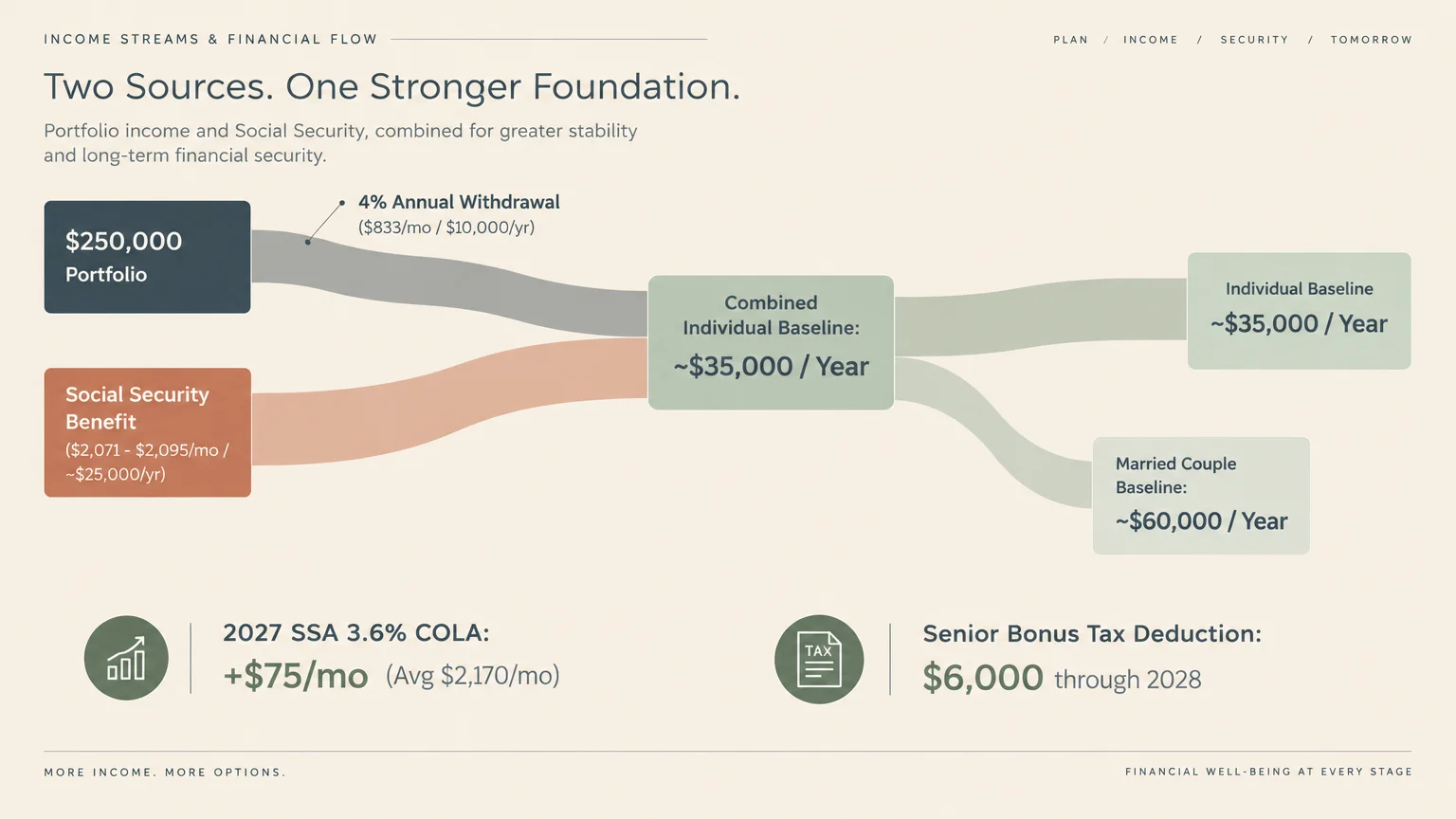
Understanding portfolio withdrawal mechanics helps you see how a modest balance covers real-world bills. Financial planners frequently recommend a four percent annual withdrawal rate to preserve long-term capital.
Applying that rule to your $250,000 portfolio generates $10,000 each year; this provides an additional $833 per month. While $833 cannot cover all your living costs alone, you do not retire on investments alone.
The Social Security Administration pays an average monthly benefit of $2,071 to $2,095 for retired workers. That translates to roughly $25,000 annually in guaranteed income.
Adding your portfolio distributions to this baseline gives you an individual income of roughly $35,000 per year. For a married couple receiving two typical benefit checks, annual household income reaches roughly $60,000.
Upcoming inflation adjustments will boost your baseline security even further. On October 14, 2026, the SSA announced a 3.6% COLA for 2027, raising the average check by approximately $75 per month to roughly $2,170.
Federal tax laws also favor older adults with moderate nest eggs. Under the One Big Beautiful Bill Act, qualifying seniors receive a temporary $6,000 bonus tax deduction through 2028.
This federal relief allows most retirees earning $35,000 or less to eliminate or drastically reduce their federal income tax burden. You keep almost every dollar you receive.
Core Factors That Make Retirement Savings Last
Living comfortably on a fixed income requires controlling three major budgetary categories. If you keep housing, healthcare, and state taxes low, your money lasts indefinitely.
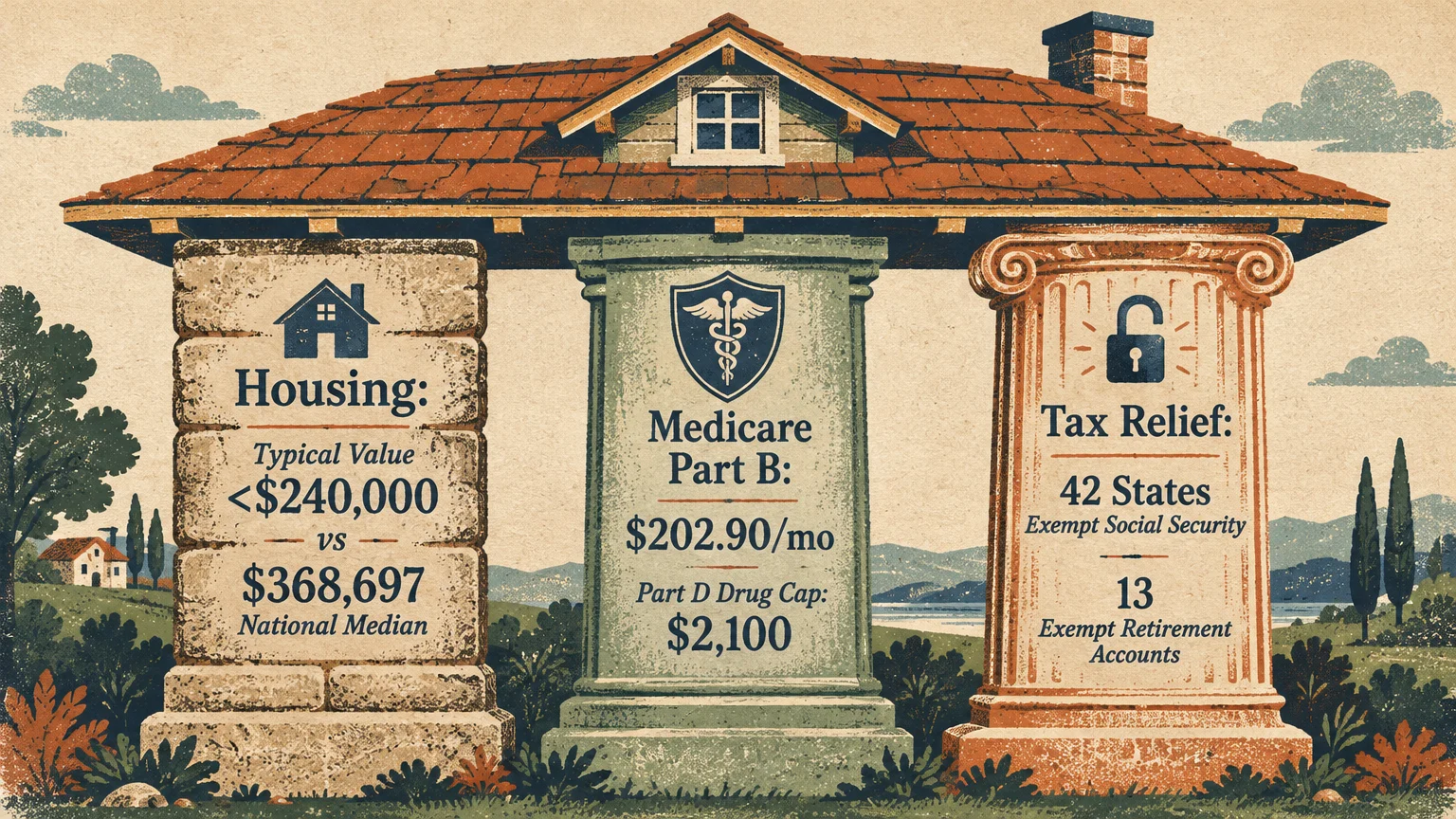
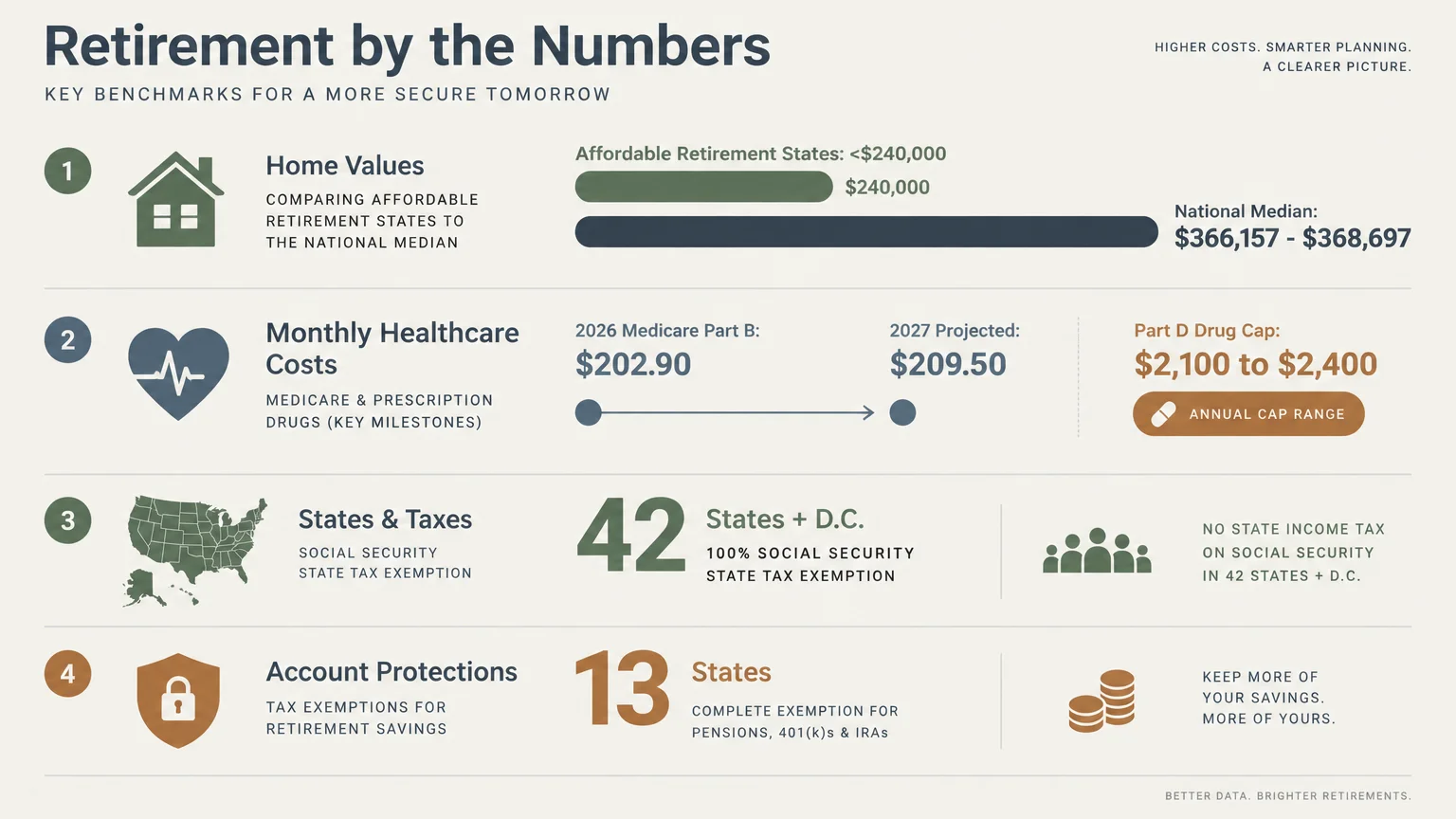
Housing remains the largest expense for any retiree. The national median home value sits between $366,157 and $368,697; paying that price can strain a modest portfolio.
In contrast, the cheapest states to retire feature typical home values well below $240,000. Lower purchase prices mean cheaper homeowners insurance, lower real estate transfer costs, and reduced maintenance outlays.
Healthcare constitutes another essential pillar of retirement planning. In 2026, standard Part B premiums through Medicare.gov cost $202.90 per month with an annual deductible of $283.
Trustees project those Part B figures will increase modestly to $209.50 per month and $292 in 2027. Fortunately, the out-of-pocket spending cap on Medicare Part D prescription drugs stands at $2,100, rising to $2,400 in 2027.
State tax policy serves as the third critical component. Currently, 42 states and Washington, D.C., exempt Social Security benefits entirely from state income taxation.
Additionally, 13 states do not tax retirement income from pensions, 401(k) accounts, or traditional IRAs. Choosing one of these jurisdictions protects your distributions from state tax withholding.

8 States Where $250k Is Enough to Retire Comfortably
These eight destinations combine exceptionally low real estate prices with favorable tax structures. They represent the best states where $250k is enough to retire without compromising your lifestyle.
1. West Virginia
West Virginia offers some of the most accessible real estate anywhere in the United States. Typical home values range between $176,576 and $179,496—more than 50% below the national median.
The state features an overall Cost of Living Index of approximately 88.3. Furthermore, Bureau of Economic Analysis data shows its housing cost index is the lowest nationwide at just 54.2.
Taxes will not eat away at your benefits here either. West Virginia completed its multi-year phase-out on January 1, 2026, making Social Security income 100% tax-exempt for all residents.
Outdoor enthusiasts enjoy world-class hiking along the Appalachian Mountains, state-maintained fishing access, and calm rural communities. Your retirement savings by state metrics stretch farthest in these scenic mountain towns.
2. Mississippi
Mississippi delivers some of the lowest day-to-day living costs in the nation. Its overall cost of living index sits at 86.2, ranking as the third lowest in the country.
Housing remains extraordinarily budget-friendly, with typical home values hovering between $194,531 and $197,606. You can easily downsize and purchase a home with cash from previous equity.
Medical care is similarly economical for aging adults. Mississippi boasts the lowest healthcare cost index in the United States at 85.1, keeping out-of-pocket medical bills manageable.
Best of all, Mississippi exempts all qualified retirement distributions from state taxation. The state levies no tax on Social Security, 401(k) withdrawals, traditional IRA distributions, or public and private pensions.
3. Oklahoma
Oklahoma holds the crown for the lowest overall cost of living in the entire country. Its Cost of Living Index measures just 83.5, which is 16.5% below the national average.
The state achieves this distinction thanks to a rock-bottom housing index score of 66.9. Typical single-family properties throughout Oklahoma average $223,261.
Utility bills, groceries, and services consistently track below typical regional benchmarks. These low baseline prices mean your fixed $833 monthly portfolio withdrawal covers far more discretionary spending.
Oklahoma completely exempts Social Security benefits from state income taxes. It also provides structured tax exemptions on other retirement income sources up to designated thresholds.
4. Louisiana
Louisiana combines rich cultural history, world-renowned cuisine, and an affordable Gulf Coast cost structure. Typical home values throughout the state sit at approximately $217,039.
That real estate baseline represents the third-lowest home value benchmark in the country. Lower acquisition prices allow you to minimize ongoing insurance and upkeep overhead.
The state has streamlined its revenue system by instituting a flat individual income tax rate of 3.0%. This predictable flat rate prevents unexpected tax spikes on taxable withdrawals.
Louisiana levies no state income tax on Social Security payments. Generous state exclusions on public pensions and retirement accounts protect other portions of your nest egg as well.
5. Arkansas
Arkansas consistently ranks as one of the most budget-conscious destinations in America. The Bureau of Economic Analysis ranked Arkansas as the number one lowest-cost state under its Regional Price Parities index at 86.9.
Typical home values across the Natural State range from $224,158 to $227,264. Retirees can easily find comfortable housing in quiet communities like Bella Vista or the Ozark foothills.
Social Security checks pass through to your bank account completely untaxed at the state level. Arkansas also provides meaningful deductions for other qualified retirement distributions.
Plentiful public parks, freshwater lakes, and temperate winters provide a vibrant outdoor lifestyle. You do not need to spend significant money to stay active and entertained.
6. Kentucky
Kentucky offers scenic rolling hills, vibrant mid-sized cities, and stable housing economics. Typical residential properties sell for around $232,577, well under national benchmarks.
Kentucky lawmakers have steadily reduced individual income tax burdens to support economic competitiveness. On January 1, 2026, the state income tax dropped to a flat 3.5% rate.
Social Security income remains completely untaxed under Kentucky state statutes. Furthermore, the state provides an exclusionary cushion for pension income and retirement account distributions.
College towns like Lexington and historic riverfront communities provide excellent libraries, lifelong learning programs, and cultural events. Healthcare infrastructure is robust throughout central Kentucky.
7. Iowa
Iowa represents one of the premier Midwest havens for budget-minded retirees. Its Regional Price Parity index sits at 87.8, giving it the third-lowest overall price level in the nation.
Typical home values throughout the state average between $236,623 and $239,547. Housing inventory in welcoming communities like Cedar Rapids and Des Moines remains stable and accessible.
Iowa enacted landmark tax reforms to attract and keep retirees inside the state. It eliminated all state income taxes on retirement income—including 401(k) accounts, IRAs, and pensions—for residents age 55 and older.
Social Security benefits are completely exempt from Iowa state taxes. The state also repealed its inheritance tax, ensuring your remaining assets pass directly to your heirs unencumbered.
8. Alabama
Alabama offers warm southern winters, Gulf Coast beaches, and exceptionally light tax obligations. The state ranks as the second lowest in overall cost of living with an index of 85.0.
Typical real estate across Alabama is valued between $238,614 and $241,613. Property taxes rank among the lowest in the United States, keeping permanent homeownership costs modest.
The state fully exempts Social Security payments from state income taxation. Traditional defined-benefit pensions from government and private employers also enjoy complete tax-free treatment.
Distributions from 401(k) and traditional IRA accounts remain taxable at standard state rates. However, exceptionally low property tax bills compensate for this tax treatment.
State-by-State Retirement Cost Comparison
Evaluating these locations side by side clarifies where your nest egg works hardest. The following table illustrates key economic metrics across each candidate state.
| State | Typical Home Value | Cost of Living Index | Social Security Tax | Retirement Account Tax |
|---|---|---|---|---|
| West Virginia | $176,576–$179,496 | 88.3 | 100% Tax-Exempt | Partially Deductible |
| Mississippi | $194,531–$197,606 | 86.2 | 100% Tax-Exempt | 100% Tax-Exempt |
| Oklahoma | $223,261 | 83.5 | 100% Tax-Exempt | Partial Deductions |
| Louisiana | $217,039 | 89.1 | 100% Tax-Exempt | Flat 3.0% Rate / Exemptions |
| Arkansas | $224,158–$227,264 | 86.9 | 100% Tax-Exempt | Partial Deductions |
| Kentucky | $232,577 | 89.5 | 100% Tax-Exempt | Flat 3.5% Rate / Exemptions |
| Iowa | $236,623–$239,547 | 87.8 | 100% Tax-Exempt | 100% Tax-Exempt (Age 55+) |
| Alabama | $238,614–$241,613 | 85.0 | 100% Tax-Exempt | Taxable (Pensions Exempt) |
Comparing these metrics against the U.S. median home value of $366,157 to $368,697 shows clear savings. Purchasing a home in West Virginia or Mississippi frees up substantial equity for investment.

Practical Strategies to Stretch Your Nest Egg
Living well on a $250,000 nest egg requires smart structural decisions before and during retirement. Implementing actionable money habits preserves your portfolio balance against volatile markets.
- Downsize without debt: Sell an expensive home in a high-cost area and buy a smaller property with cash to eliminate monthly mortgage payments.
- Delay Social Security claims: Working until full retirement age increases your base benefit significantly, locking in lifetime inflation-protected cash flow.
- Optimize Medicare selections: Review Part D prescription formularies annually to ensure your recurring medications fit within the $2,100 annual spending cap.
- Maintain a cash buffer: Keep two years of portfolio distributions in high-yield savings to avoid selling equities during temporary stock market downturns.
- Take advantage of senior deductions: Utilize the federal $6,000 senior bonus deduction to lower your taxable profile through the 2028 tax year.
Discipline and geographic arbitrage deliver peace of mind that a bloated portfolio alone cannot guarantee. Controlling your overhead provides true financial freedom.
“Do not save what is left after spending, but spend what is left after saving.” — Warren Buffett, Chairman and CEO of Berkshire Hathaway
When your mandatory baseline expenses remain low, your savings automatically generate surplus cash. You can spend that difference on family travel, personal hobbies, and community engagement.
Pitfalls to Watch For
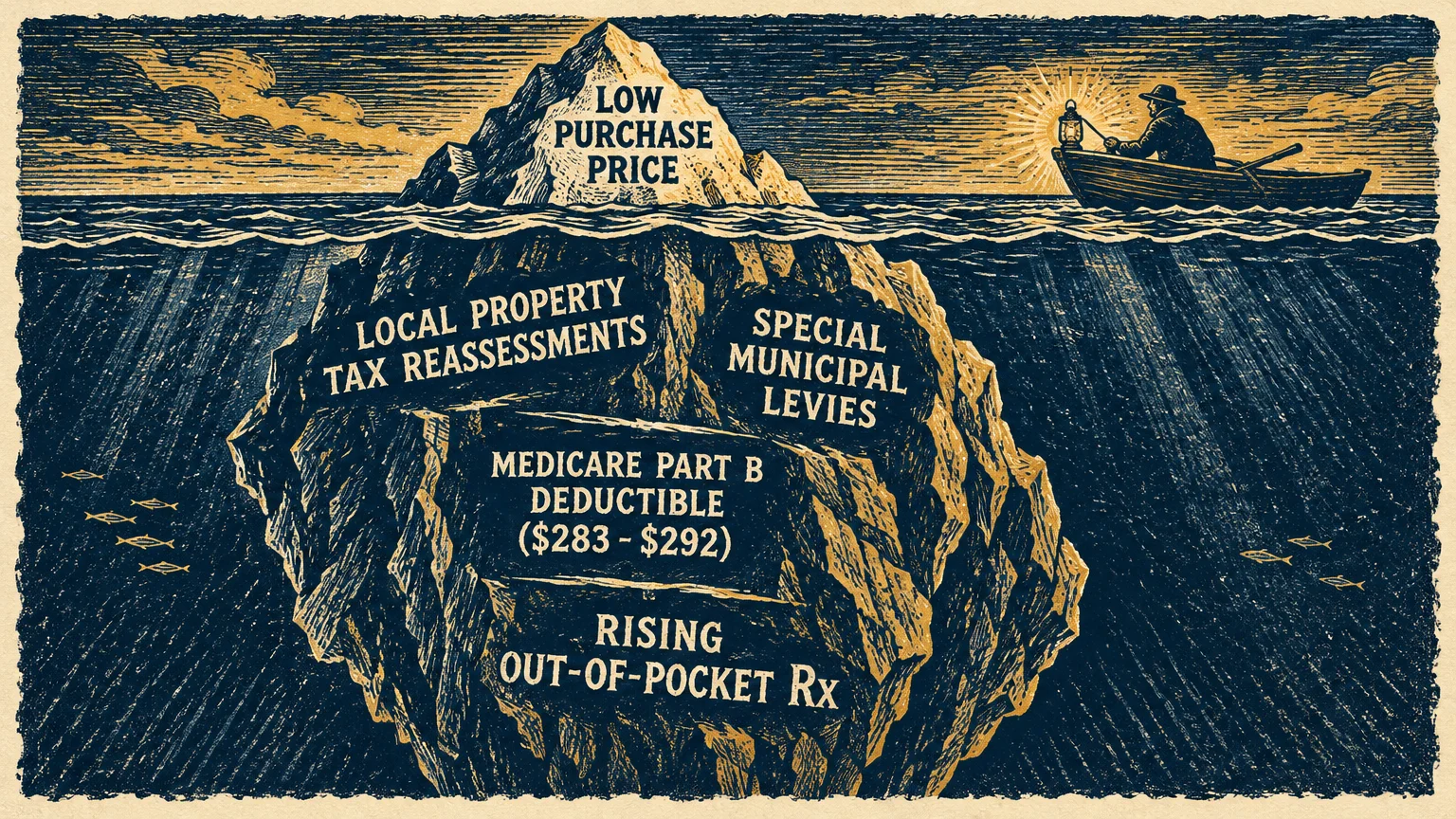
Relocating to an unfamiliar state requires careful research into hidden lifestyle costs. Focusing solely on cheap housing can lead to expensive oversights.
Property tax structures vary wildly between individual counties. While Alabama offers low residential tax rates, other jurisdictions make up for low income taxes with high local sales taxes.
Healthcare access requires special attention when moving to rural communities. Confirm that local hospitals accept Medicare Part B and that nearby clinics have specialists to treat your conditions.
Extreme weather patterns can also impact your budget through home maintenance and insurance premiums. Louisiana and Mississippi face Gulf hurricane seasons, while Oklahoma encounters severe convective storms.
Factor rising homeowners insurance costs directly into your relocation calculations. Checking insurance quotes on specific addresses prevents unwelcome budget surprises after closing.
Isolation can diminish your quality of life if you relocate far from children or established friends. Spend time visiting prospective communities during various seasons before purchasing real estate permanently.

Getting Expert Help
Navigating retirement relocations and tax boundaries involves intricate rules. Working with qualified financial and tax professionals ensures you avoid expensive procedural mistakes.
Consider seeking advice under these specific scenarios:
- Establishing clean state domicile: An accountant helps you legally sever tax residency from high-tax states to prevent dual-state income claims.
- Social Security timing analysis: A fee-only financial planner from the Certified Financial Planner Board can model whether delaying benefits until age 70 improves longevity protection.
- Strategic Roth conversions: An enrolled agent or CPA can project tax brackets under Internal Revenue Service rules before moving to a state that taxes IRA withdrawals.
- Managing healthcare transitions: A licensed Medicare counselor clarifies whether your current supplemental insurance plans transfer cleanly to your new county.
Professional advisors identify savings opportunities that easily offset their advisory fees. A short consultation protects your $250,000 portfolio from structural tax traps.
Frequently Asked Questions
Can you realistically retire on $250,000 today?
Yes, you can retire on $250,000 if you combine it with Social Security and reside in an affordable state. A four percent withdrawal provides $833 monthly, supplementing an average Social Security benefit of $2,071 to $2,095.
Do any of these eight states tax Social Security benefits?
No, none of these eight states tax Social Security income. West Virginia completed its phase-out on January 1, 2026, joining the 42 states that fully exempt benefits.
How does Medicare fit into a lower-cost retirement?
Medicare premiums remain standardized nationwide, with Part B set at $202.90 per month in 2026. However, overall healthcare services and supplemental plans cost significantly less in states like Mississippi.
What happens to my retirement income if inflation rises?
Social Security benefits include automatic annual Cost-of-Living Adjustments to offset inflation. The announced 3.6% increase for 2027 raises the average retired worker benefit by approximately $75 monthly.
Planning Your Next Chapter
Retiring on $250,000 does not require personal sacrifice when you control where you live. By moving to states like West Virginia, Mississippi, or Oklahoma, you instantly lower your monthly burn rate.
Begin by auditing your expected Social Security entitlement and cataloging your current home equity. Match your lifestyle preferences against these affordable retirement states to build a secure future.
The information in this guide is meant for educational purposes. Your specific circumstances—including income, health needs, tax situation, and goals—may require different approaches. When in doubt, consult a licensed professional.
Last updated: October 2026. Retirement benefits, tax rules, and healthcare regulations change frequently—verify current details with official sources.









Leave a Reply