
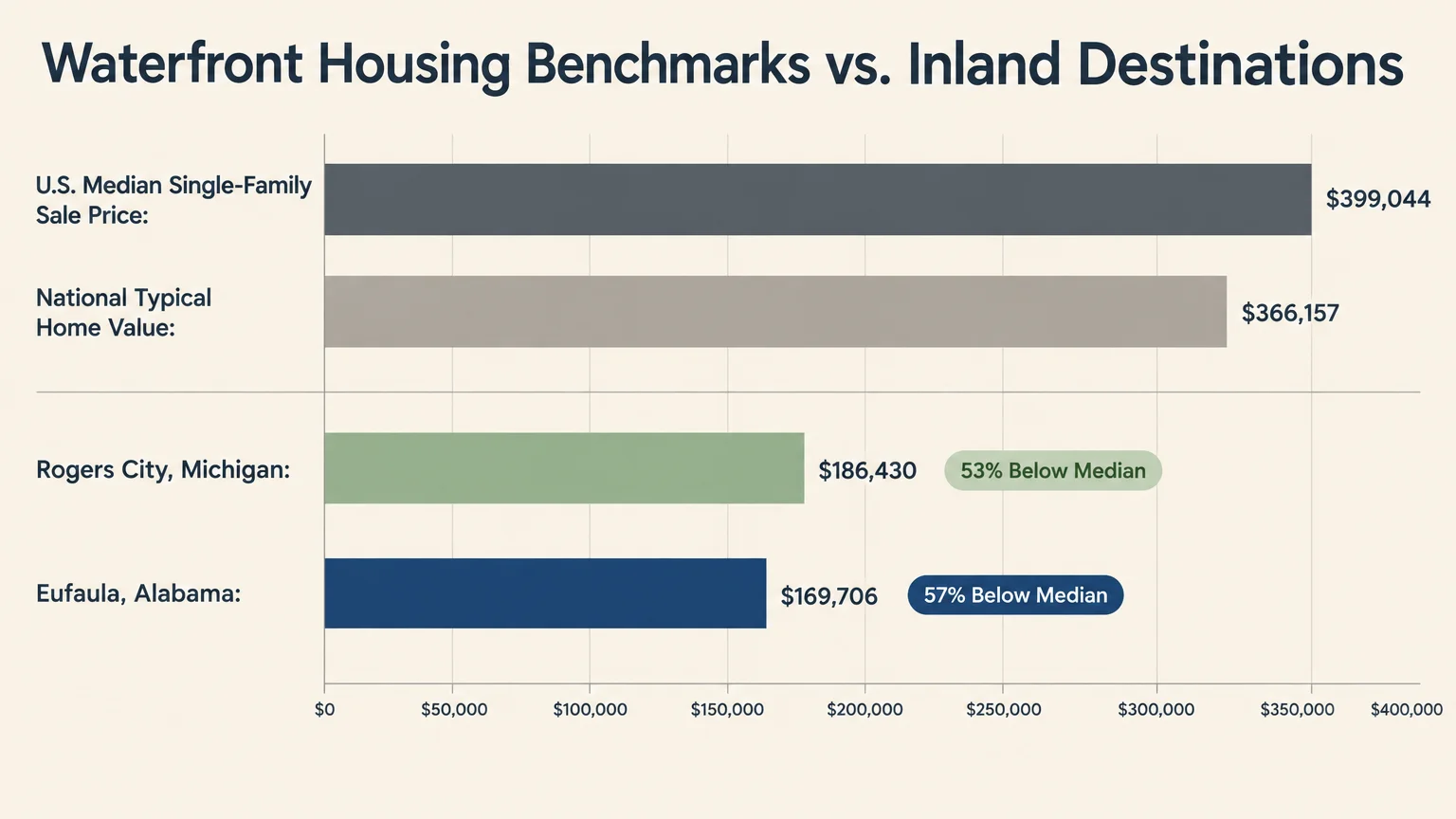
You can retire near scenic water without draining your nest egg on seven-figure coastal real estate. Across the United States, charming river communities and lake destinations offer peaceful waterfront views well below the national typical home value of $366,157.
Choosing the right waterfront retreat lets you stretch your retirement savings while enjoying boating, fishing, and vibrant downtown living.
This guide highlights fifteen affordable lake and river towns that deliver exceptional scenery, lower living expenses, and attractive tax advantages for your retirement years.
Why Waterfront Retirement Is More Accessible Than You Think
Many retirees assume that waterfront living requires millions of dollars in net worth. While coastal enclaves command steep premiums, inland lakes and river valleys across America offer remarkable affordability.
The U.S. median single-family home sale price sits at $399,044, yet numerous water-rich towns feature housing costs far below that threshold. Relocating to these communities allows you to preserve capital while enjoying daily aquatic recreation.
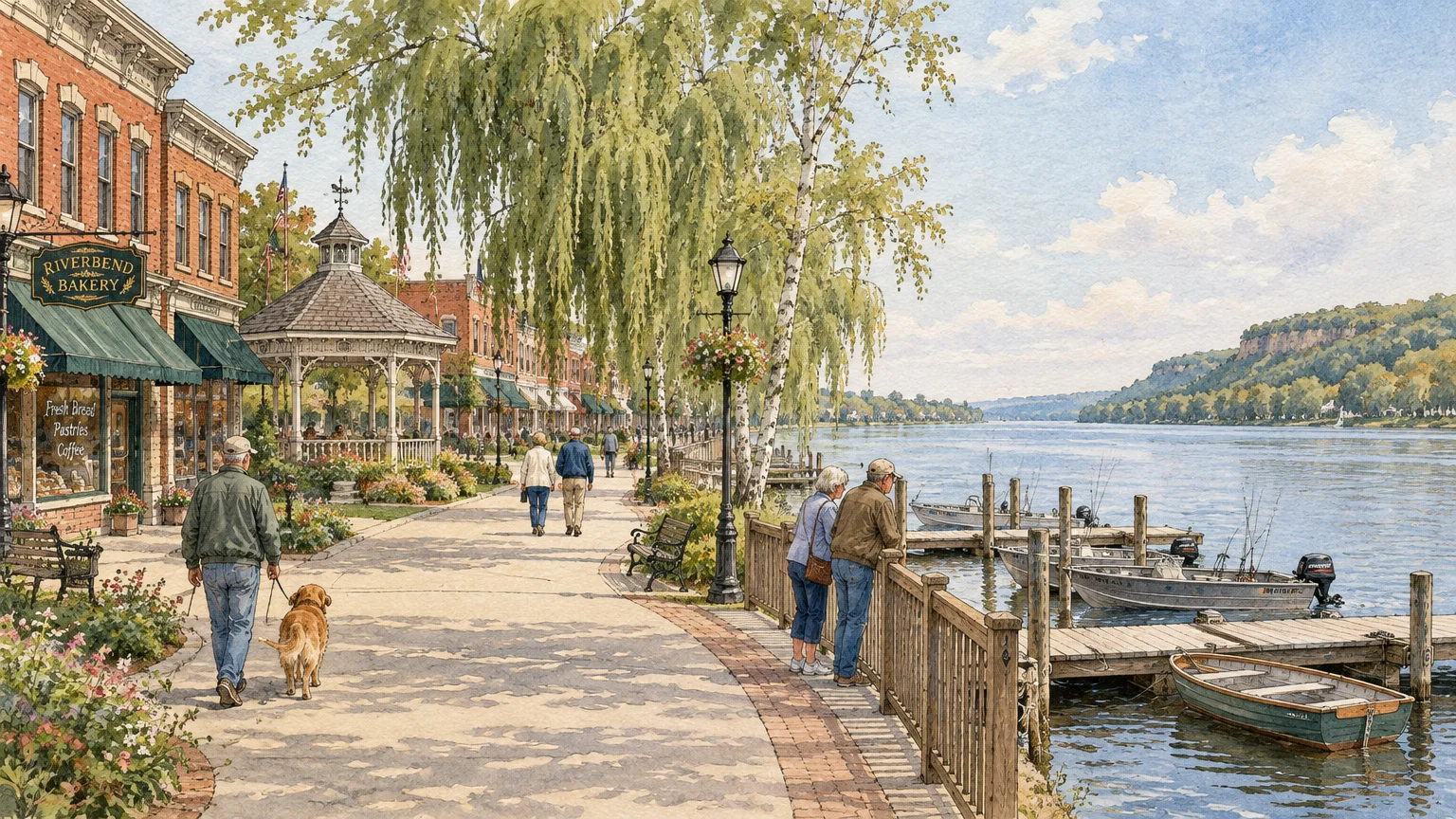
Waterfront living also provides proven lifestyle and wellness benefits. Daily walks along the water, peaceful kayaking outings, and scenic sunsets encourage physical activity and reduce everyday stress.
“Retirement is not a financial decision; it’s a life decision that requires financial planning.” — Mitch Anthony, Retirement Lifestyle Expert
By pairing low home purchase prices with retiree-friendly state tax structures, you can secure a rewarding waterfront lifestyle on a standard pension or Social Security budget.
15 Affordable Lake and River Towns for Retirees
The following fifteen communities offer typical home values below the national benchmark of $366,157. Each town provides dependable access to lakes or navigable rivers, vibrant local culture, and solid healthcare infrastructure.
1. Eufaula, Alabama
Eufaula borders the 45,000-acre Walter F. George Reservoir, widely known as Lake Eufaula. The destination earned national fame for trophy bass fishing and its historic antebellum district.
The typical home value here is $169,706, representing a 4.5% year-over-year increase. That valuation makes it one of the most affordable waterfront retirement towns in the country.
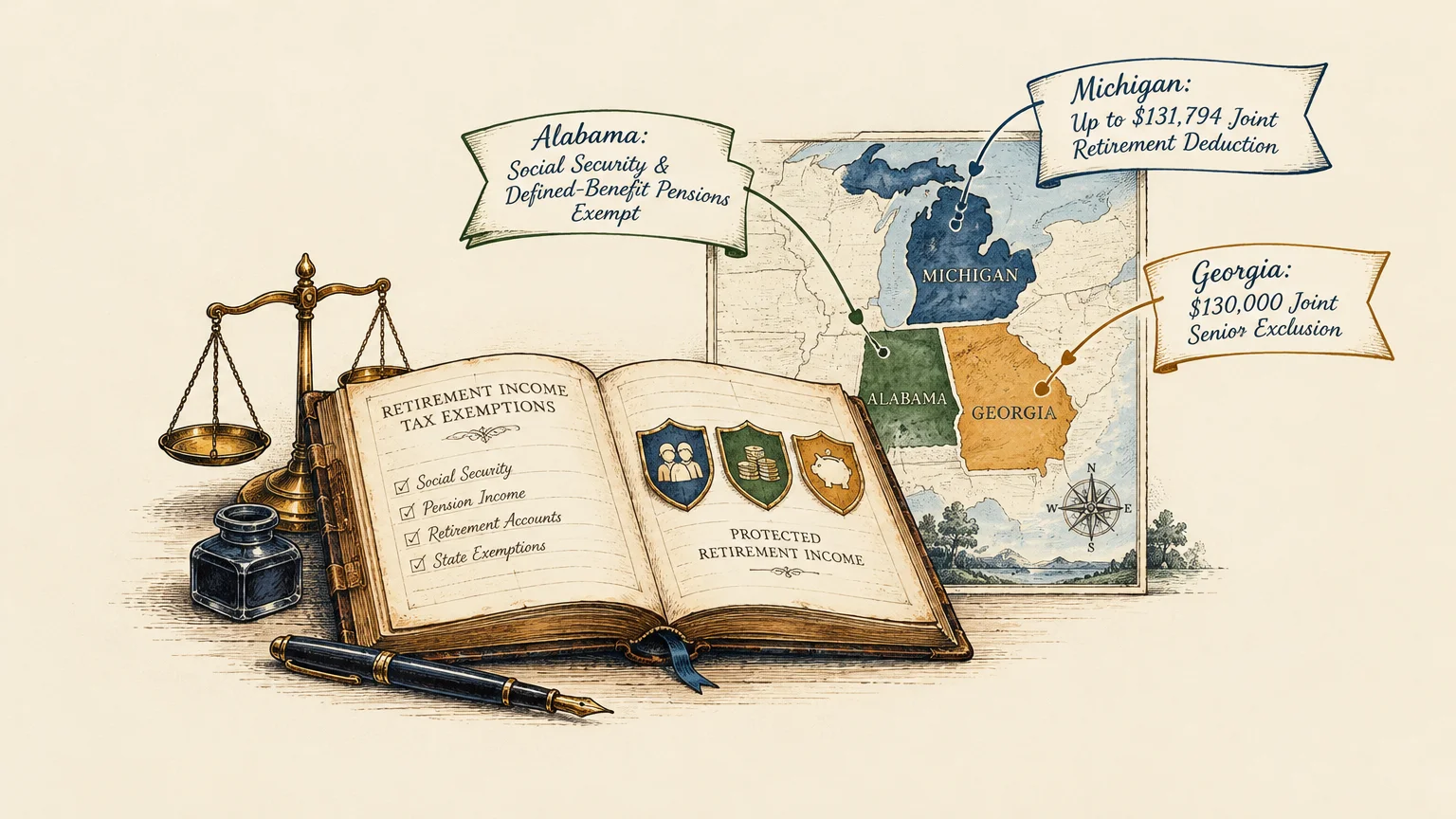
Alabama exempts Social Security benefits and traditional defined-benefit pensions from state income taxation. That rule helps you keep more income in your pocket each month.
Lakepoint Resort State Park offers full marina services, walking trails, and lakefront dining without straining your budget.
2. Rogers City, Michigan
Rogers City sits along Lake Huron’s sunrise coast in northeastern Michigan. The town features quiet sand beaches, municipal marina slips, and uncrowded parks.
The typical home value in Rogers City is just $186,430. Local average rents sit at $598 per month, and overall living expenses run 22% below the national average.
Michigan’s retirement tax deduction allows single retirees to deduct up to $65,987 in retirement distributions, or $131,794 for married joint filers. This phase-in shields most nest eggs from state income tax.
You can bike along the 40-mile coastal trail or explore the historic 40 Mile Point Lighthouse on calm summer afternoons.
3. Augusta, Georgia
Augusta borders the Savannah River and sits downstream from Clarks Hill Lake. Its riverfront promenade hosts weekend markets, live concerts, and scenic walking trails.
The typical local home value is $187,663, up 2.4% year-over-year, while the median sale price is $180,350. These numbers offer extraordinary purchasing power.
Georgia exempts Social Security benefits and grants seniors aged 65 and older a $65,000 per-person retirement income tax exclusion. A retired couple can shield up to $130,000 in joint income.
Retirees also enjoy access to comprehensive regional hospital systems and university medical centers located right in the city.
4. Alpena, Michigan
Alpena rests on Thunder Bay along Lake Huron and straddles the Thunder Bay River. The city blends freshwater maritime history with small-town hospitality.
The typical home value is $192,261, following an 8.7% annual gain, while the median sale price is $178,333. Housing remains accessible for downsizers seeking cheap lakefront living.
The Thunder Bay National Marine Sanctuary protects nearly 100 historic shipwrecks, drawing divers and glass-bottom tour boats throughout the warm months.
Active civic theaters, community concerts, and winter recreation keep your social calendar full year-round.
5. Paducah, Kentucky
Paducah sits at the confluence of the Ohio and Tennessee Rivers, just minutes from Kentucky Lake. The historic district features 19th-century architecture and brick walkways.
The typical home value stands at $192,711, showing a modest 1.2% dip over the past year. The median sale price sits at $243,725.
Kentucky exempts Social Security benefits and offers an exclusion on pension and retirement distributions. That policy provides meaningful relief for fixed-income households.
As a designated UNESCO Creative City, Paducah offers world-class quilt arts, waterfront trails, and public boat launches along the riverfront.
6. Clearlake, California
Clearlake surrounds California’s largest natural freshwater lake, offering mountain vistas and bass fishing in Northern California. It ranks as the most affordable lake town on the West Coast.
The typical single-family home value is $211,659. The estimated monthly cost of living averages approximately $3,447, far below coastal California benchmarks.
While California taxes regular pension distributions, the state does not tax Social Security benefits. This policy provides essential breathing room for conservative budgets.
You can enjoy clean air, local Lake County vineyards, and quiet shoreline parks without paying coastal real estate prices.
7. Florence, Alabama
Florence sits along the Tennessee River in northwest Alabama, flanked by Wilson Lake and Pickwick Lake. The area is celebrated for music history and rolling river bluffs.
The typical home value in Florence is $214,156, reflecting a 2.7% annual gain. The median sale price sits at $227,050.
Living here allows you to enjoy Robert Trent Jones championship golf courses and lectures at the University of North Alabama. Alabama’s low property taxes preserve your cash flow.
You can fish for smallmouth bass below the Tennessee Valley Authority dams or cruise calm open waters all year.
8. Inverness, Florida
Inverness is located in Citrus County along the Tsala Apopka Chain of Lakes and the Withlacoochee River. The area provides miles of interconnected waterways and cypress preserves.
The typical home value is $236,583, with a median sale price of $243,750. These values have remained steady, showing a slight 0.3% year-over-year decline.
Florida levies zero personal income tax. This tax shelter protects your Social Security payouts, pension checks, and traditional IRA distributions from state taxation.
You can cycle the 46-mile paved Withlacoochee State Trail or launch kayaks into crystal-clear spring-fed tributaries.
9. Sebring, Florida
Sebring circles the shoreline of Lake Jackson in south-central Florida. The lake features public boat ramps, fishing piers, and white sandy swimming beaches.
The typical home value is $236,617, down 1.6% annually. Recent three-month median sale prices dropped as low as $197,000, far below Florida’s statewide median of $383,897.
Retiring here eliminates state income taxes while offering low municipal assessments and reasonable utility rates.
You can stroll around the historic downtown circle, golf year-round, and boat across freshwater shallows every afternoon.
10. Mountain Home, Arkansas
Mountain Home sits between Norfork Lake and Bull Shoals Lake in the rugged Ozark Mountains. The White River and Buffalo National River flow nearby.
The typical home value is $239,338, rising 1.9% over the past year. The median sale price is $242,300.
Arkansas does not tax Social Security benefits, and the state maintains modest real estate property tax rates. That protects retirees living on fixed incomes.
This region serves as a premier destination for world-class trout fishing, clean mountain air, and peaceful pontoon outings.
11. Hot Springs, Arkansas
Hot Springs provides access to three premier reservoirs: Lake Hamilton, Lake Catherine, and Lake Ouachita. The city is famous for thermal bathhouses and historic downtown architecture.
The typical home value is $242,674, remaining flat over the past year. The median sale price sits at $274,483.
For a planned lakeside setting, nearby Hot Springs Village offers gated lake neighborhoods with a typical home value of $306,048.
Retirees enjoy mineral springs, active arts districts, and extensive boating without paying major metropolitan housing prices.
12. Dubuque, Iowa
Dubuque overlooks the upper Mississippi River amid steep limestone bluffs where Iowa, Illinois, and Wisconsin meet. Its port features riverboat docks and a historic downtown.
The typical home value is $247,824, reflecting 4.0% annual appreciation. The median sale price is $255,333.
Iowa completely exempts retirement income from state taxation for residents aged 55 and older. This policy covers pensions, 401(k) withdrawals, and traditional IRAs.
The town delivers top-tier regional healthcare, vibrant riverboat tourism, and scenic parks along the Mississippi channel.
13. Winona, Minnesota
Winona rests along the Mississippi River in southeastern Minnesota’s bluff country, with Lake Winona sitting directly inside the community. Paved pathways loop around the calm waters.
The typical home value is $262,043, up 3.9% year-over-year, while the median sale price is $282,950. Housing stays comfortably below national benchmarks.
Upper Midwest buyers also consider nearby options like Sheboygan, Wisconsin on Lake Michigan at $267,169, or La Crosse, Wisconsin along the Mississippi at $282,230.
Winona pairs stained-glass Victorian architecture and active arts festivals with premier river fishing and kayaking.
14. New Bern, North Carolina
New Bern sits at the scenic confluence of the Neuse and Trent Rivers in coastal North Carolina. This colonial capital offers historic streets, waterfront boardwalks, and direct coastal sound access.
The typical home value is $283,192, up 1.7% over the past year. The median sale price is $320,833.
North Carolina exempts Social Security benefits from state taxation. The state also maintains a modest flat income tax rate on other distributions.
Sailing enthusiasts, recreational boaters, and history lovers find a rich maritime culture without Outer Banks price tags.
15. Bullhead City, Arizona
Bullhead City stretches along the emerald Colorado River, just south of Lake Mohave. The area delivers over 300 days of sunshine each year.
The typical home value is $299,303, while the median sale price sits at $294,667. This makes it an affordable alternative to Lake Havasu City, where values reach $462,037.
Other sunny alternatives under $350,000 include Crossville, Tennessee at $306,626 and Kerrville, Texas on the Guadalupe River at $349,946.
Bullhead City retirees enjoy low property taxes, affordable golf, and convenient gaming and dining across the river in Laughlin, Nevada.
At a Glance: Comparing Affordable Waterfront Retirement Towns
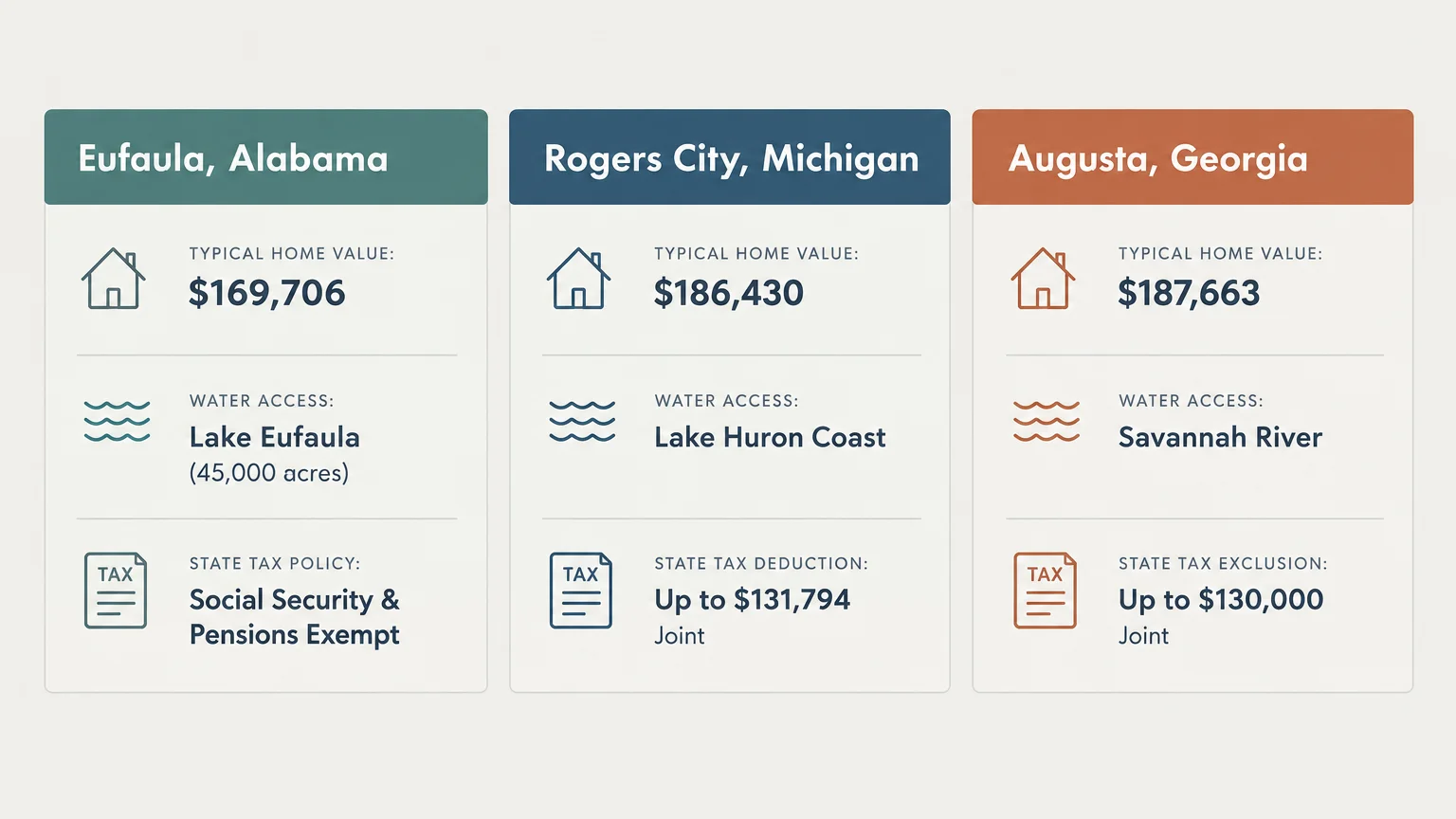
Comparing home values and regional tax policies helps you identify the best fit for your budget. The table below outlines all fifteen destinations with their primary water access and typical home values.
| Town and State | Primary Water Body | Typical Home Value | Key Financial Advantage |
|---|---|---|---|
| Eufaula, AL | Lake Eufaula | $169,706 | Exempts pensions and Social Security |
| Rogers City, MI | Lake Huron | $186,430 | Cost of living 22% below national average |
| Augusta, GA | Savannah River | $187,663 | $65,000 retirement tax exclusion at 65 |
| Alpena, MI | Lake Huron & River | $192,261 | Large state retirement income deduction |
| Paducah, KY | Ohio & Tennessee Rivers | $192,711 | Exempts Social Security; low housing costs |
| Clearlake, CA | Clear Lake | $211,659 | Most affordable West Coast lake market |
| Florence, AL | Tennessee River | $214,156 | Low property tax rates; exempts pensions |
| Inverness, FL | Tsala Apopka Chain | $236,583 | Zero state personal income tax |
| Sebring, FL | Lake Jackson | $236,617 | Zero income tax; low median sale prices |
| Mountain Home, AR | Norfork & Bull Shoals Lakes | $239,338 | Low property taxes; exempts Social Security |
| Hot Springs, AR | Lake Hamilton & Ouachita | $242,674 | Affordable lakeside communities |
| Dubuque, IA | Mississippi River | $247,824 | Zero state tax on retirement income (55+) |
| Winona, MN | Mississippi River | $262,043 | Affordable housing in scenic bluff country |
| New Bern, NC | Neuse & Trent Rivers | $283,192 | Exempts Social Security; coastal sound access |
| Bullhead City, AZ | Colorado River | $299,303 | Low-cost alternative to Lake Havasu City |
Every location on this list allows you to buy well under the national median listing price of $419,250. This gives you room to invest surplus funds in income-generating assets.
The Hidden Costs of Waterfront Homeownership
While purchasing an affordable home frees up capital, direct waterfront ownership introduces specialized operational expenses. You must account for these expenses when building your retirement budget.
Dock installation and regulatory permits represent major upfront costs. On regulated reservoirs, such as Tennessee Valley Authority lakes, a permitted dock costs between $25,500 and $30,000 before adding a boat lift or electrical service.
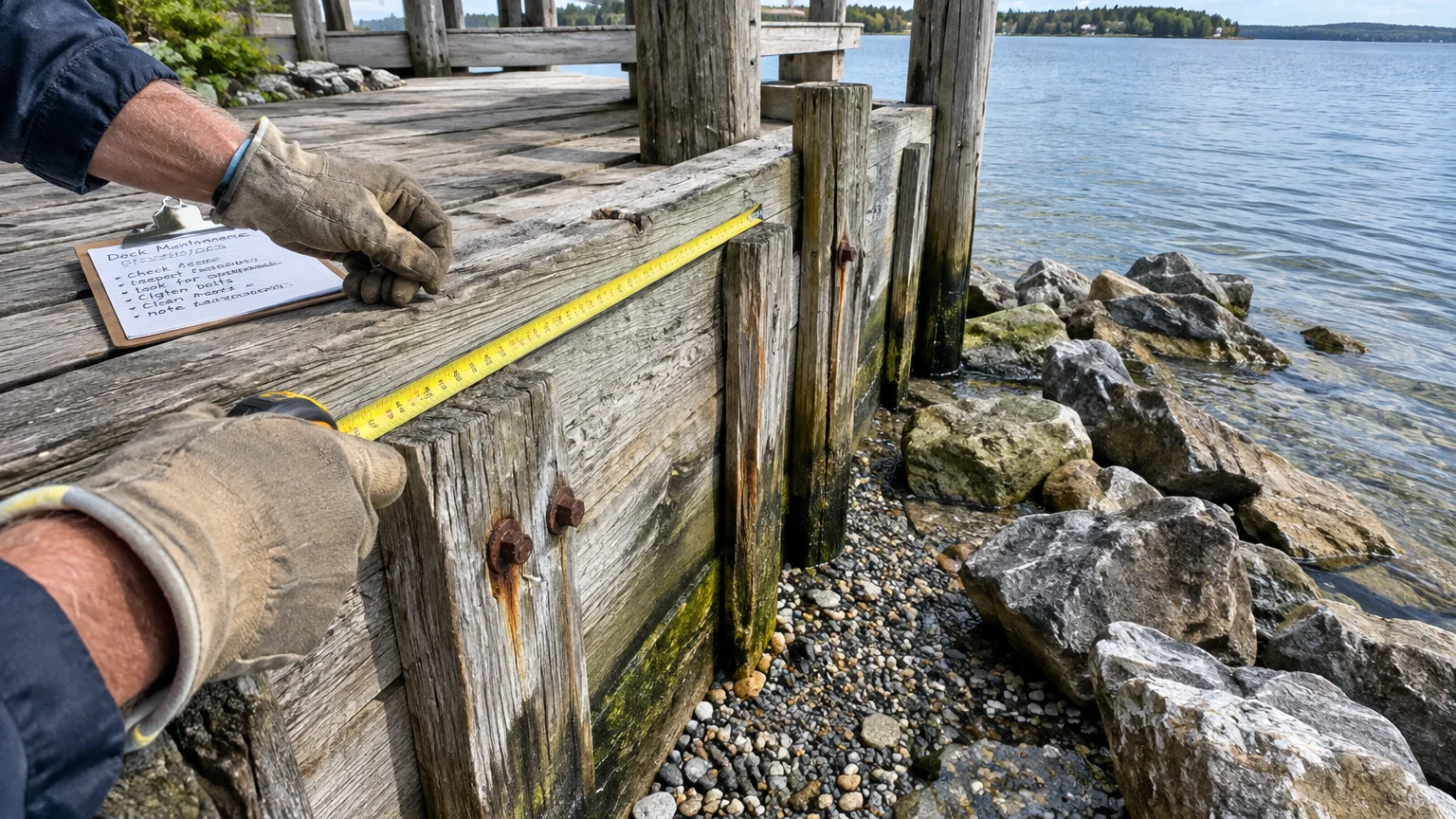
Shoreline erosion control requires long-term capital planning. Rebuilding a deteriorating seawall can cost up to $90,000, depending on shoreline length, site accessibility, and environmental permitting rules.
Insurance coverage requires extra attention. Specialized waterfront property and flood insurance premiums can climb to $12,000 annually over a 30-year retirement if your home sits in a high-risk flood zone.
“A big part of financial freedom is having your heart and mind free from worry about the what-ifs of life.” — Suze Orman, Financial Educator
Routine watercraft maintenance, municipal slip fees, and winterization can add several thousand dollars each year. Factoring these line items into your cash flow projection prevents unpleasant surprises.
Navigating State Taxes on Retirement Income
Your geographic location significantly shapes your net spendable income. Relocating to a state with favorable retirement tax rules allows your savings to last longer.
Nine states levy no broad personal income tax: Alaska, Florida, Nevada, New Hampshire, South Dakota, Tennessee, Texas, Washington, and Wyoming. These states exempt all Social Security, 401(k), IRA, and pension income.
Four states with an income tax broadly exempt qualifying retirement income: Illinois, Iowa for residents 55 and older, Mississippi, and Pennsylvania. In these states, traditional distributions escape state income taxation.
Currently, 41 states and Washington, D.C., do not tax Social Security benefits. This policy shelters the foundation of most retirees’ monthly cash flow.
The Social Security Administration (SSA) reports that the average monthly benefit for a retired worker is $2,087.52, or roughly $25,050 annually, following a 2.8% cost-of-living adjustment (COLA). The SSA also announced a 3.6% COLA increase for 2027, which will raise average monthly benefits by $75.
Reviewing tax laws in both your current and prospective states helps ensure you do not exchange lower housing costs for higher state tax burdens.

When DIY Isn’t Enough
Researching towns online is an excellent starting point, but buying waterfront property involves complex legal and environmental factors. Several scenarios warrant professional guidance.
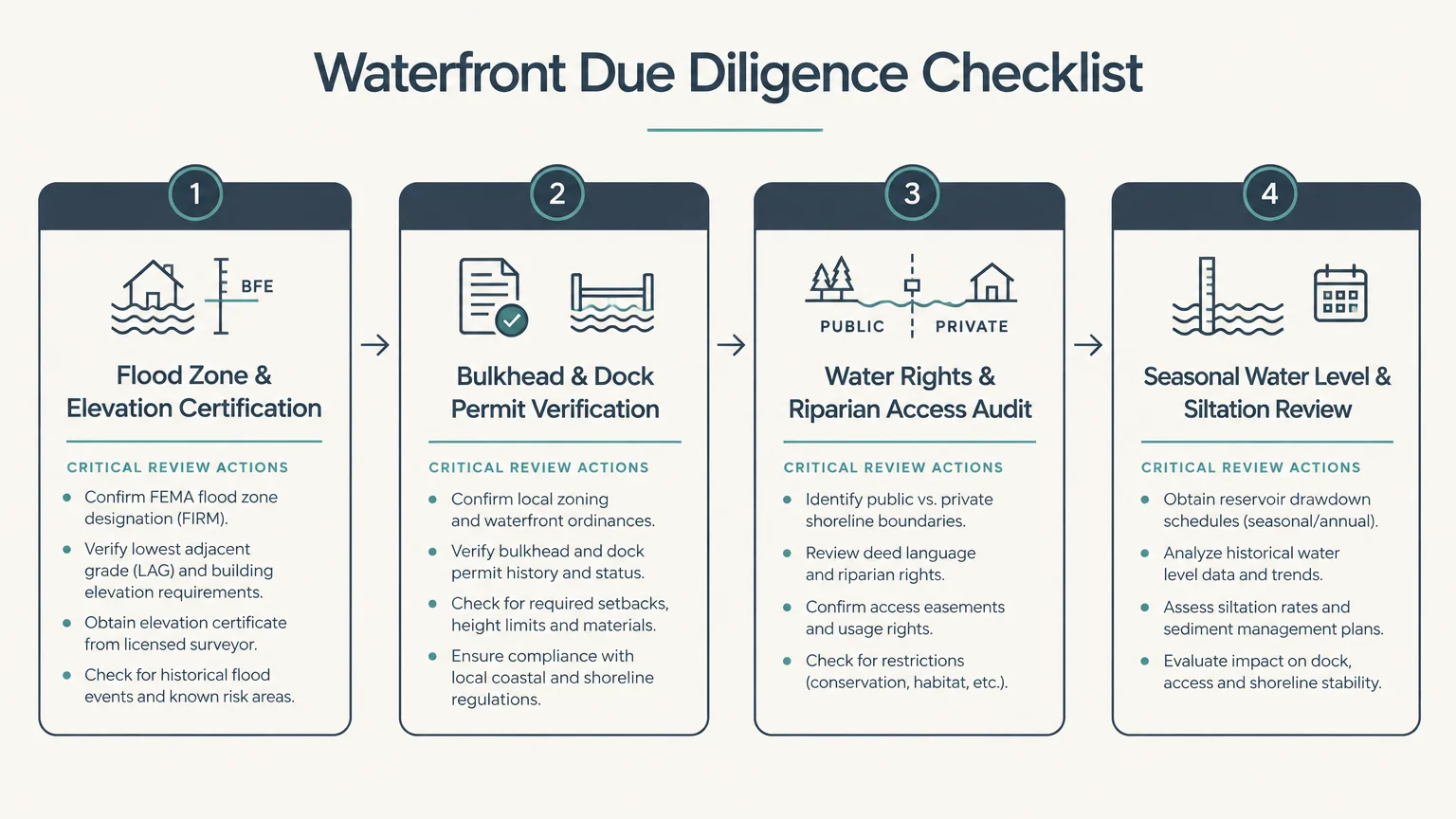
- Riparian rights and deed restrictions: Hire a real estate attorney to verify deeded water access, dock permits, and shoreline easements before signing a contract.
- Bulkhead and seawall inspections: Retain a licensed marine contractor to assess structural integrity, soil erosion, and underwater anchoring systems.
- Flood zone determinations: Consult an independent insurance agent to obtain elevation certificates and official flood maps before finalizing your mortgage.
- Multi-state retirement tax planning: Work with a certified financial planner or CPA to structure retirement withdrawals and establish legal domicile across state lines.
Securing professional support protects you from expensive structural repairs or tax liabilities after closing.
Avoiding Common Errors When Buying Near Water
Retirees often fall in love with sparkling water views and overlook practical ownership challenges. Being aware of these pitfalls keeps your retirement secure.
Never buy waterfront property without checking official flood plain maps. A property sitting just outside a designated flood zone can save you thousands of dollars in mandatory annual insurance premiums.
The Consumer Financial Protection Bureau (CFPB) offers clear guidance on mortgage disclosures and closing costs that helps you evaluate financing options safely.
Do not assume water levels remain constant year-round. Many hydroelectric reservoirs and river basins experience seasonal drawdowns of ten to thirty feet, leaving docks stranded on dry mud during winter months.
Verify emergency healthcare transit times. A picturesque lake cabin loses its charm if the nearest emergency room or cardiac care hospital is more than 45 minutes away.
Organizations like AARP provide valuable relocation checklists that help retirees evaluate community services, transit options, and long-term livability.
Frequently Asked Questions
Which lake town has the lowest home prices for retirees?
Eufaula, Alabama offers the lowest typical home value on this list at $169,706. Its low cost of living and pension exemptions make it an exceptional value for retirees.
How do waterfront insurance costs affect a fixed retirement budget?
Specialized flood and hazard insurance can add hundreds of dollars to your monthly housing expense. Over a 30-year retirement, high-risk coastal or riverfront flood premiums can accumulate up to $12,000 annually.
Can I find cheap lakefront living in states with zero income tax?
Yes. Sebring and Inverness, Florida both feature typical home values under $240,000, while Crossville, Tennessee offers lake communities with typical home values around $306,626 in a state with zero income tax.
Are river towns more vulnerable to flooding than lake towns?
River towns often face dynamic current shifts and rapid water rises during heavy upstream rains. However, regulated reservoirs and dam-controlled river channels often provide predictable water levels managed by the Army Corps of Engineers or local utility authorities.
Steps to Secure Your Waterfront Retirement
Begin your search by renting a home for a month during the off-season. Visiting in November or February reveals true weather patterns, traffic levels, and community services when tourists are gone.
Test the daily drive to essential amenities, including medical clinics, grocery stores, and community centers. Establishing that these services are nearby ensures you can comfortably age in place.
This is educational content based on general retirement and financial principles. Individual results vary based on your situation. Always verify current benefit rules, tax laws, and eligibility requirements with official sources like SSA, Medicare.gov, or the IRS.
Last updated: October 2026. Retirement benefits, tax rules, and healthcare regulations change frequently—verify current details with official sources.








Leave a Reply