


Coordinating doctors, rides, and daily help gets harder as health needs grow. A federal health option called PACE brings all that support together so older adults can keep living safely at home.
PACE stands for Program of All-Inclusive Care for the Elderly. It combines medical care, prescription drugs, meals, and personal home help through one local team.
Most enrollees pay nothing out of pocket for approved care. Learning how the program works and what it costs helps you decide if it fits your family.

How All-Inclusive Care for the Elderly Keeps Seniors at Home
About 70% of Americans turning 65 will need long-term care, according to the U.S. Department of Health and Human Services. Many families want aging in place care instead of moving to a facility.
A PACE program makes that goal realistic for frail older adults. Instead of juggling separate clinics and home aides, one care team handles every medical and daily need.
National PACE Association data shows that about 94% of enrollees live at home rather than in a nursing home. The average participant is 76 years old and visits a PACE day center 2.5 days a week.
Staying in the program can add up to four more years of independent living at home. Enrollees also have fewer hospital stays and shorter visits when they do go.
Families feel the relief too. National PACE Association survey data shows that 95% of family caregivers would recommend the program to others.

What Services Your PACE Care Team Covers
Every local program builds an 11-member team to manage your health 24 hours a day, 365 days a year. You get one contact instead of calling five different offices.
That team includes a primary doctor, registered nurse, social worker, physical therapist, occupational therapist, and dietitian. It also includes a recreation coordinator, center manager, home care coordinator, personal care aide, and driver.
Under Medicare.gov rules, PACE covers all Medicare Part A, Part B, and Part D services plus all Medicaid services. Your team can also approve extra support without standard visit limits.
Here is what a PACE program covers when your care team approves it:
- Primary doctor visits, specialists, hospital care, and emergency services
- Prescription drugs and recommended adult vaccines
- Home health aides, bathing and dressing help, and caregiver respite
- Adult day center meals, activities, and physical or speech therapy
- Dental care, eye exams, glasses, hearing aids, and foot care
- Free rides to the PACE center and specialist visits
- Hospice care and nursing home care if living at home becomes unsafe
Once you join, your coverage starts on the 1st of the next month. Within 30 days, eight team members meet with you in person to build one shared care plan.
Under federal rules, your team reviews that plan at least every 180 days. If your health changes, they must update your plan within 14 days.
Who Can Get PACE and Where It Operates
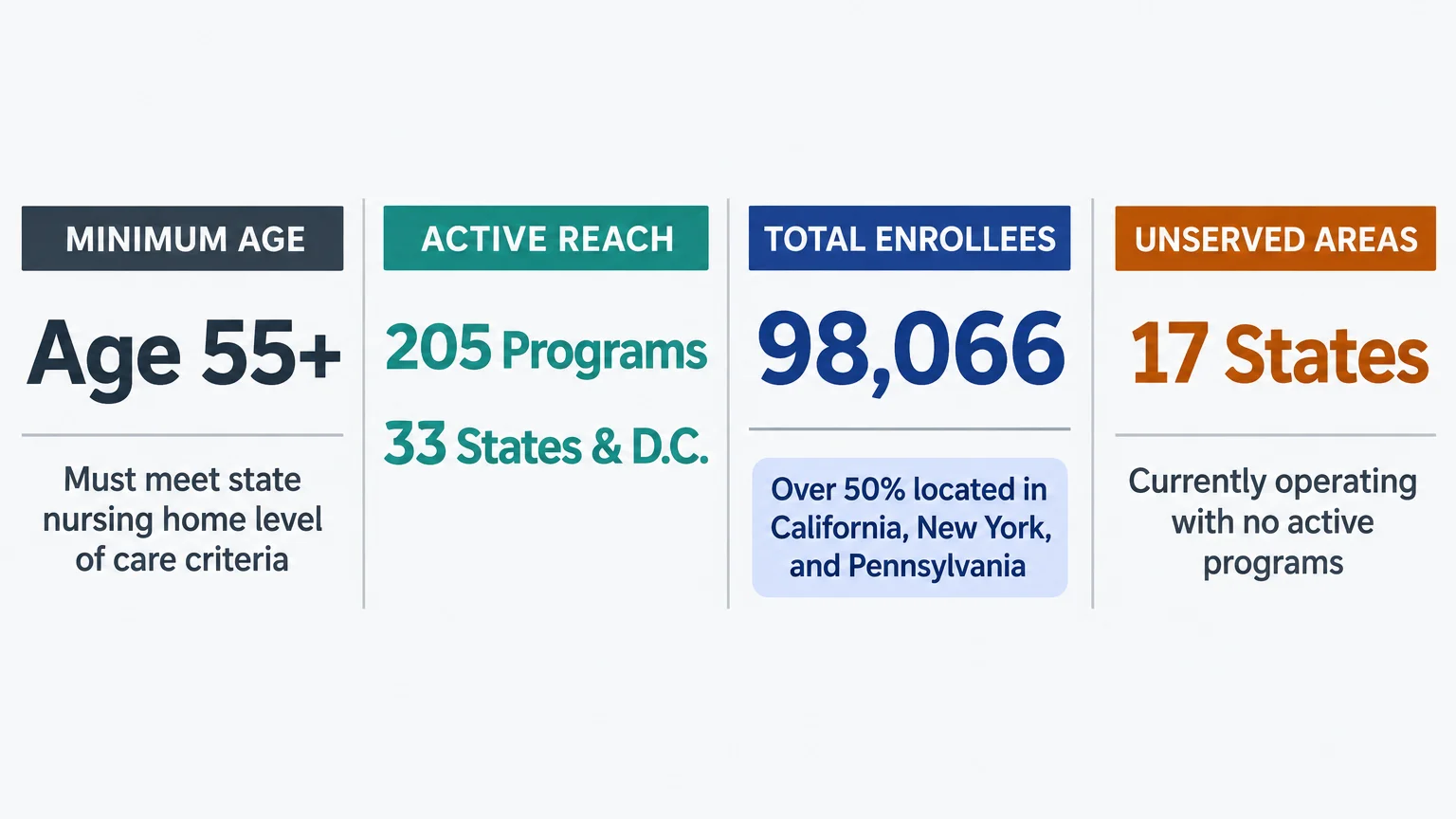
You do not have to be on Medicare or Medicaid to apply. However, federal rules set four basic conditions you must meet before you can join.
- You are age 55 or older.
- You live inside a local PACE group’s service area.
- Your state certifies that you need a nursing home level of care.
- You can live safely at home with PACE support when you join.
Availability depends heavily on your zip code. As of September 2026, the National PACE Association reports 205 programs in 33 states and Washington, D.C., serving 98,066 people.
Over half of all enrollees live in California, New York, or Pennsylvania. Seventeen states still have no active programs, though Georgia is working toward launching one.
States without PACE include Alaska, Arizona, Connecticut, Georgia, Hawaii, Idaho, Maine, Minnesota, and Mississippi. Montana, Nevada, New Hampshire, South Dakota, Utah, Vermont, West Virginia, and Wyoming also lack programs as of September 2026.
You can check local programs through Medicare.gov or the Administration for Community Living.
What PACE Costs Compared to Other Senior Care Options
Regardless of your income, you pay $0 in copays, deductibles, and coinsurance for approved care. Your monthly fee depends on the health coverage you already have.
Most enrollees qualify for both Medicare and Medicaid. National PACE Association data shows about 80.5% to 87% hold both, while 13% to 19% have Medicaid only.
People with Medicaid pay a $0 monthly premium for PACE. In many states, Medicaid long-term care caps 2026 income at $2,982 a month, rising to $3,087 in 2027.
States also typically limit countable savings to $2,000 for one person. Your primary home usually does not count toward that savings limit.
Less than 1% of enrollees pay without Medicaid. If you have Medicare only, you pay a monthly long-term care fee plus a Part D drug premium.
You also keep paying your Medicare Part B premium, which is $202.90 a month in 2026 and $209.40 in 2027. Private-pay rates without Medicaid or Medicare typically run $6,000 to $7,000 a month.
Even at private-pay rates, PACE often costs less than full-time home care or a facility. The table below compares 2025 CareScout national median prices with typical PACE costs.
| Care Option | Typical Monthly Cost | What It Covers |
|---|---|---|
| PACE (with Medicaid) | $0 | All medical care, drugs, home aides, meals, rides, and day visits |
| PACE (Medicare only or private pay) | $4,000 to $7,000 | All medical care, drugs, home aides, meals, rides, and day visits |
| Adult day health care (5 days/week) | $2,058 | Daytime care and activities only, with no medical or home care |
| Assisted living (private one-bedroom) | $6,200 | Housing, meals, and basic help, with medical care billed separately |
| In-home caregiver (44 hours/week) | $6,673 | Non-medical help at $35 an hour, with no doctors or nurses |
| Nursing home (semi-private room) | $9,581 | 24-hour room, meals, and skilled nursing in a facility |
| Nursing home (private room) | $10,798 | 24-hour private room, meals, and skilled nursing in a facility |
Medicare Advantage plans cap in-network medical bills at $9,250 in 2026, yet skip long-term custodial care. Standard Part D plans also cap drug costs at $2,100 in 2026 and $2,400 in 2027.
With PACE, your Medicare-Medicaid care rolls into one predictable monthly number. You avoid surprise bills for hospital stays, rehab, or home aides.

What Can Go Wrong With PACE
Switching to all-inclusive care means giving up some freedom when picking doctors. Knowing these four traps ahead of time prevents costly mistakes.
- You must use PACE doctors and clinics. Seeing an outside doctor without approval means paying the full bill, except in emergencies.
- You cannot keep separate drug or Medigap plans. Signing up for a standalone Part D plan automatically drops you from PACE.
- You might face an intake wait. Even after approval, your coverage does not begin until the first day of the next month.
- People ages 55 to 64 on expansion Medicaid face federal work rules by January 2027. Confirm that you qualify under a long-term care pathway.
Ask your local center how their doctors handle specialist visits before you sign enrollment papers. If you trust a current specialist, check whether that doctor works with the program.

When to Consult a Professional
Most families can tour a center and apply on their own. Still, certain money and health questions call for expert advice before you switch senior care options.
- Your savings top the $2,000 Medicaid limit and you need legal advice on protecting a spouse’s income or home.
- You are comparing Medicare Advantage or Medigap against private-pay PACE fees over the next five years.
- You are age 55 to 64 and unsure if new Medicaid work rules affect your coverage.
- You want help checking state Medicaid long-term care rules before applying.
You can get free Medicare counseling through your State Health Insurance Assistance Program via the National Council on Aging. You can also check official rules at the Centers for Medicare & Medicaid Services.
Frequently Asked Questions
Can you leave a PACE program if you change your mind?
Yes, you can leave a PACE program at any time without a penalty. Your team helps move you back into standard Medicare and Medicaid plans so your coverage never stops.
Do you have to give up your house to join PACE?
No, federal rules do not force you to sell your home to enroll. When applying for Medicaid, your primary home generally does not count toward the $2,000 savings limit.
Does PACE cover prescription drugs and dental care?
Yes, both prescription drugs and dental care cost $0 out of pocket when approved by your team. The program also covers glasses, hearing aids, and recommended adult vaccines.
What happens if you need a nursing home later?
Your PACE program stays with you even if living at home becomes unsafe. The group arranges and pays for needed nursing home care while overseeing your health.

Next Steps to Check Local Care
Start by checking whether a PACE center serves your zip code on Medicare.gov, then call for a tour. Bring your medication list, doctor names, and monthly income details so staff can estimate your exact cost.
This is educational content based on general retirement and financial principles. Individual results vary based on your situation.
Always verify current benefit rules, tax laws, and eligibility requirements with official sources like SSA, Medicare.gov, or the IRS.
Last updated: November 2026. Retirement benefits, tax rules, and healthcare regulations change frequently—verify current details with official sources.